With Kind Permission of: Edvard Csanyi (Editor-In-Chief & Electrical Engineer at EEP)
Author: Anne Thyssen (DTU Electrical Engineering, Center for Electric Power and Energy (CEE), Technical University of Denmark)
33kV & 66kV Models
A generic wind farm with a 33kV collection grid is compared to a wind farm with a 66kV collection grid in Powerfactory. As the collection grid voltage is different in the 33kV and the 66kV wind farm the same wind turbine transformer cannot be used as the high voltage level of the transformer will be different.
To be able to make a good comparison between the two wind farms, it has been decided to use the 33kV wind farm’s wind turbine transformer as base component and only change the high voltage level of the transformer in the 66kV wind farm.
Model design
The 33kV wind farm is built in Powerfactory using standardised components based on an existing project library provided by Siemens Wind Power.
The 66kV wind farm is a modified version of the 33kV wind farm where the size of high voltage cables, the wind turbine transformers and substation transformers are changed to fit the 66kV level in the collection grid.
Hence, both wind farms have the same layout which is shown in Figure 1.
Figure 1 – Layout of wind farm as designed in Powerfactory
All the wind turbines consist of a generator, filters and a transformer. An example of a wind turbine is shown in Figure 2 representing wind turbine AA01.
The layout of the wind farms, in terms of number of wind turbines in an array, number of turbines connected to each substation and the length of the cables, has been predetermined using a standardised model provided by Siemens Wind Power.
It is assumed that this layout is a well representative model of a real offshore wind farm.
Figure 2 – Layout of wind turbine AA01 in Powerfactory. All wind turbines in the model are designed in a similar way.
The point of common coupling (PCC), the location where the public network is entered, is chosen to be after the sea cable and land cable at the PCC busbar.
At PCC the results of all load flow simulations carried out are recorded as generally up until PCC the wind farm operators are accountable for the losses and only the power delivered after PCC is paid for.
The overall specifications of the two wind farms are summaries in Table 1.
Table 1 – General Information About 33kV & 66kV Wind Farm
Total wind power plant capacity
183.6 MW
Total number of wind turbines
51
Size of wind turbines
3.6 MW
Number of substation transformers
2
Size of substation transformers
180 MVA
Size of wind turbine transformers
4 MVA
Length of cables between wind turbines in the internal grid
The wind turbines modelled in Powerfactory consist of a static generator connected to a turbine transformer and a harmonic filter.
The wind turbines modelled are the Siemens 3.6 MW.
It is equipped with a full-size converter, which control the behaviour of the wind turbine as seen from the grid side, and can therefore be modelled as a static generator in Powerfactory.
The wind turbine has an apparent power of 4 MVA with a power factor of 0.9.
The turbines are modelled with PV control and the capability curve of the Siemens 3.6 MW turbine have been specified in the Powerfactory model.
➡ Please Note: For the simulations conducted in Powerfactory, the harmonic filters are only of interest in term of their active and reactive power consumption.
When running a load flow, the turbine filters produce 0.08 MVAr reactive power, hence, affecting the reactive power capability of the high voltage wind farm and consume 0.4 kW of active power.
A harmonic filter is also connected at the point of common coupling. This harmonic filter consumes 1.4 MW, hence, increasing the active power loss while it produce 27 MVAr reactive power also affecting the reactive power capability of the wind farm.
As the harmonic filters will affect the results of the simulations, they are kept as components in the wind farm and the exact same harmonic filters used in the 33kV wind farm are duplicated into the 66kV wind farm.
Thorne & Derrick International are specialist distributors of LV, MV & HV Cable Installation, Jointing, Duct Sealing, Substation & Electrical Equipment – servicing UK and global businesses involved in cable installations, cable jointing, substation, overhead line and electrical construction at LV, 11kV, 33kV and EHV.
Stockists of MV Cable Accessories up to 66kV for Power & Inter-Array Cables (IAC)
Uploaded By: Chris Dodds - reading time 5 minutes
Cable Covers
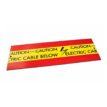
Centriforce Tapetile and Stokbord underground cable protection tiles and covers are the market leading, heavy duty utility protection system for protecting underground cable and pipes – this includes low voltage, medium voltage and high voltage power networks working at 11kV/33kV up to and including 132kV/275kV extra high voltage cables.
➡ The following Selection Table outlines the current approved Cable Protection Systems for UK DNO’s for underground medium and high voltage cables.
Northern Powergrid
Centriforce
Tapetile
150×2.5mmx40m
Northern Powergrid
Centriforce
Tapetile
200×2.5mmx40m
Northern Powergrid
Centriforce
Stokbord
1000x244x12mm
Scottish Power
Centriforce
Tapetile
200×2.5mmx40m
Scottish Power
Centriforce
Stokbord
1000x244x12mm
UK Power Networks
Centriforce
Tapetile
200×2.5mmx40m
UK Power Networks
Centriforce
Stokbord
1000x244x9mm
Western Power Distribution (WPD)
Centriforce
Stokbord
1000x450x12mm
Western Power Distribution (WPD)
Centriforce
Stokbord
1000x244x12mm
Scottish & Southern Energy (SSE)
Centriforce
Stokbord
1000x244x12mm
GTC
Centriforce
Tapetile
150×2.5mmx40m
GTC
Centriforce
Tapetile
200×2.5mmx40m
National Grid
Centriforce
Tapetile
200×2.5mmx40m
National Grid
Centriforce
Stokbord
1000x300x14mm
National Grid
Centriforce
Stokbord
1000x450x14mm
Centriforce Benefits
Centriforce Stokbord and Tapetile heavy duty plastic underground cable covers have virtually replaced concrete cable covers, tiles and plates for several reasons:
Clearest warning of underground buried cables to third parties
Can be custom made with sizes to suit specific utility cable protection for 11kV, 33kV, 66kV and 132kV
Contains bold warning text and UK DNO logo for clear cable identification
Damage to medium and high voltage cables less likely therefore reducing the cost of repairs, jointing and outages
Lightweight and easy to install cable covers irrespective of weather and soil conditions
Durable with good impact resistance
Rotproof and resistant cable covers to wide range of soil conditions
Electrical Explosion – An 11kV Cable Strike
Two construction companies have been fined £90,000 after workers were seriously burned, and one scarred for life, after they cut into a live 11kV electrical cable. Unprotected underground cables distributing medium and high voltage electricity pose serious health and safety dangers.
UK DNO’s
T&D are Specialist Distributors to the UK Distribution Network Operators (DNO’s), NERS Registered Service Providers, ICP’s and High Voltage Jointing Contractors of an extensive range of Cable Joints, Substation, Distribution, Tooling & Installation Equipment approved by the utilities:
T&D distribute the most extensive range of LV, MV & HV Cable Jointing, Terminating, Cable Pulling & Installation Equipment – we service UK and international clients working on underground cables, overhead lines, substations and electrical construction at LV, 11kV, 33kV and EHV transmission and distribution voltages.
Thorne & Derrick invite you to join LinkedIn’s largest LV-HV Electrical Discussion Group : Low & High Voltage Power, Cabling, Jointing & Electricals. Discussion subjects include cable installations, cable jointing, substation, overhead line and electrical construction at LV, 11kV, 33kV and EHV. Network, engage and promote your profile, company or products with over 10,000 influencers.
Request a Quote Call Us: +44 (0)191 410 4292 Stokbord cable protection covers are rigid HDPE protection boards designed to be installed above buried cables in trenches. They are manufactured and designed by Centriforce to provide strong mechanical protection...
Restoring transformer termination integrity with LoviSil When a major site recently experienced a fault on an 11kV transformer termination, the challenge was clear: restore the system quickly, safely and without the expense/disruption of full PILC cable replacement. Upon investigation,...