Cable Drum Jacks Explained: Types, Capacity & Safe Cable Drum Handling
Published 16 Nov 2026
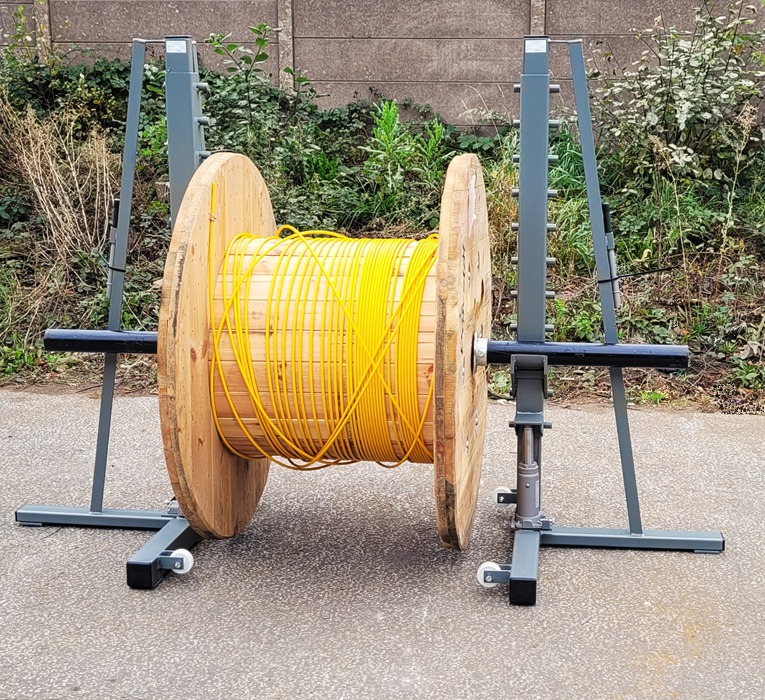
Cable drum jacks are lifting and support devices used to raise electrical cable drums off the ground so that the drum can rotate during cable pulling, laying and installation. They are widely used by electrical contractors, utilities, cable jointers and infrastructure installation teams working with low voltage (LV), medium voltage (MV) and high voltage (HV) power cables.
Also known as cable jacks, cable drum lifting jacks or cable drum stands, these systems typically operate in pairs, positioned on either side of a cable drum. A steel spindle passes through the drum’s central bore and is supported by the jacks, allowing the drum to be raised and cable to be paid out under controlled conditions.
There are three main types of cable drum lifting systems: hydraulic cable jacks, mechanical screw jacks and heavy-duty cable jack towers. Each uses a different lifting arrangement and accommodates different drum weights, dimensions and installation requirements.
Correct selection is essential. The combined capacity of the jacks, spindle, support arrangement and ground conditions must be suitable for the loaded cable drum. A drum that is too heavy, too wide or incorrectly supported can create significant risks during lifting and cable payout.
This guide explains how cable drum jacks work, the differences between hydraulic and screw types, how lifting capacity is specified, and what to consider when selecting equipment for LV, 11kV, 33kV and higher-voltage cable projects.
Thorne & Derrick supply a comprehensive range of cable drum jacks, including hydraulic cable jacks, mechanical screw jacks, cable jack towers and compatible spindle bars for electrical cable installation.
Quick Answer: What Are Cable Drum Jacks?
Cable drum jacks are mechanical or hydraulic lifting devices that raise and support cable drums so that electrical cables can be unwound during installation.
A typical arrangement uses two jacks, one on each side of the drum, with a steel spindle passing through its centre. The spindle supports the weight of the loaded drum and enables rotation as cable is paid out.
Hydraulic jacks use hydraulic pressure to raise the drum, while screw jacks use a mechanical threaded lifting mechanism. For particularly large and heavy drums, cable jack towers provide higher-capacity lifting and support.
Cable drum jacks are selected according to drum weight, drum diameter, width, spindle requirements, ground conditions and the intended cable installation method.
How Do Cable Drum Jacks Work?
Cable drum jacks lift a cable drum by supporting a spindle that passes through its central bore.
Once positioned correctly, the lifting mechanisms raise the spindle and drum sufficiently for the drum flanges to clear the ground. This permits the drum to rotate as the cable is drawn into the installation route.
The supporting arrangement generally includes four essential components:
- Two cable drum jacks – support the loaded drum on opposite sides.
- A steel spindle bar – passes through the drum’s central opening and transfers the load to the jack supports.
- Spindle supports or bearing blocks – provide the specified contact and support arrangement for the spindle.
- Locking collars or retaining components – help maintain the spindle and drum in the intended position, where required by the equipment design.
The lifting mechanisms are operated according to the manufacturer’s instructions to maintain stability and an appropriately level drum position.
The drum must be supported securely, and the site team must control payout throughout the installation.
Why Are Cable Drum Jacks Used Instead Of Leaving A Drum On The Ground?
A cable drum resting directly on the ground cannot normally rotate freely around its central axis.
Supporting it on suitable jacks allows the cable to be paid out from the drum without repeatedly moving or rolling the entire drum across the site.
This supports more controlled cable handling and integration with cable rollers, winches and other installation equipment.
However, raising a drum does not automatically control its rotational speed. Suitable supervision and approved braking arrangements may also be necessary.
What Are The Different Types Of Cable Drum Jacks?
There are three principal cable drum lifting arrangements used across electrical cable installation projects.
1. Hydraulic Cable Drum Jacks
Use hydraulic lifting mechanisms for convenient height adjustment and drum handling. They are available in various capacities and are commonly used for larger drums or frequent site operations.
2. Mechanical Screw Cable Jacks
Use threaded mechanical lifting systems to raise and support a drum. These offer a straightforward lifting arrangement without a hydraulic circuit.
3. Cable Jack Towers
Use robust lifting frames and suitable hydraulic mechanisms for large, heavy drums requiring higher lifting capacity and greater support arrangements.
Separate from these lifting systems are braked cable drum stands and drum cradles, which may be selected where controlled payout or a different handling arrangement is required.
Hydraulic Cable Drum Jacks Explained
Hydraulic cable drum jacks use hydraulic pressure to raise the spindle supports and lift a cable drum from the ground.
They are widely used where relatively heavy drums must be lifted, adjusted or repositioned as part of cable installation operations.
Many hydraulic drum jacks are fitted with wheels to assist movement around a cable yard or installation area when unloaded and handled in accordance with the manufacturer’s instructions.
SEB Hydraulic Cable Drum Jack Range
Thorne & Derrick supply the SEB hydraulic cable drum lifting range, including models with rated capacities of 3, 6 and 10 tonnes per pair.
Capacities and drum diameter ranges shown are for the specified SEB models. Suitability also depends on the approved spindle, collars, installation conditions and complete lifting arrangement.
When Should You Choose Hydraulic Cable Jacks?
Hydraulic cable jacks may be preferred where:
- Heavier cable drums require lifting and controlled height adjustment.
- Drums of different approved sizes are handled regularly.
- Convenient adjustment is important during installation preparation.
- The equipment will be moved between suitable working locations.
- The specified drum weight and size fall within the hydraulic system’s approved capacity.
Explore the Hydraulic Cable Drum Lifting Jacks range for model specifications and available lifting capacities.
Mechanical Screw Cable Drum Jacks Explained
Screw cable drum jacks use a mechanically threaded lifting arrangement to raise and support a cable drum.
They are commonly selected for applications where a straightforward mechanical system is preferred and the drum falls within the equipment’s approved lifting capacity and dimensions.
Mechanical screw jacks do not require a hydraulic pressure system, although the screw mechanism must still be inspected and maintained in accordance with the manufacturer’s requirements.
SEB Screw Cable Jack Range
The SEB screw jack range includes models with rated lifting capacities of 3, 6 and 8 tonnes per pair.
The SEB screw models feature base plates designed to provide support during drum lifting. However, ground stability and load distribution must still be assessed; a large base plate does not make unstable ground automatically safe.
When Are Screw Cable Jacks Suitable?
- Where manual mechanical lifting is appropriate.
- Where the drum size and weight fall within the specified equipment limits.
- For cable installations where a simple adjustable lifting system is preferred.
- Where a compatible spindle and support arrangement is available.
View the SEB Screw Cable Drum Lifting Jacks range for individual product specifications.
What Are Heavy-Duty Cable Jack Towers?
Cable jack towers are heavy-duty cable drum lifting systems designed for larger cable drums and more demanding lifting applications.
Unlike many compact drum jacks, jack towers use substantial support frames, hydraulic lifting components and suitable spindle support blocks.
They are commonly associated with large utility cable drums and major infrastructure projects.
How Much Weight Can Cable Jack Towers Lift?
The SEB cable jack tower range includes models rated for 20, 30 and 40 tonnes per pair, subject to the model configuration.
Some models incorporate additional outriggers or enhanced support arrangements to improve stability for their approved applications.
A 40-tonne rating must not be interpreted as permission to lift any 40-tonne drum. Drum dimensions, the spindle system, ground-bearing conditions and the complete approved configuration must be confirmed.
Typical Cable Jack Tower Applications
- Large HV and EHV cable drums.
- 66kV and 132kV power cable installation projects.
- Major electrical transmission and distribution works.
- Substation and grid connection infrastructure.
- Large renewable energy and industrial power projects.
Browse Cable Jack Towers for heavy cable drum lifting.
Hydraulic vs Screw Cable Drum Jacks: What’s The Difference?
The principal difference is how the equipment raises the spindle and drum.
Hydraulic jacks use hydraulic pressure, while screw jacks use a threaded mechanical lifting mechanism. Cable jack towers are typically selected where greater capacity or a more substantial support structure is required.
The capacities above apply to the specified SEB product ranges, not to all cable drum jacks available from every manufacturer.
No type is universally better. The correct choice depends on the complete lifting and cable payout requirements.
Cable Drum Jack Lifting Capacity Explained
One of the most important specifications when selecting cable jacks is the safe working load (SWL).
SWL indicates the maximum permitted load for the specified equipment configuration under its intended operating conditions.
What Does 3 Tonne Capacity Per Pair Mean?
Where a manufacturer describes a cable jack system as having a 3 tonne SWL per pair, the rating applies to the specified pair of jacks operating together in the approved configuration.
It does not mean that each individual jack can independently lift 3 tonnes or that two jacks have a combined capacity of 6 tonnes.
For example, a hypothetical loaded cable drum weighing 4 tonnes would exceed the stated capacity of a 3-tonne-per-pair system.
Simply replacing the jacks with a higher-rated pair may not be sufficient if the spindle, supports, working surface or associated components are unsuitable.
Cable Drum Weight vs Cable Weight
The load used for jack selection must account for the gross drum weight, rather than only the weight of cable wound onto the drum.
The gross weight includes the cable and the drum structure, together with any other components that form part of the lifted load.
Cable drum flanges may carry information about the drum and cable, including weight and dimensions. Where this information is missing or uncertain, the load must be confirmed before lifting.
Does Cable Voltage Determine Jack Capacity?
No. A cable’s voltage rating does not directly determine the required drum jack capacity.
For example, an 11kV cable drum may weigh more than a particular 33kV cable drum depending on cable size, construction, length and drum dimensions.
Select the lifting system using the actual loaded drum characteristics, not voltage classification alone.
Why Drum Diameter Matters
Drum diameter influences the height required to raise its flanges sufficiently clear of the ground.
Each jack model has a specified minimum and maximum compatible drum diameter, reflecting its lifting geometry and support arrangement.
However, diameter compatibility does not guarantee suitability for the drum’s weight, width or spindle requirements.
Cable Drum Spindles & Locking Collars Explained
A cable drum spindle is the steel bar that passes through the centre of the cable drum and transfers its weight onto the jack supports.
The spindle is a critical part of the lifting system. It must be selected for the drum dimensions, loaded weight and compatible jack arrangement.
What Does A Cable Drum Spindle Do?
During cable payout, the spindle supports the drum while allowing the intended rotation through the approved bearing or support arrangement.
It must have suitable strength and stiffness for the load and the distance between support points.
An incorrectly specified spindle may deflect excessively, fail to fit the drum bore or be incompatible with the jack supports.
How Do You Select The Correct Spindle?
Key factors include:
- Spindle diameter – compatibility with the drum bore and jack supports.
- Spindle length – sufficient engagement with the specified supports and retention components.
- Spindle capacity – suitability for the actual loading and support arrangement.
- Construction – solid or tubular steel, as specified by the manufacturer.
- Locking collars – compatible components that secure or position the drum where required.
SEB Spindle Bar Examples
These published spindle ratings are not independent approvals for every lifting configuration. The permitted load depends on the compatible jacks, support arrangement and manufacturer requirements.
For product dimensions and compatible accessories, see Cable Drum Spindle Bars & Locking Collars.
How To Choose The Correct Cable Drum Jacks
Selecting cable drum jacks requires several measurements and checks before the equipment is brought onto site.
The following factors should be established as part of the approved lifting and installation plan.
Example: Selecting Jacks For A 5-Tonne Cable Drum
Consider a hypothetical loaded cable drum with a verified gross weight of 5 tonnes.
A jack pair rated at 3 tonnes SWL would be unsuitable because the gross drum weight exceeds the pair’s rated capacity.
A 6-tonne-rated jack pair might provide sufficient nominal lifting capacity, but it cannot be selected on capacity alone.
The drum diameter and width, compatible spindle, support components, ground conditions and full installation arrangement must also be checked.
Where the necessary information cannot be confirmed, lifting should not proceed until the equipment has been properly specified.
Cable Drum Payout: Rotation, Braking & Cable Handling
Once a drum is correctly raised and supported, the cable must be paid out in accordance with the approved cable installation procedure.
Cable payout control is particularly important for larger drums, which may possess significant rotational inertia.
Why Must Drum Rotation Be Controlled?
If a drum rotates faster than required, cable may unwind without adequate control.
This can create slack, disturb the cable route and introduce hazards around the drum and payout area.
Suitable supervision and approved control or braking arrangements help manage these risks.
Are Cable Drum Jacks Fitted With Brakes?
Not all cable drum jacks incorporate a braking system.
Some drum stands are specifically designed with adjustable braking arrangements for controlled cable payout.
Do not assume that an ordinary hydraulic or screw jack automatically provides drum braking or tension control.
Cable Drum Jacks vs Braked Drum Stands
Cable drum jacks primarily lift and support the drum. A braked drum stand incorporates a mechanism intended to control drum rotation during payout.
The appropriate system depends on the cable installation method, drum size, required control and approved site procedure.
Why Cable Payout Direction Matters
The cable should leave the drum in the manner prescribed by the cable manufacturer and approved installation procedure.
Incorrect payout can introduce excessive bending, twisting or other unwanted mechanical stresses.
The drum arrangement must be coordinated with cable rollers, winches, bellmouths and any additional cable handling equipment used along the route.
Cable Drum Jacks For LV, 11kV, 33kV & HV Cable Installations
Cable drum jacks are used throughout electrical power infrastructure, but the correct equipment is selected by drum characteristics rather than voltage alone.
Low Voltage Cable Installation
LV installations can include armoured power cables, industrial distribution cables, feeder connections and other electrical cable systems.
Mechanical or hydraulic jacks may be suitable depending on drum weight, dimensions and handling requirements.
11kV & 33kV Cable Installation
Medium voltage cable installations commonly involve drum handling during the construction of underground distribution networks, substations and renewable energy connections.
Hydraulic or mechanical cable jacks can provide suitable drum support where the complete equipment arrangement is approved.
The drum payout operation must also be coordinated with the cable’s permitted pulling force and minimum bending radius.
66kV & 132kV Cable Installation
Large HV and EHV cables may be supplied on substantial drums requiring heavy-duty lifting and support equipment.
Depending on drum mass and dimensions, specialist cable jack towers or other engineered drum handling arrangements may be necessary.
Such projects typically require detailed planning of lifting, cable tension, route geometry and drum handling.
Renewable Energy & Grid Connection Projects
Cable drum jacks are also used on wind farms, solar developments, battery energy storage projects and associated grid connections.
Site access, ground-bearing conditions, working space and drum transportation are important considerations when selecting equipment.
Safe Cable Drum Lifting: LOLER, Inspection & Site Safety
Cable drum lifting must be planned and carried out safely by competent personnel. Large cable drums can present serious hazards if lifted using unsuitable equipment or an unstable support arrangement.
In the UK, lifting operations involving lifting equipment used at work are subject to applicable requirements under the Lifting Operations and Lifting Equipment Regulations 1998 (LOLER).
Other relevant requirements may include the Provision and Use of Work Equipment Regulations (PUWER), which address the suitability, maintenance and safe use of work equipment.
What Does LOLER Mean For Cable Drum Jacks?
Where LOLER applies, lifting equipment must be suitable for its intended use, of adequate strength and stability, and appropriately marked with its rated capacity.
Lifting operations must be properly planned by a competent person, appropriately supervised and carried out safely.
Equipment must also be subject to the required inspections and thorough examinations in accordance with the applicable regulations and examination scheme.
Essential Cable Drum Jack Safety Checks
- Confirm the gross drum weight and equipment SWL.
- Inspect the drum, flanges and central bore for relevant damage.
- Confirm the spindle is correctly specified and adequately supported.
- Inspect jack frames, lifting mechanisms and support points.
- Check locking collars or other retention components.
- Assess the ground and required load-spreading arrangements.
- Keep the drum correctly positioned and stable during lifting.
- Establish a suitable exclusion zone around the lifting operation.
- Keep personnel clear of suspended loads and pinch points.
- Control drum rotation during cable payout.
- Follow the manufacturer instructions and the approved lifting plan.
Can Cable Drum Jacks Be Used On Uneven Ground?
Only where the complete equipment and support arrangement is approved for the conditions.
Uneven, soft or poorly compacted ground can affect jack stability and load distribution.
Suitable engineering assessment and support measures may be required. The presence of a broad base plate does not eliminate the need to check ground-bearing conditions.
Common Cable Drum Jack Selection & Installation Mistakes
Errors during cable drum jack selection can create problems before cable pulling even begins.
1. Confusing Capacity Per Pair With Capacity Per Jack
A 6-tonne-rated pair should not be interpreted as two independently rated 6-tonne jacks.
2. Using The Wrong Cable Drum Spindle
An unsuitable spindle may be too short, incorrectly sized or inadequately rated for the lifting arrangement.
3. Selecting By Drum Diameter Alone
Diameter is important, but the gross weight, width, drum bore and support geometry must also be considered.
4. Ignoring Ground Conditions
Even correctly rated jacks may be unsafe if installed on unsuitable or unstable supporting ground.
5. Assuming All Jacks Provide Braking
Ordinary lifting jacks do not necessarily control payout speed. Suitable rotational control may require additional equipment.
6. Failing To Inspect The Drum
A damaged flange, central bore or drum structure can compromise the lifting and handling arrangement.
7. Using Equipment Without Suitable Inspection Records
Applicable lifting equipment inspections, maintenance and thorough examinations must be completed before use.
Cable Drum Jacks, Spindles & Equipment From Thorne & Derrick
Thorne & Derrick supply specialist cable drum lifting and cable pulling equipment for utilities, electrical contractors, renewable energy projects, substations and infrastructure installations.
Our range includes:
- Cable Jacks – overview of hydraulic, screw and heavy-duty drum lifting equipment.
- Hydraulic Cable Drum Jacks – SEB HJ3, HJ6 and HJ10 models for approved drum lifting applications.
- Screw-Type Cable Drum Jacks – SEB SJ3, SJ6 and SJ8 mechanical lifting systems.
- Cable Jack Towers – heavy-duty lifting arrangements with capacities up to 40 tonnes per pair.
- Spindle Bars & Locking Collars – compatible drum support and retention components.
- Cable Drum Jacks & Drum Handling Products – additional mechanical and drum stand options.
- Cable Rollers – cable support and guidance during pulling and laying.
- Cable Pulling & Laying Equipment – supporting equipment for LV, MV, HV and EHV cable installation.
For advice on a suitable jack arrangement, provide the drum’s gross weight, diameter, width, bore size and intended installation conditions.
Cable Drum Jacks Frequently Asked Questions
Q: What are cable drum jacks used for?
A: Cable drum jacks lift and support loaded cable drums so the drums can rotate during cable pulling and laying. They are used in LV, MV and HV electrical cable installation projects.
Q: What is the difference between hydraulic and screw cable jacks?
A: Hydraulic cable jacks use hydraulic pressure to lift the drum spindle, while screw jacks use a threaded mechanical lifting arrangement. Both must be selected for the drum’s weight, dimensions and compatible support components.
Q: What does 6 tonnes SWL per pair mean?
A: It means the specified pair of cable jacks has a safe working load of 6 tonnes when used in its approved configuration. It does not mean that each individual jack can independently lift 6 tonnes.
Q: How do you select the correct cable drum jack?
A: Confirm gross drum weight, drum diameter, width, bore dimensions, spindle compatibility, ground conditions and the required cable payout arrangement. The complete lifting system must meet the manufacturer’s specifications.
Q: What are cable jack towers used for?
A: Cable jack towers are heavy-duty systems used to lift and support larger, heavier cable drums. Selected SEB models provide rated capacities up to 40 tonnes per pair, subject to the approved equipment configuration.
Q: Do cable drum jacks come with spindle bars?
A: Some hydraulic cable jack packages include compatible spindles and locking collars, while certain screw jacks and tower systems may require them to be specified separately. Check the exact product supply configuration before ordering.
Q: Can cable drum jacks be used for 11kV and 33kV cables?
A: Yes. Suitable cable jacks can support drums used for 11kV and 33kV cable installations. Equipment selection depends on the actual drum characteristics and loading rather than the cable voltage alone.
Q: Are cable drum jacks covered by LOLER?
A: Cable drum lifting equipment used for lifting operations at work is subject to applicable LOLER requirements. These include suitable equipment, competent planning, supervision, safe operation and required inspection or thorough examination. The responsible organisation must establish the requirements applicable to its equipment and use.
Q: Do hydraulic cable jacks automatically control cable drum rotation?
A: No. Hydraulic lifting does not necessarily include braking or rotational speed control. If controlled payout or braking is required, a suitable approved system must be specified.
Q: Can a cable drum jack be used on soft ground?
A: Only where the ground and complete lifting arrangement have been assessed as suitable. Additional support or load-spreading measures may be required, and the equipment must be used within the approved manufacturer and lifting-plan requirements.
Conclusion: Selecting The Right Cable Drum Jacks
Cable drum jacks are essential equipment for supporting and handling electrical cable drums during installation. By lifting the drum clear of the ground, they allow the cable to be paid out through an appropriately planned cable pulling or laying arrangement.
Hydraulic cable jacks offer convenient lifting adjustment, mechanical screw jacks provide a straightforward threaded lifting system, and heavy-duty jack towers are available for larger drum handling requirements.
However, selecting the correct equipment involves more than choosing a lifting capacity. Gross drum weight, drum diameter, width, spindle dimensions, compatible supports, ground conditions and cable payout requirements must all be checked.
For LV, MV, HV and EHV cable installations, correct drum handling helps support controlled cable payout and reduces avoidable installation risks.
Thorne & Derrick supply a comprehensive range of cable drum jacks, jack towers, spindle bars and cable pulling equipment for utilities, contractors, substations, renewable energy and industrial infrastructure projects.
Contact our technical sales team with your drum specifications and project requirements for assistance identifying a suitable lifting and cable handling solution.