ATEX Cable Glands Explained: Ex d, Ex e & Barrier Glands
Published 04 Nov 2026
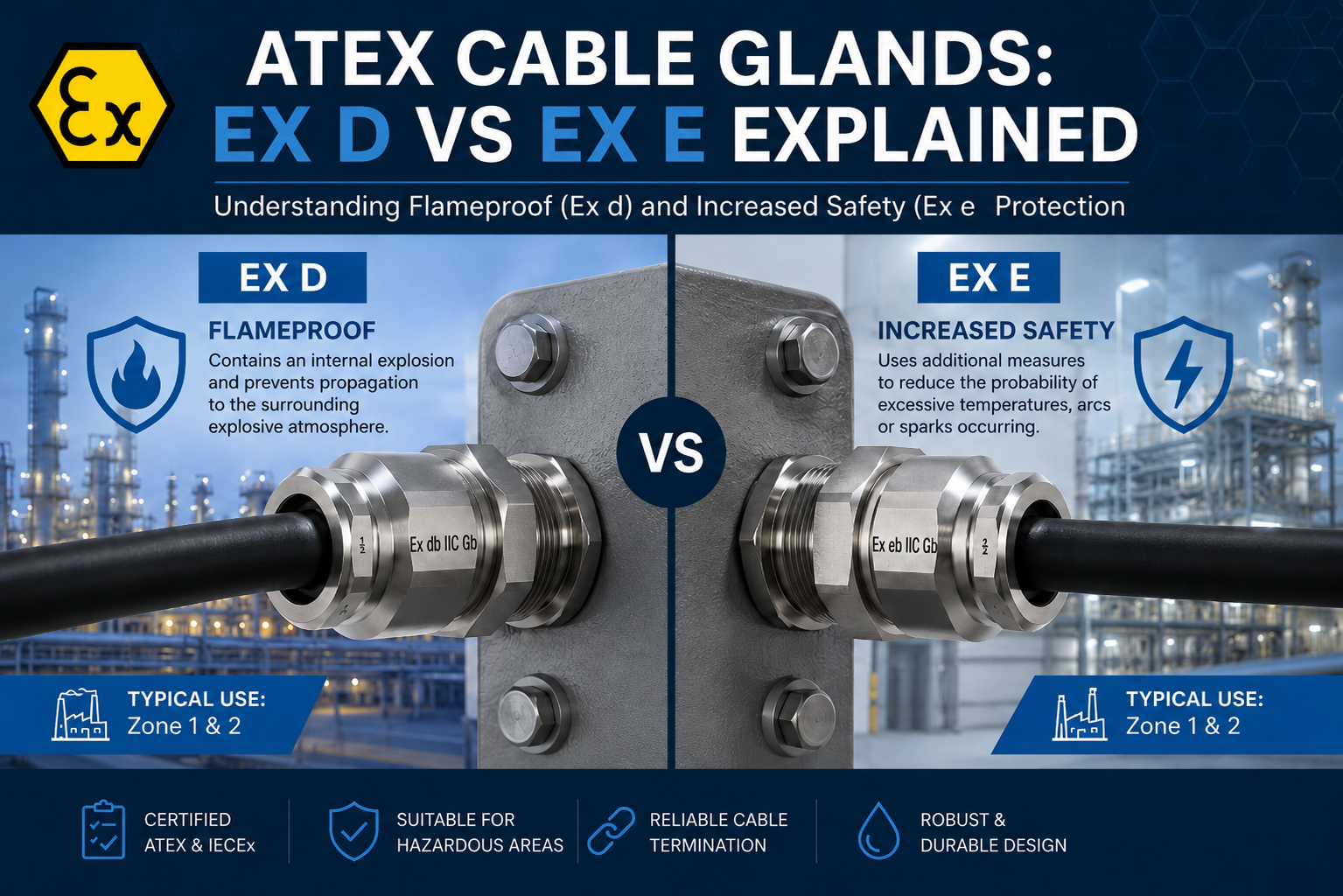
ATEX cable glands are certified cable entry devices used in electrical equipment installed in potentially explosive atmospheres. They secure and seal cables while helping maintain the equipment’s explosion protection. As a result, correct gland selection is an important part of hazardous area electrical safety.
These glands are commonly used in Zone 1, Zone 2, Zone 21 and Zone 22 hazardous areas, subject to the relevant certification and installation requirements. In addition, they must be compatible with the electrical equipment, cable construction and operating environment.
Also known as Ex cable glands, hazardous area cable glands or IECEx cable glands, these components are widely used across oil and gas, petrochemical, pharmaceutical and industrial facilities.
However, different applications require different gland designs. For example, Ex d flameproof and Ex e increased safety equipment have different cable entry requirements. Some installations may also require a barrier gland to address particular flame transmission risks.
Thorne & Derrick supply ATEX and IECEx cable glands from established manufacturers, including Prysmian. Our range supports hazardous area electrical installations involving compatible armoured and unarmoured cables.
This guide explains the main protection concepts, certification markings, gland types and selection requirements. It also covers the differences between Ex d and Ex e, barrier gland selection and the standards that apply to hazardous area cable entries.
Quick Navigation
- What Is an ATEX Cable Gland?
- Why Are ATEX Cable Glands Required?
- ATEX vs IECEx Cable Glands
- Ex d vs Ex e Cable Glands
- Barrier Cable Glands Explained
- ATEX Cable Glands and Hazardous Area Zones
- ATEX Cable Gland Markings
- Armoured and Unarmoured Cable Glands
- Materials and IP Ratings
- Cable Gland Selection Checklist
- ATEX Cable Gland Standards
- Common Specification Mistakes
- Industrial Applications
- ATEX Cable Glands from Thorne & Derrick
- Frequently Asked Questions
- Conclusion
What Is an ATEX Cable Gland?
An ATEX cable gland is a certified device that secures a cable entering electrical equipment in a potentially explosive atmosphere. Its primary purpose is to maintain the required explosion protection while providing a suitable cable entry.
Depending on the design, the gland may also provide mechanical retention, environmental sealing and electrical continuity. Furthermore, certain designs incorporate specialist sealing arrangements to address flame transmission risks.
What Does an ATEX Cable Gland Do?
A correctly selected gland can perform several important functions:
- Cable Retention: Helps prevent excessive strain on internal electrical connections.
- Environmental Sealing: Helps protect equipment against moisture, dust and contaminants.
- Armour Clamping: Provides mechanical termination for compatible armoured cables.
- Electrical Continuity: Supports suitable bonding and earthing arrangements.
- Explosion Protection: Maintains the applicable equipment protection concept when correctly specified and installed.
However, certification alone does not make a gland suitable for every hazardous area installation. Instead, the complete cable entry arrangement must match the equipment, cable and installation requirements.
ATEX Cable Glands – Quick Summary
Why Are ATEX Cable Glands Required?
Electrical equipment installed in potentially explosive atmospheres must meet specific protection requirements. In particular, cable entry points need careful attention because they create openings in the equipment enclosure.
Without a suitable gland, an entry could compromise environmental sealing or the intended explosion protection. Therefore, selecting a certified and compatible cable gland is an important installation requirement.
Maintaining Explosion Protection
ATEX cable glands help maintain the certified protection concept of electrical equipment.
For example, Ex d flameproof equipment requires a cable entry arrangement that satisfies the applicable flameproof protection requirements. Meanwhile, Ex e increased safety equipment requires entries that maintain its increased safety protection.
Although some glands carry certification for both concepts, their suitability must still be checked against the equipment certificate.
Environmental Sealing
Suitable cable glands also help protect enclosures against moisture, dust and other contaminants. This is particularly important in outdoor and demanding industrial environments.
However, the gland alone does not determine the complete enclosure’s ingress protection. The threads, washers, accessories and installation arrangement must also be suitable.
Cable Retention and Mechanical Protection
A cable gland provides mechanical retention and helps prevent excessive movement of the installed cable. As a result, pulling forces are less likely to place unacceptable strain on internal electrical terminations.
Nevertheless, the gland must match the cable’s actual dimensions and construction to provide the intended performance.
Armour Earthing and Electrical Continuity
For compatible armoured cables, some glands provide an electrical connection between the cable armour and the equipment’s earthing arrangement.
In addition, the complete installation must meet any applicable bonding, continuity and fault-current withstand requirements.
ATEX vs IECEx Cable Glands – What’s the Difference?
ATEX and IECEx both relate to equipment intended for use in explosive atmospheres. However, they operate under different regulatory and conformity assessment frameworks.
ATEX refers to European legislation governing equipment and protective systems intended for potentially explosive atmospheres. In the European Union, the relevant equipment directive is 2014/34/EU.
By comparison, IECEx is an international conformity assessment system based on applicable IEC standards.
Can a Cable Gland Have Both ATEX and IECEx Certification?
Yes. Manufacturers may obtain both ATEX and IECEx certification for a particular cable gland.
However, approval under one framework does not automatically establish compliance with every national requirement. Consequently, buyers must check the certification needed for their specific market and installation.
ATEX vs IECEx – Comparison Table
| Requirement | ATEX | IECEx |
|---|---|---|
| Framework | European regulatory framework. | International conformity assessment system. |
| Technical Basis | Applicable standards and conformity assessment requirements. | Relevant IEC explosion protection standards. |
| Documentation | ATEX marking, conformity information and applicable certification. | IECEx certificate and Ex marking. |
| Application | Relevant European markets. | Markets recognising or requiring IECEx. |
Before purchasing a cable gland, confirm which approvals apply to the equipment and installation location. Also, review any specific conditions included in its certificate.
Ex d vs Ex e Cable Glands – What’s the Difference?
Ex d and Ex e are two commonly used explosion protection concepts for hazardous area electrical equipment.
Although both aim to reduce ignition risks, they achieve protection in different ways. Therefore, their cable entry requirements are not interchangeable.
What Is an Ex d Flameproof Cable Gland?
Ex d flameproof protection uses an enclosure designed to withstand an internal explosion and prevent it from igniting the surrounding explosive atmosphere.
As a result, the cable entry must meet the relevant flameproof requirements. Depending on the equipment and cable construction, this may involve a certified barrier cable gland or another permitted entry arrangement.
Importantly, the complete gland and cable combination must meet the approved installation requirements.
What Is an Ex e Increased Safety Cable Gland?
Ex e increased safety uses design and construction measures to reduce the likelihood of ignition sources arising under the applicable operating conditions.
For example, equipment may incorporate measures that limit the risk of dangerous temperatures, arcs or sparks.
Similarly, the cable gland must maintain the relevant protection concept and environmental sealing requirements.
Ex d vs Ex e – Comparison Table
| Feature | Ex d | Ex e |
|---|---|---|
| Protection Concept | Flameproof enclosure. | Increased safety. |
| Main Purpose | Prevent an internal explosion from igniting the surrounding atmosphere. | Reduce the likelihood of ignition sources arising. |
| Gland Selection | Must meet flameproof entry requirements. | Must maintain increased safety protection. |
| Barrier Gland | May be required for the approved entry arrangement. | Not automatically required. |
Important: Some glands carry both Ex d and Ex e certification. Nevertheless, the product must still match the equipment certificate, cable construction and installation conditions.
What Is a Barrier Cable Gland?
A barrier cable gland incorporates a certified sealing compound or another approved barrier arrangement around individual cable cores.
This additional seal helps address flame transmission risks where required by the installation. Consequently, barrier glands are particularly relevant to certain Ex d flameproof applications.
How Does a Barrier Cable Gland Work?
A conventional compression gland generally seals around the cable sheath or another specified surface.
By contrast, a barrier gland provides a sealing arrangement around the cable core region. This helps address potential flame transmission paths through the cable entry.
However, the exact sealing method and installation procedure depend on the certified product design.
Barrier vs Non-Barrier Cable Glands
| Gland Type | Sealing Arrangement | Main Consideration |
|---|---|---|
| Non-Barrier | Compression seals around approved cable surfaces. | Must be permitted for the cable and equipment. |
| Barrier | Certified barrier around the cable cores. | Used where the approved entry arrangement requires it. |
When Is a Barrier Cable Gland Required?
Not every Ex d installation requires a barrier gland. Instead, the requirement depends on the equipment certificate, cable construction and permitted installation method.
For example, a non-barrier gland may be suitable for one approved entry arrangement but unsuitable for another. Therefore, the decision must be based on the complete installation requirements.
In particular, specifiers should review the relevant provisions of IEC 60079-14 and the manufacturer’s documentation.
For further product information, explore our Barrier Cable Glands.
ATEX Cable Glands for Zone 1, Zone 2, Zone 21 and Zone 22
Hazardous areas are classified according to how frequently an explosive atmosphere is expected to occur and how long it may remain present.
For gases and vapours, the classifications include Zone 0, Zone 1 and Zone 2. Meanwhile, combustible dust atmospheres use Zone 20, Zone 21 and Zone 22.
Although the zone influences the required Equipment Protection Level, it does not determine the complete gland specification.
Hazardous Area Zone Comparison
| Zone | Atmosphere | Description |
|---|---|---|
| Zone 0 | Gas or vapour | Present continuously, frequently or for long periods. |
| Zone 1 | Gas or vapour | Likely to occur occasionally during normal operation. |
| Zone 2 | Gas or vapour | Unlikely during normal operation and normally short-lived if it occurs. |
| Zone 21 | Combustible dust | Likely to occur occasionally during normal operation. |
| Zone 22 | Combustible dust | Unlikely during normal operation and normally short-lived if it occurs. |
Can the Same Gland Be Used in Different Zones?
Some certified glands may be suitable for more than one hazardous area classification. However, the actual permitted applications depend on the certificate and Equipment Protection Level.
For example, a gland certified only for a Zone 2 application must not automatically be used in Zone 1.
Before installation, check that the complete cable entry arrangement meets the required level and type of protection.
ATEX Cable Gland Markings Explained
ATEX cable gland markings provide important information about the product’s certified explosion protection.
For example, markings may identify the protection concept, gas or dust group and Equipment Protection Level.
However, the marking alone does not provide every detail required for safe installation. Therefore, the full certificate and manufacturer’s instructions must also be reviewed.
What Does Ex db IIC Gb Mean?
Consider the illustrative marking Ex db IIC Gb.
Although this example explains the individual marking elements, it does not represent a complete product certificate.
What Do X and U Mean on Ex Certificates?
Some Ex certificates include additional letters after their certificate numbers. In particular, the suffixes X and U have specific meanings.
- X: Indicates that specific conditions of use apply. These conditions must be followed.
- U: Indicates an Ex component certificate rather than unrestricted certification of complete equipment.
Consequently, installers must review the complete certification documentation rather than relying only on the product description.
ATEX Cable Glands for Armoured and Unarmoured Cables
Cable construction is an important consideration when choosing an ATEX gland. In particular, armoured and unarmoured cables require different mechanical retention arrangements.
For example, an armoured cable gland may need to clamp metallic armour and provide electrical continuity. Meanwhile, an unarmoured gland must secure the cable without an armour termination.
Armoured ATEX Cable Glands
Armoured cables use different types of metallic protection. Therefore, gland selection must match the particular armour construction.
Common examples include:
- SWA: Steel Wire Armour.
- AWA: Aluminium Wire Armour.
- Wire Braid: Braided metallic protection.
- Steel Tape Armour: Metallic tape construction.
In addition, the gland must match the cable’s bedding diameter, overall diameter and any required electrical connection arrangement.
Unarmoured ATEX Cable Glands
Unarmoured glands provide cable sealing and retention without a metallic armour clamp.
However, they must still maintain the specified equipment protection and environmental sealing.
Single-Seal vs Double-Seal Cable Glands
Some cable glands seal against the outer cable sheath, while others also incorporate an inner bedding seal.
As a result, the correct design depends on the cable construction and installation requirements.
Importantly, a double-seal compression gland is not automatically equivalent to a barrier gland. Barrier sealing involves separate design and certification considerations.
ATEX Cable Gland Materials and IP Ratings
The correct gland material depends on the environment in which the equipment operates. For example, moisture, chemicals and temperature can influence long-term material suitability.
Furthermore, the gland must be compatible with the enclosure and any project-specific corrosion requirements.
Common ATEX Cable Gland Materials
- Brass: Commonly used in industrial cable gland applications.
- Nickel-Plated Brass: Provides a plated finish for suitable environments.
- Stainless Steel: Used in demanding or corrosive conditions where the selected grade is appropriate.
- Non-Metallic Materials: Used in selected approved and certified gland designs.
When selecting a material, consider chemical exposure, potential galvanic corrosion and the expected operating temperature.
What Do IP66 and IP68 Mean?
An IP rating describes protection against access to hazardous parts and the ingress of solids and water under specified test conditions.
For example, the following ratings are commonly encountered:
- IP66: Dust-tight protection and resistance to powerful water jets.
- IP68: Protection during immersion under the conditions specified for the product.
However, an IP rating does not establish suitability for an explosive atmosphere.
Therefore, an IP66 or IP68 gland must not automatically be considered ATEX certified.
In addition, the installed gland and enclosure arrangement must maintain the required ingress protection.
How to Select the Correct ATEX Cable Gland
Correct ATEX cable gland selection requires information about the hazardous area, electrical equipment, cable and operating environment.
For example, choosing a gland based only on cable diameter may overlook important certification or sealing requirements.
Therefore, specifiers should review all relevant details before selecting a product.
Step 1 – Confirm the Hazardous Area and Equipment
First, establish the hazardous area classification and the required Equipment Protection Level.
Next, check the equipment’s protection concept, certificate and cable entry requirements. This information helps identify which gland designs may be suitable.
Step 2 – Check the Cable Construction and Dimensions
Then, confirm whether the cable is armoured or unarmoured. The armour type, cable bedding and sheath dimensions must also match the gland’s published ranges.
In addition, consider any requirements for electrical continuity and mechanical retention.
Step 3 – Review the Installation Environment
Finally, assess the operating temperature, ingress protection and corrosion requirements.
Where applicable, confirm whether a barrier seal or another permitted cable entry arrangement is required.
ATEX Cable Gland Selection Checklist
For more detailed guidance, read our IECEx Cable Gland Selection Guide.
ATEX Cable Gland Standards and Certification
Several standards apply to hazardous area cable gland design, testing and installation. However, each addresses a different aspect of equipment protection.
Consequently, specifiers should consider the complete set of applicable requirements rather than relying on a single standard.
IEC 60079-14 – Electrical Installation
IEC 60079-14 covers electrical installation design, equipment selection, installation and initial inspection in or associated with explosive atmospheres.
The sixth edition was published in 2024 and introduced technical changes and restructuring. However, projects must follow the edition adopted by the applicable jurisdiction and project specification.
IEC 60079-0 – General Equipment Requirements
IEC 60079-0 provides general requirements for Ex equipment and components.
For example, it addresses relevant construction, testing and marking requirements.
IEC 60079-1 – Flameproof Enclosures
IEC 60079-1 covers equipment protection by flameproof enclosures.
In addition, it includes requirements relevant to certain certified flameproof cable entry devices.
IEC 60079-7 – Increased Safety
IEC 60079-7 covers equipment protection by increased safety.
Therefore, cable entries used with equipment relying on this protection concept must meet the relevant requirements.
IEC 62444 – Cable Glands
IEC 62444 specifies requirements and tests for cable glands used in electrical installations.
However, compliance with this general cable gland standard does not automatically establish suitability for explosive atmospheres.
Appropriate Ex certification and installation compatibility must also be considered.
Common ATEX Cable Gland Specification Mistakes
Incorrect cable gland selection can compromise the protection of electrical equipment in hazardous areas.
For example, using a gland with the wrong sealing range may affect cable retention or environmental protection.
Similarly, selecting an unsuitable flameproof entry arrangement can compromise the intended explosion protection.
Certification and Protection Concept Mistakes
- Selecting by zone alone: The gland must also match the equipment’s protection concept and certification.
- Confusing Ex d and Ex e: These concepts have different protection requirements.
- Ignoring barrier requirements: Flameproof entries must use a permitted sealing arrangement.
- Overlooking certificate conditions: Special conditions of use must be followed.
Cable Compatibility and Installation Mistakes
- Choosing by thread size only: The sealing and clamping ranges must also match.
- Using incompatible armour clamps: Glands must suit the actual armour construction.
- Overlooking IP protection: Incorrect washers or accessories can compromise sealing.
- Using unsuitable accessories: Adaptors, reducers and stopping plugs must be compatible with the certified arrangement.
- Ignoring corrosion: Gland materials must suit the installation environment.
- Incorrect installation: Assembly must follow the approved manufacturer’s instructions.
Therefore, hazardous area cable glands should be selected, installed and inspected by competent personnel using the relevant technical documentation.
Where Are ATEX Cable Glands Used?
ATEX and IECEx cable glands are used wherever electrical equipment operates in suitably classified explosive atmospheres.
These environments may contain flammable gases, vapours or combustible dusts. As a result, electrical equipment must meet the relevant protection requirements.
Oil, Gas and Petrochemical Applications
Hazardous area cable glands are widely used in oil and gas facilities, refineries and petrochemical plants.
For example, they may be specified for motors, instrumentation, junction boxes and control equipment.
Manufacturing and Process Industries
In addition, certified glands may be required in chemical processing, pharmaceutical manufacturing and industrial production facilities.
However, the correct gland depends on the classified area and the equipment protection concept.
Offshore, Marine and Utility Applications
Offshore and marine equipment may face demanding environmental conditions alongside explosion protection requirements.
Therefore, material selection, corrosion resistance and environmental sealing are also important.
Typical Industrial Applications
- Oil and Gas: Electrical equipment in onshore and offshore facilities.
- Petrochemical Plants: Motors, instrumentation, junction boxes and control equipment.
- Chemical Processing: Electrical installations in classified process areas.
- Pharmaceutical Manufacturing: Equipment exposed to relevant gas, vapour or dust hazards.
- Fuel Storage and Handling: Equipment associated with fuel transfer and storage.
- Marine and Offshore: Certified electrical equipment in demanding environments.
- Industrial Manufacturing: Process areas containing potentially explosive atmospheres.
- Food and Grain Processing: Electrical equipment in classified combustible dust areas.
However, the presence of flammable substances does not automatically establish a particular hazardous area zone.
Instead, a suitable hazardous area assessment must determine the required equipment protection level.
ATEX and IECEx Cable Glands from Thorne & Derrick
Thorne & Derrick supply certified cable glands and related accessories for hazardous area electrical installations.
Our range includes products for compatible armoured and unarmoured cables. Furthermore, specialist barrier glands are available for installations requiring an approved barrier sealing arrangement.
Explore Our Cable Gland Ranges
- Prysmian IECEx and ATEX Cable Glands – certified products for compatible hazardous area cable entries.
- ATEX Cable Glands – hazardous area gland ranges, including CMP products.
- Barrier Cable Glands – compound barrier sealing systems for applicable installations.
- Cable Glands – our wider range of industrial and specialist cable entry products.
What Information Should You Provide?
When enquiring about ATEX cable glands, provide the equipment certification, hazardous area classification and cable construction.
In addition, include the cable dimensions, armour type, entry thread and operating conditions.
With these details, our technical sales team can help identify suitable product options for further specification checks.
ATEX Cable Glands – Frequently Asked Questions
The following answers address common questions about hazardous area cable glands, Ex protection concepts and product selection.
ATEX and IECEx Certification FAQs
Q1. What is an ATEX cable gland?
An ATEX cable gland is a certified cable entry device for suitable electrical equipment in potentially explosive atmospheres. It provides cable retention and sealing while maintaining the required equipment protection.
Q2. What is the difference between Ex d and Ex e cable glands?
Ex d relates to flameproof enclosure protection, whereas Ex e relates to increased safety. Therefore, the gland must match the equipment’s certified protection concept.
Q3. Are ATEX and IECEx cable glands the same?
No. Although ATEX and IECEx address equipment for explosive atmospheres, they operate under different frameworks. Some glands hold both approvals. However, the required certification depends on the market and installation.
Q4. When is a barrier cable gland required?
A barrier gland may be required for certain flameproof cable entries. In particular, the equipment certification, cable construction and approved entry arrangement determine whether barrier sealing is necessary.
Q5. Can ATEX cable glands be used in Zone 1?
Yes, provided the gland is appropriately certified and compatible with the equipment, cable and Zone 1 requirements. However, suitability must be confirmed using the complete certification.
Q6. Can a Zone 2 cable gland be used in Zone 1?
A gland suitable only for Zone 2 must not automatically be used in Zone 1. Instead, the certification and Equipment Protection Level must support the intended application.
Cable Gland Selection and Installation FAQs
Q7. What is the difference between barrier and non-barrier glands?
A barrier gland seals around the cable cores to address relevant flame transmission risks. By contrast, a conventional compression gland generally seals around specified cable surfaces.
Q8. Do ATEX cable glands have IP ratings?
Many ATEX cable glands have specified IP ratings. However, the actual protection depends on the gland and its installation. An IP rating does not replace Ex certification.
Q9. What does Ex db IIC Gb mean?
This example indicates flameproof protection level db, gas group IIC and Equipment Protection Level Gb. Nevertheless, the complete product certificate must also be checked.
Q10. What information is needed to select an ATEX gland?
You will need the hazardous area classification, equipment protection concept, cable construction, dimensions, armour type, entry thread and environmental conditions. In addition, the applicable certification and entry arrangement must be confirmed.
Q11. Can a standard industrial cable gland be used in a hazardous area?
A standard industrial gland must not be assumed suitable for hazardous area equipment. Instead, the complete gland and entry arrangement must meet the relevant explosion protection and installation requirements.
Conclusion – Selecting ATEX Cable Glands
ATEX cable glands are important components of hazardous area electrical installations. They help maintain equipment protection while securing and sealing the cable entry.
However, different installations require different gland designs. For example, Ex d flameproof and Ex e increased safety equipment have distinct protection requirements.
Furthermore, the cable construction and installation conditions influence whether a compression or barrier gland is suitable.
Therefore, correct selection must consider the hazardous area classification, equipment certification, cable dimensions and applicable standards.
Thorne & Derrick supply ATEX and IECEx cable glands from established manufacturers for suitable armoured and unarmoured cable applications.
For assistance with product identification, contact our technical sales team with your cable and equipment details.