Single-Eye vs Double-Eye Cable Socks | Guide
Published 02 Nov 2026
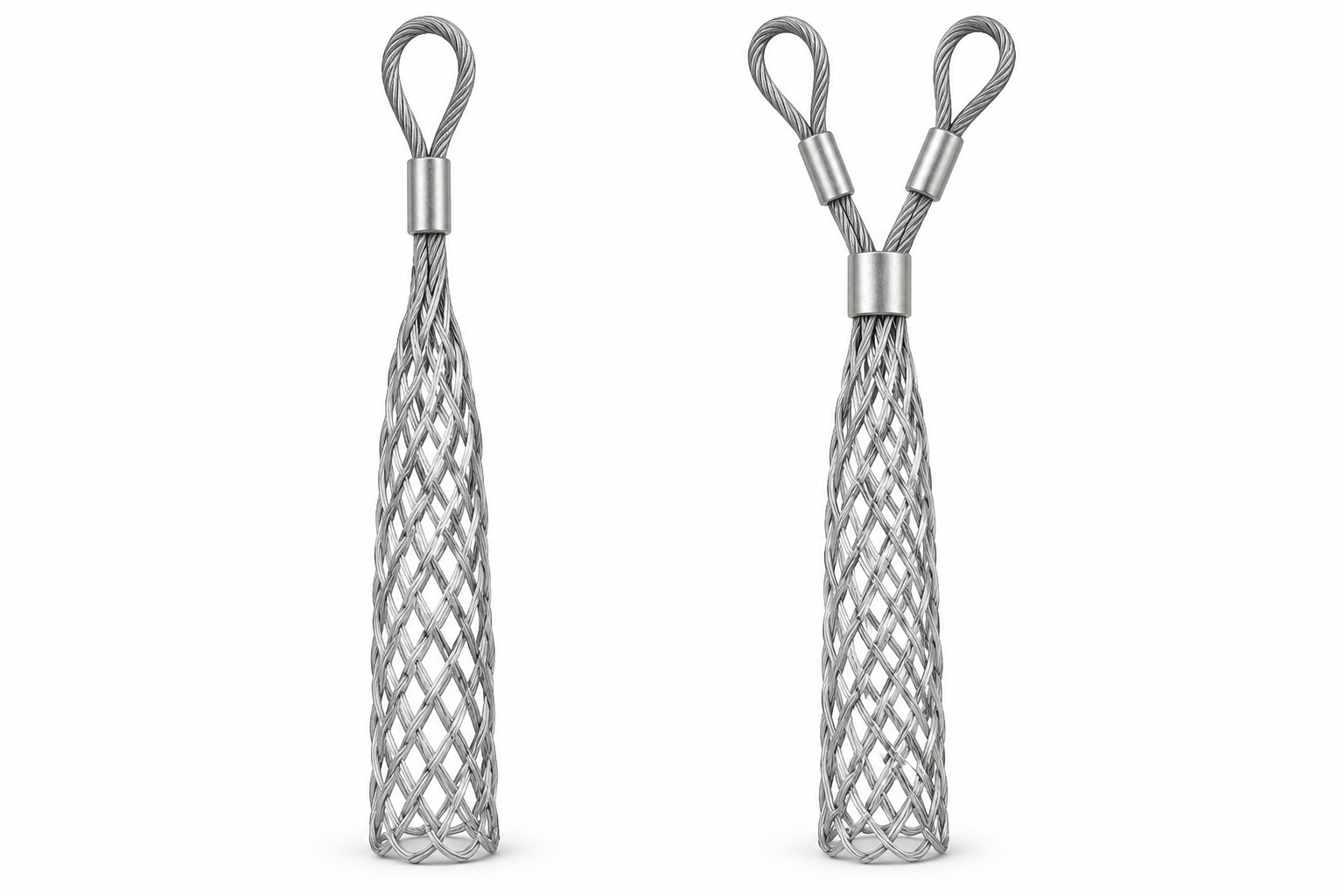
Single-eye and double-eye cable pulling socks are wire mesh grips used to establish a pulling connection with electrical cables, conductors and other cylindrical products during installation. Although both grip types use a flexible woven lattice to transfer pulling force, they differ in their attachment configuration, positioning options and suitability for different cable pulling arrangements.
A single-eye cable sock is commonly used for pulling from the end of a cable, with the pulling connection located at one end of the grip. A double-eye cable sock incorporates two pulling eyes and can allow the cable to pass through the grip, making it suitable for selected intermediate pulling and support arrangements.
Choosing the correct configuration is important when installing LV, 11kV, 33kV and higher-voltage power cables through underground ducts, cable trenches, substations and other electrical infrastructure. Cable outside diameter, pulling force, grip construction and the condition of the cable sheath must all be considered.
This guide explains the differences between single-eye and double-eye cable socks, when each configuration may be appropriate, and how engineers can assess cable pulling grip selection without exceeding the limitations of the cable or pulling equipment.
Thorne & Derrick supply a comprehensive range of cable pulling socks and grips, including single-eye cable socks, double-eye cable socks and specialist pulling equipment for LV, MV and HV cable installations.
Quick Answer: What Is The Difference Between Single-Eye & Double-Eye Cable Socks?
The main difference between single-eye and double-eye cable pulling socks is the configuration of their pulling attachments and how the grip can be positioned on the cable.
Single-eye cable socks have a pulling eye at the leading end of the mesh grip. They are widely used for end pulling, where the cable is drawn through a duct, trench or other route from its end.
Double-eye cable socks have two pulling eyes arranged around the cable path. This configuration can permit the cable to pass through the grip, allowing the grip to be used at selected positions along a cable where the pulling arrangement is suitable.
Neither eye configuration is automatically stronger. The appropriate grip must be selected according to its diameter range, mesh construction, rated or assessed pulling capability and compatibility with the cable and pulling equipment.
How Do Cable Pulling Grips Work?
Cable pulling grips, also called cable socks or cable stockings, generally consist of a flexible woven wire mesh that fits around the outside of a cable or conductor.
When suitable longitudinal pulling force is applied, the lattice tends to contract around the cable, creating a gripping action between the mesh and the cable surface.
The pulling force is transferred through the contact between the mesh and cable over the engaged grip length, rather than through a single clamp at the cable end.
How Does The Mesh Grip A Cable?
The braided construction is designed to tighten around the cable when loaded in the intended direction.
The effectiveness of this grip depends on several factors:
- Cable outside diameter – the cable must fall within the grip’s specified range.
- Cable sheath material – surface characteristics can influence grip behaviour.
- Lattice length – the length of mesh engaged around the cable.
- Weave construction – single, double or multi-weave arrangements have different characteristics.
- Pulling load – the anticipated maximum tension must remain within the permitted system limits.
- Attachment method – eyes, links, swivels and other connections must be compatible with the pull.
- Grip condition – worn or damaged mesh and attachments can compromise performance.
A cable sock is not simply selected by matching the cable diameter to the nominal grip size. Its suitability must be assessed for the complete installation.
What Is A Single-Eye Cable Pulling Sock?
A single-eye cable sock has one pulling attachment at the leading end of the mesh grip.
The grip is generally introduced over the cable end, after which its eye is connected to an appropriate pulling link, swivel or other approved attachment.
Single-eye grips are widely used where a cable is pulled from its leading end into a duct, trench, conduit or cable route.
Typical Single-Eye Cable Sock Applications
- Pulling LV power cables into suitable ducts or conduits.
- Installation of compatible 11kV and 33kV cables.
- End pulling during cable trench and substation installations.
- Pulling compatible overhead line conductors.
- Selected heavy-duty and specialist cable installation operations.
Single-eye grips are available with different wire materials, diameter ranges and lattice constructions.
For example, single-eye double-weave cable socks are available for suitable medium and heavy pulling applications.
When Is A Single-Eye Grip A Good Choice?
A single-eye cable sock may be appropriate when the cable end is accessible, a leading-end pulling connection is required and the grip can be fitted and retained using its approved method.
The cable’s permitted pulling tension, outer sheath suitability and grip performance must still be confirmed.
Single-eye does not mean a grip is automatically approved for high pulling loads. Strength depends on the exact grip construction and model.
What Is A Double-Eye Cable Pulling Sock?
A double-eye cable sock has two pulling eyes positioned so that the cable can pass through the grip body.
This arrangement provides additional positioning options compared with a conventional single-eye end grip.
It can be particularly useful where a cable needs to be pulled or supported from an intermediate position, subject to the design and permitted application of the selected grip.
What Are Double-Eye Cable Socks Used For?
Typical applications include:
- Intermediate pulling positions – where the cable needs to extend beyond the grip.
- Cable handling during staged installations – where the approved pulling arrangement includes intermediate grip locations.
- Selected cable support applications – using grips specifically designed and approved for support.
- LV and MV cable installation – where a double-eye arrangement offers suitable attachment geometry.
- Specialist power, fibre and offshore cable handling – using appropriately engineered products.
Why Does Through-Cable Positioning Matter?
With a suitable double-eye grip, the cable can pass through the mesh rather than terminating within the grip body.
This may allow the grip to be positioned at a selected location along the cable, provided the end can be passed through during installation and the arrangement is suitable for the intended loading.
However, a double-eye grip is not the same as a lace-up grip. A conventional closed-mesh double-eye grip generally still needs to be passed over an accessible cable end.
If the cable end is inaccessible or an existing termination or connector prevents the grip from being passed over it, a suitable lace-up configuration may be required instead.
Thorne & Derrick supply Slingco double-eye cable socks in different diameter ranges and material constructions.
Single-Eye vs Double-Eye Cable Pulling Socks: Technical Comparison
Although both designs use similar gripping principles, differences in eye configuration can affect how the grip is attached and positioned during installation.
The decision should be based on the pulling arrangement and approved grip specification rather than selecting double-eye simply because two attachment points appear stronger.
Which Cable Pulling Grip Should You Choose?
The most useful starting point is to establish where the pulling force needs to be applied to the cable.
Scenario 1: Pulling From An Accessible Cable End
A suitable single-eye grip is often a practical choice when the cable end is accessible and the pull is intended to be made from that leading end.
Typical examples include pulling a compatible LV or MV cable into a prepared duct route or drawing a cable along an open trench.
Scenario 2: Pulling From An Intermediate Cable Position
Where the cable must continue beyond the pulling location, a double-eye grip may offer a suitable through-cable arrangement.
The design must permit the selected attachment geometry, and the pulling load must be assessed for the cable and grip.
Scenario 3: The Cable End Is Not Accessible
If the cable cannot be passed through a closed mesh grip, a lace-up cable sock may be appropriate.
Lace-up grips are designed to wrap around the cable at a selected location before being closed using the specified lacing arrangement.
Scenario 4: A High-Tension Or Specialist Pull
High-tension cable installations may require specialist heavy-duty, double-weave or multi-weave grips rather than a standard light-duty configuration.
The number of eyes alone does not establish the maximum permitted pulling force.
For high-tension installations, the cable system designer or pulling specialist must confirm the load path, grip suitability, attachment strength and permissible cable tension.
These are selection considerations rather than universal product approvals. Each application must be checked against the exact grip and cable specifications.
Cable Outside Diameter, Grip Length & Weave Construction
Correct mesh selection is essential to the performance of a cable pulling grip.
Why Cable Outside Diameter Matters
The grip must fit the cable’s actual outside diameter (OD), including the outer sheath or protective layer over which the mesh will be fitted.
A grip that is too small may not fit properly. A grip that is too large may not engage the cable as intended.
Care must also be taken when pulling groups of cables or unusual cable constructions, because the effective shape and gripping characteristics can differ from those of a single round cable.
Single Weave vs Double Weave
Wire mesh grips are available in different lattice constructions, including single weave, double weave and multi-weave.
The weave affects the construction and mechanical properties of the grip. Double-weave or multi-weave products may be designed for more demanding applications, but permitted performance remains specific to the product.
Eye configuration and weave construction are separate choices. A single-eye grip can have double-weave mesh, just as a double-eye grip can be manufactured in different weave constructions.
Does A Longer Mesh Grip Provide More Holding Strength?
Grip length influences the area of mesh engaged with the cable, but it does not establish a universal relationship between length and permissible pulling load.
Holding performance also depends on cable sheath material, cable diameter, mesh construction, installation method and the manufacturer’s approved design.
The required grip length should therefore be selected using the relevant product specification rather than relying on a general assumption that a longer grip is always stronger.
Galvanised Steel, Stainless Steel & Aramid
Cable pulling grips may be manufactured from galvanised steel wire, stainless steel wire or specialist non-metallic fibres.
Material selection depends on the environment, required strength, corrosion exposure and application.
For example, stainless steel and specialist aramid products may be selected for particular offshore, marine or non-metallic applications where their specified characteristics are required.
Non-metallic construction must not be interpreted as permission to work on energised electrical cables.
Cable Pulling Grip Breaking Load vs Permitted Pulling Load
One of the most important technical distinctions when specifying a cable pulling sock is the difference between its breaking load and the force that can safely be applied during an actual installation.
What Is The Approximate Breaking Load?
A manufacturer’s approximate breaking load describes the load associated with failure of a grip under the relevant testing or assessment conditions.
It is not necessarily the permitted working load and must not be used directly as the maximum pulling force.
What Determines The Permitted Pulling Load?
The acceptable pulling load is affected by the complete installation, including:
- The cable manufacturer’s permitted pulling tension.
- The cable sheath and construction.
- The selected grip and its installation method.
- The grip’s strength and applicable safety factors.
- The eye and attachment arrangement.
- Pulling links, swivels, ropes and winch equipment.
- Route geometry, duct friction and bending forces.
- Environmental conditions and personnel exposure.
The weakest applicable limit within the complete pulling system must be respected.
Example: Why Breaking Load Alone Is Not Enough
Consider a hypothetical cable pulling grip with a stated approximate breaking load of 5,000kg equivalent force.
That figure alone does not establish the pulling force permitted for a particular cable installation.
The cable’s permitted sheath-pulling load may be lower, and the application may require a prescribed safety factor or a different attachment arrangement. In some cases, the grip may be unsuitable regardless of its published breaking load.
The permitted load must be determined from the complete cable pulling design and relevant manufacturer requirements.
Single-Eye & Double-Eye Socks For LV, MV & HV Cable Pulling
Single-eye and double-eye cable pulling grips are used across a wide range of electrical infrastructure projects.
Low Voltage Cable Installation
LV cable pulling applications may involve armoured power cables, unarmoured cables and other suitable constructions installed through ducts, trenches or cable containment.
Single-eye grips are commonly used for conventional end pulling, while double-eye grips can be considered where the pulling arrangement requires through-cable positioning.
11kV & 33kV Cable Installation
Medium voltage cable installation requires careful consideration of the cable’s mechanical and electrical construction.
The suitability of a mesh grip depends on the permitted pulling force and whether force may be applied to the outer sheath.
For certain MV and HV cable installations, a manufacturer-approved pulling eye attached to the conductor or another engineered pulling arrangement may be required instead of a mesh grip.
Engineers must therefore confirm the approved pulling method before selecting a sock.
High Voltage & EHV Cable Projects
Large 66kV, 132kV and higher-voltage cable installations may involve substantial cable weights, long pulling distances and demanding route conditions.
Such projects often require specialist installation engineering, tension monitoring and purpose-designed pulling attachments.
Heavy-duty cable grips are available for certain applications, including subsea and offshore cable handling, but must be selected and approved for the particular cable system.
Overhead Line Conductors
Specialist grips can also be used for pulling and stringing overhead line conductors, including suitable aluminium and reinforced conductor constructions.
The grip must be compatible with the conductor material, diameter, surface and specified pulling arrangement.
Explore the full range of LV, MV, HV and overhead conductor pulling grips.
When Are Lace-Up, Open-Ended & Other Cable Grips Used?
Single-eye and double-eye grips are only two configurations within the wider range of specialist cable pulling socks.
Lace-Up Cable Socks
Lace-up grips can be fitted around a cable without passing a closed mesh assembly over the cable end.
They may be suitable where a connector, termination or restricted access prevents conventional grip installation.
The mesh must be closed using the correct lacing arrangement specified for the product.
Open-Ended Cable Grips
Open-ended cable grips are designed for selected pulling or connection arrangements involving cables, ropes or other suitable products.
They may be used in applications such as replacing an existing cable with a new cable, subject to the correct grip and installation design.
Heavy-Duty Multi-Weave Grips
Specialist heavy-duty grips may use more complex weave constructions or purpose-designed termination arrangements.
These are used in selected high-load and specialist applications, including certain offshore and subsea cable installations.
Cable Pulling Grip Installation Considerations
Correct installation is essential to obtaining the intended performance from a cable pulling grip.
Even a grip with suitable dimensions and strength can be unsuitable if it is fitted incorrectly or connected to incompatible equipment.
Check The Cable Before Fitting A Grip
Confirm the cable outside diameter and inspect the intended gripping surface for damage, contamination and other conditions that may affect the grip’s engagement.
Assess whether the outer sheath is suitable for the intended pulling load.
Follow The Approved Grip Fitting Procedure
The selected grip must be fitted using the applicable manufacturer instructions, including specified retention arrangements.
For example, Slingco requires its cable pulling grips to be secured using the prescribed double steel banding arrangement before pulling.
Any banding, preparation or retention requirements should be confirmed for the specific product rather than assumed to be identical for every manufacturer’s grip.
Check Pulling Links & Swivels
Links and swivels used with a cable pulling grip must be suitable for the load, dimensions and intended application.
A correctly selected swivel can help limit transmission of unwanted twisting into a cable pulling arrangement where its use is approved.
The connection geometry must not impose unintended loading on the eye or other grip components.
Monitor Pulling Tension
Where necessary, the pulling arrangement should incorporate suitable tension monitoring so that force remains within the permitted cable and equipment limits.
Pulling force should be assessed alongside cable bend radius, friction and the route’s sidewall pressure where relevant.
For a wider overview of installation planning, read our Cable Pulling Explained technical guide.
Cable Pulling Grip Inspection, Safety & Common Mistakes
Cable pulling grips are load-bearing installation accessories and must be inspected and assessed before use.
Damage to the mesh, eye, ferrule or other components can affect performance and create serious risks if a grip fails under tension.
What Should Be Checked Before Use?
- Mesh condition – inspect for broken, distorted or excessively worn wires.
- Eye condition – check for deformation, damaged strands or other defects.
- Ferrules and connections – assess the integrity of fitted components.
- Corrosion – inspect for deterioration affecting the grip’s suitability.
- Identification and specification – confirm the grip can be identified and is suitable for the proposed application.
- Cable compatibility – verify diameter, sheath condition and pulling arrangement.
Common Cable Pulling Grip Selection Mistakes
- Selecting a grip using cable diameter alone.
- Assuming double-eye grips are always stronger than single-eye grips.
- Treating approximate breaking load as a permitted working load.
- Using a grip on a cable sheath not approved for the intended pulling force.
- Omitting or incorrectly applying prescribed retention banding.
- Connecting unsuitable links, swivels or pulling equipment.
- Using a damaged or unidentified grip.
- Assuming a conventional double-eye grip can be installed mid-span without access to a cable end.
- Using a pulling grip as a primary lifting device without specific approval.
For further inspection guidance, see our existing article on Cable Socks – Proper Usage, Maintenance & Inspection.
Cable Pulling Grip Selection Checklist
Before specifying a single-eye or double-eye cable sock, the following details should be confirmed.
Cable Pulling Socks & Equipment From Thorne & Derrick
Thorne & Derrick supply a comprehensive range of cable socks, pulling grips and LV, MV and HV cable installation equipment for electrical utilities, contractors, infrastructure developers and specialist cable installation companies.
Products are available for a range of underground cable installations, overhead line conductor applications and specialist industrial or offshore projects.
- Cable Pulling Socks & Grips – overview of available grip configurations, materials and cable pulling applications.
- Single-Eye Cable Socks – cable grips for suitable leading-end pulling applications.
- Double-Eye Cable Socks – cable pulling grips for suitable through-cable and intermediate arrangements.
- Single-Eye Double-Weave Cable Socks – mesh grips for selected medium and heavy-duty applications.
- Lace-Up Cable Socks – grips suitable for selected installations where a closed grip cannot be fitted over the cable end.
- Cable Rollers – straight, corner and lead-in rollers for controlled cable movement.
- Cable Pulling & Laying Equipment – wider cable installation equipment for LV, MV, HV and EHV projects.
For specialist cable pulls, our technical sales team can assist with identifying suitable products based on the cable outside diameter, required pulling arrangement, anticipated tension and installation conditions.
Single-Eye vs Double-Eye Cable Socks FAQs
Q: What is the difference between a single-eye and double-eye cable sock?
A: A single-eye cable sock has one pulling eye and is commonly used for pulling from a cable end. A double-eye sock has two pulling eyes and can allow the cable to pass through the grip, making selected intermediate pulling and support arrangements possible.
Q: Are double-eye cable socks stronger than single-eye grips?
A: Not necessarily. Strength depends on grip construction, mesh material, weave, dimensions and the exact product specification. Two pulling eyes do not automatically provide a greater permitted pulling load.
Q: Can double-eye cable socks be fitted in the middle of a cable?
A: Some double-eye grips can be positioned along a cable because the cable passes through the grip. However, a conventional closed mesh generally needs to be introduced over an accessible cable end. Where this is not possible, a suitable lace-up grip may be required.
Q: What size cable pulling sock do I need?
A: Match the cable’s actual outside diameter to the grip’s specified diameter range. Also check the cable construction, sheath condition, intended pulling force, grip design and approved installation requirements.
Q: What is the difference between single weave and double weave cable socks?
A: Single and double weave describe the construction of the wire mesh, rather than the number of pulling eyes. Different weave designs provide different mechanical characteristics, and the suitability of each depends on the specific product and installation.
Q: Can cable socks be used to pull 11kV and 33kV cables?
A: Suitable cable socks may be used for certain 11kV and 33kV installations where approved for the cable construction and pulling method. The cable manufacturer’s permitted pulling tension and restrictions on sheath pulling must be checked. Some cable systems require specialist pulling eyes or alternative arrangements.
Q: Is the breaking load of a cable sock its safe working load?
A: No. Approximate breaking load is not automatically the permitted working load. The acceptable pulling force must be established using the grip specification, required safety factors, cable limitations, attachment components and the complete pulling arrangement.
Q: Can a cable pulling grip be used to lift a cable?
A: A conventional cable pulling grip must not be assumed suitable as a primary lifting device. Lifting or sustained cable support requires equipment and arrangements specifically designed and approved for the application.
Q: When should I choose a lace-up cable sock instead?
A: A lace-up cable sock may be suitable where a cable end is inaccessible or where an existing connector or termination prevents a closed mesh grip from being introduced. The selected lace-up grip must still meet the application’s compatibility and load requirements.
Conclusion
Single-eye and double-eye cable pulling socks use similar wire mesh gripping principles but offer different attachment and positioning options.
Single-eye grips are commonly used for conventional leading-end cable pulling, while double-eye grips provide additional flexibility for appropriate through-cable and intermediate pulling arrangements.
However, the correct choice depends on more than the number of eyes. Cable outside diameter, grip construction, pulling force, cable sheath compatibility, attachment components and installation conditions must all be assessed.
For demanding LV, MV and HV cable installations, the selected grip and complete pulling arrangement must remain within the applicable cable and equipment limits.
Thorne & Derrick supply Slingco single-eye, double-eye, lace-up and specialist cable pulling socks, alongside cable rollers, winches and associated cable installation equipment for utility, infrastructure and industrial applications.
Contact our technical sales team with the cable outside diameter, cable construction, pulling arrangement and expected installation loads to help identify a suitable product.