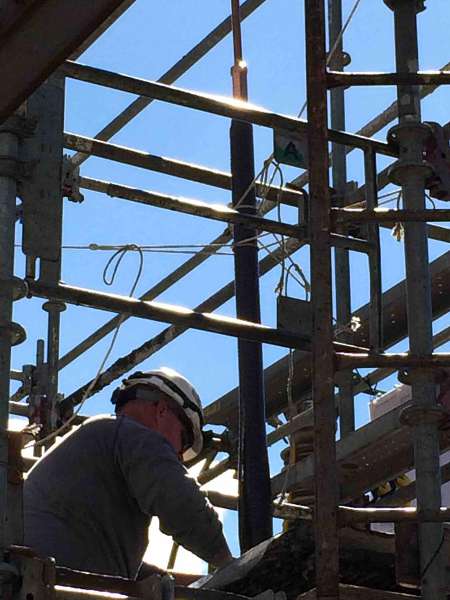
Image Courtesy of:Terry Perona (Retired) Manager Underground Cable at FirstEnergy
Contractor W.A. Chester prepares 138KV HPFF cable to receive new G&W termination.
Jointers blog
Subscribe now to our POWER NEWSLETTER– a monthly email circulation packed with news, projects, videos, technical tips, training information, promotions, webinars, career opportunities and white papers.
Includes access to our popular JOINTERS BLOGwith contributions from utility professionals, linesmen and cable jointers working on MV HV EHV cables and overhead lines typically at 11kV, 33kV, 66kV and up to 132kV.
15,000+ Subscribers. ➡
Subsea Solutions By Nexans
In today’s world power demand is on the rise together with the need for increasing reliability of power networks. HV submarine power cables are crucial to avoid blackouts by increasing the redundancy of the power grids and diversifying the energy mix.
In this mini-Blog series Nexans explain how their subsea solutions are helping to meet global demand.
Subsea Power Cables For North Sea Link
Nexans Two Cable Subsystems Generating Power For North Sea Link
How To Install A Subsea Cable – Power Networks
Nexans products include MV-HV Connectors, Joints & Terminations to connect, splice, repair and maintain medium/high voltage cable and power distribution systems – commonly referred to as cable plugs, Tee’s or elbows the Euromold range of connectors suit all European DIN EN 50180 and American (ANSI) specification bushings.
THORNE & DERRICK
Thorne & Derrick are national distributors of LV, MV & HV Cable Installation, Jointing, Substation & Electrical Equipment – servicing businesses involved in cabling, jointing, substation, earthing, overhead line and electrical construction at LV, 11kV, 33kV, 66kV and EHV. Supplying a complete range of power cable accessories to support the installation and maintenance of low/medium and high voltage cable systems:
This is the second Blog in a series by Nexans explaining how their subsea solutions are helping to meet global demand.
The North Sea Link is being created in collaboration between Statnett, the state-owned operator in the Norwegian energy system and the UK’s National Grid. It is designed to help increase opportunities for shared use of renewable energy.
A project such as the North Sea Link requires a lot of planning. In the below video you can see the cables arrive at the village of Sand, and the transported through the idyllic and very narrow streets on their way to the mountains.
The transport had to be planned well in advance and this is why…..the smallest clearing was only 2cm! At one point the Nexans team had to remove parts of a roof so they could pass through! The North Sea Link will run from Blyth in Northumberland on the northeast coast of the UK to Kvilldal in Rogaland on the Norwegian side. HVDC converter stations on each side will connect the link to the onshore grid.
THORNE & DERRICK
Thorne & Derrick are national distributors of LV, MV & HV Cable Installation, Jointing, Substation & Electrical Equipment – servicing businesses involved in cabling, jointing, substation, earthing, overhead line and electrical construction at LV, 11kV, 33kV, 66kV and EHV. Supplying a complete range of power cable accessories to support the installation and maintenance of low/medium and high voltage cable systems:
Neptco provided all of the Trace-Safe tracer wirefor The Roundtable Live, and now because of that all new utilities that are installed will be located in the future. Quality tracer wire is something that often gets overlooked, and its important for contractors to make sure it stays intact when pulling back a utility. Thanks again Neptco, for truly contributing to a day in which damage prevention was demonstrated.
The video transcript can be found below:
Jonathon Jones Western Utility
“We are here at the Roundtable as a presenting sponsor for the second year in a row. This year we have finished up where we left off last year with a bore shot across the road behind me into a hand hole for some facilities that already existed in a place so we drilled out avoiding any existing utilities – pulling back a piece of two inch HDPE polypipe attached to the tracer wire prescribed by the manufacturer using their methods. We brought it back and it stays outside of the existing pipe follows the same path as the pipe itself. The gentlemen are going to do some proofing on it right now but everything is set up. The product pulls back very easily.”
Doug Moore Subsite Electronics
“One of the major reasons that it is important to have an inspection of tracer wire after the installation is too many times during or after the pull back of the product in the tracer wire there will be a fault or the wire will pull apart. So that’s an area the contractor leaves and then it can be impossible to track them down. It is subsequently impossible to locate that utility after so a doing a bore and post bore inspection of the quality of the tracer wire is critical.”
Joe Sylvia Neptco
“Joe Sylvia Business Unit Manager for Neptco, manufacturers of Trace Safe. The gentlemen in the video are pulling in trace safe with a 2 inch HDPE pipe pulling it around 150ft. Generally speaking when you are dealing with a plastic pipe you are going to require some kind of tracer with it so you can find it as once it is buried you have to be able to find it n the future and essentially that is what this product is for.
The way the connectors are designed you can have one end to end which allows you to daisy chain all along the way until you get to a far end of the ground that’s absolutely fine or you could connect them laterally and have a ground some place else. They are a universal connector so they can do end to end or lateral. One that was installed last year in direct sunlight the whole time, then this year we put a UV inhibitor in it and the plastic is still very strong after a year in direct sunlight. The USP about this particular product is its strength – 1800 pounds of pulling strength the strongest wire on the market (possibly the world).
So with that you only have to have one wire. The other good thing about the wire is that if there is any damage to the jacket the yarn itself that gives it the tenacity is woven with a super absorbent powder and if there’s any damage to the jacket it swells up almost like a baby diaper and keeps the water away from the conductor and that is what gives it a long life. How check to the wire is related to what the contractor is required to do. However in general you need a ground at least at the far end and you can do that with a temporary solution such as a long screwdriver that is pound that into the earth and a jumper can be created with a 12 gauge wire and connect that into a trace safe connector alongside the trace safe wire. Once closed you could energise the stud and walk the line to the far end.
So if we want to connect to a gas service essentially we have a 12 gauge wire and an adapter sleeve that goes on to it. It is split so it could easily wrap around the main line added to the connector alongside a piece of trace safe. This is then closed down with a pair of channel locks. Now we have a connection.
One of the tools the company has as an accessory item is a temporary locate tool. Basically if there is no connector in place a locator with this tool can be put the trace safe in and squeeze it down and what happens is a contact is made with the connector underneath. It simply attaches to the top and energises the wire. They can remove it, a little mark maybe left but the super absorbent powder will absorb any water that can get inside and will not harm the conductor. The tool will save you so much time as it just clicks in, closes and locates no stripping is required. It is simple to put it back to its normal condition as all you have to do is take it off and move onto the next job.”
Thorne & Derrick International are specialist distributors of LV, MV & HV Cable Installation, Jointing, Duct Sealing, Substation & Electrical Equipment – servicing UK and global businesses involved in cable installations, cable jointing, substation, overhead line and electrical construction at LV, 11kV, 33kV and EHV.
This is the third Blog in a series by Nexans explaining how their subsea solutions are helping to meet global demand.
In this video Blog Nexans explain how to install a subsea cable across a mountain lake by building a new cable-laying vessel. The pontoon barge weighs over 300 tons and it carried and installed the cables across the small lake Suldalsvatnet.
Subsea power cables play a key role in the penetration of renewable energies into the transmission grids. They are also important links for islands which can be connected to the main grids to secure their energy supply, in addition to reducing their CO2 emissions by limiting the power generation from thermal power plants.
THORNE & DERRICK
Thorne & Derrick are national distributors of LV, MV & HV Cable Installation, Jointing, Substation & Electrical Equipment – servicing businesses involved in cabling, jointing, substation, earthing, overhead line and electrical construction at LV, 11kV, 33kV, 66kV and EHV. Supplying a complete range of power cable accessories to support the installation and maintenance of low/medium and high voltage cable systems:
Compound Box Filling Compound end boxes rarely get attention — until one fails. Across ageing networks, replacement of compound-filled end boxes is becoming more frequent, particularly where original insulation systems have deteriorated and air insulation is not practical because...
Nexans 240–300mm² Multi-Joint – Medium Voltage Cable Joint Installation Medium voltage cable jointing requires reliability, consistency and safe installation practices. The Nexans 240–300mm² Multi-Joint is designed to simplify medium voltage jointing while maintaining high electrical performance for demanding power...