Hydraulic vs Ratchet Cable Cutters: What’s the Difference?
Published 15 Oct 2026
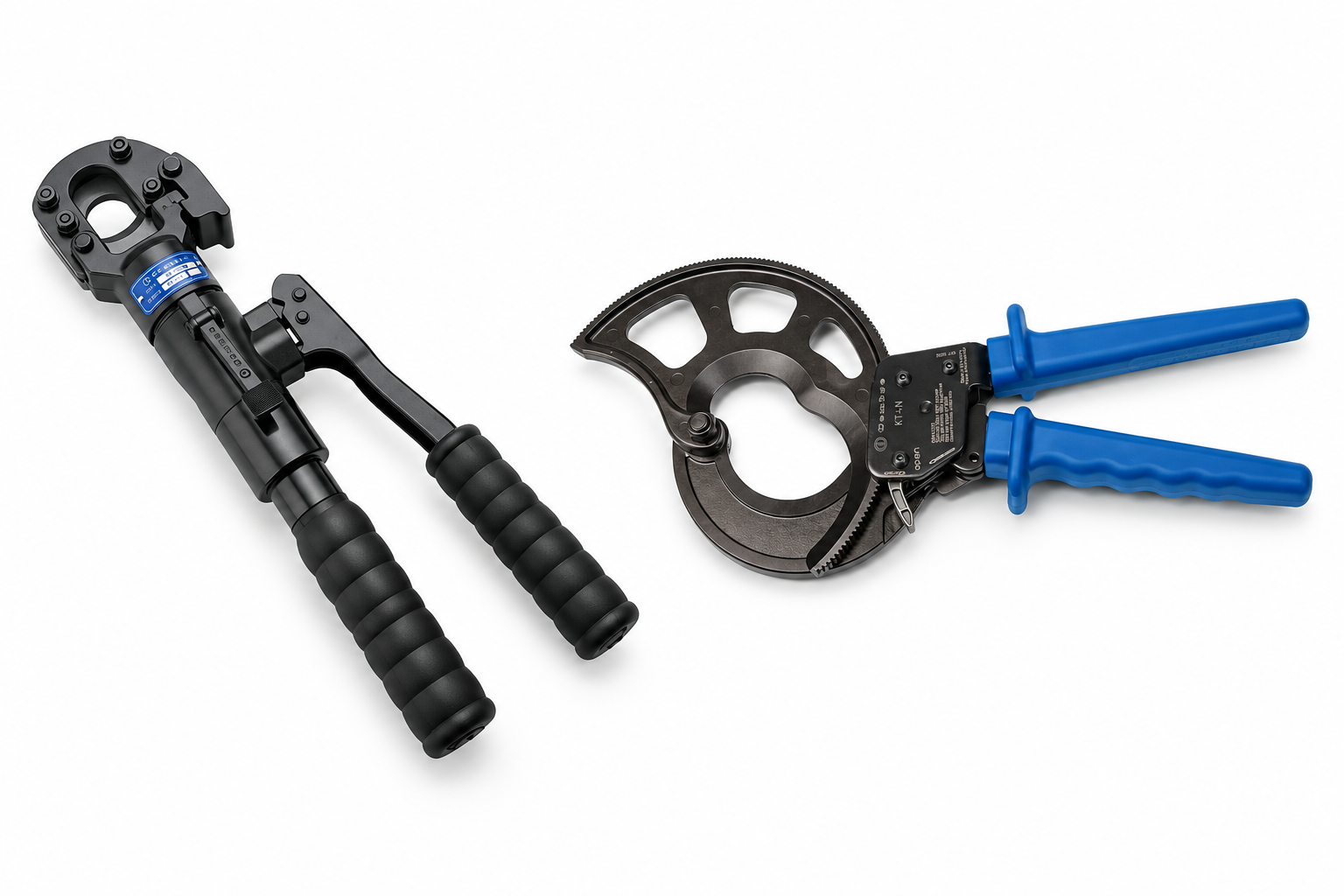
Hydraulic and ratchet cable cutters are specialist tools used to cut electrical power cables, conductors and associated cable materials during installation, jointing, maintenance and repair. Although both are designed to produce controlled cuts, they differ in the way cutting force is generated, the level of manual effort required and the cable constructions they can accommodate.
A ratchet cable cutter uses a mechanical ratcheting mechanism to advance its cutting blades through a cable in stages. A hydraulic cable cutter uses hydraulic pressure to drive a cutting blade or cutting head through the material, allowing substantial cutting force to be applied with reduced direct mechanical effort.
Choosing between these cable cutting tools depends on more than cable diameter. Copper and aluminium conductors, steel wire armoured cables, flexible conductors, lead-sheathed cables and overhead line conductors may require different blade profiles and cutting mechanisms.
For electrical contractors, cable jointers, maintenance engineers and utility installation teams, selecting the correct cutter helps improve cutting consistency, protect equipment and support efficient cable preparation before jointing or termination.
Thorne & Derrick supply cable cutting and crimping tools, including hydraulic cable cutters and ratchet cable cutting tools from specialist manufacturers such as Cembre and Klauke.
Quick Answer: What Is The Difference Between Hydraulic & Ratchet Cable Cutters?
The main difference between hydraulic and ratchet cable cutters is how the tools generate the force needed to cut a cable.
Ratchet cable cutters use a manually operated mechanical mechanism. Each movement of the handles advances the cutting blade through the cable, allowing the operator to complete the cut through successive actions.
Hydraulic cable cutters use pressurised hydraulic fluid to drive the cutting mechanism. Hydraulic force can be generated by an integrated hand pump, a separate pump or an electrically powered system.
Ratchet cutters are often suitable for routine cutting of compatible copper and aluminium cables, while hydraulic cutters are commonly selected for larger, heavier or more demanding cutting applications. However, neither cutting mechanism alone determines material compatibility.
How Does A Ratchet Cable Cutter Work?
A ratchet cable cutter uses a mechanical ratcheting action to move a cutting blade progressively through a cable.
As the handles are operated, the ratchet mechanism allows the cutting blade to advance in stages without requiring the operator to complete the entire cut in one movement.
The mechanism provides mechanical advantage, helping an engineer cut suitably rated cables using a compact hand-operated tool.
What Are Ratchet Cable Cutters Used For?
Depending on the model, ratchet cable cutters can be used for:
- Copper cable conductors – cutting compatible solid or stranded conductor constructions.
- Aluminium conductors – cutting suitable aluminium cable cores.
- Earthing conductors – preparing compatible copper and aluminium earthing cables.
- Cable jointing preparation – cutting conductors before subsequent preparation operations.
- Electrical maintenance – routine cutting work where the cable type and size fall within the tool’s rating.
Ratchet cutters are often compact and portable, making them useful where equipment weight, access and ease of handling are important.
Example: Cembre KT4N Ratchet Cable Cutter
The Cembre KT4N is a mechanical ratchet cutter designed for compatible copper and aluminium cables with a maximum cutting diameter of 62mm.
Its ratchet mechanism allows progressive cutting using manual operation. The tool is designed for specified copper and aluminium cable constructions and is not suitable for armoured cables, steel, ACSR or Class 5 and Class 6 flexible conductors.
This demonstrates why a cutter’s maximum diameter must be considered together with its approved cable construction.
How Does A Hydraulic Cable Cutter Work?
A hydraulic cable cutter uses hydraulic pressure to move a cutting ram or blade through the cable.
In a hand-operated hydraulic cutter, movement of the pump handle pressurises hydraulic fluid. This pressure drives the cutting mechanism and progressively closes the blades.
Some hydraulic cutters feature two-stage operation, allowing faster initial blade advancement followed by a slower, higher-force cutting stage.
Other hydraulic systems use external pumps or battery-powered motors to generate the pressure needed for cutting.
What Are Hydraulic Cable Cutters Used For?
Depending on the cutter model and approved cutting range, hydraulic cable cutting tools may be used for:
- Large copper conductors – cutting cables within the approved diameter and construction limits.
- Large aluminium conductors – cable installation and conductor preparation.
- Armoured power cables – where the cutter is specifically approved for the armour material.
- MV and HV cable installations – cutting suitably specified cable constructions before jointing and termination.
- Overhead line conductors – using cutter models approved for the relevant conductor and reinforcing materials.
- Industrial and utility maintenance – repeated cutting operations or applications requiring higher cutting forces.
Hydraulic cutting tools can be advantageous where a high cutting force is needed or where repeated manual cutting would impose significant effort on the operator.
Example: Cembre HT-TC026 Hydraulic Cutter
The Cembre HT-TC026 is a hand-operated hydraulic cutting tool with a maximum cutting diameter of 25mm for its specified materials.
Its hydraulic system provides controlled blade advancement, while an opening cutting head facilitates positioning around suitable cables.
The important point is that hydraulic technology does not automatically mean a greater diameter capacity than every ratchet cutter. The HT-TC026 has a smaller stated diameter capacity than the Cembre KT4N, despite using hydraulic force.
For larger applications, specialist hydraulic cable cutting heads are available with higher cutting capacities.
Hydraulic vs Ratchet Cable Cutters: Key Differences
The correct cutting tool should be selected according to cable compatibility, available working space, frequency of use, operator requirements and the cut quality needed for the next stage of installation.
Neither tool type is universally better. A correctly selected ratchet cutter can be more practical for one application, while a hydraulic tool may be preferable for another.
Which Cables Can Hydraulic & Ratchet Cutters Cut?
Cable construction is one of the most important factors when selecting a cable cutting tool.
Tools rated for copper and aluminium conductors are not necessarily suitable for steel wire armour, steel-reinforced conductors, flexible conductor classes or composite cable constructions.
Copper Conductors
Many ratchet and hydraulic cutters are designed for copper conductors. The permissible cable diameter and conductor class depend on the tool.
Blades must be appropriate for the conductor construction to avoid excessive deformation or damage to the tool.
Aluminium Conductors
Aluminium cables can also be cut using compatible ratchet or hydraulic cutting tools.
Where a cable includes steel reinforcement or other additional materials, a cutter approved only for aluminium must not automatically be considered suitable.
Flexible Conductors
Fine-stranded flexible cables require particular attention to blade design and tool compatibility.
Some cutters that are approved for conventional copper and aluminium conductors specifically exclude highly flexible Class 5 and Class 6 constructions.
Tools must therefore be selected using the actual conductor class, not merely the conductor material.
Steel Wire Armoured Cables
Steel wire armoured (SWA) cables contain metallic armour that may exceed the material limitations of cutters intended for ordinary copper or aluminium conductors.
Where the complete cable must be cut through its armour, use a cutting tool specifically approved for that construction.
Selected hydraulic cutter designs are available for armoured cables, but this capability must never be assumed for all hydraulic models.
This table provides general selection guidance. The definitive approval comes from the individual cutter’s specified cutting range and material limitations.
Can Ratchet Cable Cutters Cut Armoured Cables?
Not all ratchet cable cutters can cut armoured cables. In particular, standard ratchet tools intended for copper and aluminium conductors may be unsuitable for steel wire armour.
For example, the Cembre KT4N ratchet cutter is not designed to cut steel or armoured cables.
Attempting to cut an unsuitable material can damage the cutting blades, place excessive load on the mechanism and create risks for the operator.
Where an armoured cable must be cut through its complete cross-section, an appropriately specified armoured cable cutter is required.
Are Hydraulic Cutters Better For Armoured Cable?
Certain specialist hydraulic cutting tools can accommodate steel armoured cable constructions and other demanding cable materials.
However, a hydraulic mechanism alone does not guarantee this capability. Some hydraulic cutters are designed exclusively for copper or aluminium conductors.
Engineers should confirm:
- The armour material and construction.
- The overall cable diameter.
- Whether the tool is approved to cut the complete cable assembly.
- The required blade type and cutting head.
- Any model-specific restrictions on steel or reinforced materials.
Thorne & Derrick supply a range of hydraulic cable cutting equipment for compatible armoured and unarmoured power cable applications.
Cable Cutting Diameter vs Conductor Cross-Section
Two measurements commonly encountered when selecting cable cutting equipment are cutting diameter (mm) and conductor cross-sectional area (mm²).
They describe different characteristics and should not be confused.
What Does Maximum Cutting Diameter Mean?
The maximum cutting diameter describes the largest permitted diameter for the materials and cable constructions specified for the cutter.
For example, a tool with a stated 62mm maximum cutting diameter does not automatically cut every cable with a 62mm overall diameter.
Material restrictions and cable construction remain important.
What Does Conductor Cross-Section Mean?
Conductor cross-sectional area, normally expressed in mm², describes the nominal conductive area of the cable conductor.
A cable containing a 240mm² conductor may have a substantially larger overall diameter once insulation, screens, armour and protective sheaths are included.
Two cables with the same conductor cross-section may also have different overall diameters because of their construction.
Why Both Measurements Matter
When choosing a cutter, the engineer must identify exactly which part of the cable will be cut.
Cutting a stripped conductor during joint preparation may require a different tool from cutting the complete cable, including insulation and armour.
A cutter should never be approved for an application simply by converting conductor area into an estimated cable diameter.
Cutting Force, Speed & Operator Effort
One of the practical differences between manual ratchet and hydraulic cutting tools is the way the operator applies force.
Ratchet Cutter Operation
Ratchet cutters use successive manual handle movements to advance the cutting blades.
The ratchet mechanism provides mechanical advantage, allowing substantial cutting force to be generated using a relatively compact tool.
Operator effort depends on the cable material, tool geometry, blade condition and the number of handle movements required.
Hand-Operated Hydraulic Cutter Operation
Hand-operated hydraulic cutters use repeated pump-handle movement to pressurise the hydraulic circuit.
The cutting force is generated by the hydraulic system rather than directly through a mechanical ratchet linkage.
This can make demanding cutting operations easier to control, although the operator still needs to provide manual pumping effort.
Which Cutter Is Faster?
There is no universal answer because cutting speed depends on cable diameter, material, cutter model and operating method.
A ratchet cutter may be quicker and more convenient for a straightforward cut through a small compatible conductor.
For large cables or frequent cutting work, a suitable hydraulic or battery-powered cutter may improve productivity and reduce repetitive manual effort.
Efficiency should be assessed against the actual application rather than based only on the tool’s operating mechanism.
Manual Hydraulic vs Battery-Powered Cable Cutters
Hydraulic cable cutting tools are available with different power arrangements.
These include integrated hand-operated hydraulic systems, hydraulic cutting heads connected to external pumps, and battery-powered hydraulic tools.
Hand-Operated Hydraulic Cutters
Manual hydraulic cutters incorporate a hand-operated pump that supplies pressure to the cutting mechanism.
They can be suitable for site work where portable hydraulic cutting power is required without relying on an external electrical supply.
External-Pump Hydraulic Cutting Heads
Some larger cutting heads are connected to separate hydraulic pumps.
These systems can be useful where the cutting head must be positioned independently from the pump or where a specialist high-capacity cutting arrangement is required.
For example, the Cembre TC120 hydraulic cutting head is designed for approved copper and aluminium cables with a maximum overall diameter of 120mm.
Battery-Powered Hydraulic Cutters
Battery-powered hydraulic cutters use an electric motor and hydraulic system to generate cutting force.
These tools can reduce the repeated pumping effort associated with manually operated hydraulic cutters and may be particularly useful for frequent cutting operations.
Battery capacity, tool weight, cutting cycle time and approved materials should all be considered when selecting a powered cutter.
Explore the wider cable cutting and crimping tools range for different operating methods and product options.
Where Are Hydraulic & Ratchet Cable Cutters Used?
Both cutting mechanisms are used across electrical installation, cable jointing, maintenance and power infrastructure projects.
The suitability of each tool depends on the cable construction and the work being carried out.
For specialised cable jointing work, cutters may form part of a wider toolkit alongside sheath removal equipment, insulation stripping tools, semi-conductive screen removal tools and electrical test equipment.
How To Choose The Correct Hydraulic Or Ratchet Cable Cutter
Choosing a cutter requires accurate information about the cable and the intended cutting operation.
A tool should not be specified using conductor size, voltage or cutting diameter alone.
Where the cable construction or cutting application is unusual, selecting the tool using full cable details is preferable to relying on a generic cutter description.
Which Cutter Is Better For Occasional Use?
For occasional cutting of compatible copper or aluminium conductors, a compact manual ratchet cutter may offer a practical solution.
However, the cable must fall within the tool’s specified cutting range and material compatibility.
Which Cutter Is Better For Repeated Cutting?
Where engineers regularly cut large conductors or perform repetitive cutting operations, a hydraulic or battery-powered cutting tool may reduce physical effort and improve working efficiency.
The correct choice still depends on weight, access, cable material, cutting frequency and maintenance requirements.
Cable Cutting Safety: What Engineers Must Consider
Cable cutting is a potentially hazardous activity, particularly where electrical cables may be energised, incorrectly identified or part of an active power network.
Neither a ratchet mechanism nor an ordinary hydraulic cutting system makes a tool inherently safe for use on live cables.
Do Not Confuse Cutting Power With Electrical Protection
A standard hydraulic cutter is designed to generate mechanical cutting force. It should not be assumed to provide electrical protection for the operator.
Specialist cable safety cutting equipment exists for controlled applications, but its use is subject to specific equipment approval, competent personnel and authorised working procedures.
Ordinary cable cutting tools must not be used as a substitute for cable identification, safe isolation, proving dead or the required cable safety procedures.
Essential Cable Cutting Precautions
- Confirm cable identity and status – follow authorised procedures before any cutting operation.
- Use the correct cutting tool – confirm approval for the cable material, diameter and construction.
- Inspect the equipment – check blades, pivots, handles and hydraulic components for damage.
- Keep hands clear of blades – do not place fingers or other body parts within the cutting head.
- Secure the cutting head – ensure any locking mechanism is correctly engaged before cutting.
- Wear appropriate PPE – use the protection required by the approved work procedure and risk assessment.
- Respect material limitations – do not attempt to cut materials excluded by the tool specification.
- Follow the approved work method – cutting on electrical infrastructure must be undertaken by competent, authorised personnel.
Cable Cutter Maintenance & Common Cutting Problems
Maintaining the condition of cable cutting equipment helps support reliable operation and extends tool service life.
Maintenance requirements differ between mechanical ratchet cutters and hydraulic cutting systems.
Ratchet Cable Cutter Maintenance
Mechanical cutters should be inspected for blade damage, wear, contamination and correct operation of the ratcheting mechanism.
Cutting tools should be kept clean, stored appropriately and maintained according to the applicable instructions.
Blunt or damaged blades may produce poor cuts and increase the effort needed to operate the tool.
Hydraulic Cable Cutter Maintenance
Hydraulic cutters require suitable blade and mechanical inspection together with maintenance of the hydraulic components.
Depending on the cutter design, this may include checking for hydraulic leaks, monitoring system performance and maintaining the correct hydraulic fluid condition.
Hydraulic maintenance, servicing and fluid changes must follow the specific tool requirements.
Damaged or malfunctioning cutting tools should be withdrawn from service and assessed through the appropriate maintenance or repair process.
Related Cable Cutting Tools From Thorne & Derrick
Thorne & Derrick supply ratchet, hydraulic and battery-powered cable cutting tools for electrical installation, cable jointing and maintenance applications.
Our range includes cutting tools and cutting heads from manufacturers such as Cembre and Klauke, supporting customers working with compatible copper, aluminium and specialist power cable constructions.
- Cable Cutting & Crimping Tools – specialist cable cutters, crimping tools and associated equipment for electrical installation work.
- Cembre KT4N Ratchet Cable Cutter – mechanical cutting tool for specified copper and aluminium cables up to 62mm diameter.
- Klauke K106/1 Ratchet Cable Cutter – mechanical ratchet cutter for compatible copper and aluminium conductors up to 34mm diameter.
- Cembre Hydraulic Cable Cutting Tools – hydraulic cable cutters for a variety of approved LV, MV and HV cable constructions.
- Cembre HT-TC026 Hydraulic Cutter – hand-operated hydraulic cutting tool with a 25mm maximum cutting diameter for specified materials.
- Hydraulic Cable Cutting Heads – specialist cutting heads for compatible larger-diameter cables and hydraulic pump systems.
- Cembre TC120 Cutting Head – hydraulic cutting head for specified copper and aluminium cables up to 120mm overall diameter.
For projects involving unusual cable constructions, large conductor sizes or specialist industrial applications, selecting the tool using complete cable information will help identify an appropriate solution.
Hydraulic vs Ratchet Cable Cutters FAQs
Q: What is the main difference between hydraulic and ratchet cable cutters?
A: A ratchet cable cutter uses a manually operated mechanical mechanism to advance its blades in stages. A hydraulic cable cutter uses hydraulic pressure to produce cutting force. Both can cut approved cable constructions, but their operating methods, capacities and material compatibility depend on the individual tool.
Q: Are hydraulic cable cutters better than ratchet cutters?
A: Not necessarily. Hydraulic cutters can be advantageous for demanding cutting operations and higher force requirements, while ratchet cutters may offer greater portability and convenience for compatible cables. The best option depends on the actual cable construction, required capacity and working conditions.
Q: Can ratchet cable cutters cut steel wire armoured cables?
A: Only if the particular cutting tool is specifically approved for the armour material and complete cable construction. Standard ratchet cutters designed for copper and aluminium conductors, such as the Cembre KT4N, are not suitable for steel wire armoured cables.
Q: Can hydraulic cable cutters cut steel and armoured cables?
A: Certain specialist hydraulic cutters are designed for approved steel-containing or armoured cable constructions. However, many hydraulic cutters are intended only for specified copper and aluminium cables. Material compatibility must be verified for the exact tool model.
Q: What size cables can hydraulic cutters cut?
A: Hydraulic cutting capacities vary considerably. Some compact tools are designed for relatively small conductors, while specialist cutting heads are available for approved cables up to 120mm diameter and other application-specific sizes. Maximum cutting diameter does not establish compatibility with every cable material.
Q: What is the difference between manual and battery-powered hydraulic cutters?
A: Manual hydraulic cutters use a hand-operated pump to generate pressure. Battery-powered hydraulic cutters use an electric motor and hydraulic system, reducing the need for repeated manual pumping. Capacity, weight, speed and approved cable materials vary by model.
Q: Can a hydraulic cable cutter cut a live cable?
A: An ordinary hydraulic cable cutter must not be assumed suitable for cutting energised cables. Electrical safety requires appropriate cable identification, isolation and authorised procedures. Specialist safety cutting equipment may be used only where specifically approved and under the required competent working arrangements.
Q: How do I choose the correct cable cutting tool?
A: Confirm the cable material, overall diameter, conductor construction, presence of armour, working space and cutting frequency. Select a tool approved for the complete cutting application, rather than choosing solely by diameter or whether it uses hydraulic or ratchet technology.
Conclusion
Hydraulic and ratchet cable cutters both provide controlled methods of cutting electrical cables, but they use different mechanisms to generate cutting force.
Ratchet cutters offer a compact, manually operated solution for compatible cable constructions. Hydraulic cutting tools use hydraulic pressure and are available in a variety of manual, external-pump and battery-powered configurations.
The correct choice depends on cable diameter, conductor material, armour construction, approved cutting capacity, operator requirements and installation conditions. A hydraulic cutter is not automatically suitable for armoured cables, just as a ratchet cutter is not automatically restricted to small conductors.
Thorne & Derrick supply Cembre and Klauke cable cutting tools for LV, MV and HV cable installation, jointing and maintenance applications, including manual ratchet cutters, hydraulic cutting equipment and battery-powered solutions.
For advice on selecting cable cutting equipment, contact our technical sales team with the cable construction, overall diameter, conductor material and intended cutting requirements.