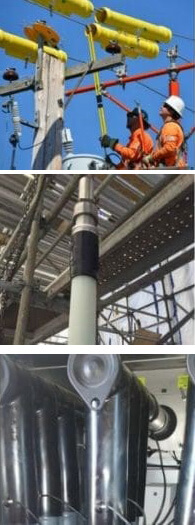
Cable Sealing Ends Explained | HV Substation Cable Terminations
Published 16 Jun 2026
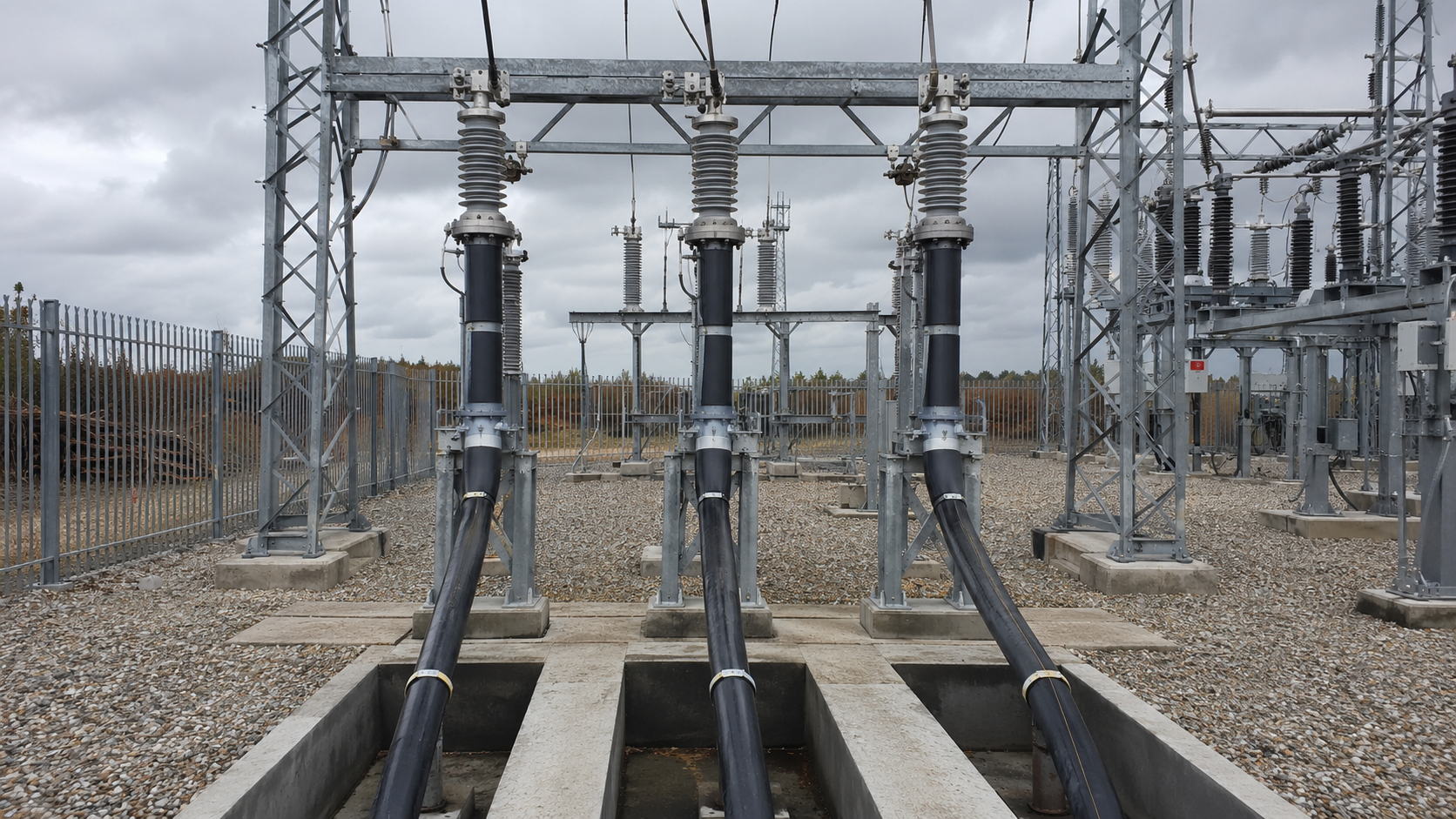
Cable sealing ends are high voltage cable accessories used to terminate, seal and connect power cables at the end of a cable circuit. They are commonly used where underground cables connect to substations, overhead lines, transformers, switchgear, GIS equipment or other high voltage electrical infrastructure.
In simple terms, a cable sealing end provides the controlled transition between a high voltage power cable and the equipment or network it connects into. It must manage electrical stress, maintain insulation performance, protect against environmental conditions and provide a safe, reliable interface for the cable system.
For MV, HV and EHV cable networks, sealing ends are not just connection points. They are critical parts of the cable system, especially on 66kV, 132kV and higher voltage installations where cable preparation, insulation coordination, earthing, sheath bonding and installation quality directly affect long-term network reliability.
Thorne & Derrick supply HV cable joints, terminations and connectors for medium and high voltage cable systems, including 66kV cable sealing ends and 132kV cable sealing ends.
Quick Answer: What Is A Cable Sealing End?
A cable sealing end is a high voltage cable accessory used at the end of a power cable circuit to terminate the cable and provide a sealed, electrically controlled interface to equipment such as switchgear, transformers, overhead lines or GIS substations.
In substation and transmission applications, cable sealing ends are commonly used on 66kV, 132kV and EHV cable systems. They help control electrical stress, maintain insulation integrity, protect the cable end from moisture and contamination, and provide a reliable connection between the cable and the wider power network.
What Is A Cable Sealing End?
A cable sealing end is the end termination assembly of a high voltage power cable. It is used where the cable has to connect safely into another part of the electrical network.
This could be:
- An outdoor substation termination connecting an underground cable to overhead equipment.
- A GIS sealing end connecting a cable into gas insulated switchgear.
- A transformer cable termination connecting the cable to transformer equipment.
- An overhead line transition where an underground cable circuit connects to an overhead line system.
- A cable sealing end compound where underground cable circuits are terminated before connection to external plant.
Unlike a simple low voltage cable termination, an HV cable sealing end must manage complex electrical and mechanical requirements. High voltage cable systems include multiple layers such as the conductor, conductor screen, insulation, insulation screen, metallic sheath, outer sheath and bonding arrangements. The sealing end must be compatible with the cable construction and the equipment it connects to.
For 66kV and 132kV systems, the cable sealing end is usually selected as part of the complete high voltage cable accessory package, together with joints, terminations, sheath bonding equipment, surge protection, earthing arrangements and specialist cable jointing tools.
Where Are Cable Sealing Ends Used?
Cable sealing ends are used wherever a high voltage cable circuit needs to be safely terminated and connected into another asset.
Typical applications include:
- Transmission substations – connecting underground cable circuits to busbars, overhead lines, switchgear or transformers.
- Distribution substations – terminating medium and high voltage cable circuits at electrical equipment.
- GIS substations – connecting cables into gas insulated switchgear using GIS-compatible sealing ends.
- Cable sealing end compounds – terminating underground cable circuits before transition to overhead line routes.
- Wind, solar and battery storage grid connections – terminating export cable circuits at substations and grid interface points.
- Industrial power systems – terminating high voltage cable circuits into transformers, switchboards or motors.
- Offshore and onshore energy projects – connecting high voltage cables to substations, turbines, switchgear and export cable systems.
Cable sealing ends are especially important where the cable termination is exposed to outdoor weather, pollution, UV radiation, high electrical stress, mechanical loading or interface requirements with specialist equipment.
Cable Sealing End vs Cable Termination
The terms cable sealing end and cable termination are closely related, and in some project contexts they may be used interchangeably. However, there is a useful distinction.
A cable termination is the general term for the accessory used to terminate a cable and connect it to equipment.
A cable sealing end is often used in higher voltage or substation contexts to describe the complete termination assembly that seals the cable end and provides the electrical interface to outdoor equipment, GIS equipment or overhead line infrastructure.
For broader product ranges, see cable terminations and HV cable joints, terminations and connectors.
Types Of Cable Sealing Ends
Different cable sealing ends are used depending on the cable voltage, cable construction, installation environment and equipment interface.
The correct sealing end must be selected according to the cable design, equipment interface, voltage rating, conductor size, insulation type, sheath arrangement, pollution level, creepage requirement, earthing system and installation environment.
Cable Sealing Ends In Substations
In substations, cable sealing ends are often used where underground cable routes enter the substation and connect into above-ground electrical infrastructure.
This may include:
- Cable sealing end compounds where underground cable circuits transition to overhead line routes.
- Outdoor termination structures where cables terminate into air insulated equipment.
- GIS cable bays where cables connect into gas insulated switchgear.
- Transformer connections where cable circuits connect to high voltage transformer terminals.
- Grid connection substations for renewables, battery storage, data centres and industrial power systems.
Substation cable sealing ends must be coordinated with the wider electrical design. This includes surge protection, earthing, cable sheath bonding, link boxes, phase spacing, structural support, mechanical loading and access for installation and maintenance.
For underground cable routes feeding substations, see also cable ducting, duct seals and HV cable sheath bonding.
SF6 & GIS Cable Sealing Ends
A GIS cable sealing end is used where a cable circuit connects into gas insulated switchgear. GIS equipment is compact and widely used in substations where space, reliability and environmental protection are important.
An SF6 cable sealing end is associated with cable interfaces into SF6 insulated equipment. The sealing end must provide the correct electrical, mechanical and sealing interface between the cable and the gas insulated equipment.
GIS and SF6 sealing end applications require careful coordination between:
- Cable manufacturer
- Sealing end manufacturer
- GIS or switchgear manufacturer
- Cable jointer or installation contractor
- Client, DNO, utility or asset owner
The interface must be technically compatible. This means the sealing end is not selected in isolation — it must match the cable system and the equipment it connects to.
66kV & 132kV Cable Sealing Ends
66kV and 132kV cable sealing ends are used on high voltage cable systems where the performance of the accessory is critical to the reliability of the network.
Thorne & Derrick supply 66kV straight cable joints, outdoor terminations and SF6 cable sealing ends and 132kV straight cable joints, outdoor terminations and SF6 cable sealing ends.
The higher the voltage, the more important correct accessory selection, cable preparation and installation competence become. At 66kV and 132kV, small errors in cable preparation, stress control, contamination control or installation procedure can have serious long-term consequences.
What To Check When Specifying Cable Sealing Ends
Selecting a cable sealing end requires complete technical information about the cable, equipment and installation environment.
The most reliable approach is to specify the cable sealing end using full cable data and equipment interface details, rather than working from voltage alone.
Cable Preparation & Jointing Tools
High voltage cable sealing ends require accurate cable preparation before installation. Cable layers such as the outer sheath, metallic screen, semi-conductive screen, insulation and conductor must be prepared carefully in line with the manufacturer’s installation instructions.
Specialist cable jointing tools are used to support this preparation, including tools for:
- Outer sheath removal
- Bonded semi-con screen removal
- Insulation stripping
- Chamfering and grooving
- Conductor preparation
- Sheath bonding and earthing preparation
For high voltage work, tools from manufacturers such as Alroc are used by cable jointers for the preparation of MV and HV cables before installing joints, terminations and sealing ends.
Correct tool selection matters because poor cable preparation can damage the insulation, semi-conductive layer or cable screen. That damage may not always be visible immediately, but it can affect long-term electrical reliability.
Pfisterer Connectors, Terminations & Cable Interfaces
Cable sealing ends often sit alongside other high voltage connection technologies, including separable connectors, bushings, surge arresters and plug-in cable terminations.
Pfisterer CONNEX connectors are used for MV and HV cable connections, including medium voltage plug-in systems, bushings and surge arresters. These systems are often used where compact, pluggable or equipment-specific cable interfaces are required.
Pfisterer products are relevant to this topic because they sit within the same wider high voltage accessory family as cable sealing ends, terminations and connectors.
Typical associated products include:
- MV and HV separable connectors
- Inner cone cable plugs
- Bushings
- Surge arresters
- Dry outdoor composite terminations
- Self-supporting dry cable terminations
View the full Pfisterer MV HV connector and termination range.
Common Cable Sealing End Specification Mistakes
Cable sealing ends are critical accessories, so specification mistakes can be costly. Common issues include:
- Specifying by voltage only – voltage is not enough; cable construction, conductor size and equipment interface are also required.
- Confusing duct seals with cable sealing ends – duct seals seal cable entries; cable sealing ends terminate high voltage cables.
- Ignoring cable sheath bonding – HV cable systems may require specific bonding arrangements, link boxes or SVLs.
- Overlooking pollution level – outdoor terminations may need extended creepage in polluted or coastal environments.
- Not checking GIS interface details – GIS sealing ends must match the equipment connection requirements.
- Using unsuitable cable preparation tools – incorrect tools can damage the cable insulation or semi-conductive screen.
- Not allowing for installation competence – 66kV and 132kV accessories require experienced HV jointers and controlled procedures.
- Failing to check data sheets and manufacturer instructions – accessory selection should be based on approved technical documentation.
For critical systems, the sealing end should be reviewed as part of the complete cable system design, not treated as an isolated product purchase.
Related HV Cable Accessory Products
Cable sealing ends are normally specified alongside other high voltage cable accessories and installation products.
- HV Cable Joints, Terminations & Connectors – medium and high voltage cable accessories for 11kV, 33kV, 66kV and 132kV systems.
- 132kV Cable Joints, Outdoor Terminations & SF6 Cable Sealing Ends – high voltage accessories for 132kV cable systems.
- 66kV Cable Joints, Outdoor Terminations & SF6 Cable Sealing Ends – accessories for 66kV high voltage cable circuits.
- Pfisterer CONNEX Connectors & Terminations – MV HV connectors, bushings, surge arresters and terminations.
- Cable Jointing Tools – tools for preparing MV and HV cables before installing joints, terminations and sealing ends.
- HV Cable Sheath Bonding – guide to solid bonding, single-point bonding and cross-bonding methods.
- Sheath Voltage Limiters – SVLs for protection of MV and HV cable sheaths.
Cable Sealing Ends FAQs
Q: What is a cable sealing end?
A: A cable sealing end is a high voltage cable accessory used to terminate, seal and connect the end of a power cable to equipment such as switchgear, transformers, overhead line plant or GIS substation equipment.
Q: What is a cable sealing end in a substation?
A: In a substation, a cable sealing end is used where an underground power cable terminates and connects to substation equipment, overhead line infrastructure, transformers or GIS switchgear. It provides the electrical and sealed interface between the cable and the equipment.
Q: Is a cable sealing end the same as a cable termination?
A: The terms are closely related. A cable termination is the general accessory used to terminate a cable. A cable sealing end is usually a high voltage termination assembly that also provides sealing and a controlled interface to outdoor equipment, GIS, switchgear or overhead line systems.
Q: What is an SF6 cable sealing end?
A: An SF6 cable sealing end is used where a high voltage cable connects into SF6 insulated equipment, such as gas insulated switchgear. The sealing end must provide the correct electrical and mechanical interface between the cable and the equipment.
Q: Where are 132kV cable sealing ends used?
A: 132kV cable sealing ends are used on high voltage transmission and grid infrastructure projects where 132kV underground cable circuits connect to substations, overhead lines, GIS equipment, transformer bays or outdoor termination structures.
Q: What information is needed to specify a cable sealing end?
A: To specify a cable sealing end, you need the system voltage, cable construction, conductor material, conductor size, insulation type, screen and sheath details, equipment interface, installation environment, bonding arrangement and any project-specific approval requirements.
Q: What tools are used to install cable sealing ends?
A: HV cable sealing end installation requires specialist cable preparation tools for sheath removal, semi-con screen removal, insulation stripping, chamfering, grooving and conductor preparation. The exact tooling depends on the cable construction and manufacturer installation instructions.
Q: Can cable sealing ends be used outdoors?
A: Yes. Outdoor sealing ends are specifically designed for external substation and overhead line interface applications. Outdoor suitability depends on the termination design, pollution level, creepage distance, weather exposure, UV resistance and installation conditions.
Conclusion
Cable sealing ends are essential high voltage cable accessories used to terminate, seal and connect power cables at substations, overhead line interfaces, GIS equipment, transformers and other network assets.
They are especially important on 66kV, 132kV and EHV cable systems, where correct specification, cable preparation, stress control, insulation performance and installation competence are critical to long-term reliability.
When specifying a cable sealing end, engineers should check the complete cable system: voltage, conductor size, cable construction, equipment interface, installation environment, sheath bonding, surge protection, jointing tools and manufacturer instructions.
Thorne & Derrick supply HV cable joints, terminations, connectors and cable sealing ends for medium and high voltage power systems, including 66kV and 132kV cable accessory solutions for substations, utilities, renewables, industrial power systems and grid infrastructure projects.