Cable Sheath Damage: Repair Sleeve or Cable Joint?
Published 16 Oct 2026
Cable Sheath Damage: Repair Sleeve or Cable Joint?
Cable sheath damage is the cutting, abrasion, puncturing or deterioration of a power cable’s outer protective covering. Depending on the extent of the damage, the cable construction and the condition of its internal components, a damaged cable may require a heat shrink cable repair sleeve, an engineered cable repair, a cable joint or complete replacement.
Where damage is confined to the outer sheath and the underlying cable components remain intact, an appropriately specified wraparound cable repair sleeve may restore the required environmental protection without cutting the cable. However, damage affecting the insulation, metallic screen, armour or conductors requires further assessment to establish whether a more extensive repair or replacement is necessary.
Understanding the difference between outer sheath damage and internal cable damage is essential when selecting a suitable repair method for low voltage (LV), medium voltage (MV) and high voltage (HV) electrical infrastructure.
For further product information, browse our cable repair and sheath restoration range, including specialist wraparound jacketing and repair systems.
This technical guide explains how to assess damaged cable sheaths, when repair sleeves may be appropriate, when cable jointing should be considered and which factors influence the decision to repair or replace a power cable.
Can a Damaged Cable Sheath Be Repaired?
Yes, certain types of cable sheath damage can be repaired without cutting the cable. Where damage is limited to the outer protective covering and a suitable engineering assessment confirms the integrity of the underlying components, an approved heat shrink wraparound repair sleeve may be used to reinstate the sheath’s environmental protection.
However, a repair sleeve cannot restore damaged conductors, primary insulation, metallic screens or armour continuity. If any of these components have been affected, an engineered repair, appropriately specified cable joint or cable replacement may be necessary.
The correct repair method depends on the depth and extent of damage, cable construction, service environment and applicable electrical safety requirements.
QUICK NAVIGATION – Cable Sheath Damage & Repair Guide
- What Is Cable Sheath Damage?
- How to Assess Cable Sheath Damage
- Cable Repair Sleeve vs Cable Joint vs Replacement
- When Can a Cable Repair Sleeve Be Used?
- When Is a Cable Joint Necessary?
- LV, MV & HV Cable Repair Considerations
- Selecting the Correct Repair Method
- Inspection & Testing Requirements
- Preventing Cable Damage
- Frequently Asked Questions
What Is Cable Sheath Damage?
The outer cable sheath, sometimes described as the cable jacket, provides a protective covering around the internal components of an electrical cable. Depending on the cable design, its functions can include protection against moisture, abrasion, environmental contamination and mechanical exposure.
Power cables may use materials such as polyethylene (PE), polyvinyl chloride (PVC) or other specially formulated sheath compounds selected for their operating environment.
Damage to this outer protective layer may occur during manufacturing, transportation, handling, cable pulling, excavation, installation or service.
Common Types of Cable Sheath Damage
| Damage Type | Typical Cause | Potential Consequence |
|---|---|---|
| Abrasion | Cable pulling, dragging or contact with rough surfaces | Reduced sheath thickness and mechanical protection |
| Cuts & Gouges | Sharp edges, tools or installation equipment | Loss of protective covering and possible damage to underlying layers |
| Punctures | Excavation equipment, sharp objects or accidental impacts | Possible moisture ingress and concealed internal damage |
| Cracking | Ageing, environmental deterioration or mechanical stress | Reduced environmental protection and potential widespread deterioration |
| Compression & Deformation | Incorrect handling, crushing or excessive installation forces | Possible distortion of the insulation, screening or conductor system |
The visual appearance of damage does not always establish its severity. A relatively small puncture may extend through multiple cable layers, while superficial surface scuffing may leave the original sheath function unaffected.
Consequently, the decision to undertake a cable sheath repair should begin with an assessment of the cable construction and the components potentially affected.
How to Assess Cable Sheath Damage Before Repair
Before selecting a repair product, competent personnel must establish whether the damage is confined to the outer protective sheath or extends into the cable’s electrical and mechanical components.
A cable that remains operational after mechanical damage is not necessarily safe or suitable for continued service. Suspected cable damage should be managed under the applicable site and network electrical safety procedures, including isolation and proving dead where required before examination or repair.
1. Identify the Cable Type and Construction
Record the cable’s voltage rating, insulation type, sheath material, outside diameter, screening or armouring arrangement and installation environment.
For example, an LV multicore XLPE/SWA/PVC cable has a different internal construction from a single-core 11kV XLPE-insulated cable with a metallic screen and polymeric outer sheath.
These construction differences influence the inspection requirements and the method used to restore damaged components.
2. Determine the Extent and Depth of Damage
The affected section should be examined to establish which cable layers may have been compromised.
Important observations include:
- Whether the damage is superficial or penetrates the outer sheath.
- Whether metallic armour, screens or other protective layers are exposed.
- Whether there is evidence of insulation damage or cable deformation.
- Whether the cable has experienced crushing, excessive bending or impact.
- Whether moisture, corrosion or contamination may have entered the construction.
Where the extent of damage cannot be established reliably, further specialist assessment is required before deciding on a repair.
3. Examine the Location of the Damage
The position of the damaged section can influence repair suitability.
Damage near a cable gland, joint, termination, cleat, support or bend may present additional challenges involving available space, mechanical loading, movement or access for installation.
For underground cables, the surrounding ground conditions, cable protection and possibility of further external damage should also be considered.
4. Assess Environmental Exposure
The cable’s operating environment affects the level of protection required from a repaired outer sheath.
Factors may include moisture, direct burial, ultraviolet exposure, chemicals, oils, operating temperature and mechanical movement.
A repair suitable for a stationary cable installed indoors should not automatically be assumed suitable for a flexible trailing cable, subsea installation or chemically aggressive industrial environment.
5. Confirm the Approved Repair Procedure
The final repair decision should consider the cable manufacturer’s requirements, asset-owner specifications, relevant engineering standards and applicable inspection and testing procedures.
Where an authorised repair method cannot restore the required cable functions, replacement or more extensive rehabilitation may be necessary.
Cable Repair Sleeve vs Cable Joint vs Replacement
The distinction between a cable repair sleeve, cable joint and cable replacement is determined by which parts of the cable have been damaged and which functions must be restored.
A wraparound repair sleeve is primarily used for external sheath restoration. A cable joint or engineered repair is needed where affected electrical components require reinstatement. Replacement may be the appropriate option for extensive damage or where reliable repair cannot be demonstrated.
| Cable Condition | Potential Solution | Assessment Required |
|---|---|---|
| Minor surface abrasion | Inspection; localised sheath repair if necessary | Remaining sheath integrity and condition |
| Localised outer sheath cut | Wraparound cable repair sleeve, where approved | Depth of damage and condition of underlying components |
| Exposed or damaged armour | Engineered armour restoration, jointing or replacement | Electrical continuity, corrosion and mechanical integrity |
| Damaged metallic screen | Specialist cable system repair, jointing or replacement | Screen continuity, electrical performance and cable construction |
| Damaged primary insulation | Approved insulation repair, cable joint or replacement | Insulation integrity and suitability of the complete repair system |
| Severed or extensively damaged conductors | Appropriately specified cable joint or replacement | Electrical continuity, conductor condition and jointing requirements |
| Widespread sheath deterioration | Engineered rehabilitation or replacement | Extent of deterioration and remaining cable service life |
Important: These are potential repair approaches, not automatic repair approvals. A competent assessment must establish whether the chosen method can restore the required cable performance and meet the applicable network, installation and safety requirements.
When Can a Heat Shrink Cable Repair Sleeve Be Used?
A heat shrink wraparound cable repair sleeve may be appropriate when a localised section of the outer cable sheath has been damaged but the underlying components remain suitable for continued service.
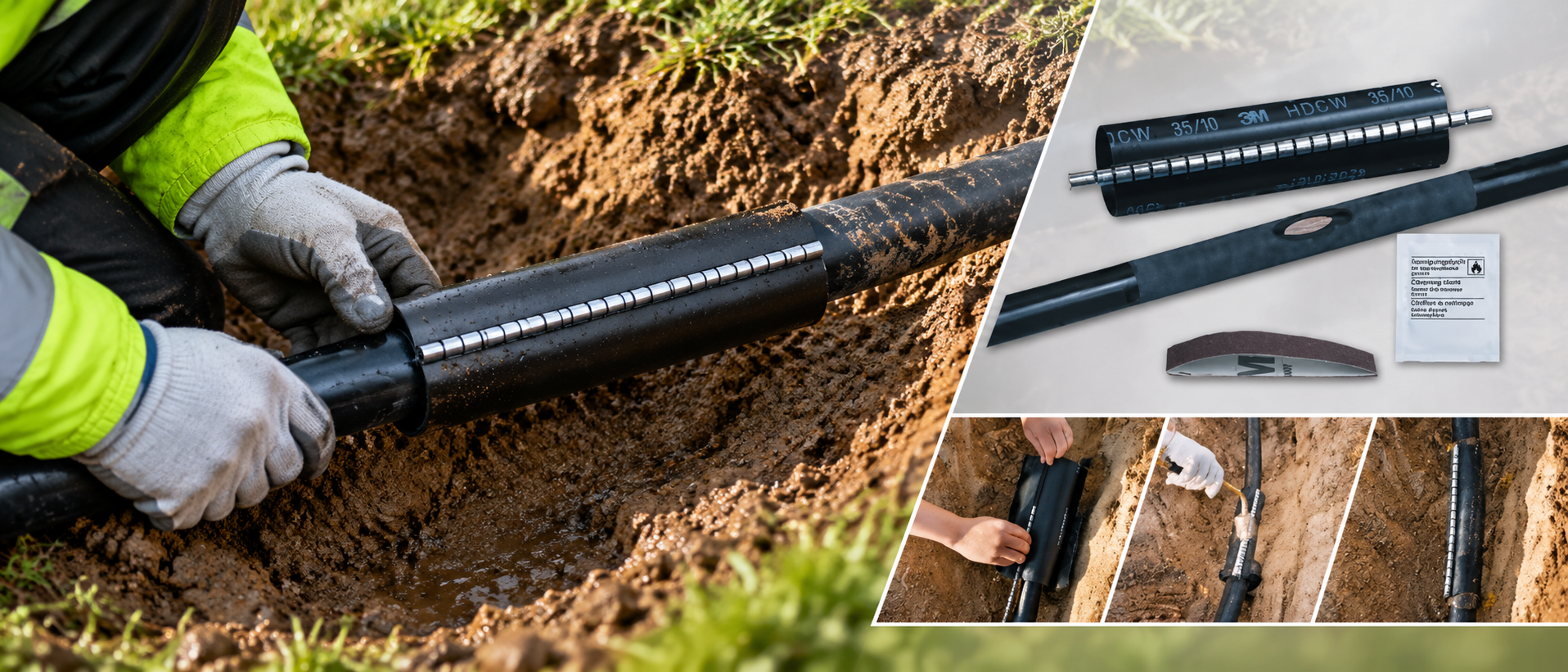
Unlike a continuous tubular sleeve, a wraparound design can be positioned around an accessible section of an existing cable without needing to slide the product over a free cable end.
This can reduce the need for unnecessary cable cutting or disconnection where a simple outer sheath repair has been approved.
How Wraparound Repair Sleeves Work
Typical heat shrink wraparound systems consist of a heat-recoverable polymer sleeve with a mechanical closure arrangement and an adhesive lining.
When installed according to the applicable instructions, the sleeve shrinks around the prepared cable surface while the adhesive forms a seal against suitable sheath materials.
The resulting repair is intended to reinstate the specified external protection against environmental exposure and mechanical wear within the product’s approved application limits.
The suitability of a particular sleeve depends on the cable diameter, sheath material, repair length, operating environment and selected product’s specification.
Typical Cable Repair Sleeve Applications
- Localised outer sheath damage on stationary LV power cables.
- Approved sheath restoration applications on MV and HV cables.
- Protective jacket repairs following cable installation damage.
- Outer sheath reinstatement on suitable armoured or unarmoured cables.
- Restoration of environmental protection around appropriate cable jointing assemblies.
Specialist cable constructions, including flexible, fire-resistant and low smoke zero halogen cables, may require specifically approved restoration systems to preserve their intended performance.
Thorne & Derrick can deliver Cable Repair Solutions to suit high performance (Low Smoke Zero Halogen LSZH | Fire-Resistant | Seawater Resistant | Flexible & Trailing) and high voltage cable applications including 11kV (Triplex), 33kV (BS7870 BS6622), Protolon and 66kV offshore Inter-Array Cables (IAC).
When Is a Cable Joint Necessary Instead of a Repair Sleeve?
A cable joint may be necessary where damage extends beyond the protective outer sheath and affects components that cannot be restored using a simple external repair.
Cable joints are engineered to connect or reconnect electrical cables while restoring the necessary conductor continuity, insulation, screening, earthing and environmental protection functions for the particular cable construction.
Damage to Conductors
Where conductors have been severed or mechanically damaged beyond an approved local repair limit, the affected section may need to be removed and the cable reconnected using an appropriately specified joint.
Damage to Electrical Insulation
Primary insulation is a critical part of the cable’s electrical performance. Damage to this component cannot be remedied by applying an outer jacket sleeve alone.
The repair method must restore the necessary insulation properties and be compatible with the cable voltage and construction.
Damage to Metallic Screens or Armour
Metallic screens and armour perform important electrical and mechanical functions, depending on the cable design.
Damage may require specialist repair methods to restore continuity, corrosion protection and the intended cable system performance.
Where cable jointing is required, Thorne & Derrick supply a range of LV cable joints, including heat shrink, cold shrink and resin jointing solutions.
MV and HV repair requirements must be assessed against the specific cable system and the appropriate approved jointing arrangements.
LV, MV & HV Cable Sheath Damage: What Changes?
The general principle of outer sheath protection applies across low, medium and high voltage cable systems. However, the consequences of cable damage and the required repair procedures depend on the electrical construction.
Low Voltage Cable Sheath Damage
LV power cables used in industrial installations, buildings, distribution networks and infrastructure projects may experience sheath abrasion, cuts or punctures during installation and service.
Where an assessment confirms that the damage is restricted to the outer covering, an approved repair sleeve may provide a suitable restoration method.
For armoured LV cables, the condition of the armour and any associated protective conductor function must also be considered.
11kV and 33kV Cable Sheath Damage
Typical 11kV and 33kV XLPE-insulated cable systems incorporate components such as conductor screens, primary insulation, insulation screens and metallic screens beneath the outer protection.
Damage extending into these components may affect the cable’s electrical performance, even where the cable has not experienced an immediate failure.
Appropriate inspection and diagnostic testing may therefore be required to determine whether an outer sheath repair is sufficient.
Repair sleeves must not be treated as replacements for damaged MV cable insulation or screening systems.
High Voltage Cable Sheath Damage
Higher-voltage power cables can incorporate complex metallic sheath arrangements, bonding systems and insulation structures.
Damage to metallic sheaths, screens or related components requires specialist investigation because it may affect electrical integrity and cable system operation.
Although appropriately specified wraparound sleeves may be used for approved outer jacket restoration, any damage beneath the jacket must be assessed separately.
The nominal voltage of a cable does not, by itself, determine whether a repair sleeve is suitable.
How to Select the Correct Cable Sheath Repair Method
Once the damage assessment is complete, the appropriate repair approach should be selected according to the cable construction, damage extent and intended operating conditions.
The following factors are particularly important when specifying a cable sheath restoration system.
Cable Outside Diameter
Where a wraparound sleeve is proposed, the cable’s outside diameter must fall within the selected product’s approved application range.
Heat shrink sleeves are commonly identified using expanded and recovered diameter dimensions, but these figures should not be used as a substitute for the specified working diameter range.
Damage Length and Sealing Overlap
The repair sleeve must provide sufficient coverage over the affected section and the required overlap onto sound cable sheath material.
The suitable repair length and sealing requirements depend on the product design and approved installation procedure.
Cable Sheath Material
Compatibility between the repair system and original sheath material is essential to achieve the required adhesion and environmental protection.
Different products may be suitable for different cable jacket materials, including PE, PVC and specialist industrial sheath compounds.
Installation Environment
Requirements for an underground cable may differ from those of an exposed cable installed on a tray, within an industrial facility or in an offshore environment.
Consider moisture exposure, temperature, chemical resistance, ultraviolet exposure and expected mechanical loading.
Special Cable Performance Requirements
Where cables have defined fire resistance, flame propagation, low smoke, halogen emission or other specialist performance requirements, any repair must be assessed for its effect on those characteristics.
A standard heat shrink sleeve must not automatically be assumed to preserve every performance characteristic of the original cable construction.
Examples of Cable Sheath Restoration Systems
Different wraparound repair systems are available for cable sheath and jacket restoration. Their dimensions, materials and application limits vary.
| Product Range | Technology | Purpose |
|---|---|---|
| SPS SWRS | Heat shrink wraparound sleeves | Localised cable outer sheath and jacket repair |
| 3M HDCW | Adhesive-lined heat shrink wraparound sleeves | Protective cable jacket and sheath restoration |
| Nexans GT11 / GT11R | Heat shrink wraparound sheath restoration systems | Cable sheath repairs and appropriate joint outer jacket rebuilding applications |
These product families are examples of available technologies. They are not interchangeable, and suitability must be confirmed against the exact product specification and cable application.
Explore the 3M cable sheath repair range or Nexans wraparound cable sheath repair sleeves for further product information.
What Inspection and Testing Is Required After Cable Sheath Repair?
A completed cable repair should be inspected and tested according to the cable construction, approved repair procedure, applicable standards and asset-owner requirements.
The purpose of inspection and testing is to establish that the repair has achieved the required protective and electrical functions before the cable is returned to service.
Visual Inspection
For an approved heat shrink sheath repair, visual inspection may include checking the completed sleeve for correct positioning, full recovery, appropriate sealing and visible defects.
Any product-specific indicators and acceptance criteria should be assessed according to the installation instructions.
Electrical Testing
Depending on the cable system and the scope of damage, appropriate tests may include insulation resistance, sheath integrity or other cable-specific diagnostic procedures.
The correct tests, methods and voltages depend on the cable construction and applicable specifications. A general insulation resistance test alone must not be assumed sufficient to verify every type of cable repair.
Repair Documentation
Recording the location and nature of the damage, repair materials, inspection findings and test results can assist future maintenance and asset management.
For utility and infrastructure installations, documentation should comply with the network or asset owner’s required procedures.
Electrical safety: The ability to fit a wraparound sleeve without cutting a cable does not establish that the work may be performed on an energised circuit. Inspection, preparation, heating, testing and return to service must all comply with the applicable electrical safety rules and authorisations.
How to Prevent Cable Sheath Damage During Installation
Preventing sheath damage during cable installation is generally preferable to undertaking remedial repair work.
Mechanical damage can arise from poor cable handling, unsuitable pulling arrangements, excessive bending, contact with sharp surfaces or improper cable support.
Maintain the Correct Cable Bending Radius
Exceeding the specified minimum bending radius can damage the outer sheath and potentially affect internal cable components.
The correct bending radius depends on the cable construction, outside diameter and whether the cable is being pulled into position or installed in its final configuration.
For a more detailed explanation, see Cable Bending Radius Explained: Minimum Radius & Installation Risks.
Use Suitable Cable Pulling Equipment
Cable rollers, guides, pulling socks and other installation equipment should be selected to suit the cable size, pulling forces and installation conditions.
Correct equipment can help reduce friction, abrasion and uncontrolled mechanical loading during cable laying operations.
Explore Thorne & Derrick’s range of cable pulling and laying equipment for LV, MV and HV cable installations.
Protect Cables During Handling and Backfilling
Suitable handling, trench preparation, cable support and backfilling procedures help reduce the possibility of cuts, crushing and puncture damage.
Where cable routes are exposed to future excavation work, appropriate location records, marking and mechanical protection can help reduce accidental cable strikes.
Inspect Cables Before Commissioning
Accessible cable surfaces should be inspected as required during installation and before commissioning.
Identifying damage early allows the necessary assessment and corrective action to take place before the cable enters normal operation.
Cable Sheath Damage: Key Repair Decisions
When assessing a damaged electrical cable, the most important question is not simply whether the visible defect can be covered. It is whether the selected repair can restore the functions affected by the damage.
Outer sheath damage may be suitable for restoration using an approved wraparound repair sleeve where the underlying cable construction remains intact.
Insulation, armour, screen or conductor damage requires additional assessment and may involve more extensive repair, cable jointing or replacement.
Extensive or repeated damage may justify replacement where the reliability or remaining service life of the cable cannot be adequately established.
For every application, the chosen method must be appropriate to the cable design, environment and operational requirements.
Cable Sheath Damage – Frequently Asked Questions
Cable Repair Sleeves & Jointing Solutions from Thorne & Derrick
Thorne & Derrick supply specialist heat shrink cable repair sleeves, cable sheath restoration products and LV, MV and HV cable jointing accessories to support electrical utilities, contractors, industrial maintenance teams and infrastructure projects.
Our technical sales team can help identify suitable products based on the cable construction, damage type, dimensions and intended application.
Whether your requirement involves restoring a damaged outer sheath or sourcing a cable jointing solution, selecting the correct product begins with establishing the condition of the cable and the functions that must be reinstated.
DISCUSS YOUR CABLE REPAIR REQUIREMENT