Waterproof Cable Joints | MV HV Joint Kits for High Water Table Cables 11kV 36kV
Waterproof cable joint kits
Underground Power Cable Networks with High-Water Tables | 11kV 36kV
Straight | Transition | Trifurcating | Special Application & Custom-Design Waterproof Cable Joints

Lovisil range of Lovink cable joints are manufactured and designed for high-voltage, high-challenge applications including cable jointing and repair applications and environments with wet soil, high groundwater levels and temporary or recurring flooding.
In practice, MV HV power cable and network failures after extreme weather events are most often caused by accessories such as cable joints which are typically used to repair, extend, overlay and divert 11kV/36kV cables – not by the medium/high voltage cable.
Lovink develops and supplies waterproof cable joint solutions for land‑based and underground applications, designed to maintain electrical and mechanical integrity even when cable joints are fully submerged in water. These solutions are system‑tested for submersion up to 2 bar water pressure, making them suitable for flooded trenches, manholes and areas with permanently high groundwater levels.
Real‑world projects across the UK, Europe and international locations demonstrate that designing joints for water exposure as a normal operating condition significantly improves Medium & High Voltage Power network resilience.
High Water Table, Submersible, Seawater Resistant & Flood Zone Installations
Superior Waterproofing & Mechanically Strong – the Lovink range of Lovisil Waterproof Cable Joints prevents moisture penetration and guarantees long-term protection and reliability of power cables distributing electricity at 11kV, 24kV and 36kV voltage classes, even in demanding, harsh and hazardous-area environments.
When do you need a waterproof cable joint?
A waterproof cable joint is required whenever underground installations are exposed to moisture that cannot be reliably controlled, prevented or drained and typically where competitor technologies do not document the required performance levels in immersed, submerged and flooded locations.
Typical Applications
- 11kV/36kV cables and joints with high groundwater tables in urban and rural networks
- Flood‑prone cable trenches and cable pits after heavy rainfall exposing joints to prolonged levels of water immersion
- Underground manholes with limited drainage consequently exerting water immersion and pressure onto the cable joint
- Medium and high voltage cable Infrastructure exposed to extreme weather conditions
Lovink and Thorne & Derrick sees these conditions increasingly across the Netherlands, the UK, Germany, Belgium and Southern Europe. Field experience shows that treating water exposure as a design parameter, rather than an exception, reduces outages, repair interventions and customer minutes lost.
HV Joint Field Failure | Here water has penetrated a Cold-Shrink type of HV Joint in an underground cable trench due to inadequate cable sealing and mastic application creating entry path for the moisture to enter the joint. In medium and high-voltage cables, the combination of moisture, voltage stress and microscopic voids in the insulation (XLPE, EPR or PILC) creates a phenomenon referred to as tracking or water treeing.
Thorne & Derrick provide expert diagnosis on Medium & High Voltage Cable Fault analysis, causes and prevention of cable joint failures.
What makes a cable joint waterproof?
Waterproof performance is not defined by a single material or component, but by the performance of the complete joint system under wet and submerged conditions.
A waterproof underground cable joint for medium/high voltage power cable networks must provide:
- Long‑term sealing at the cable sheath and interface transitions
- Resistance to hydrostatic water pressure
- Stable electrical insulation during and after submersion
- Mechanical protection of the cable joint against soil movement and external impact
Lovink uses its in-house developed and produced Protolin® Resin system to make sure cable joint systems are waterproof.
Lovink waterproof cable joints are type‑tested as complete systems, ensuring predictable and repeatable performance in wet soil and temporarily flooded environments. This system‑level approach is essential for underground reliability.
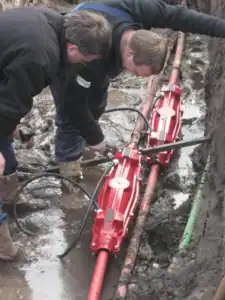
Waterproof performance
for land based installations only
The waterproof cable joint solutions are exclusively intended for land‑based and underground applications, including:
- Medium‑voltage distribution networks at 11kV/36kV
- Onshore renewable energy installations including Wind Energy, Solar & Storage (BESS)
- Industrial underground cable routes with trenched/direct buried MV HV power cables
They are not designed for offshore or subsea applications, which require fundamentally different design principles, materials and certification standards. Lovink offers two proven cable joint families that deliver reliable waterproof performance in underground, land‑based installations. Both solutions are suitable for submersion up to 2 bar water pressure when installed as part of the complete joint system
The LoviSil® -M series Joints for Transition Cable Jointing and the LoviX® -R series for Straight-Through Jointing.
The LoviSil® -M series consists of different types of joints that all have the water resistance up to 2bar water pressure.
- Transition Joints
- Straight Joints
- Branch Joints
- Feed-In Joints
- Loop Joints
- Cross-Bonding Joints
- Oil-Refill Joints
- End Joints
- Repair Joints
FAQ
What does “waterproof” mean for an underground cable joint?
Waterproof means that the complete cable joint system maintains electrical, mechanical and sealing performance when exposed to wet soil or full submersion. Lovink waterproof joints are system‑tested for land-based submersion up to 2 bar water pressure.
Are Lovink waterproof cable joints suitable for permanent submersion?
Yes. When installed according to instructions, Lovink waterproof cable joints are suitable for temporary or permanent submersion in environments with high groundwater levels or recurring flooding, up to 2 bar water pressure.
Is a waterproof cable joint always required in underground installations?
A waterproof cable joint is required whenever moisture cannot be reliably controlled or drained, such as in flood‑prone trenches, manholes, areas with high groundwater tables or regions exposed to extreme weather conditions.
What makes Lovink cable joints waterproof?
Waterproof performance is achieved through the complete joint system, not a single component. This includes long‑term sealing, resistance to hydrostatic pressure, stable electrical insulation and mechanical protection. Lovink uses its in‑house developed Protolin® Resin system as part of this system approach.
Are resin cable joints the same as waterproof cable joints?
No. “Waterproof” refers to the required performance under wet or submerged conditions. “Resin” refers to one possible sealing technology. Not all resin joints are waterproof, and not all waterproof joints rely solely on resin.
Which Lovink cable joint families are waterproof?
Lovink offers two proven waterproof cable joint families for land‑based underground applications:
- Lovink LoviX® R Series Joints for straight‑through joints for medium and high voltage power cables (Single & 3 Core Types)
- Lovink LoviSil® M‑Series Joints for straight, transition, branch and other joint configurations
Both are tested for submersion up to 2 bar water pressure.
Can Lovink waterproof cable joints be used offshore or subsea?
No. Lovink waterproof cable joints are designed exclusively for land‑based and underground applications. Offshore and subsea installations require different designs, materials and certifications.
In which applications are waterproof cable joints most commonly used?
Typical applications include underground medium‑voltage distribution networks, urban infrastructure with limited drainage, onshore renewable energy installations and regions with high groundwater levels or flood risk.
How does waterproof joint design improve network reliability?
By treating water exposure as a normal operating condition rather than an exception, waterproof cable joints reduce failure rates, unplanned outages and repair interventions after heavy rainfall or flooding events.
Can Lovink help select the right waterproof cable joint?
Yes. Lovink specialists support joint selection based on cable type, installation environment and operational conditions, ensuring the correct waterproof solution for each application.
Moisture Ingress, High Water Tables & Cable Joint Failures
Moisture ingress remains one of the leading causes of cable joint failures, especially in underground and high-humidity installations. Water can enter the cable joint due to poor cable sealing, damaged cable sheaths, improper heat shrink tubings or Cold-Shrink installation, or long-term environmental exposure.
Once moisture penetrates the insulation system of the MV HV cables (XLPE PER PILC), it can initiate water treeing inside XLPE insulation. Water treeing occurs when microscopic channels form within the insulation under combined electrical stress and moisture exposure. Over time, these channels weaken the dielectric structure and may eventually result in partial discharge activity or insulation breakdown.
Moisture-related failures are particularly common in underground cable ducts, coastal environments, renewable energy installations, solar farms and areas exposed to flooding or heavy humidity. Proper environmental sealing and high-quality insulation interfaces are therefore critical for long-term reliability. Contact us to discuss your requirements for permanent waterproof cable joints.
Thorne & Derrick are the UK Authorised Distributor for Lovink Enertech and provide stock supply, technical support, project specification assistance, and global export logistics for Lovink’s cable jointing solutions.
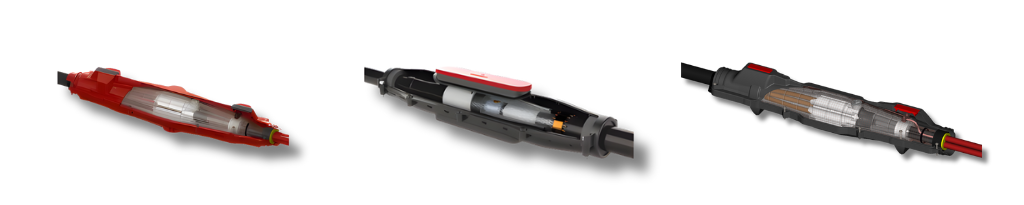
Cable Joints for Medium & High Voltage Cables |the Lovink range of cable joints provide high-performance for high-challenge applications including configurations for straight, transition, branch and loop jointing of cables typically distributing electricity at 11kV, 24kV and 36kV; this includes connection joints for extensions and repairs for MV HV cables with XLPE, PILC & EPR insulation.
 Lovink – Cable Joints MV 11kV 24kV 36kV CatalogueDownload