uploaded by Chris Dodds - Thorne & Derrick Sales & Marketing Manager
Feeder Pillars
Thorne & Derrick International are leading UK Distributors of the Lucy Zodion range of Fortress brand feeder pillars designed to provide LV Power Distribution across a diverse range of market sectors including:
Street Lighting
EV Charging
Rail
Urban Regeneration
Highways & Motorways
Airports
Retail & Leisure
Utilities – Water, Gas & Electricity
Feeder pillars are manufactured to the highest level of standard including Cast Iron, Stainless Steel, Glass Resin Plastic (GRP) and Hot Dip Galvanised Steel (HDG).
Here follows the list of optional extras available for use with Fortress Feeder Pillars:
T&D distribute the most extensive range of LV, MV & HV Cable Jointing, Terminating, Pulling & Installation Equipment – we service UK and international clients working on underground cables, overhead lines, substations and electrical construction at LV, 11kV, 33kV and EHV transmission and distribution voltages.
uploaded by Chris Dodds - Thorne & Derrick Sales & Marketing Manager
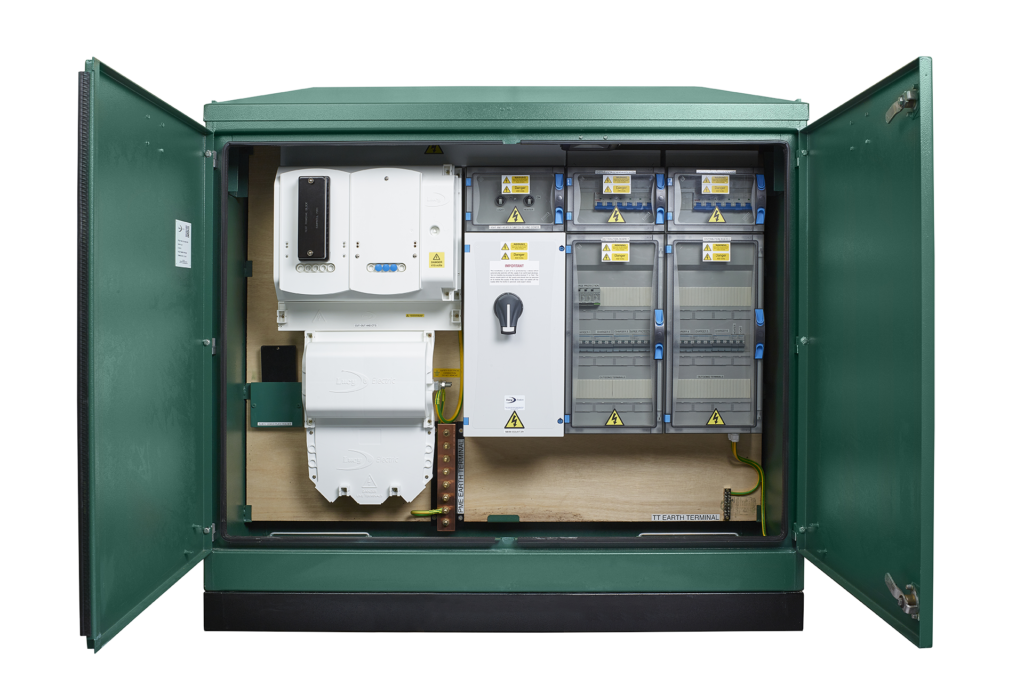
Thorne & Derrick with Lucy Zodion supply both standard and bespoke feeder pillars in a selection of materials, paint finishes and dimensions to meet all indoor and exterior power distribution, control and lighting requirements up to 1,000 volts with IP65 door seal – this includes LV substation and network pillars with DNO supply cut-outs for utility applications.
Specialist EV Charging Pillars can be produced to customer specification for electrical vehicle charging points and applications.
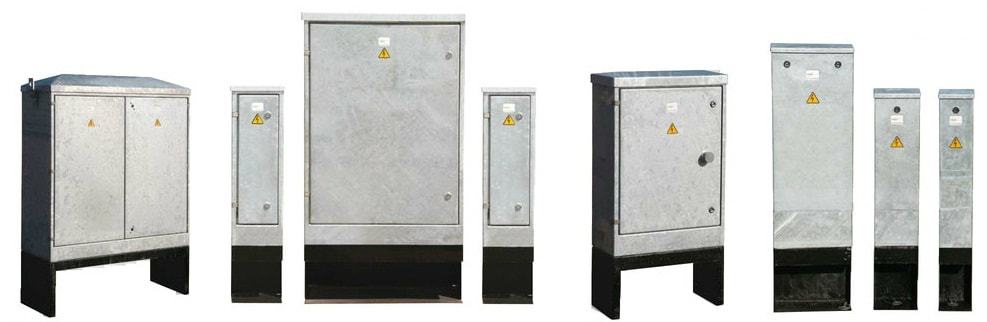
The wide range of Lucy Zodion pillars from the Fortress range include mini, slimline, single-door and double-door types available in galvanised mild and stainless steel with cast iron option for heritage applications.
➡ Contact us to discuss how T&D and Lucy Zodion can provide innovative custom design solutions and ex stock delivery of standard feeder pillars to your project.
The series of feeder pillar images below shows a behind the scenes look into the manufacturing of bespoke pre-wired pillars.
Pre-Wired Feeder Pillars
Design Process
Lucy Zodion CAD driven design procedure guarantees a well engineered product from enquiry to delivery. The dedicated design team will work with a client not only from the start, but through all the processes to the finished product. Lucy Zodion have designed and produced some very exciting innovative products over the last few years, and T&D offer customers the latest cutting edge technology with highly skilled engineers and designers.
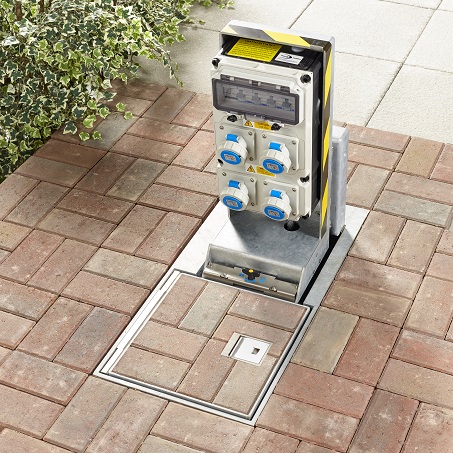
110V, 230V and 400V a.c. variant feeder pillars are available in both above ground and in-ground locations equipped with earth leakage and overload protection devices to ensure high operator safety levels. Compact retractable power pillars with telescopic design to mount flush to the floor surface provide discreet electrical power for typical applications including markets, shopping centres and airports.
1.
2.
Pictures 1 and 2 show the intricate engineering detail that goes into the design of a bespoke pre-wired feeder pillar. Although you can tell that the feeder pillar is only partially complete you can see the attention to detail and pride that Lucy Zodion input into all of their feeder pillars.
After manufacture the feeder pillars are thoroughly tested within the purpose built LV test area at Lucy Zodion to ensure they meet BS7671 and meet the requirements of BSEN 60439. The test procedures and quality assurance inspections driven by the ISO 9001 accreditation ensure all products including pillars perform correctly and safely.
3.
4.
Pictures 3 and 4 show how painting or powder coating the feeder pillars helps them to blend into their environmental surroundings to suit the needs of the client.
5.
6.
Pictures 5 and 6shows a stainless steel feeder pillar that is ideal for high saline, coastal and marine atmospheres to provide power for temporary events – the pillar is manufactured in non-corrosive 316 grade stainless steel for hostile climatic conditions.
7.
8.
9.
10.
11.
Pictures 7 to 11 show that careful consideration is taken when designing the feeder pillar to ensure that the installer, end user and maintenance team are satisfied with the completed installation. In this case an external override switch which is provided to avoid opening the feeder pillar unnecessarily. Please note the space below the isolator on the right for the Distribution Network Operator (DNO).
12.
Picture 12shows how feeder pillars can be sympathetically painted to suit their surroundings. Lucy Zodion can paint feeder pillars to any RAL or BS. This specific pillar has been modified to provide temporary supplies for regular events that take place in recreational areas including parks, open spaces, playgrounds, nature reserves, wildlife sites and sports pitches.
T&D distribute the complete range of Lucy Zodion pillars for low voltage power distribution to the building services, rail, construction, utilities, oil and gas, retail and leisure, ports, airports and heavy industries – GRP feeder pillars, cast iron, galvanised and stainless steel types customised to your application:
Pre-Wired Power Distribution Panels (Outdoor IP65 & Underground Retractable)
Substation Power, Cable Distribution & LV Interconnection Panels (Onshore Wind)
DNO Single & 3 Phase Network Pillars (25A-800A)
Network Rail & Electrification – Station & Trackside Pillars (incl. London Underground)
Low Voltage Connections – New Housing & Commercial Development Pillars (LV)
Defence Estates MoD – Load Shedding Fuse Pillars
Lighting Feeder Pillars – Street, Road, Flood, Sports Stadium & Car Parks
BT Telecommunications & Interface Pillars
Environment Agency – Rivers, Coastal & Waterways
Cast Iron Electrical Distribution Pillars – National Heritage & Historic Buildings
➡ For further information about how Lucy Zodion provide control and power distribution products for street lighting applications, please review the Lucy Titan (Cut-outs) and Lucy Trojan (Isolators) ranges of products.
T&D distribute the most extensive range of LV, MV & HV Cable Jointing, Terminating, Pulling & Installation Equipment – we service UK and international clients working on underground cables, overhead lines, substations and electrical construction at LV, 11kV, 33kV and EHV transmission and distribution voltages.
Feeder Pillars, Power Management & Control Equipment
Uploaded By - Chris Dodds (Thorne & Derrick Sales & Marketing Manager)
Guest Post By - Giles Davidson (Area Sales Manager at Lucy Zodion Limited)
Lucy Zodion were approached by the client (Eagle) to manufacture a galvanised steel feeder pillar from their Fortress range to supply three electric vehicle charging points within the clients own site – the double door feeder pillars are designed to provide robust and reliable distribution of low voltage electrical power.
The initial plan was for the EV charging points to be fitted to the wall of the building.
Lucy Zodion suggested that the side walls of the feeder pillar could be utilised to provide the three IP67 sockets, which lessened the upheaval to the site with less civil engineering, electrical and cabling work required.
The client also wanted to be able to provide electrical isolation via each socket from within the feeder pillar but also needed to ensure that only authorised personnel could do this.
To achieve this Lucy Zodion fitted the new Hasp and Staple lock system so the client could fit a padlock as pictured below.
To complete the project the electric vehicle power pillars were painted to the clients specific RAL paint colour specification.
The design, procurement, assembly and testing was all completed in time and the customer saved money on the project.
Lucy Zodion bespoke feeder pillars with customised design and pre-wired solutions, tailored to the customers’ requirements without compromise.
Feeder Pillars – Electric Vehicle (EV) Power Supply Pillars
Feeder Pillars For Electric Vehicles With Padlockable Vandal Resistant Protection
Feeder Pillars
T&D together with Lucy Zodion are able to offer a range of feeder pillar enclosures and cabinets that are robust, durable and secure providing weatherproof and padlockable vandal resistant protection. Feeder pillars are available as standard empty enclosures or custom manufactured low voltage pre-wired electrical distribution equipment consisting of a robust galvanised steel pillar with vandal resistant lockable doors housing LV electrical switchgear and control systems.
EV Electricity Supply Pillar in production at Lucy Zodion incorporating CTCU and surge protection – the feeder pillar also uses Matt:e’s O-pen technology devices which eliminates the need for earth mats or rods.
Electric Vehicle Charging Supply Pillars – Lucy Zodion are empowering EV with pre-wired feeder pillar and electricity distribution solutions. Lucy Zodion develop EV solutions considering the charge speeds each charge point is capable of, from fast to super, to ensure the client receives the most suitable and compatible option. The standard range of pre-wired supply feeder pillars for EV charging come in four sizes and can supply power for up to 54 fast charge points, 12 rapid charge points and 2 super. Additional components can be integrated as optional extras, for smart and adaptive power distribution solutions.
T&D distribute the most extensive range of LV, MV & HV Cable Jointing, Terminating, Pulling & Installation Equipment – we service UK and international clients working on underground cables, overhead lines, substations and electrical construction at LV, 11kV, 33kV and EHV transmission and distribution voltages.
Installation Of Retractable Type Feeder Pillars Manufactured by Lucy Zodion
uploaded by Chris Dodds - Thorne & Derrick Sales & Marketing Manager
Feeder Pillars
INTRODUCTION
This article covers the installation and maintenance of Pre-wired Feeder Pillars & Retractable Power Pillars as distributed by Thorne & Derrick and manufactured by Lucy Zodion.
This article is to provide assistance to the end user in the installation, maintenance and operation of their feeder pillars – it is not exhaustive and a suitably qualified person should be consulted if in any doubt. It is important to note that any modifications made to the pillars without authorisation by Lucy Zodion are outside the scope of this article.
Retractable Type Feeder Pillars
Lucy Zodion supply two types of retractable power supply feeder pillars namely ‘Castle’ and ‘Westminster’ types – these feeder pillars are part of the Lucy Fortress range of Low Voltage Electrical Distribution Equipment.
These feeder pillars mount flush to the top paving surface when not in use and are pulled up for use when LV power supply is required. Feeder pillars typically supply low voltage power sockets for supplying temporary power to events such as markets, outdoor events and broadcasting. Pillars are available in a variety of specifications, including single and three phase electrical connections and data sockets, as specified by the end user.
A downloadable specification form is available to initiate the electrical engineering design of all Lucy Zodion type feeder pillars.
♦ Electrical Regulations
This Blog written with the support of Lucy Zodion should be read in conjunction with BS 6423:2014 (this replaced BS 6423:1983), the Code of Practice for maintenance of LV electrical switchgear and control gear for electricity voltages up to and including 1000V/1kV.
All electrical work should be conducted in accordance with the Electricity at Work Regulations 1989.
All feeder pillar installations should be designed, tested and installed in accordance with the IET Wiring Regulations BS7671 Requirements for Electrical Installations – any other local regulations in force at the time should be observed.
Installing Feeder Pillars
Pre-wired Electrical Distribution Feeder Pillars
Prewired pillars can be mounted either on the supplied metal root, which is buried in the ground see Figure 1 below, or bolted directly to a concrete base.
Lucy Zodion do not specify the exact nature of installation as it is the customer’s duty to consult a suitably qualified civil engineer for feeder pillar installation.
The following procedure is for guidance only:
Excavate a trench to the depth of the root section plus the depth of the solid base the unit will mount on, and approximately 30 cm greater than the width and depth of the feeder pillar
Lay a solid base to the trench, for example paving slabs
Place feeder pillar on to base and draw cabling into pillar
Backfill trench with suitable gravel
We advise capping of the gravel with concrete in the base of the feeder pillar and make good the surrounds with suitable material
➡ It is the customer responsibility to ensure the suitability of the site for the feeder pillar unit specified.
Figure 1 Pre-wired Feeder Pillars – Method of Installation
Retractable power pillars are mounted flush with the existing road/paving surface, and have recesses manufactured at a suitable depth to continue the existing surface material onto the folding
doors of the feeder pillar to leave a safe installation with low visual impact.
Figure 2below is supplied for guidance only and a suitably qualified civil engineer should always be consulted to determine the exact method of installation.
It is crucial that the unit is equipped with suitable drainage. Lucy Zodion recommend using a 100mm drain pipe with positive drainage to the main sewer. While the low voltage installation is IP67 rated, incorrectly replaced caps and covers allow opportunity for ingress of water and long term exposure can permanently damage to internal components of the feeder pillar.
Figure 2 Westminster Retractable Feeder Pillar – Method of Installation
Westminster Retractable feeder pillars are supplied with recess pockets of a suitable depth for the proposed infill material. This depth is specified at order. Infill material must be installed flush with the surface and around the lock cover and hinges. Some means is necessary to hold the material in place when the feeder pillar is in the vertical, raised position, e.g. solvented grab adhesive.
Figure 3 – Top Cover Of Westminster Retractable Feeder Pillar
Electrical Requirements
Pre-wired feeder pillars and retractable power pillars are supplied pre-wired and tested at Lucy Zodion’s factory. A copy of the test documentation, along with a schematic drawing of the Lucy Zodion supplied equipment, is supplied with the pillar. It is assumed that electrical installation is conducted by a suitably qualified and skilled person and the following information is for general guidance only.
➡ A full test in accordance with BS7671 must be carried out, and a certificate issued, by the installing party after installation on site.
Electrical Connection Of The Feeder Pillar
Feeder pillars are typically supplied with a single phase 230V or 3 phase 415V electrical power supply feed from either a DNO/REC or private supply. Suitable space has been left for installation of DNO/REC cut-out if specified; this can be verified with reference to the drawings supplied with the pillar.
DNO/REC power supplies are connected to the pre-installed equipment using the pre-wired double insulated tails from the main switch disconnect.
Private supply feeder pillars are wired into the equipment using the customer’s cable.
The cable may be wired and connected directly into the main switch disconnect, wired through a cable spreader chamber or wired into a terminal enclosure depending on the size of the incoming cable.
The provision for terminating incoming cable can be determined from the drawings that accompany the feeder pillar or identification of the parts on the pillar.
Lucy Zodion Westminster Feeder Pillars – In Ground Power Distribution Pillars | LV Power Distribution
Lucy Westminster Feeder Pillar Features
Modified lift assist at first lid to improve longevity and operation ease
Lift assist added to tower for smoother and safer set-up
Improved locking system for vibration resistance
Enhanced Tower latching with slam lock means quick and easy access
As feeder pillars are often located remotely from the electrical equipment they supply the outgoing cable sizes often have a large cross-sectional-area for the current rating and cannot be terminated directly into the pillar equipment.
For large outgoing CSA cable sizes suitable cable termination equipment, terminal studs or blocks, are supplied pre-wired into a terminal box.
Incoming and outgoing cables should be wired into these terminals, if supplied, to avoid overcrowding on the main distribution board or where equipment is unable to accept cables of the size specified.
Smaller cable sizes can be wired directly onto the equipment as appropriate.
Suitable space has been left for the cable glanding of outgoing unarmoured or armoured cables, in the form of cable gland plates on the distribution or terminal enclosure, a cable spreader chamber or a horizontal length of galvanised trunking.
Earthing
A dedicated ten way, brass earth block with an adjacent label reading ‘SAFETY ELECTRICAL CONNECTION, DO NOT REMOVE’, is supplied in a prominent and easily assessable location on the feeder pillar backboard. The pillar and all accessible metal parts within the pillar and all CPC earth in pre-wired equipment are equipotentially bonded to the earth block.
It is essential that pillars are connected to a suitable earth upon installation.
Electrical Connection Of The Feeder Pillars
Retractable feeder pillars are supplied with a terminal enclosure mounted in the fixed base of the unit and attached to the outgoing circuits via a pre-installed flexible cable. Once cable terminals have been connected and appropriate tests conducted the supplied Magic Gel should be used.
Magic Gel Instructions:
Empty both sachets into a suitable mixing container
Mix thoroughly; pour into the terminal box to above the height of the terminals
The Magic gel starts to cure in about 4 minutes and will fully cross-link in about 10 minutes depending on temperature
The Magic gel can be broken up and removed should the installation require alteration
In all cases the installation must be connected to a suitable earth supply. The installer should check the earth loop impedance of the installation as this cannot be verified at the factory. Unsupported lengths of cable should be kept to a minimum.
Where there is more than one cable they shall be connected along their length at not more than 1 metre intervals.
Operation : Pre-wired Pillars
This section covers standard equipment often supplied pre-wired into Lucy Zodion pillars.
For special equipment not covered in this manual please contact Thorne & Derrick.
All pre-wired pillars are supplied with isolation devices which can be locked off.
It is essential that the supply is isolated before any covers are removed from enclosures. For work to be carried out on the incoming terminal board or switch disconnect it is necessary to isolate the supply coming into the feeder pillar.
Figure 4 Common Components of Pre-Wired Pillar
Switch Disconnect
Switch disconnect isolates the main incoming supply from the rest of the equipment in the feeder pillar.
Switch disconnects may be SP & N, TP & N, SP&SN or TP &S N as required by the customer.
In cases where a switched neutral is installed the live phases always cut out first when the switch is disconnected. All main isolators are capable of being locked off to allow safe working on the equipment.
It is essential to lock-off the device when working remotely from the pillar, for example double sided or double length feeder pillars, or equipment being supplied from the pillar.
Switch disconnects may be Fuse Combination Units which are suitable for making, breaking and isolation. The correct fuse for the device is installed prior to the unit leaving the Lucy Zodion factory.
Should the fuse require replacement it is essential that the correct rating of BS88 HRC fuse is fitted. The switch fuse can be locked-off to isolate the rest of the system from the incoming electrical power supply.
24 Hour Board
24 Hour Board provides a continuous, overload protected supply to electrical equipment within installation.
Usually this supply is the main panel board or fuse board of the installation.
In cases where the main board is group switched an auxiliary board will be supplied to supply 24 hour power the pillar equipment (e.g. light, heater and socket) and the group switch control equipment.
Socket outlets
Socket outlets for use by normal persons are supplied as standard via an overload protected, residual current device, e.g. RCBO, RCCD on the 24 Hour board. Periodic testing of this device is required via the test button on the unit.
Group Switch
Group switch controls a group of equipment, typically street lighting installations, via a control system, such as a photocell or timer. Be sure to isolate a group switch from the incomer on the 24 Hour board, as group switches are remotely controlled they can go live at any time.
Group switch control – the group switch can be controlled by a timer, photocell or an override. A typical installation with a group switch would control street lighting.
Solar Time Clock – is pre-set in the factory for the final geographical location of the pillar. To override the time switch press and hold the two central buttons on the controller until the output condition of the unit changes in the display.
Photocell – either one or two part, switches the group switch contactors when ambient light levels fall below pre-determined level. One part photocells have the sensor mounted on the side of the pillar as standard. Two part photocells allow the installer to install the sensor head remotely from the pillar, the terminal from the photocell are wired into the unit in the pre-mounted 125x125mm enclosure within the pillar.
Override Switch – switches the contactors on for testing of outgoing circuits, or for functional switching of the load. The use of a timer in conjunction with a photocell allows the lighting to be illuminated when either light levels or time dictates
Residual Current Devices
Residual current devices all socket outlets are protected by a residual current device as well as suitable overload protection. It is the end users’ responsibility to ensure that all equipment connected to sockets within the feeder pillar is within the specified load and connected by a suitable cable as required by BS7671. All residual current devices should be tested periodically and at least every six months.
Surge Protection
Surge protection devices are installed, if specified, to suit the earth system indicated by the customer e.g. TT or TNS. Should the earth system change from the original specification it will be necessary to change the surge protection device. The surge protection device has an end of life indicator based on the amount of KVA diverted to earth. This requires periodic inspection. Should the device indicate an end of life condition the unit will need to be replaced by a competent person.
Operation Instructions
Raising and lowering: – the unit is unlocked using the supplied T key. The key is inserted and twisted through 90 degrees. The key is held in the lock and is used as a handle to pull the top cover open. The socket unit is raised using the handle on the top and locked into position using the two retractable lugs. The cover is subsequently lowered back into position.
The socket box is fitted with a tilt switch which switches on the supply to the unit as it is raised. The LED on the top of the box indicates that the power is connected. Plugs are connected into the sockets by rotating the cover anti-clockwise until it is released and able to swing up. The sockets are functionally switched using the toggle switch on the RCD.
➡ To maintain the IP rating of the unit all caps must be properly replaced on the sockets and the RCD cover fully tightened before the unit is lowered after use. Lowering is the reversal of opening.
Electrical Supply
Functional switching for sockets is provided by the isolation switch on the RCD. The transparent plastic cover provides ingress protection to the residual current devices. To access the switches rotate the knurled thumbwheels anti-clockwise until the bolt exit the hole and pull down the flap. Sockets are activated by pushing the switch into the up position.
Test the functioning of the residual current device at the time of switching. This is achieved by pressing the test button, upon which the power should instantly be cut and switch revert to the down position. It is essential that the transparent cover is closed while the pillar is in use in order to avoid possible contact between water and electrical parts.
Retractable power pillars are fitted with cenorm style outdoor sockets with a minimum ingress protection of IP67.
Generally sockets will be 16A or 32A Single phase or 3 Phase. Single phase sockets are identified by a blue body and three phase by a red body, current ratings are printed on
the labels on the socket cover. Sockets and plugs of different types are not interconnectable and only plugs that match the current and phase rating of the socket should be plugged into it.
To open socket covers, rotate the grey outer wheel quarter turn and hinge the cover upwards. Holding the cover up, plug the plug into the socket, with the tang pointing downwards. The cover should locate with the raised lug on the socket to ensure security of installation. Removing the plug is a reverse of the process and it is essential to ensure all covers are properly replaced before lowering the power pillar.
Figure 5 Westminster Socket Box
Inspection & maintenance
➡ Warning: Feeder pillars may contain accessible live parts even when the unit has been isolated. Equipment covers should only be removed by skilled and authorised personnel.
The following recommendations are for guidance only as the nature of the environment and the conditions of operation will have a significant influence on the maintenance schedule required.
General Maintenance Policy
This document describes the routine maintenance requirements of Lucy Zodion Pre-wired pillars and retractable power pillars. It is assumed throughout that necessary precautions to render the apparatus safe to work on have been undertaken by suitably qualified personnel.
Conditions of use will have a significant impact on the service intervals of the equipment and it is advised that when units are installed in adverse conditions such as coastal areas, areas of high pollution, very frequent switching of loads or areas accessible to the public, that the maintenance interval is reduced to ensure reliable and safe operation of the equipment.
Under normal conditions of service, Lucy Zodion Prewired Pillars and Retractable Power Pillars are intended to give years of trouble free service. The best way to ensure trouble free service of your product is to conduct regular visual inspections and report any defects to a suitably qualified person for maintenance. As the retractable pillar is located below ground level, it is recommended that the adjacent area is kept clean around the lock mechanism.
Safety Precautions
Only skilled and instructed persons may remove covers from enclosures within the pillars. In order to avoid live working, installations should be isolated from the supply prior to maintenance within enclosures. General good housekeeping techniques, including the regular removal of any foreign bodies that have fallen into the tub are recommended as part of the maintenance programme.
* Incorrect alignment with a suitable drainage point, or blockage to existing drainage pipework on retractable power pillars may cause the container to fill with water, therefore route cause for blockage should be remedied by technically competent persons.
Socket caps fitted as standard are designed for compliance to IP67 rating, when correctly aligned and fitted. Please note that the socket caps incorporate a recess on the reverse face and in the folded flat position condensation may form in this recess which is released when unscrewing the cap, for socket connection, this has no detrimental effect on safety or performance.
Feeder Pillars – Lucy Zodion Fortress
Service Schedule For Lucy Zodion Fortress Feeder Pillars
Should you require competitive pricing, delivery or any further technical support to enable to specification or purchase of feeder pillars please do not hesitate to contact us.
Maintenance Period For Feeder Pillar
Operations
Who Should Perform
After each use
Ensure all caps are
replaced properly on IP
rated sockets.
End -User
Close and lock units
appropriately
End -User
At least every 6 months
Test Residual Current
Devices
End -User
Ensure locking
mechanism is cleaned
End -User
Removal of any foreign
bodies.
End -User
At least Annually
Visual inspection :
Damage – internally and
externally,
Paintwork,
Operation of internal
light.
T&D distribute the most extensive range of LV, MV & HV Cable Jointing, Terminating, Pulling & Installation Equipment – we service UK and international clients working on underground cables, overhead lines, substations and electrical construction at LV, 11kV, 33kV and EHV transmission and distribution voltages.
T&D Main UK Suppliers Of Lucy Zodion Feeder Pillars
Feeder Pillars
Case Study 1
Working with the M&E Contractor and their Consultant Engineers, T&D have supplied road lighting feeder pillars to provide reliable low voltage power distribution to an urban design and infrastructure project predicted to deliver £74.2m in gross value added to the local economy in South Yorkshire.
The road lighting feeder pillars were supplied by T&D with anti-vandal lock, detachable root section and painted to RAL9005 Abcite Black colour scheme.
Abcite thermoplastic powder coatings provide tough, impact resistant protection for outdoor pillars without a primer undercoat – excellent corrosion and UV protection.
Project Details:Advanced Manufacturing and Research Centre Campus (AMRC2), Sheffield UK – 860,000 sq ft of advanced manufacturing and research space, 468,000 sq ft for a residential training centre and conferencing and 16,000 sq ft for outdoor and indoor recreation. The original University-backed AMRC on the Advanced Manufacturing Park (AMP) now comprises more than 40 companies including Rolls-Royce and Boeing – a nucleus of innovation, research and technology designed for collaboration and rapid commercialisation.
T&D distribute the complete range of Lucy Zodion feeder pillars for low voltage power distribution to the building services, rail, construction, utilities, oil and gas, retail and leisure, ports, airports and heavy industries – GRP, cast iron, galvanised and stainless steel types customised to your application:
Pre-Wired Power Distribution Panels (Outdoor IP65 & Underground Retractable)
Substation Power, Cable Distribution & LV Interconnection Panels (Onshore Wind)
DNO Single & 3 Phase Network Pillars (25A-800A)
Network Rail & Electrification – Station & Trackside Pillars (incl. London Underground)
Low Voltage Connections – New Housing & Commercial Development Pillars (LV)
Defence Estates MoD – Load Shedding Fuse Pillars
Lighting Feeder Pillars – Street, Road, Flood, Sports Stadium & Car Parks
BT Telecommunications & Interface Pillars
Environment Agency – Rivers, Coastal & Waterways
Cast Iron Electrical Distribution Pillars – National Heritage & Historic Buildings
➡ For further information about how Lucy Zodion provide control and power distribution products for street lighting applications, please review the Lucy Titan (Cut-outs) and Lucy Trojan (Isolators) ranges of products.
➡ Contact us to discuss how T&D and Lucy Zodion can provide innovative custom design solutions and ex stock delivery of standard feeder pillars to your project.
Compound Box Filling Compound end boxes rarely get attention — until one fails. Across ageing networks, replacement of compound-filled end boxes is becoming more frequent, particularly where original insulation systems have deteriorated and air insulation is not practical because...
Nexans 240–300mm² Multi-Joint – Medium Voltage Cable Joint Installation Medium voltage cable jointing requires reliability, consistency and safe installation practices. The Nexans 240–300mm² Multi-Joint is designed to simplify medium voltage jointing while maintaining high electrical performance for demanding power...