 Cable entry seals
for the energy storage industry
Sealing Cabinets & Enclosures
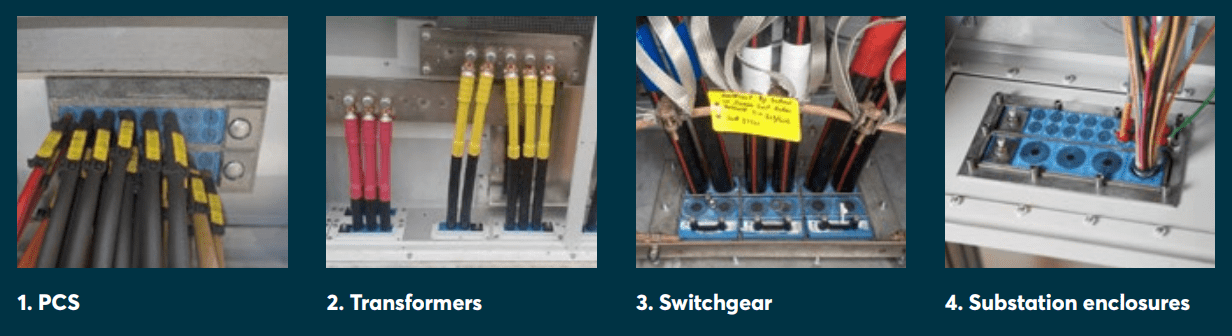
Roxtec’s area efficient seals are ideal for entries to power conversion system (PCS) enclosures, transformers, switchgear and other cabinet applications with high cable density.
Protect your Low & High Voltage Electrical Equipment by an organised cable entry manufactured by Roxtec that is also openable to simplify maintenance and sudden changes for future retrofit and cable alterations and additions.
Cabinets & Enclosures
Sealing Buildings & Containers
Roxtec cable and pipe seals work efficiently in above ground and underground walls and floors in buildings, battery storage containers, PCS enclosures and kiosks. Avoid fire, water, humidity and animal issues in your buildings and battery storage containers.
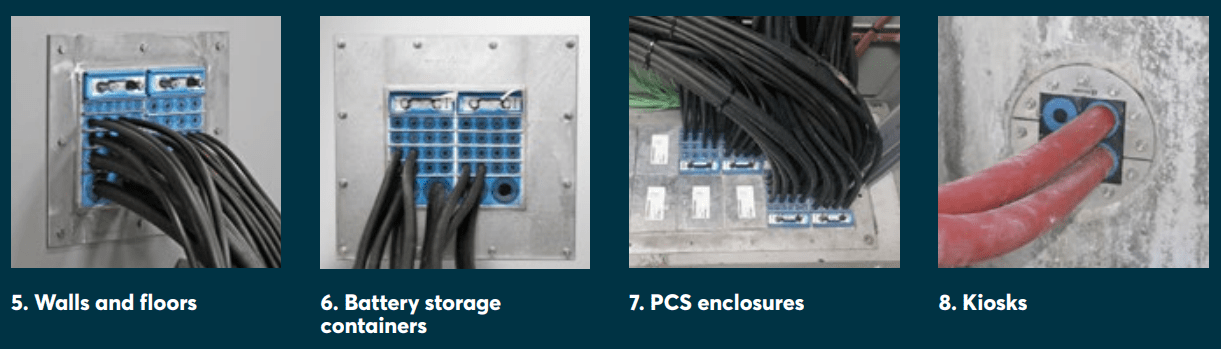
Buildings & Containers
➡ View the Roxtec range of Rectangular Cable Seals & Transit Frames & Round Cable Transit Frames & Cable Seals
 Why use Roxtec?
- Firestop
- Vapor-tight
- Animal mitigation
- Watertight
- Bonding, grounding and EMI protection
- Cable retention
Superior simplicity
- One cut-out for dozens of pre-terminated cables
- Flexibility for cables and pipes of different sizes
- Built-in spare capacity for future cables and pipes
Standardise for protection and spare capacity
Use Roxtec cable and pipe seals to minimise the risk of downtime caused by fire, animals, water and dust. Install them in power conversion system (PCS) enclosures, battery buildings and containers, substation equipment and transformers.
Roxtec seals are extremely space efficient and can be used for new or retrofit applications. Built-in spare capacity enables installers to quickly add cables without having to cut or punch new holes in the equipment.
Further Reading
Flexible Cable Seals for Gas Insulated Substations
Data Centres | Safely Sealing LV HV Cables & Electrical Equipment
Roxtec Pipe & Cable Seals | Offshore & Onshore Windfarm Product Spotlight
Cable Sealing Using Roxtec
Roxtec cable seals are used in cable vaults, duct banks, electrical substations, trenches and M&E building services protecting low, medium and high voltage power systems against numerous external risk factors:
- Fire – A60, H120 Class bulkhead sealing for offshore classification against jet-fire or spray and prevention of suffocating smoke spread
- Gas – ensure complete tightness against air and gas pressure or migration through cable ducts with DSEAR compliance
- Water – prevent flood and water penetration into substations and buildings – avoid humidity and partial discharge conditions
- Cables – withstand cable bending load in heavy power and high voltage cable seal applications
- Pressure – protect against catastrophic sudden or constant pressure
- Electrical – protect cables and electrical infrastructure against EMI, EMP and lightning strike effects
- Particles – control levels of of dirt, dust, chemical and fumigants from entering buildings, cable ducts and substations
- Blast – protect against vibration, shock-waves and the risk of explosion in industrial and hazardous area locations

Cable Transits – Sealing Cables & Pipes
Cable Transits
Roxtec cable transits are used to prevent water, gas, fire, dust and rodents from entering cable duct openings and potentially causing damage to cables and other electrical infrastructure.
Cable transit systems can be designed for sealing medium/high voltage substations including 11kV/33kV and “triplex” type cables in single, multiple or trefoil configuration.
Roxtec modular cable transit seals are based upon a rubber design with seals that are constructed of a number of removable layers to secure a watertight, gas tight and fire proof seal around the cable or pipe – the range includes rectangular transits and round transits to fit a variety of pipes and cable sizes.
Cable transit products ensure safety, reliability and efficiency by providing an effective, dependable seal around cables and pipes through an opening, penetration or duct.

LV MV HV Jointing, Earthing, Substation & Electrical Eqpt
Key Product Categories: Duct Seals | Cable Cleats | Cable Glands | Electrical Safety | Arc Flash Protection | Cable Jointing Tools | Cable Pulling | Earthing | Feeder Pillars | Cable Joints LV | Joints & Terminations MV

“30,000 Arc Flash Incidents per year” Source: ISHN
Arc Flash Risk
Electric Metering
Across the country, there are millions of electricity meters. The quality of these varies from very modern installations to very old assets. An important fact is that there are certain activities undertaken by a meter operator that can only be conducted ‘LIVE’ and it’s important that if you are responsible for people working with electricity that the inherent arc flash risks are considered and addressed. The primary risk for a meter operative are activities involving the cut-out (service head):
- Fuse carrier withdrawal
- Polarity testing and voltage measurements
- Installation of a shroud
- Checking the tightness of connections within the cutout
- Withdrawal of a shroud
- Re-insertion of the cut-out (service head)
There is an additional risk around metal-clad cut-outs and the opening of the cover. As the cover is conductive if there is a problem with the hinges, or if the cover is in fact unhinged, it can drop and come into contact with energized conductors causing an arc event. A similar risk can exist around multi-way distribution boards if any of the busbar covers are missing. This can’t be established before the opening of the cover of the distribution board.
Law & Legislation
There have been a number of life-changing injuries to meter operators/engineers with engineers being hospitalized for lengthy periods of time with repeated skin grafts being needed on their hands, arms, and face. Typically engineers have not been wearing adequate Arc PPE protection which is required by law in the UK and in many countries around the world.
Electricity at Work Regulation 1989. Regulation 14 Work on or Near Live Conductors; Standard of Duty is Absolute! No person shall be engaged in any work activity on or so near any live conductor (other than one suitably covered with insulating material to prevent danger) that danger may arise unless:
(a) it is unreasonable in all the circumstances for it to be dead; and
(b) it is reasonable in all the circumstances for him/her to be at work on or near it while it is LIVE; and
(c) suitable precautions (including where necessary the provision of suitable protective equipment) are taken to prevent injury.
Arc Flash In Conclusion
If you have engineers/operators working on or near LIVE or potentially LIVE conductors then it is very likely they are exposed to the risk of an Arc Flash or Electric Shock. Adequately protecting people and the organization is paramount and is your duty under the Law.
Ensuring that understanding the risk and creating meaningful steps to mitigate that risk is something each organization is responsible to carry out.
There are various professional organizations that have dedicated technical team(s) that work through the hierarchy of controls assisting clients in ways to:
1. Eliminate the risk by physically removing the risk
2. Substitute the risk by replacing the hazard
3. Engineering out the risk by isolating people from the hazard
4. Use of administrative controls to change the way people work – Comprehensive Electrical Safety Rules
5. Mandate Correct PPE (Personal Protective Equipment) – Last but not least!
Arc Flash Learning & Resources

Thorne and Derrick are proud to be distributors of ProGARM arc flash coveralls and protection.
We can help – should you require arc flash calculators or advice on the type of clothing and protection available please do not hesitate to contact us.

Thorne & Derrick International supply arc flash clothing and protection equipment including coveralls, gloves, helmets, face shields and general head-to-toe PPE is used to protect against flashover – complete range of insulating matting is also available for worker protection when exposed to energised electrical switchgear and transformers.
Typical applications include LV, HV & EHV cable jointing and terminating, fuse pulling, switchgear commissioning, racking circuit breakers, electrical switching and live working on medium and high voltage electricity networks.
T&D are national distributors LV, MV & HV Cable Installation, Jointing, Substation & Electrical Equipment – we service UK and global businesses involved in cable installations, cable cleating, cable jointing, substation, overhead line and electrical construction at LV, 11kV, 33kV and EHV.
Since 1985, T&D have established an international reputation based on SERVICE | INTEGRITY | TRUST.
Guidelines for cable drum handling during transport and storage
Transport
Cable drums must be handled with care.
Improper handling procedures or cable drum handling equipment can easily cause damage like broken drums or visible or invisible damage of the cable itself.
Main danger comes from invisible damages leading to unusable cables.
Therefore some base guidelines shall be followed. The cable itself must always be protected and may not be touched improperly during transport and storage. A drum, damaged by handling or showing signs of wear or rotting must be checked. Special handling procedures may be necessary.
If a wooden drum is handled and/or stored properly as described in this document LEONI Kerpen GmbH gives warranty for stability and usability for a period of up to 18 months after delivery. In case of wooden drums show signs of damage from transportation any warranty obligation given for cable drums and any subsequent cable problems resulting from it are null and void.
Beside the general guidelines, please refer to the cable data sheet for additional information regarding temperature range and possible special requirements for transport and storage.
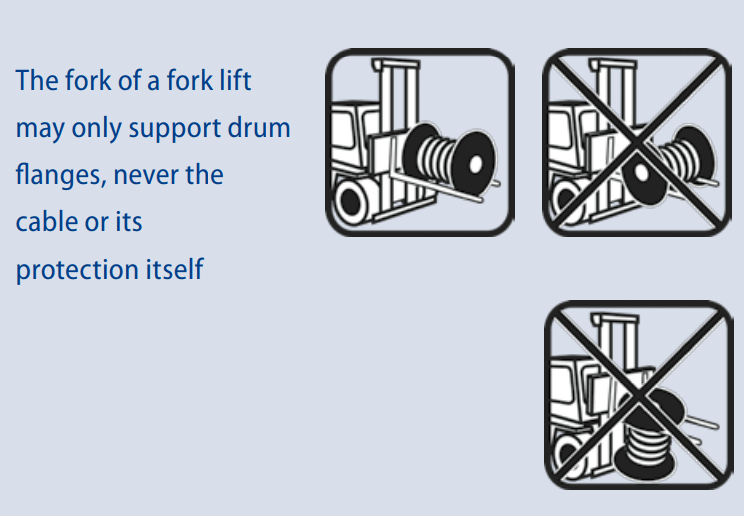
- Lifting cable drums with a fork lift is only allowed from the “flange side”. The fork may never touch the cable or its protective cover to avoid damage. The fork must support both flanges while lifting.
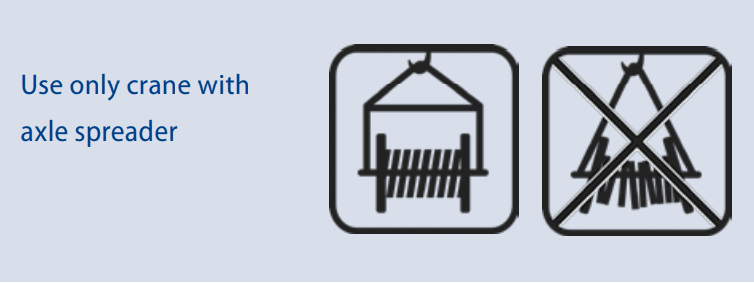
- If lifting a drum with a crane an axle or a spreader beam must be used to avoid lateral pressure on flanges.
- Suitable devices must be used for loading and unloading in order to avoid damage to the cable and the drum. Drums may never be dropped from a truck, ramp or container.
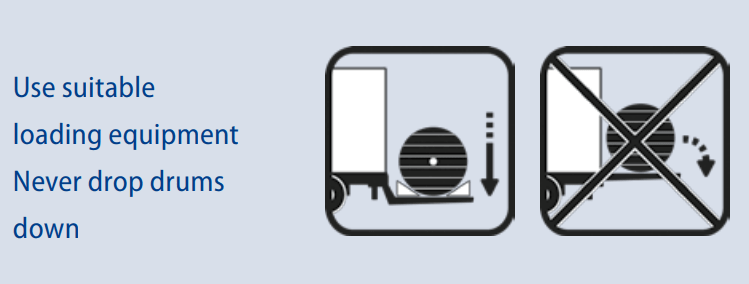
- Cable drums should only be transported with suitable vehicles and must be fixed, so that they cannot shift during transportation. The same applies in case cables are transported in a container.
- During transport and storage drums shall always be in upright position.
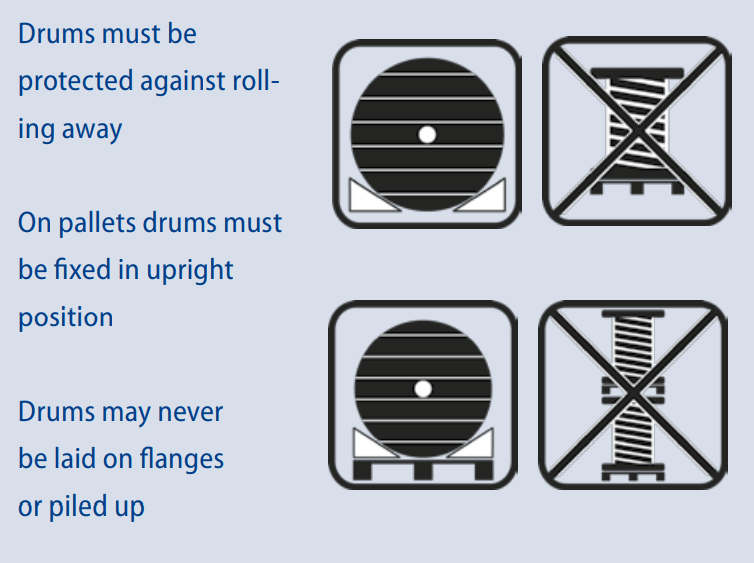
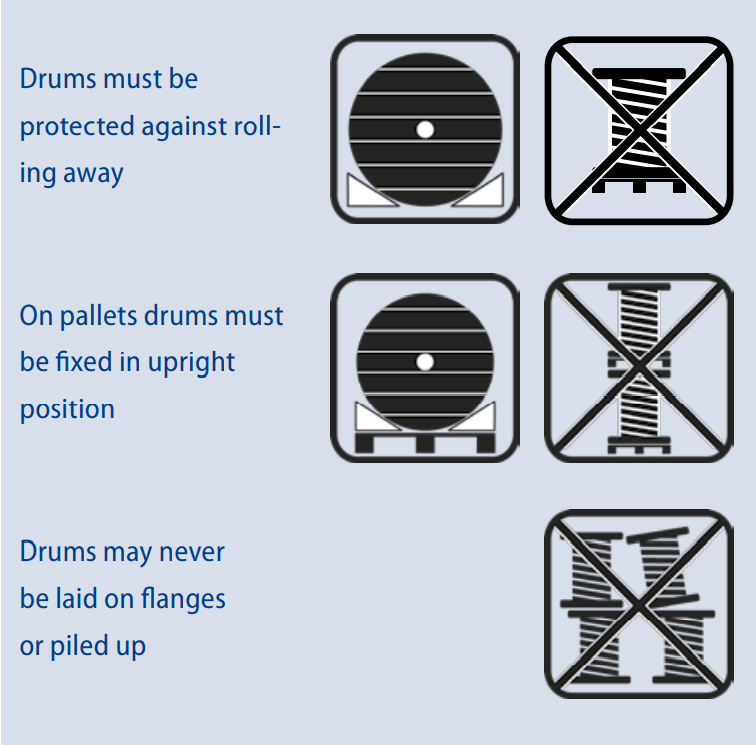
Drums must be protected against rolling away. On pallets drums must be fixed in upright position. Drums may never be laid on flanges or piled up.
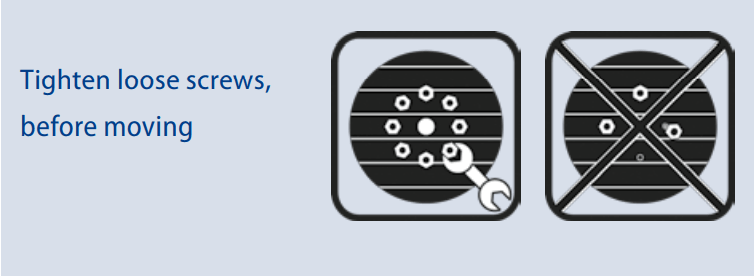
- All screws holding the flanges must be checked and tightened before moving the drums.
- In case of dry and hot weather conditions screws have to be tightened as required to compensate for shrinking of wood. Tightening of screws shall be done with a torque wrench. The force shall be as mentioned on the drum or as follows:
| Drum Size |
Force |
| 700–1400 mm |
80 Nm |
| 1600–2200 mm |
100 Nm |
| 2500–2800 mm |
120 Nm |
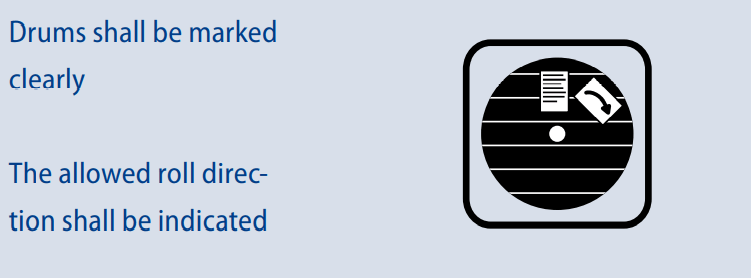
- Drums with cables may only be rolled over short distances and on a firm and even surface in the direction which is indicated on the drum (label with arrow and inscription “Roll This Way”).
- Each drum is identified by an unique drum number. In case a cable or part of it is rewound onto another drum, it is recommended to note the original drum number, otherwise backtracking is impossible.
- Drums must be labelled to allow easy and quick identification of the cable:
– identification labels showing cable type, length, code no., etc.
– other markings.
- The maximum temperature for transportation is indicated in the data sheet, section “Transport and Storage”.
- Due to interdicted stress during transportation, nails used to fix the two layers of a flange might be forced to shift into the inner side of a drum. Drums damaged or overstressed (e.g. dropped on a flange) needed to be checked carefully from the outside. Nails in question have to be removed by pliers before rolling or turning the drum to avoid continuous damages of outer sheath by rotating cable layers.
It is always a sign of incorrect cable handling, when hats of nails are sticking out of the inner flange of a cable drum. This movement is caused by shifts of the 2 wooden flange layers against each other under interdicted force while moving the drum.
In addition, multiple damages might occur by such a nail hat, due to unavoidable but “normal” movements of a cable on a cable drum while being un-drumed.

Cable Rollers
Cable Drum Storage
Cable drums shall be stored safely. Improper storage conditions can easily cause damage to cable drums or cables themselves. Therefore some base guidelines shall be followed.
The cable itself must always be protected and may not be touched improperly during transport and storage.
Check drums before moving. Check for nails, which might have shifted out of the inner side of the flange. Remove it from the surface before rolling or moving the drum.
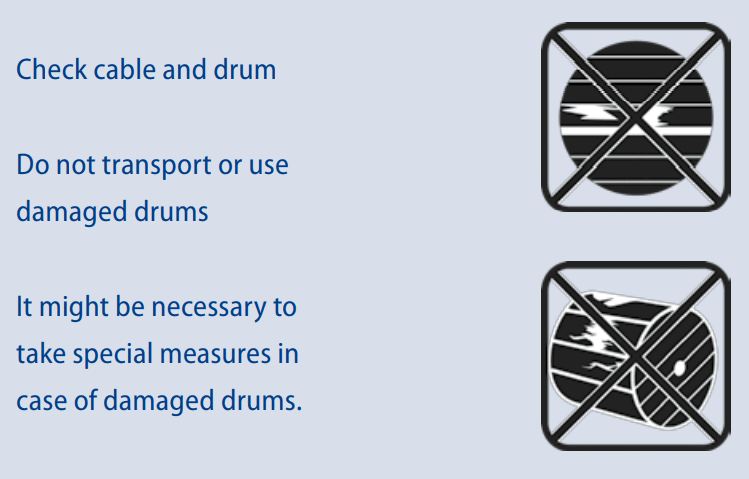
A damaged drum must be checked. Special procedures may by necessary, like rewinding on a new drum.
If a wooden drum is handled and/or stored properly as described in this document LEONI Kerpen GmbH gives warranty for stability and usability for a period of up to 18 months after delivery. In case wooden drums show signs of damage from handling and/or storage any warranty obligation given for cable drums and any subsequent cable problems resulting from it are null and void.

Cable Protection | LV MV HV
Beside the general guidelines, please refer to the cable data sheet for additional information regarding temperature range and possible special requirements for transport and storage.
- Cables for indoor use shall be stored indoor.
- Cables for outdoor use may be stored outside. Their allowed temperature range for storage should cover the conditions defined for storage. See cable data sheet, section “Transport and Storage”, for any details.
- All cables on drums shall be protected with suitable protection package, such as black plastic sheeting, lagging, etc.
- Cables (especially with black sheath) exposed to direct sunlight will become warmer than the ambient temperature. It must be ensured that the temperature of the cable will not exceed the allowed maximum temperature for storage. See cable data sheet, section “Transport and Storage”, for any details.
To avoid direct exposure to sunlight the cable shall be protected with suitable package, such as a dark foil, and/or by storage in shadow.
- Cable ends must be fixed on the drum to avoid getting loose during transport, handling or storage.
- Cable ends shall be sealed with caps against ingress of water.
- Drums must be labelled to allow easy and quick identification of the cable and of main handling issues:
– identification labels showing cable type, length, code no., etc.
– a label to indicate the allowed roll direction (“Roll This Way”)
- Drums must be handled and stored always in upright position, standing on the flanges. The ground must be firm, even, well-drained and stable, so that the flanges cannot sink in. Pressure on flanges must be equal on complete flange surface in contact with ground.
- Drums must be protected against rolling away while stored.
- The drums shall not be standing in direct contact with water or damp soil to avoid rotting of the drum.
- Drums may never be transported or stored lying on a flange. Damages to cable or drum are likely in this case. Lying and handling horizontally is only acceptable for small drums and light weight cables.
- Cables shall be stored in areas without influence of high heat or close to (open) fires. Areas where chemicals, petrol, etc. could be spilled over them must be avoided.
- If stored in a secure and suitable area, periodical inspections of the drums are recommended, at least quarterly. In case of direct exposure to weather, sunlight, etc. the interval between inspections should be shortened.
- Damaged drums must be checked carefully. It might be necessary to take special care during transport or installation or to rewind the cable on another drum.
Further Reading
Cable Drum Handling | Halogen Free Shipboard Cables Recommendations
HV Cables | Underground Cable Tunnel Pull 400kV By ABB
Cable Drum Handling | Jack Towers for LV to EHV Power Cable Lifting & Site Handling
Cable Drum Handling & Laying Cables | A Guide from Nexans
Cable Pulling | 37km Offshore Cable to Connect NnG to Onshore Substation

CABLE SOCKS & PULLING PRODUCTS LV MV HV
Complete range of LV, MV and HV cable pulling products for installation and enabling cable jointing in trench or ducts including LV, 11kV/33kV medium voltage (MV), 66kV/132kV high voltage (HV) and EHV transmission and distribution cables up to 400kV.
Further Reading | Cable Drum Handling & Laying Cables | A Guide from Nexans
Arc Flash Protection

ProGARM Arc Flash Clothing, Garments & Electrical PPE
An Arc Flash Study is a risk assessment of a workplace environment that determines Arc Flash hazards. An expert in electrical safety conducts an assessment to ensure that a company understands the risks their workplace poses to their team and how to protect against them. Assessment providers may also offer training to increase your team’s awareness and options for periodic reviews.
WHAT DOES AN ARC FLASH STUDY INVOLVE?
How big would the bang be? That is the central question that an Arc Flash study seeks to answer. Only by knowing this can you adequately protect your team against the Arc Flash risks of their working environment.
An Arc Flash study will identify areas of low risk, as well as those at high risk of an Arc Flash incident. This allows you to tailor your Arc Flash protection strategy accordingly. The study will also assess the potential severity of injury at a given distance and locate the protection boundary at which there is a severe danger of second-degree burns.
There are many facets to a successful Arc Flash assessment and generally, they are adapted to fit your specific industry and requirements. They can include Arc Flash calculations, fault level studies and comprehensive site surveys.

WHO NEEDS TO CARRY OUT AN ARC FLASH STUDY?
Companies in the UK are not currently obliged to perform Arc Flash assessments on their sites. This is in stark opposition to the USA, where there is more awareness about the dangers of Arc Flash incidents. An Arc Flash study may be optional, but the positive impact on safety within your organisation is likely to be significant.
Arc Flash protective clothing is vital to protect your team should they be at risk. An Arc Flash study will highlight what level of protection is needed, allowing you to make an informed decision about your team’s Arc Flash protective clothing requirements. Arc Flash garments are available from specialist Arc Flash and non-specialist suppliers – we believe that when lives are at stake that you should trust a specialist. All garments that are rated for Arc Flash protection conform to EN Standards, but not all Arc Flash garments are created equal.
Take a look at what it takes to create a ProGARM garment and explore how our garments protect your team, the quality and durability of our arc flash clothing and how the comfort and design of our garments contribute to protecting your team.
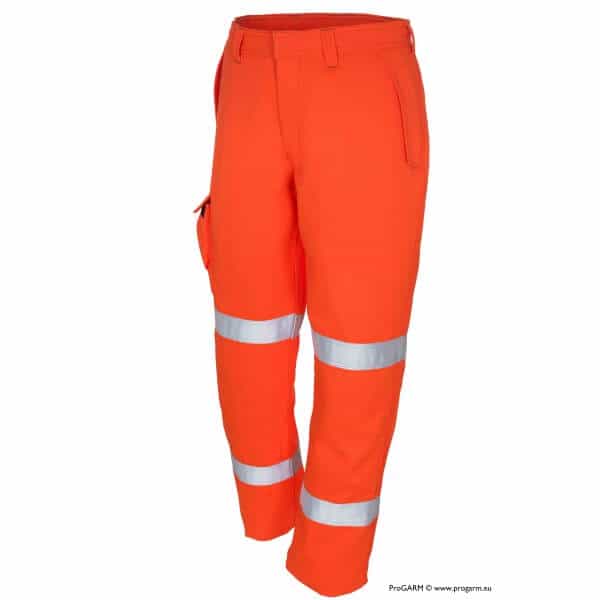
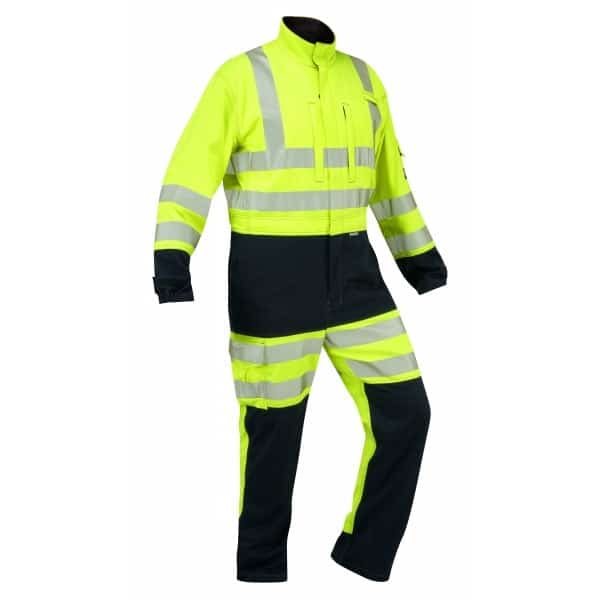
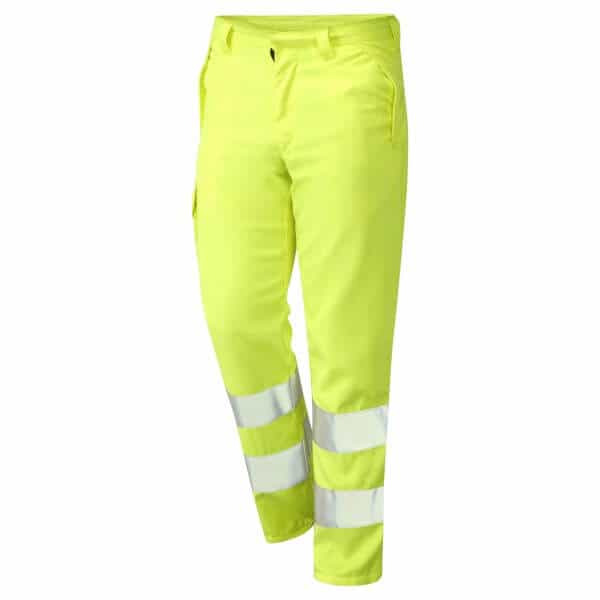
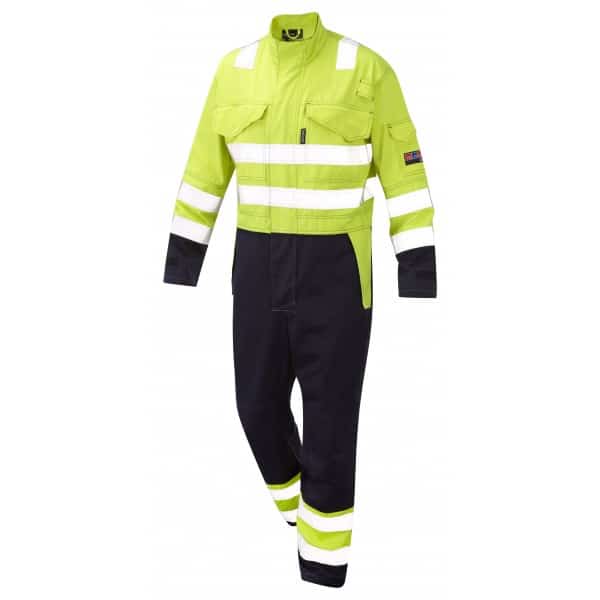
Thorne & Derrick distribute a range of arc flash coveralls to suit a range of requirements. Variations include ladies coveralls, designs for overhead linesmen, orange and yellow hi vis options and a wide range of sizes. Contact Thorne & Derrick with your specific PPE requirements and we will be happy to help.
The ProGARM range of Flame Resistant protective garments are designed for every-day wear and protection – the highly breathable clothing ranges are designed for comfort and safety without compromising the ability of the wearer to work productively, safely and unhampered by cumbersome garments prone to overheating.
Other garments and protection products include Arc Flash Gloves, Arc Clothing, Arc Flash Suits and Arc Flash Helmets & Visors.
Further Reading
💡 Did you know? – While high voltage equipment does increase the likelihood and intensity of arc flash explosions, they can occur in any live electrical environment – even low voltage.
Arc Flash Learning & Resources
Thorne and Derrick are proud to be distributors of ProGARM arc flash coveralls and protection.
We can help – should you require arc flash calculators or advice on the type of clothing and protection available please do not hesitate to contact us.
Republished by Kind Permission of The OHS Body of Knowledge – The OHS Body of Knowledge (OHS BoK) is the collective knowledge that should be shared by generalist OHS professionals to provide a sound basis for understanding the causation and control of work related fatality, injury, disease and ill health (FIDI). This knowledge can be described in terms of its key concepts and language, its core theories and related empirical evidence, and the application of these to facilitate a safe and healthy workplace. The OHS BoK has been developed for the Australian OHS context but has international application.
Source is Australian Institute of Health and Safety
Uploaded by Chris Dodds | Sales & Marketing Manager at Thorne & Derrick UK
Authored by | Brett Cleaves, Director, Engineering Safety Pty Ltd
Peer Review by | Vanessa Garbett, Team Leader, Electrical Installation Safety, Energy Safety Victoria, Australia
Acknowledgements to | The Australian Institute of Health and Safety (AIHS) financially and materially supports the OHS Body of Knowledge as a key requirement of the profession. The Australian OHS Education Accreditation Board influences, supports and monitors the OHS Body of Knowledge.
Second Edition, 2019

The Understanding Arc Flash Document includes a content page as follows:
Table of Contents
A1 Introduction
A1.1 Some electrical terms
A2 The extent of the problem
A3 Understanding arc flash
A3.1 Electrical arcs
A3.2 Arc faults, arc flash and arc blast
A3.3 Impact of arc flash
A3.4 Arc flash and nature of work
A4 Risk assessment
A5 Legislation and standards
A5.1 Legislation
A5.2 Standards
A6 Control of arc flash hazards
A6.1 Elimination
A6.2 Substitution
A6.3 Engineering controls
A6.4 Administrative controls
A6.5 Personal protective equipment (PPE)
A6.6 Resilience of controls
A7 Implications for OHS practice
A8 Summary
List of Figures
Figure A1 Arc flash and arc blast
Figure A2 Electrical work and arc flash
Figure A3 Prevention and mitigation of arc flash hazards
List of Tables
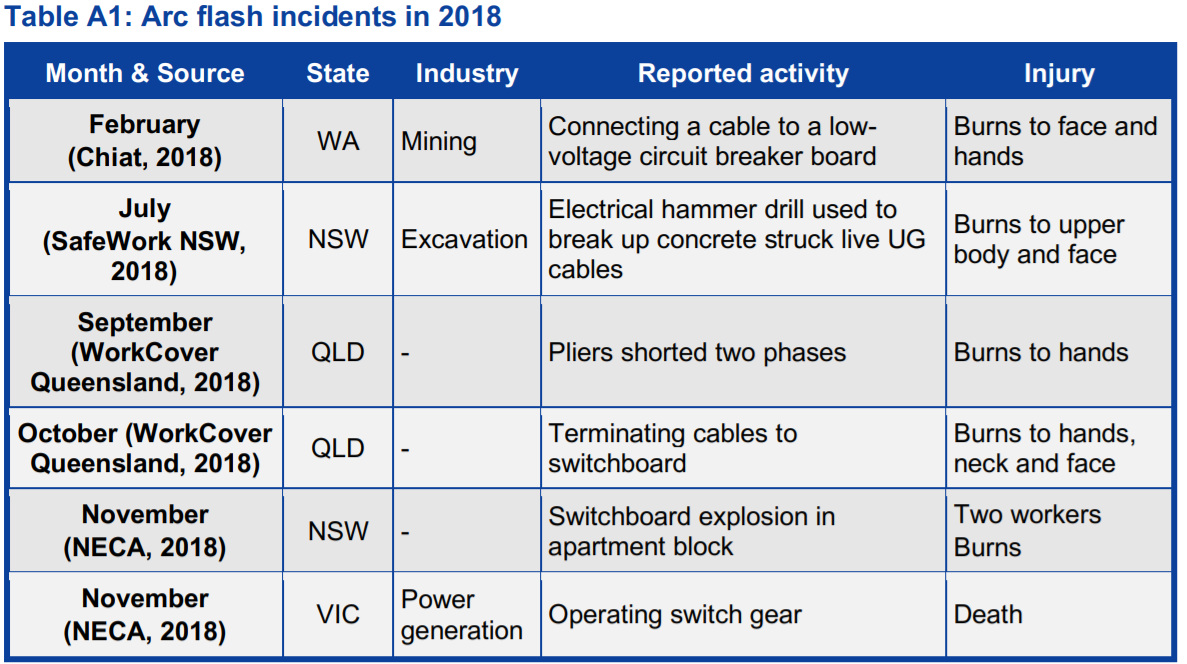
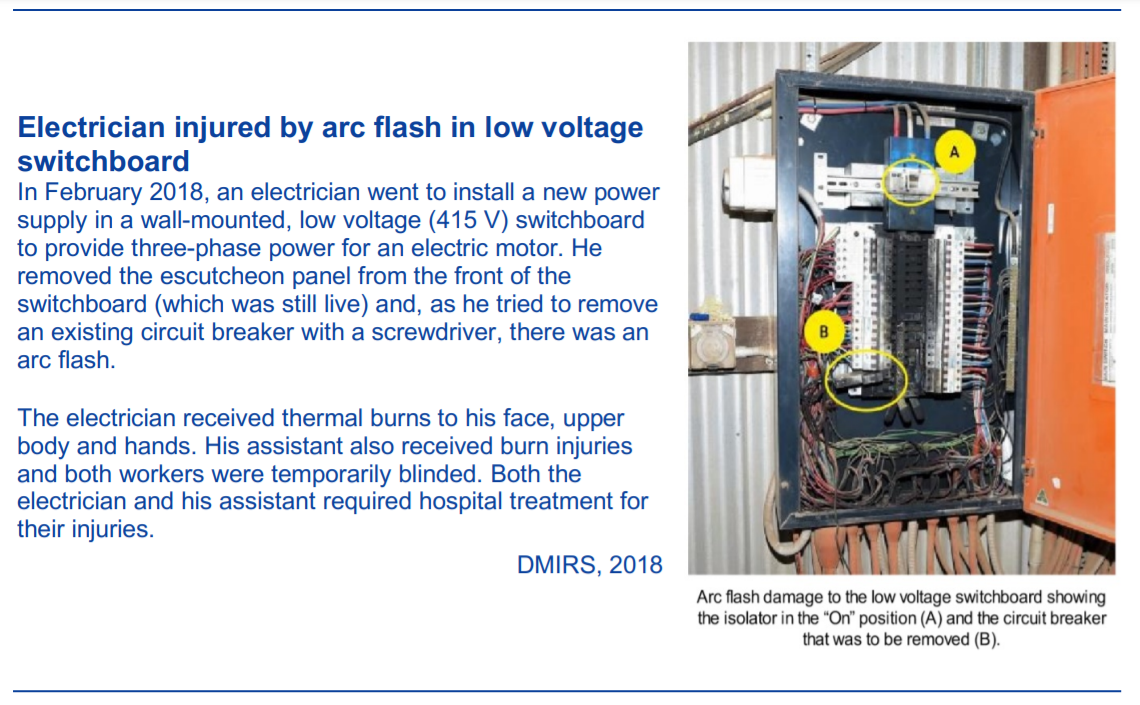
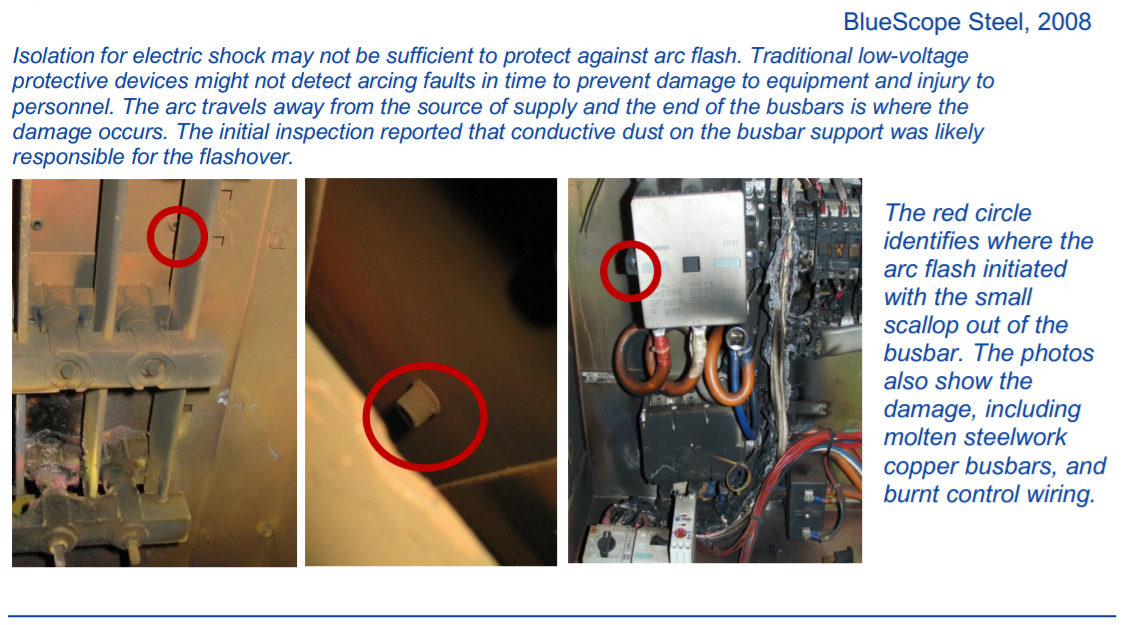
Table A1 Arc flash incidents in 2018
Table A2 Risk factors for arc flash
Table A3 Control options for arc flash
Table A4 Examples of impact of organisational context on implementation of arc flash controls
Abstract
This appendix to the OHS Body of Knowledge Chapter ‘Physical Hazards: Electricity’
focuses on the electrical hazard of arc flash from the perspective of the generalist OHS
professional. After defining relevant terms, examining the incidence of arc flash injuries and
reviewing relevant legislation and standards, it considers options for control of arc flash and
implications for OHS practice.
A1 Introduction
The OHS Body of Knowledge chapter Physical Hazards: Electricity presents information required by generalist OHS professionals to enable them to better understand the nature of electricity as a hazard, how it can harm the human body and the standard control measures.
The chapter emphasises the severity of potential consequences of an electrical incident, noting that several deaths by electrocution occur in workplaces across Australia every year. This appendix focuses on one particularly dangerous type of electrical hazard – arc flash – the consequences of which can range from inconsequential to severe burns and death as well as power outages, fire and significant property damage.
While arc flash is associated with electrical work, and may be considered a specialist topic, all workplaces have electricity and so arc flash hazards are of pervasive relevance. With the introduction of metal clad switchboards from the mid-20th century came the practice of switchboard arc flash containment and testing, and it was not until the 1980s that arc flash hazards were first quantified.
Consequently, knowledge of arc flash hazards, the risk factors and the mechanism of injury causation is still evolving. The dynamic nature of this knowledge is reflected in the existence and use of different standards and terminology across countries and organisations; this inconsistency can present problems for generalist OHS professionals working with electrical personnel to implement a risk management approach to minimising arc flash.
To Receive Your Free Copy
of the Full Report
Please Email
Meet the Author, Brett Cleaves BE(Elec)
Director, Engineering Safety Pty Ltd
Email: [email protected]
Since starting as a cadet with BHP in 1993, Brett has worked in steel mills, mines and electrical utilities, executing a range of duties in maintenance, engineering, governance, production and project management.
He developed a strong commitment to electrical safety, and received BlueScope awards for leadership and engagement. In 2013, Brett established Engineering Safety through which he provides project management services for a range of electrical companies together with general advice on electrical safety to industry.
At the leading edge of hazard identification, assessment and control for arc flash in Australia, Brett is a strong advocate for the need for knowledge of arc flash to evolve to provide clarity on the most appropriate practices and controls.