By David Hall, Head of Sales at Lucy Zodion

EV Charging | Lucy Zodion Feeder Pillars
The government has the unenviable task of managing one of the world’s most significant, and important, transitions to occur in industry for a very long time. Perhaps the most important to happen in motoring, ever.
The government’s Road to Zero strategy aims to be net-zero by 2050. The sale of new conventional petrol and diesel cars will also be phased out by 2040 (and now brought forward to 2035) to support this ambitious goal.
The Department for Transport said its £400m public-private Charging Infrastructure Investment Fund will see thousands more charge points installed around the country. The UK currently has approximately 11,000 public charging locations providing 30,000 EV connectors. Whilst that is quite impressive, it is still a cause for concern.
One factor that impacts on our industry enormously is the lack of charging infrastructure available. While charge point numbers are increasing, the UK is still some way short of what it needs, and this feeds into consumer EV ‘range anxiety’, in turn dampening demand.
Home & Workplace Charging

It is claimed 90% of people who charge their electric car do so at home. The government has set out ambitions for all new homes in the UK to be built with the provision of EV charge points, a world first. But while charging at home is ideal for those who have access to a drive and a charge point, for those without, charging immediately becomes more challenging.
The BBC recently reported on this apparent gap in charging infrastructure, where it identifies real life cases of users struggling to charge thier new electric vehicle due to lack of off-road parking. Read the article here.
The article states: “A recent report from Capital Economics suggested that fleshing out the UK’s electric vehicles (EV) charging network will cost £45.9bn between now and 2050. There are even fears that the electricity grid won’t be able to cope as thousands more EVs get plugged in by their new owners.”
Nevertheless, as Lighting Journal highlighted in the autumn, on-street EV charging is gradually becoming more available, with a range of funding streams available for local authorities and others to tap into (‘Plug in and play?’, November/December 2019, vol 84, no 10). All this, in turn, puts street lighting and streetlamps firmly in the spotlight when it comes to EV charging.
Why Street Lighting? It is existing infrastructure, ubiquitous and common throughout most urban spaces. As streetlights are constantly powered, it makes sense to utilise existing street furniture, especially when adding further street clutter is not suitable or desired.
Nevertheless, as Lighting Journal highlighted in the autumn, on-street EV charging is gradually becoming more available, with a range of funding streams available for local authorities and others to tap into (‘Plug in and Play?’, November/December 2019, vol 84, no 10). All this, in turn, puts street lighting and streetlamps firmly in the spotlight when it comes to EV charging.
Retrofitting EV charging facilities into streetlights can often be cheaper than installing new on-street charge points, which often include expensive ‘new connection’ costs.
Saying that, existing streetlights have their own costs and complications, particularly around connections and earthing requirements. However, manufacturers such as ubitricity have made good headway in tackling this area.
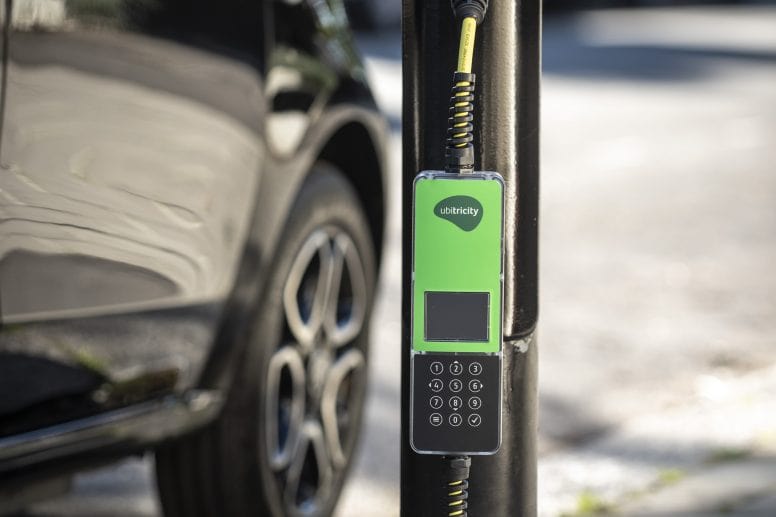
As Allan Howard outlined in Lighting Journal in January (‘It’s not just a case of “here’s a vertical tube, let’s go and drill a hole in it”,’ vol 85 no 1), in order to make streetlights multi-purpose assets in this way, providing both illumination and charging facilities, the electrical infrastructure within the lighting column itself must be adapted, and done so by an approved electrician.
Although streetlights are already connected to a DNO electricity supply there are a number of considerations and requirements, particularly on earthing systems (conversion to a TT earthing system). The correct type of protection must be used and locality of nearby assets must be considered to reduce the potential of electric shock (touching distance).
At Lucy Zodion, we strongly recommend using the latest edition of the IET Code of Practice for Electrical Vehicle Charging Equipment Installation (BS7671+ A3) as your guide for installations. Work with your DNO and appoint an approved contractor to help ensure that your street lighting infrastructure is compatible and in line with industry standards.
In the event when a secondary isolator is not present, ensure you install a product such as (to use our own examples) a Trojan Midi (3-way) or Trojan Maxi (4-way), manufactured to current British and industry standards and tested to IEC/EN 60947-3 and the fuse carrier to IEC/ EN60269-1.
This will provide a reliable protection. Use any service department to help manage variations, gland plates, locking options and so on, where possible, giving individual protection for both the EV charging equipment, feeder pillars and the luminaire.
Public Realm Charging Points
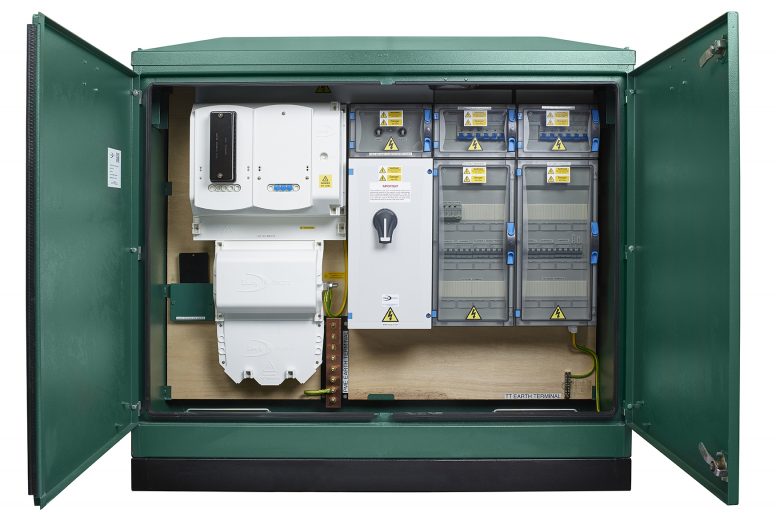
One thing is certain, to implement a holistic EV charging infrastructure, a mix of charging types is required, not just slow (home) and fast (7kW on-street). Public realm charging points are becoming increasingly crucial as adoption rates for electric vehicles surge. People will need to charge their cars as they go about their daily lives. Whether at schools, shopping, train stations, or airports (and the list goes on), EV charging needs to be commonplace and readily accessible, not just when at work or home. The need for convenience is paramount.
These public realm chargers will need to have faster charging times – between four hours and 30 minutes – falling into the ‘rapid’ and ‘super charging’ category. With this, of course, comes a different set of requirements. These are associated with larger power capacity, the need for new connections, either from DNO supply or perhaps even a package sub station if a large installation.
And the requirements will vary in different areas of the country, as each DNO will have its own approved products and working practices. Luckily for us at Lucy Zodion our street lighting cut-outs are widely approved across all DNO networks. Additionally, our sister company Lucy Electric has been working with DNOs for decades, supplying heavy duty cut-outs, CTCOs and package sub stations.
Given all this, we recommend five things to consider when installing a new connection for an EV charge point.
1. Plan properly – Anticipate that the process will take longer than expected and, given the increasing demand for new connections, timescales will only get longer.
2. Follow the process – Check with your DNO when ordering a new connection that you are using the right process. Many have fallen foul by not checking first, resulting in an installation that will not get approved.
3. Install quality products –Installing high-quality products will reduce potential issues that may arise in the future. Ensure all your products comply to the appropriate regulations and are tested regularly.
4. Consider oversizing – Consider oversizing your supply and include some spare capacity in your EV connection and supply pillar. By making your system scalable, you can add to the number of charge points or upgrade the rating of your charge points in the future, when technology supersedes current equipment.
5. Maintain regularly – In order to keep your equipment in good working order test and inspect regularly. It is pointless having stranded assets that aren’t serving customers and/or earning revenues.
This article was originally published in the March 2020 edition of the Lighting Journal, available here.
Further Reading
➡ More Lucy Zodion blogs:
Cut Outs & Isolators – Lucy Zodion Explain The Differences
Feeder Pillars From Lucy Zodion – LV Electrical Power Distribution
Optional Extras For Use With Lucy Zodion Fortress Feeder Pillars
Waveform Cable Termination – 3 Core 300sqmm Cable Onto A 2 Ganged Metered Way In Lucy Cabinet
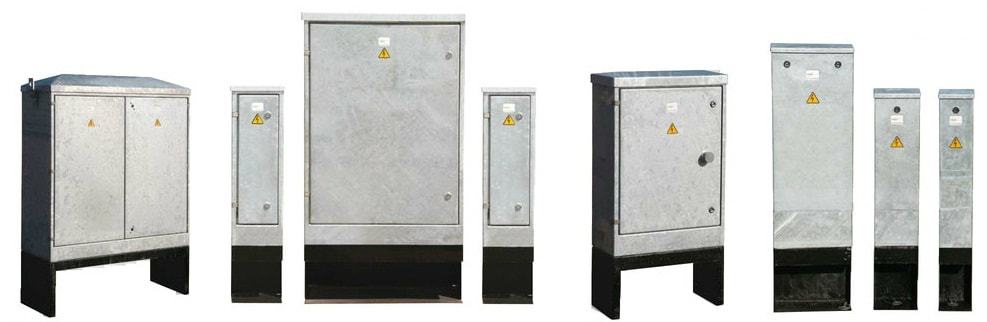
Galvanised & Stainless Steel | GRP | Pre-Wired | Underground Retractable Feeder Pilars
THORNE & DERRICK SPECIALIST ELECTRICAL DISTRIBUTOR
LV ♦ MV ♦ HV
T&D distribute the most extensive range of LV, MV & HV Cable Jointing, Terminating, Pulling & Installation Equipment – we service UK and international clients working on underground cables, overhead lines, substations and electrical construction at LV, 11kV, 33kV and EHV transmission and distribution voltages.
- Key Products: MV-HV Cable Joints & Terminations, Cable Cleats, Duct Seals, Cable Transits, Underground Cable Protection, Cable Jointing Tools, Feeder Pillars, Cable Ducting, Earthing & Lightning Protection, Electrical Safety, Cable Glands, Arc Flash Clothing & Fusegear.
- Distributors for: 3M, ABB, Alroc, Band-It, Catu, Cembre, Centriforce, CMP, Elastimold, Ellis Patents, Emtelle, Furse, Lucy Zodion, Nexans Euromold, Pfisterer, Polypipe, Prysmian, Roxtec.

LV – Low Voltage Cable Joints, Glands, Cleats, Lugs & Accessories (1000 Volts)

MV HV – Medium & High Voltage Cable Joints, Terminations & Connectors (11kV 33kV EHV)

Cable Laying – Underground Cable Covers, Ducting, Seals & Cable Pulling Equipment
Republished with the Kind Permission of Sam Soady |
Eccentricity Pty Ltd Director /HV Operator / Cable Jointer
Verifying MV Cable Sheath Integrity
As a cable jointer, most of the time I am called in to jobs at specific times during construction to complete high voltage cable terminations.
I usually only see the end stages of most projects, and the HV cables have already been installed by other contractors.
As the cable jointer and electrician certifying the cable installation, it is important to verify the cable has been installed appropriately. As the cables are generally buried direct underground or in conduit systems, it can be difficult to inspect the cable for physical damage that may have occurred during installation.
This is when a sheath integrity test should be performed. Eccentricity recommends testing the sheath integrity prior to installation (on the cable drum) and post installation (in the ground). This gives you a good baseline to compare to after the cable has been installed and whether damage has occurred during installation.
Potential hazards that can damage the MV cable sheath include:
- Binding machinery that wraps single core cables to tightly into trefoil
- Rocks / debris present in the underground trench
- Sharp edges along the route of installation
- Not using suitable aggregate material or sand when backfilling around cables
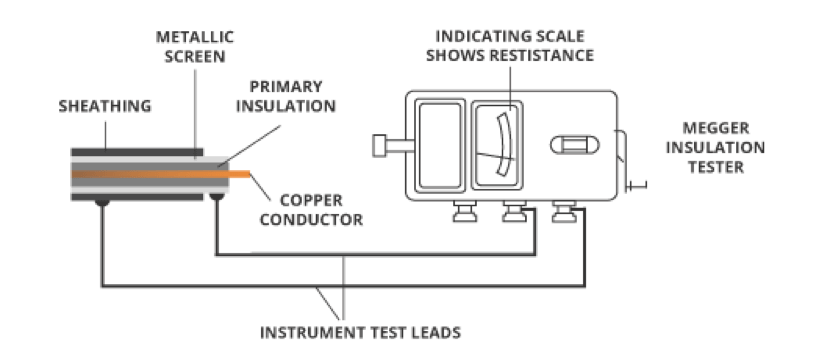
The sheath integrity test consists of a DC voltage injection on the screen wires of generally 1000V on MV cables to the general mass of earth. By proving the insulation resistance of the outer sheath is acceptable, it can be expected no damage to the outer sheath has occurred during installation.
Before Eccentricity completes any terminations for our clients, we complete this sheath integrity test to further ensure the baseline of the cable installed is adequate and the termination has not compromised the sheath in any way.
About Eccentricity

Eccentricity is a specialised Brisbane based company with a team of dual trade electricians and cable jointers. Our technicians are fully qualified to work on cables up to 66kV, including XLPE, PILC and EPR cables, backed by over a decade of industry experience.
With a modern and fully compliant fleet of industry vehicles, we are capable of accessing any high risk environment to perform works with a wide range of major MV HV cable jointing projects including, mining, oil, gas, renewable energy, and high voltage transmission networks.
Eccentricity has the capacity for small or large scale projects, providing reliability of power networks wherein client satisfaction is a top priority. We provide a high level of quality with all aspects of both installation and commissioning, ensuring we comply with all relevant regulations and legislative provisions.

Specialist Suppliers of High Voltage Electrical Equipment & Cable Accessories
Jointing, Earthing, Substation Electrical & Safety Equipment Distributors
Thorne & Derrick International are specialist distributors of LV, MV & HV Cable Installation, Jointing, Duct Sealing, Substation & Electrical Equipment – servicing UK and global businesses involved in cable installations, cable jointing, substation, overhead line and electrical construction at LV, 11kV, 33kV and EHV.
THORNE & DERRICK Product Categories: Duct Seals | Cable Cleats | Cable Glands | Electrical Safety | Arc Flash Protection | Cable Jointing Tools | Cable Pulling | Earthing | Feeder Pillars | Cable Joints LV | Joints & Terminations MV HV
Ander-Fin Cable Anchoring Systems
ANDERTON REDUCING CABLE THEFT
With cable theft costing the UK rail network millions of pounds each year, Anderton are tackling the issue with the launch of a new innovative-patented product, Ander-fin – this complements their market-leading range of cable trough systems specified extensively throughout the UK and international rail networks.
Ander-Fin Cable Theft Deterrent
Metal & Cable Theft
Theft of metal on the rails has been a prominent problem for many years, not only at the cost of taxpayers, but it also has the potential to bring the network to a standstill. As the leading manufacturer of precast concrete products, we have designed a system to make cable theft virtually impossible.
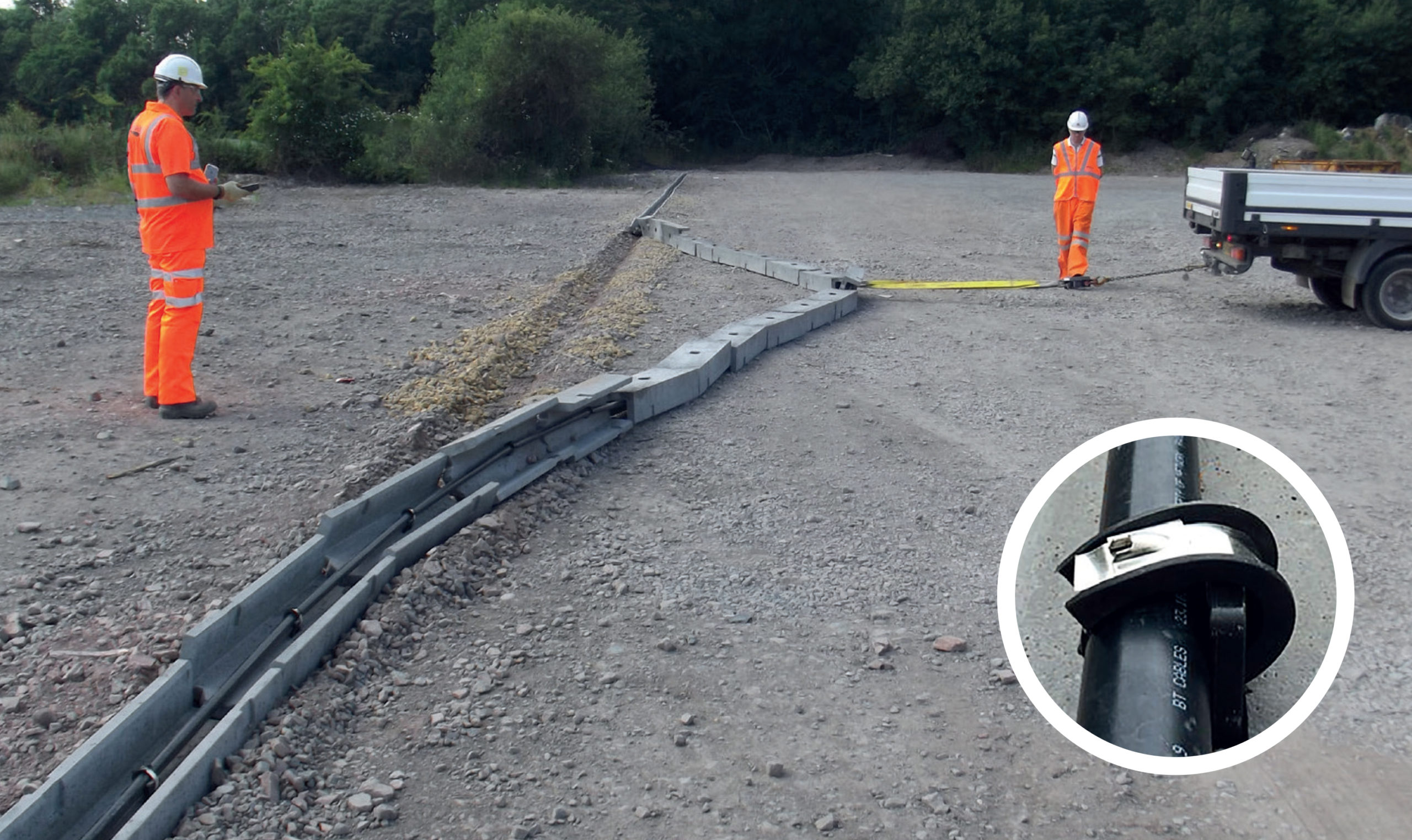
Ander-fin is a newly approved cable anchoring system, which is patent approved and can be used in conjunction with our cable troughs to protect from metal theft.
Every reduced weight trough, which we now manufacture, incorporates a slot in its base to allow Ander-fin to be fitted at the point of installation, which when used in unison creates a system that makes cable theft virtually impossible.
Shaun Forrester, Sales Director for Anderton Concrete commented: “We believe Ander-fin offers an extremely effective solution to a continuing problem within the rail network and its shocking to learn an estimated 50,000 minutes per year are lost on the rail system due to cable theft. The beauty of our patented system is that we have protected every aspect of the system; this includes the void in the trough and the fin itself to anchor down the cable, which prevents any other system replicating the anchoring of cable via a void in the trough.
“For any railway scheme designers who are working in high risk areas, we encourage to specify the patented system as early as possible within the process. This will mean that the trough route is protected against potential theft and therefore reduces the chance of costly delays once the network is operational.”
Ander-Fin Rail Cable Anchoring System
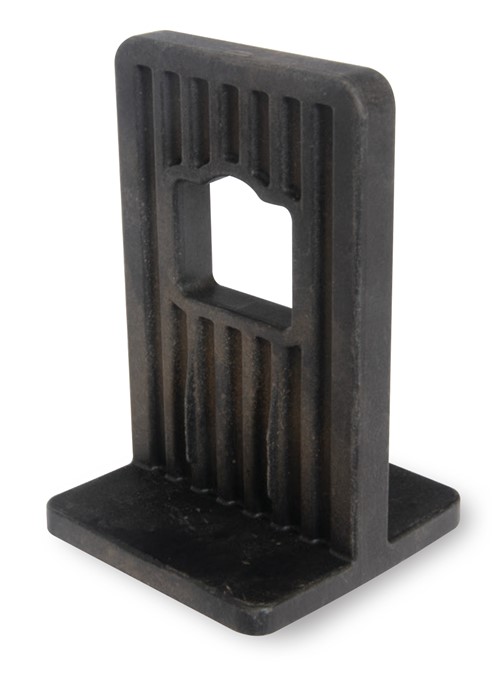
Anderfin Cable Anchoring Systems
Protect against cable theft with Ander-Fin – the newly approved cable anchoring system from Anderton.
Benefits Of The Ander-Fin
- Cable theft costs the rail industry thousands of delayed minutes each year and is costly to replace
- Cable theft causes safety hazards
- Ander-Fin helps to prevent cable theft by securing and tying the cables to the trough
- Ander-Fin secures long lengths of cable
- Can be used in conjunction with Anderton cable troughs
- Ander-Fin cable anchoring system is patent approved
How Does The Ander Fin Work?
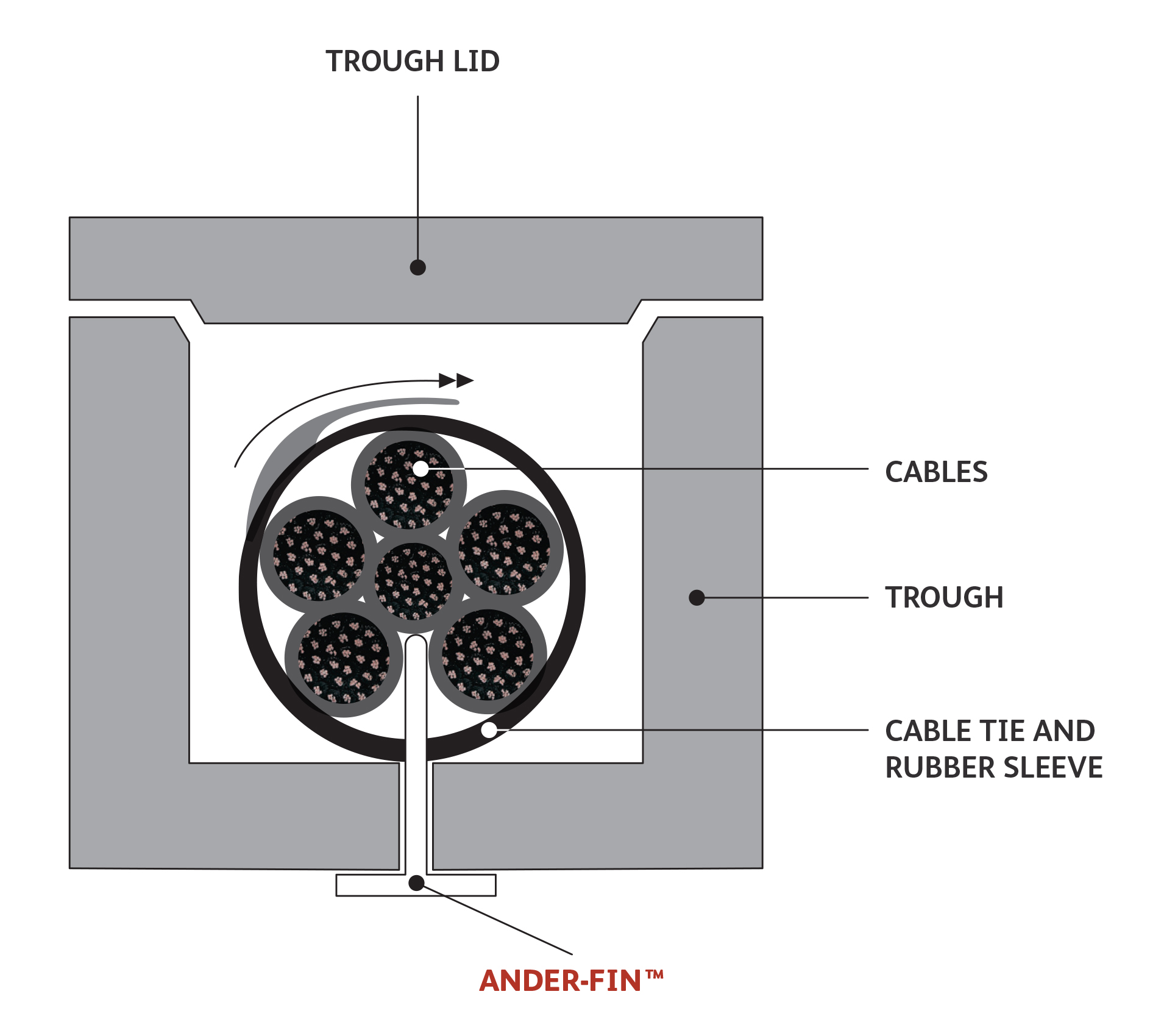
How The Ander-Fin Works
The Ander-Fin is inserted into the Anderton trough from below. Then, a Network Rail approved cable tie with rubber sleeve is threaded through the Ander-Fin. Cables are then bundled and secured with a cable tie.
Specification
- The fin is compatible with a range of Network Rail approved clips and sleeves
- The fin is manufactured from glass filled nylon
- Strength depending on orientation of the fin has a failure load in excess of 2kN
- FIRE – The fin material has been tested to UL 94 and achieved V5A rating
- Limiting Oxygen Limit is 32.5 and the material contains no halogen
Thorne & Derrick
THORNE & DERRICK are national distributors of LV, MV & HV Cable Installation, Jointing, Duct Sealing, Substation & Electrical Equipment – we service UK and global businesses involved in cable installations, cable jointing, substation earthing, overhead line and electrical construction at LV, 11kV, 33kV and EHV.
NEW MANUFACTURER – We have signed a new distributorship agreement and are now approved distributors of Cubis. Contact us for Access Chamber Systems, Cable Troughs and Cable Protection.
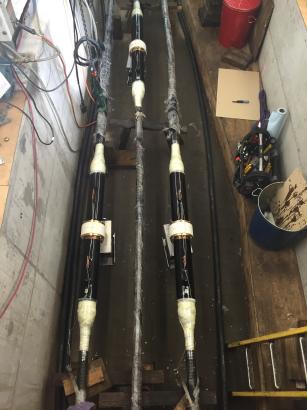
Image: Andrew Brezovszky (EHV Cable Jointer | Australia)
Pictured: 110kV Oil Filled Cable Joint (Screen Break) With Cross Bonding Leads & Link Box
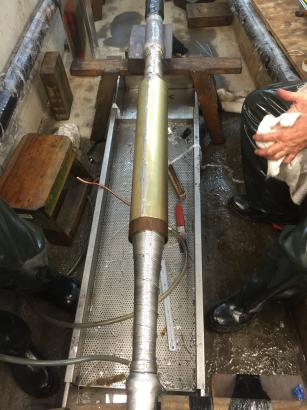 110kV Fluid Cables On Flowboards Prepared For Cable Jointing
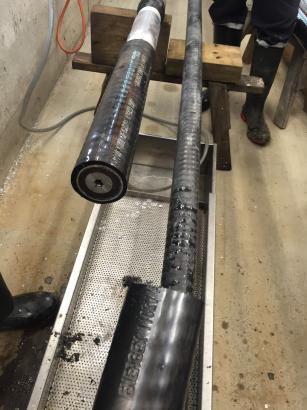
The Final Three Cable Joints Fibreglassed
Jointers blog
Subscribe now to our POWER NEWSLETTER– a monthly email circulation packed with news, projects, videos, technical tips, training information, promotions, webinars, career opportunities and white papers.
Includes access to our popular JOINTERS BLOG with contributions from utility professionals, linesmen and cable jointers working on MV HV EHV cables and overhead lines typically at 11kV, 33kV, 66kV and up to 132kV.
15,000+ Subscribers. ➡ 
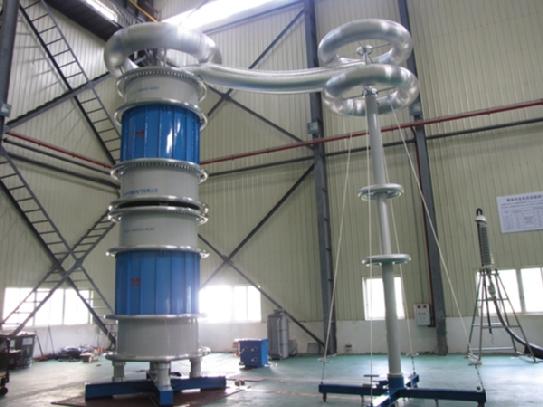
Image Courtesy of : Jessica Chen (Yangzhou Power Electric Co.Ltd)
Pictured: 400kV 3200kVA AC Resonant Test System For Guangdong Nanyang Cable
Jointers blog
Subscribe now to our POWER NEWSLETTER– a monthly email circulation packed with news, projects, videos, technical tips, training information, promotions, webinars, career opportunities and white papers.
Includes access to our popular JOINTERS BLOG with contributions from utility professionals, linesmen and cable jointers working on MV HV EHV cables and overhead lines typically at 11kV, 33kV, 66kV and up to 132kV.
15,000+ Subscribers. ➡