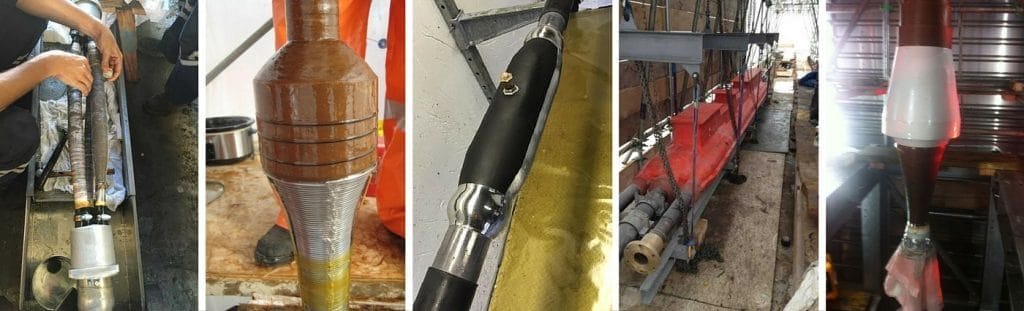
SMPGB straight joints manufactured by ABB are for jointing EHV XLPE and EPR insulated transmission cables with aluminium or copper conductors. The cable joints are suitable for jointing two cables that have different dimensions or screen sheath designs. The cable joint consists of a pre-moulded rubber tube with two pre-moulded rubber adapters, a bolt connector and a prefabricated PUR casted copper casing as outer protection for the joint.
In this instance it is recommended to use Alroc Tools for sheath, screen and insulation removal, however the correct cable jointing tool to use is dependent on the length of the chamfer and the EHV Joint product that is being installed.
T&D distribute the most extensive range of LV, MV & HV Cable Jointing, Terminating, Installation & Cable Pulling Equipment – we service UK and international clients working on underground cables, overhead lines, substations and electrical construction at LV, 11kV, 33kV and EHV transmission and distribution voltages.
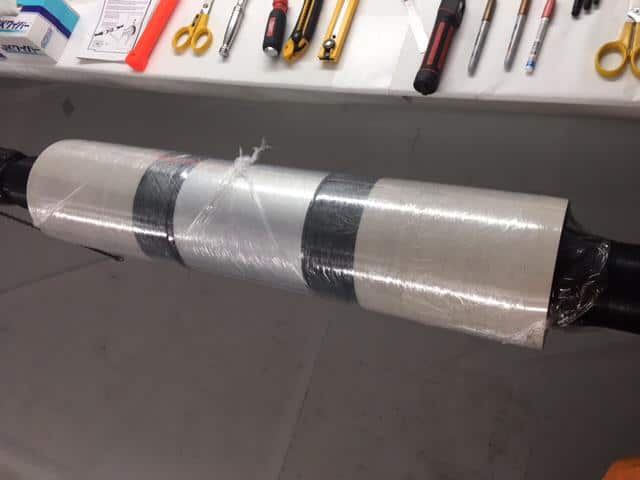
3M Scotch tapes are used to cable joint, splice, repair damaged cables, seal and protect cables against abrasion, fire and corrosion – this includes protection of LV-HV (11kV-33kV) cables and connections.
Please contact T&D should you require assistance with selecting the correct 3M Scotch tape.
The 3M video explains the benefits of using Scotch electrical tape over alternative tapes.
Extreme Heat or Cold Applications For Scotch Tapes
Watch the video to see how Scotch tapes perform and endure installation and service conditions at temperatures down to 0°F and up to 220°F temperatures with cracking or unwinding. Scotch tapes will not degrade overtime when subject to temperature extremes, weathering, moisture or chemicals.
3M Scotch tapes demonstrate strong adhesion and excellent durability ensuring they are ideal for permanent jobs such as insulating and protecting electrical cable connections – once wound properly it remains wound.
3M Scotch tapes can also be used in zero degree temperatures and withstands high temperature up to 220ºF unlike other vinyl electrical tapes which would crack and unwind.
A greater stretch and tape elasticity provides a smooth, professional wrap and the coloured coded and fade resistant design ensures permanent and clear cable identification using 3M Scotch vinyl electrical tapes.
Scotch Tapes Manufactured By 3M Electrical For Professionals
The Scotch brand of PVC vinyl electrical tapes, manufactured by 3M Electrical, provide distinct competitive advantages over unbranded poor quality tapes which may have a superficial low price but actual high cost associations – since plastic vinyl tapes hit the mass-market in the 1940’s 3M Scotch has been the choice brand of the professional electrician for tapes with excellent electrical and mechanical properties.
For instance, 3M Scotch Super 33+ is the market-leading “fit and forget” vinyl electrical tape for providing cable protection, insulation and repair in industrial and hazardous area installations – this includes chemical (resists acids and alkalies), offshore (resists abrasion and corrosion) and industrial outdoor (resists UV ultraviolet light) applications.
As standard Scotch 33+ is coloured black so for colour-coding, phase marking and identification applications go with 3M Scotch 35 – same product specification as Scotch 33+ but with a colour spectrum of red, yellow, blue, brown, grey, white, green, orange and violet.
For cold weather and extreme low temperature applications select 3M Scotch 88 for continuous service down to 0 Degrees Celsius – Scotch 88 by 3M features excellent pliability and adhesion.
A varnished cambric tape is “off-the-shelf” for high puncture and cut-through resistance with Class A thermal stability – contact sales and ask about 3M Scotch 2510 for further information.
The protection of medium/high voltage cables and joints demands heavy-duty electrical tapes – substandard and under specified tapes pose risk and danger to power systems and life. Here, upgrade your tape choice to 3M Scotch 22, recommended by 3M Electrical for outer sheath and cable jacket protection or repairs to high voltage power cables and joints with rubber or polymeric cables. That’s XLPE and EPR in “cables-speak”.
Where cost is King but a good quality and general purpose PVC electrical tape is required contact us to place an order for 3M Temflex 1500.
All 3M Electrical Tapes are super stretch and strong for holding power in place without fail.
Due to the physical properties of 3M Scotch the tapes provide moisture-tight, chemical resistant electrical sealing of cables, connections and cable joints.
So overall, Thorne & Derrick distribute an extensive range of electrical tapes including fire proofing tapes with arc protection, see 3M Scotch 77 and high specification fire resistant tapesmanufactured by Nexans.
Cold Shrink – invented by 3M over 40 years ago and now the preferred technology for heat-free jointing, terminating, sealing and abandonment of LV HV cables
We hope you find this video informative and educational, contact T&D for technical support, quotations and stock availability for 3M Scotch Electrical Tape.
➡ Visit 3M Electrical for further information about joints, terminations, tapes and insulation to seal, repair, splice and connect LV MV HV cables.
Driven earth rods manufactured from solid copper and bonded with copper are available from stock – contact Thorne & Derrick
There are three types of LPS Earthing systems types A, B and Foundation Earth Electrodes
Type A – The conventional LPS Earthing system using
vertical or horizontal electrodes such as
copperbond Earth rods or copper tape
Type B – The ring electrode sited around the periphery of the structure
Foundation Earth Electrodes
The foundation electrode system installing the conductors in the concrete foundations of the structure.
Type A Earthing Arrangement
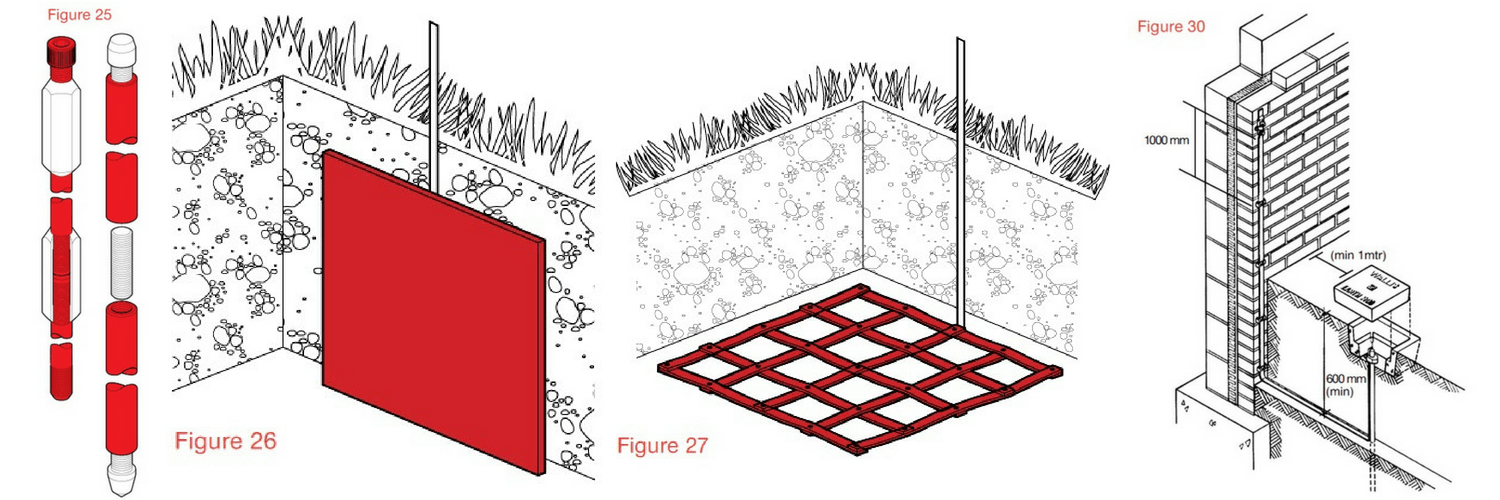
This is the conventional type of LPS Earthing System where earthing rods are used to form the earth electrode and usually each down conductor, such as copper earthing tapes, are connected to an earth rod.
The type A earth termination arrangement is suitable for low structures (below 20 metres in height) or an LPS with rods or stretched wires. For an isolated LPS the British Standard BS EN 62305 recommends a type B earthing arrangement where the structure is housing extensive electronic systems.
The type A arrangement uses vertical or horizontal earth electrodes. Practically it uses both connected to each down conductor, installed outside the structure (below the foundation) to be protected and housed in a plastic or concrete pit for ease of inspection (figure 30).
Lightning Protection – Copper Earthing Equipment
The minimum number of electrodes is 2.5 metres, regardless of the perimeter of the structure/class of LPS.
The minimum length of each earth electrode at the base of each down-conductor is specified in BS EN 62305 and the table below.
Minimum length l¹ of each earth electrode according to class of LPS
It is 11 for horizontal electrodes – usually copper tapes.
Or
0.511 for vertical copperbonded rods or solid copper rods. Or
>11 in the case of a lattice mat measuring the total length of the conductor in the earth mat.
Or
If copper plates are to be used the surface area of the plate should be at least equal to either.
The surface area of the length of earthing conductor that would need to be used to satisfy the requirement for a vertical electrode 0.511.
Or
The surface area of the length of earthing conductor that would need to be used to satisfy the requirement for a lattice mat electrode 11.
Or
If using vertical and horizontal electrodes, the individual earthing electrode lengths should follow the 0.511 and 11 principle respectively.
Type A earth electrodes should be installed so that the top of the earth rod is 0.5 m below the surface, this distance is to reduce the effects of step potential at ground level.
The earth rod should be housed in an inspection pit, commonly concrete or plastic for ease of inspection and registering the location during and after installation figure 30.
Full range of copper earth tapes available from stock in range of widths and thicknesses.
Type B Earthing Arrangement
The type B Earthing arrangement is most suitable for:
The type B earthing is recommended as either a ring conductor outside the perimeter of the structure which it’s recommended should be in contact with the soil for at least 80% of its total length.
The alternative is to use a foundation earth electrode which can be in a mesh form.
It is recommended that the type B earthing network whichever method is chosen should be integrated as a meshed network buried to a minimum depth of 5 rats.
The reinforced concrete floor slab can be used around the structure.
If the required resistance cannot be achieved by this method the vertical or radial earthing electrodes can be added to the network.
For ease of testing after installation an inspection pit with an earth bar should be installed where the legs of the ring and conductor routing onto the ring from the each test clamps join (figure 31).
Any internal down conductors should be connected to the internal foundation using a test clamp for ease of maintenance.
Foundation Earth Electrodes
Once all the services are connected its unlikely the installer will be able to measure the earthing resistance of the foundation earth in isolation.
The use of the foundation as an earth electrode is allowable only where the reinforcement network is below any insulating or waterproof membrane.
Where a foundation is used as an earth-termination the reinforcing bars must be clamped or welded together to ensure electrical continuity.
Alternatively an additional meshed network of conductors can be installed to ensure continuity. The additional network should be connected to the reinforcing bars by clamps or welded joints every 20 m throughout the system.
The earthing system whether using reinforcing bars or additional conductors or a combination of both must be connected to every down conductor and internal steelwork.
Internal Lightning Protection System
The internal LPS is important to fully complete the installation to fulfil the requirements of BS EN 62305.
The main reason for installing an internal LPS is to avoid any dangerous sparking within the building.
The sparking is caused by current flow and the difference in potential between internal conductive components such as steelwork and the external LPS on the outside of the building or from the use of the internal steelwork as part of the LPS.
The earthing system whether using reinforcing bars or additional conductors or a combination of both must be connected to every down conductor and internal steelwork.
T&D are Specialist Distributors to UK Distribution Network Operators (DNO’s), NERS Registered Service Providers, ICP’s and HV Jointing Contractors of an extensive range of LV, MV & HV Jointing, Earthing, Substation & Electrical Eqpt – this includes 11kV/33kV/66kV cable joints, terminations and connectors for both DNO and private network applications.
Contact our UK Power Team for competitive quotations, fast delivery from stock and technical support or training on all LV-HV products.
The LPS (Lightning Protection System) is required to:
Intercept the lightning strike (the air termination network)
Conduct the lightning strike safely to ground (using down conductors, such as copper earth tapes)
Disperse the strike safely into the earth (earthing)
Whilst the structural protection is there to conduct a strike safely to earth this is normally combined with internal protection to prevent sparking within the structure ensuring all metallic services are at equipotential (bonding)
The designer of the LPS should ensure that:
The safest path to earth is the LPS
The risk of sparking whilst the strike is conducted safely to earth is minimised (separation distance/s)
The risk of voltage differential whilst the strike is being dissipated in the ground safely is minimised (step & touch potentials)
The designer of the LPS has to gather all the relevant information to ensure the earthing system design is as safe as possible within any economic restraints:
A designer may find it impractical to fully install the desired LPS
A designer may not be able to justify the cost of providing the desired LPS
A designer may consider using the metal roof or reinforcing bars within a building as the safest and most economic design
A designer may consider extra bonding and surge protection devices are required to protect the internal space, especially if the space houses sensitive electronic equipment
A designer may consider a building of such a high risk that additional measures are taken to ensure safety, possibly a flour factory or a building with a combustible roof, in these cases the LPS system may have to stand off the building
Contact Thorne & Derrick for largest UK stocks of copper earth tapes.
Criteria For The Protection Of Structures
The level of protection/Lightning Protection Level (LPL) applied to the structure is identified by the risk assessment.
Lightning Protection System (LPS) Level
LPL I requires a Class I
LPS LPL II requires a Class II
LPS LPL III requires a Class III
LPS LPL IV requires a Class IV LPS
Design of The LPS General Considerations
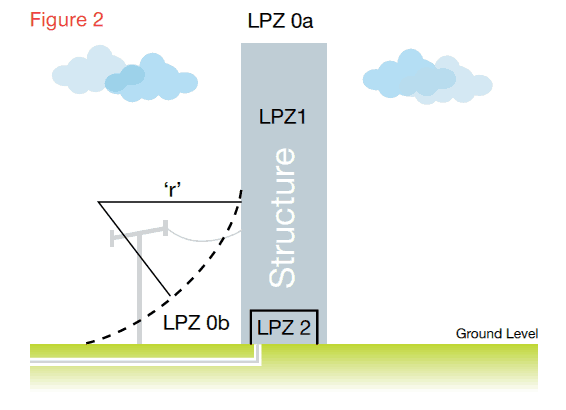
To help the earthing system designer, the threat of lightning to a structure or building can be defined in lightning protection zones requiring protection and the type of lightning strike likely to enter the building shown in Figure 2.
S1 – Strike directly to the structure
S2 – Strike on the ground near the structure
S3 – Strike to a service connected to the structure
S4 – Strike on the ground near a service connected to the structure
LPZ1 – The protected zone inside the building, the zone where current is limited by current sharing and SPD’s at the boundary (less the separation distance)
LPZ Oa – At risk from the full lightning strike and the full lightning electromagnetic field
LPZ Ob – Not at risk from a direct lightning strike considering the protected area through the rolling sphere but at risk from the full lightning electromagnetic impulse. (LEMP)
LPZ 2 – Protected zone with further dampened magnetic field
The LPS designer should ensure everything to be protected falls inside the LPZ Ob range in figure 2.
The bonding measures employed need consideration at the design stage
The earthing design should consider fully the step and touch potential risks
The requirements for Surge Protection Devices (SPDs) on incoming mains and conductive services should be considered in accordance with the risk assessment carried out for the structure LPS requirements
Where combustible wooden type materials are present a distance of 0.15 m should be maintained between the LPS conductors and the roof, for any other combustible surfaces a distance not less than 0.10 m is required
Some structures will have reinforced sections with expansion joints, if the designer of the LPS considers electronic equipment within the building is at risk then bonding conductors should be provided across the joints to provide low-impedance potential equalization. The separation distance between the bonds should not be more than half the distance between the down conductors
Natural components within/part of the structure such as the rebars can be made use of provided they will always remain an integral part of the structure conforming to the requirements below
Manufacturer by high conductivity and purity copper the range of earth tapes provide effective protection to buildings and substations
Using natural conductors as part of the LPS
The building’s natural components, metal roof, rebar, steelwork etc can be considered as part of the LPS provided they meet the minimum criteria shown in Table 1.
Material for LPS levelI to IV
Prevents puncture, hot spots or ignition. minimum thickness (mm) (ta) requirement
Only for metal sheets where preventing puncture, hot spots or ignition is not important. minimum thickness (mm) requirement (tb)
Lead
2.00
Stainless Steel
4
0.50
Titanium
4
0.50
Copper
5
0.50
Aluminium
7
0.65
Zinc
0.70
The reinforcing bars within the concrete structure can be used as a natural component of the LPS provided they are electrically continuous by either welding or clamping the joints.
The re-bars are considered as electrically continuous provided that the major part of interconnections of vertical and horizontal bars are welded or otherwise securely connected by clamps conforming to BS EN 50164 standards.
The connecting rebar must overlap and be clamped using rebar clamps or welded to a minimum of 20 times the diameter of the rebar as shown in figure 3. (Welding to be done on either side of the rebars.)
Example of a rebar joined by clamps
To test the continuity of the reinforcing bars the resistance between the re-bar connection to the air termination network and the rebar connection to the earthing network should be measured, the resistance should not exceed 0.252, otherwise proprietary down conductors will be required.
In order to provide a connection to the rebar from outside the concrete a cast-in earth plate can be used as shown in figure 4, the earth point sits in the wall (or within an enclosure) providing a connection to the re-bar with a welded copper tail attached to the earth point and to the re-bar with propriety clamps.
Earth point sits in the wall providing a connection to the rebar
The designer of the structural LPS has 4 main criteria to consider:
The roof termination system
The down conductor configuration
The Earth Termination network including equipotentialization and the risk of step and touch potential (equipotentialization on its own is not effective in reducing the risk against touch voltages)
Bonding (creating a euipotential zone across all zones, Oa, Ob, Z1, Z2)
The diameter of the sphere depends on the class of LPS selected/determined.
Class LPS
Sphere Radius
I
20
II
30
III
45
IV
60
Complete range of earth bars with connection options and number of cable termination ways to provide effective common isolation point.
Methods Of Designing The Air Termination Network
1 – The rolling sphere
2 – The protective angle design
3 – The mesh design
The Rolling Sphere Method
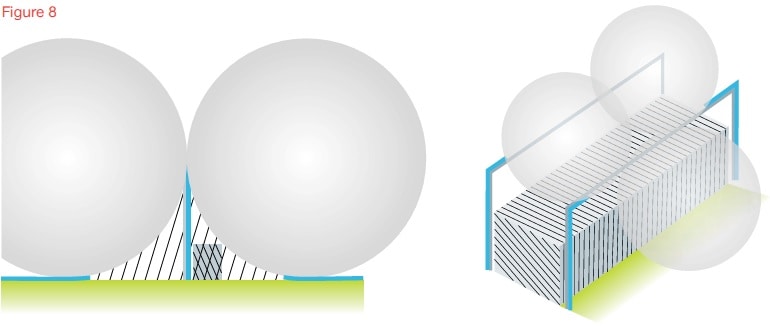
This method simply rolls a sphere around the building to be protected, wherever the sphere touches the building dictates where the protection measure is to be applied, where the sphere does not touch the building, this is accepted as a protected area, this method can be used to design the LPS on complex structures or where the LPS has to be isolated.
The rolling sphere method is especially relevant on complex structures with many different levels, this method easily identifies the protected space and where protection measures should be applied to the structure.
Examples of the air termination system using the rolling sphere technique
Designing The Lightning Protection System (LPS)
The Protective angle design
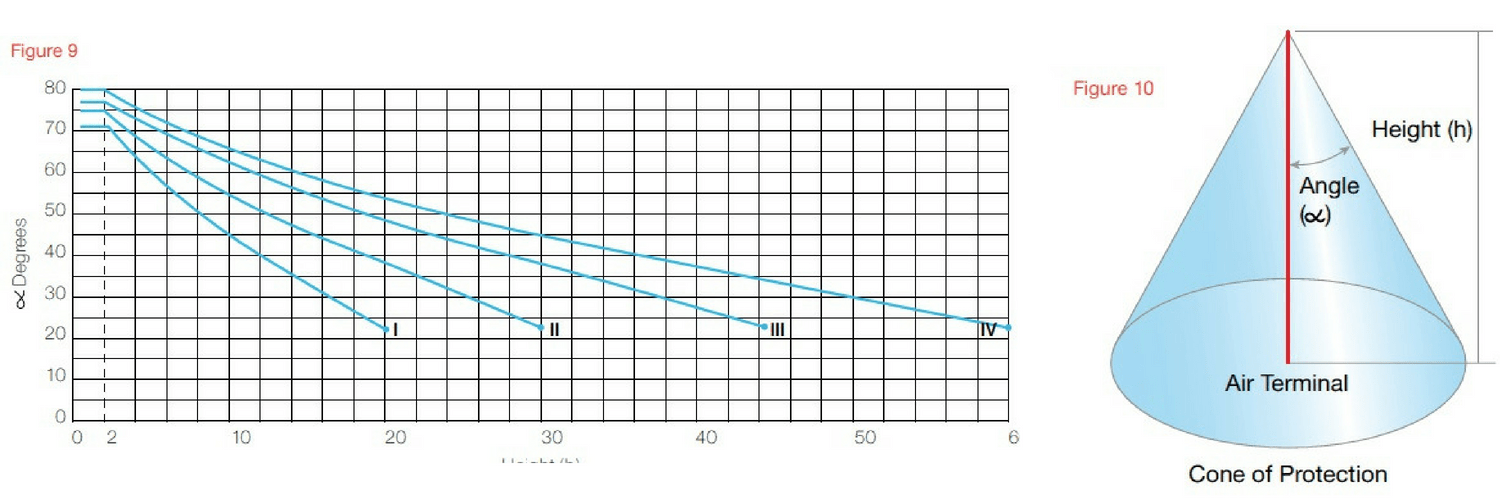
The Protective Angle method in figure 10 is only used on simple structures or for small sections of larger structures.
The Protective Angle design method cannot be used where the part of the structure/service to be protected is higher than the radius of the rolling sphere corresponding to the class of LPS.
The level of LPS dictates the angle of protection depending on the reference height, see figure 9.
This method of earthing system design is an alternative method based on the rolling sphere and is not offered to give a wider range of protection than the rolling sphere.
In figure 9 the height limits for designers are clear and correspond to the radius of the rolling sphere.
Protective Angle Design
The Mesh design
The most commonly used method, is usually employed where the structure is simple, a square or rectangular building or typical house or block of apartments with a sloping roof, the mesh method is for protection in zone OA.
The mesh design protects the whole area if conductors are positioned on the edge of the roof where the slope of the roof exceeds 1:10.
Protective angle design to protect free standing equipment on the roof of a building
On structures up to 60 metres in height, only consider applying an air termination system to the roof and provide protection to points, corners and edges of the structure. No lateral air termination is required regardless of the class of LPS.
On structures higher than 60 metres lateral air termination systems should be applied to the top 20% of the structure relevant to its class of LPS (or at least conforming to class IV LPS).
The mesh of earth conductors are installed on the roof, the earth conductor must be at the edge of the area to be protected and for metal items such as air conditioning units that protrude above the conductor, the protective angle design should be applied for protection.
The size of earth mesh required is defined by the level of LPS determined/selected
T&D are Specialist Distributors to UK Distribution Network Operators (DNO’s), NERS Registered Service Providers, ICP’s and HV Jointing Contractors of an extensive range of LV, MV & HV Jointing, Earthing, Substation & Electrical Eqpt – this includes 11kV/33kV/66kV cable joints, terminations and connectors for both DNO and private network applications.
Contact our UK Power Team for competitive quotations, fast delivery from stock and technical support or training on all LV-HV products.
Uploaded By - Chris Dodds (Thorne & Derrick Sales & Marketing Manager)
Press Release: Lucy Zodion
Street Lighting Cut Outs
Lucy Zodion Ltd have secured sole approval for street lighting cut outs in the Western Power Distribution (WPD) Network – the Lucy SLCO cut outs are now approved by all UK Distribution Network Operators (DNO’s).
Lucy Zodion Ltd, leading UK manufacturer of cut-outs, controls, feeder pillars and street lighting isolators, is pleased to announce its street light cut outs(SLCOs) are now part of the G81 specification framework, won by Lucy Group for industrial and commercial underground connected loads up to and including 11kV.
WPD exclusively specifies a number of Lucy Group secondary power distribution solutions throughout the East and West Midlands, South West and Wales regions.
The updated specification means that Lucy Zodion’s street lighting cut-outs are now approved by every Distribution Network Operator (DNO) throughout the UK – the Lucy Titan range of cut outs include several market-leading design features such as the cam lever handle that enables effortless release of the fuse carrier in one movement or the generous cabling space to terminate a wide variety of conductor types and sizes. Where dual or triple cable entries are required, a choice of either insulated or brass cable gland plates is available, the latter being specifically provided for the termination of armoured SWA cables.
➡ For further information about how Lucy Zodion provide control and power distribution products for street lighting applications, please review the Lucy Titan (Cut-outs) and Lucy Trojan (Isolators) ranges of products.
Should you require any technical support or have any commercial requirements about G81 Approved 11kV/33kV Cables & Accessories please do not hesitate to contact Thorne & Derrick Sales Team.
Lucy Titan2 Street Lighting Cut Outs
Furthermore, Western Power Distribution (WPD) specifies Lucy Zodion SLCOs onto contract for exclusive use within their region.
The G81 standard included cut-outs for street lighting control are:
Lucy THM0048847 SLF IPC Type 1 Cut Out (SNE) HEX Drive Clear Cover
Lucy THM0041767 SLF IPC Type 2 Cut Out (CNE) HEX Drive Clear Cover
Lucy Zodion is one of the UK’s leading manufacturers of street lighting cut outs and is dedicated to adhering to industry standards, as well as its own quality procedures.
Lucy Zodion’s SLCOs are compliant with BS7654, which covers all aspects of the cut out from the materials in which it is manufactured, to a series of tests relating to temperature, ingress protection, current and mechanical strength.
Other features of the approved products include clear covers, enabling quick and safe inspections, Insulating Piercing Connectors (IPC) to protect against insulation shrink back, as well as many more high quality benefits associated with the Lucy Zodion SLF range.
Street Lighting Cut Outs | Isolators | Feeder Pillars
THORNE & DERRICK
T&D are Specialist Distributors to UK Distribution Network Operators (DNO’s), NERS Registered Service Providers, ICP’s and HV Jointing Contractors of an extensive range of LV, MV & HV Jointing, Earthing, Substation & Electrical Eqpt– this includes 11kV/33kV/66kV cable joints, terminations and connectors for both DNO and private network applications.
Contact our UK Power Team for competitive quotations, fast delivery from stock and technical support or training on all LV-HV products.
klauke ekm60unv – universal cutting, crimping & punching tool The Klauke EKM 60 UNV is a versatile battery powered hydraulic universal tool engineered that can be used as a battery powered cable crimping tool and battery operated cable cutting tools that comes...
INDUSTRIAL LABEL PRINTING SOLUTIONS When clear, durable and professional identification is required across control panels, cable systems, production facilities and industrial installations, print quality, reliability and ease of use are critical. Cembre industrial label printers are designed to support...