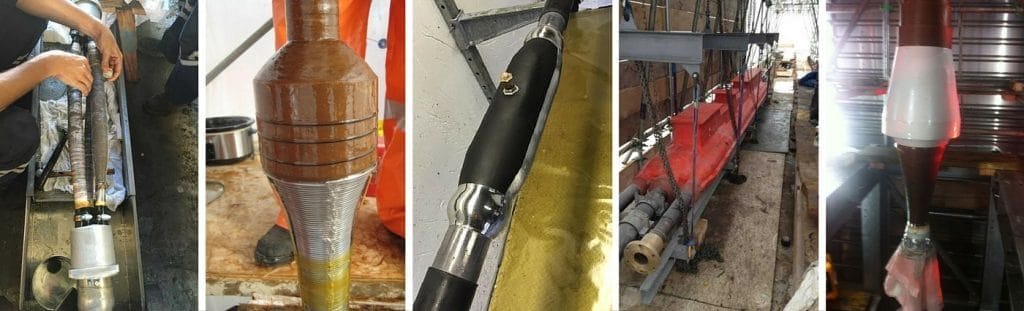
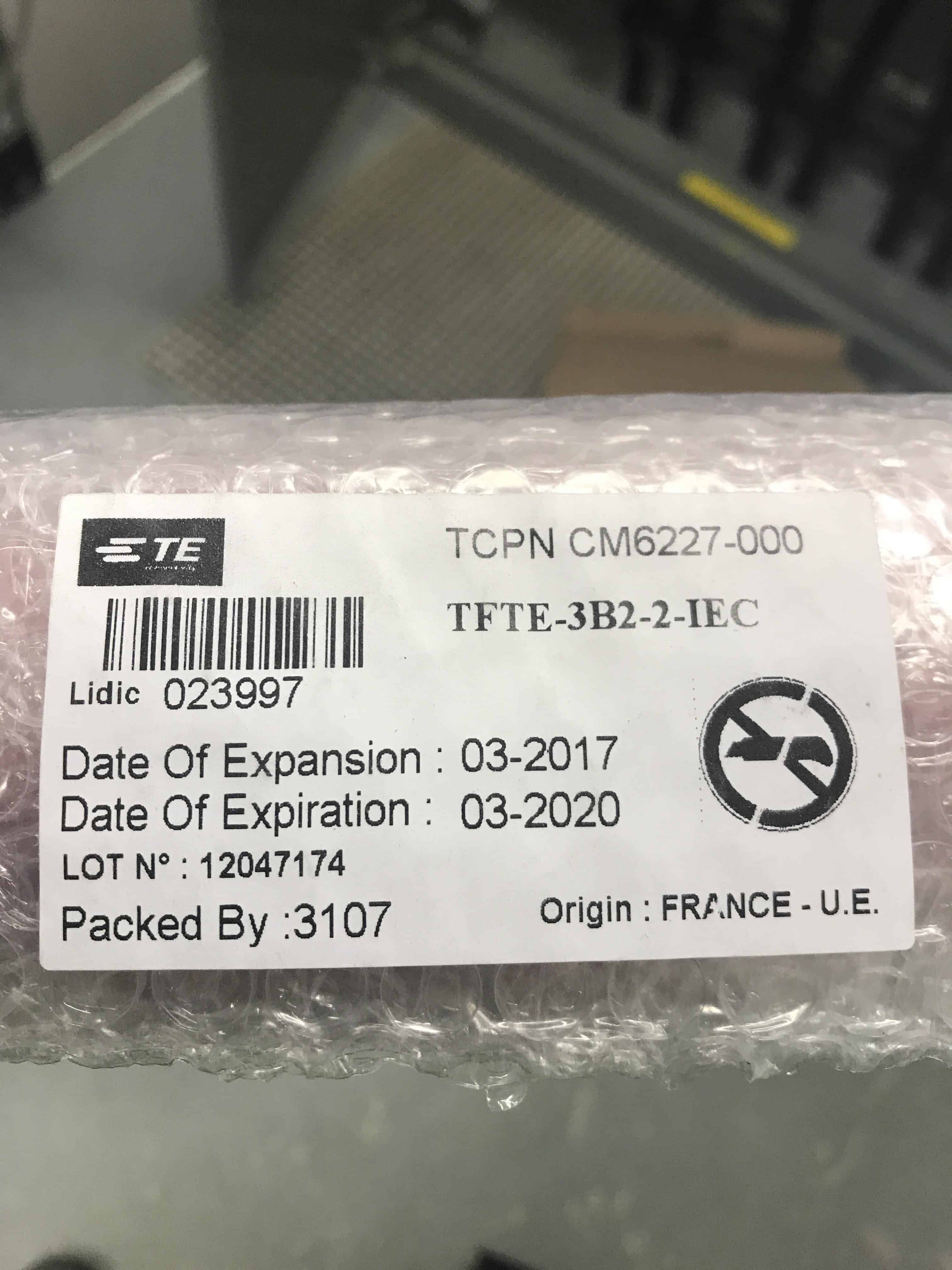
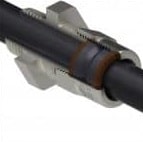
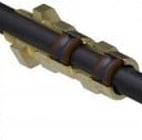
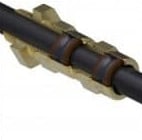
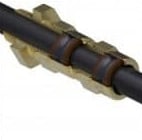
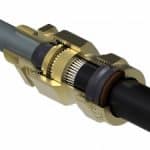
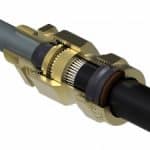
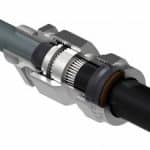
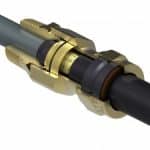
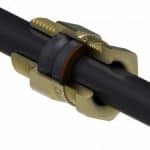
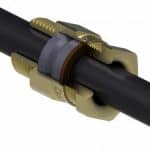
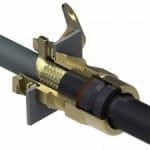
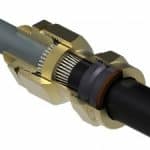
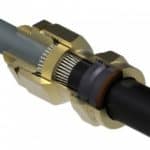
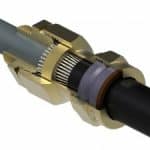
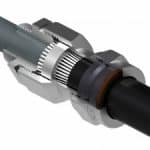
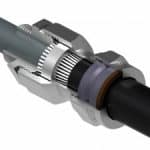
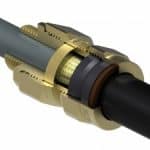
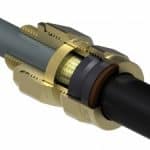
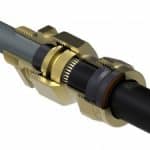
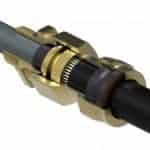
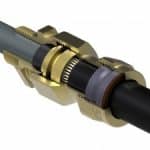
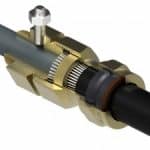
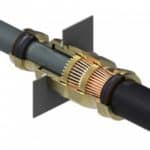
Raychem TFTI is a high voltage cold shrink, cold-applied cable termination designed with an extended neck to cover the mechanical shearbolt cable lug connection. Additional anti-track heat shrink tubing has been applied onto the MV HV cable sheath jacket for the centre phases to achieve enhanced electrical insulation between copper wire shield and the medium/high voltage busbar – the cold shrink terminations provide safe cable connections for working in potentially explosive atmospheres such as MV HV substations where flammable gas could be present.
The cable conductors are terminated using either crimp (compression) or mechanical (shearbolt) high voltage cable lugs from manufacturers such as Cembre or Pfisterer SICON.
T&D distribute the most extensive range of LV, MV & HV Cable Jointing, Terminating, Installation & Cable Pulling Equipment – we service UK and international clients working on underground cables, overhead lines, substations and electrical construction at LV, 11kV, 33kV and EHV transmission and distribution voltages.
Providing Competency Training Courses For Cable Jointers LV
By Chris Dodds - Thorne & Derrick Sales & Marketing Manager
Pragmatic Consulting Ltd have been approved to deliver under EUSR – Competency Accord Unit 060 Live LV Cable Jointing Training Courses.
Pragmatic Consulting offer a range of courses that meets the needs of the Cable Jointing, Electrical and Utility Power Industryand are prepared to travel and provide cable jointer training events across the UK so that you are able to have training when it suits you.
Pragmatic Consulting approach each Cable Jointer Training Course in an individual manner to ensure candidates who pass through the door are trained to the highest standard whilst ensuring that they receive the support they require to help them progress and achieve.
Training: Live Cable jointing On Mains Cables
Cable Jointer Training Courses
After successful completion of the Cable Jointers Training Course and assessment the candidate will then need to complete a period of supervised on job experience, before returning with his / her evidence portfolio and undertake a formal cable jointing skills and knowledge assessment – this will preserve trade integrity and protect employers against under-skilled labour causing reputational damage to the industry.
On successful completion of their portfolio, witness testimonies and further assessment each candidate will then be eligible to have their achieved competence modules registered on the Energy and Utility Skills Register (EUSR) for acceptance as a level of Competence by member Companies of the Industries Competency Accord scheme.
This is cable jointer training and assessment and not authorisation.
Power Unit 060 has been split this into 3 separate cable jointing courses:
LV1 – Introduction to LV Cable Jointing – Single & Three Phase Services
LV2– LV Polymeric (Wavecon) Main Cable Three Phase Jointing Course
LV3– LV Transition Polymeric (Wavecon) to PILC STA Main Cable – 3 Phase Jointing Course
Location:Cable Jointer Training Centre – Stoneleigh Park, Warwickshire
Cable Jointing Training Dates
LV1 Training Course
23rd April to 27th April 2018
18th June to 22nd June 2018
20th August to 24th August 2018
LV2 Training Course
16th April to 20th April 2018
11th June to 15th June 2018
2nd July to 6th July 2018
LV3 Training Course
4th June to 8th June 2018
9th July to 13th July 2018
6th August to 10th August 2018
EUSR help employers to develop industry recognised schemes of learning and register individuals’ skills and competencies on their register.
The EUSR provide workshops to approve trainers for Passport Schemes such as Safety, Health & Environmental Awareness (SHEA) Water Hygiene and Cross Country Pipelines Health Safety & Environmental (CCPHSE).
Power Unit 060
Live Low Voltage Cable Jointing
This cable jointer training specification has been developed from the power network standard. The specification details the required skills, knowledge and behaviours to establish competence to carry out live jointing procedures on low voltage mains cables.
The specification details the requirements for TWO separate low voltage categories. Candidates will be assessed and receive registration for BOTH of the following categories:
LV Cable (XLPE)
LV Mains Cable (Consac and / or PILC)
The specification details the critical requirements of the activity to establish competence and does not preclude employers from adding to the skills and knowledge detailed by the specification in their own training programmes.
What does competence look like?
LVJ1 Course – The cable jointer will be able to confidently carry out a range of live low voltage electrical cable jointing procedures on underground cables in accordance with company procedures.
LVJ2 Course – The cable jointer will demonstrate a safety conscious approach to the control of hazards associated with the activity whilst working and communicating effectively with other team members to achieve tasks.
What do I need to take this module?
Candidates to be assessed as competent in this skill area should have completed the modules shown below or have evidence demonstrating an equivalent level of competence:
SHEA Power (Revised Version) – providing basic health, safety and environmental awareness and an introduction to specifactors relating to the power sector
Access, Movement and Egress (Underground Cables) – an industry assessment of a person’s competence to enter, move around and exit an underground cable work area in a safe manner
Location and Avoidance of Utilities – an industry assessment of a person’s competence to identify and locate utilities using electronic location equipment
Safe Excavation of Utilities – an industry assessment of a person’s competence to safely use hand tools and hand held power tools to excavate and maintain excavations
Performance Criteria
To achieve this unit, you will need to be able to:
General Requirements
P1. Identify the cable jointing work area to be accessed using available information P2. Select and wear the PPE required to carry out the cable jointing activity P3. Carry out a site specific risk assessment of the cable jointing area, identifying hazards and the control measures required including justification for live working (requirements included in SHEA Power and BESC / AME Underground Cables) P4. Implement the control measures necessary to meet safety requirements for activity e.g. barriers, signage and lighting P5. Communicate the risks and control measures to the working party P6. Carry out a pre-use inspection of the cable jointing tools and equipment to be used inspecting for condition and service information P7. Assess and confirm the work space is adequate for the jointing task to be carried including suitable access / egress, lighting and protection from adverse weather P8. Identify the correct underground cable to be worked on using company procedures P9. Carry out a visual inspection of the integrity of cables to be worked on and jointed P10. Use approved tools to prepare and joint cables in accordance with company working procedures P11. Carry electrical testing of the cable to confirm its integrity, including insulation continuity testing (PILC and CONSAC to include moisture testing) P12. Confirm cable joint measurements and tolerances meet with joint specifications and requirements
Task Specific Training – Live Low Voltage Mains Jointing
Complete ALL of the following cable jointing procedures in BOTH of the following categories.
P13. LV XLPE Cable (Mains and Service)
a) Service straight through cable joint (single and three phase)
b) Service cable termination (single and three phase)
c) Service pot end joint (single and three phase)
d) Multi service cable joint (single and three phase)
e) Terminate LV mains cable
f) Mains straight through joint
g) Mains breeches joint
h) Mains pot-end joint
i) Cable sheath repairs
P14. LV Cable Consac and / or PILC (Mains and Service)
a) Transition service straight through joint (single and three phase)
b) Service pot end PILC joint (single and three phase)
c) Multi service joint off PILC and / or Consac (single and three phase)
d) Transition mains straight through joint
e) Transition mains breeches joint
f) Mains pot-end (PILC and / or Consac)
P15. Carry out post connection testing procedures including voltage, polarity, earth loop impedance, phase rotation P16. Install joint protection to ensure connections are protected from ingress of moisture and mechanical damage P17.Record cable joint positions and test results in accordance with company procedures P18. Dispose of hazardous and non-hazardous waste materials in line with company procedures P19.Store tools and equipment safely and securely and leave the work area work in a safe condition in accordance with company procedures
Cable Jointer: Billy Ayling
Cable Jointer Training Knowledge & Understanding
To achieve this unit, you will need to know and understand:
General Requirements
K1. The principles of Health, Safety and Environmental legislation in relation to work on or near electrical power networks and cables K2. The organisation’s safety rules, policies and procedures relating to work on or near electrical power networks K3. The hazards associated with work on or near electrical power networks and how to deal with them K4. How to select, inspect and use PPE for work on or near electrical power networks K5. How to carry out a site specific risk assessment and identify workplace hazards K6. The dangers of electricity and how an electric shock can be received including: direct contact, induced voltage and arcing K7. The roles and responsibilities of the relevant person/s involved in the control of the jointing procedure K8. How to complete relevant company safety documentation for control of the LV network K9. The effect of adverse weather conditions on jointing activities K10. How to respond in the event of emergency situations in the work environment, including electric shock K11. How to deal with hazardous and non-hazardous waste materials in accordance with company procedures K12. How to leave an underground work area in a safe and secure condition. e.g. signs, lighting and barriers K13. How to update, report and record information in accordance with company procedures
Task Specific Training – Live Low Voltage Mains Jointing
K14. How to interpret utility drawings / control diagrams to identify underground cables and apparatus K15. How to interpret manufacturers’ jointing specifications / company procedures K16. How to select, inspect and use approved tools and equipment for live low voltage jointing procedures K17. How to positively identify the correct underground service / mains cable/s to be worked on K18. The different types of earthing systems used on distribution networks K19. The company live low voltage working procedures and how to apply them K20. The reasons and requirements of maintaining earth continuity K21. The test values for pre and post electrical testing of underground low voltage cables K22. How to interpret the test results obtained from electrical testing
Book Cable Jointer Training Course
How To Book Your
Jointer Training Course
For further information on the courses that Pragmatic Consulting offer please contact Jo Niblett (Managing Director).
THORNE & DERRICK are national distributors of LV, MV & HV Cable Installation, Jointing, Duct Sealing, Substation & Electrical Equipment – we service UK and global businesses involved in cable installations, cable jointing, cable cleating, substation, overhead line and electrical construction at LV, 11kV, 33kV and EHV.
Since 1985, T&D have established an international reputation based on SERVICE | INTEGRITY | TRUST.
Contact us for 3M Electrical, ABB, Alroc, AN Wallis, CATU Electrical, Cembre, Centriforce, CMP, CSD, Elastimold, Ellis Patents, Emtelle, Euromold, Filoform , Furse, Lucy Electric & Zodion, Nexans, Pfisterer, Polypipe, Prysmian, Roxtec, Sicame, WT Henley.
Invitation
Thorne & Derrick invite you to join LinkedIn’s largest LV-HV Electrical Discussion Group : Low & High Voltage Power, Cabling, Jointing & Electricals.
Discussion subjects include cable installations, cable jointing, substation, overhead line and electrical construction at LV, 11kV, 33kV and EHV. Network, engage and promote your profile, company or products with over 10,000 influencers.
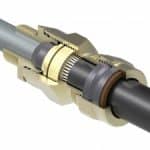
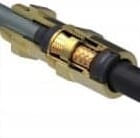
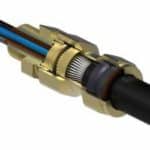
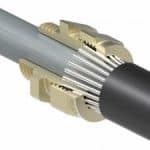
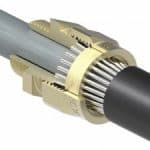
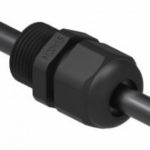
➡ The following selection table enables the specification of Cable Glands manufactured by Prysmian to suit industrial cable installations – view the complete range of Prysmian Cable Glands for industrial, hazardous areas and medium/high voltage cables.
➡ The following selection table enables the specification of Cable Glands manufactured by Prysmian to suit industrial cable installations – view the complete range of Prysmian Cable Glands for industrial, hazardous area and medium/high voltage cables.
Uploaded By Chris Dodds – Thorne & Derrick Sales & Marketing Manager
Why Use Cable Protection Covers?
Tape Tile & Stokbord
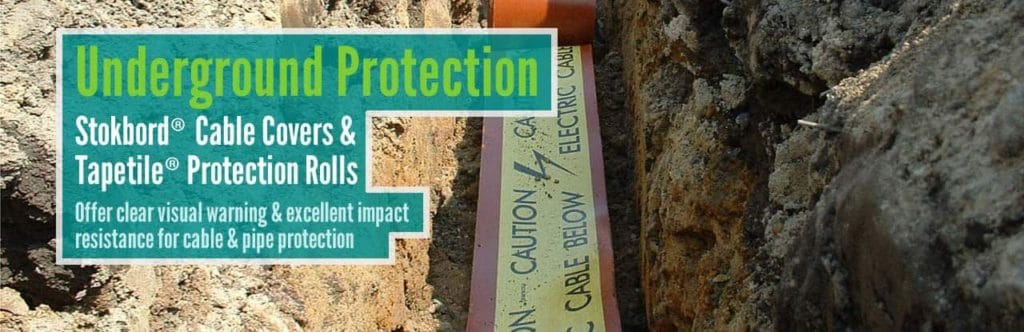
Centriforce Stokbord underground cable protection covers are manufactured from high impact, recycled polyethylene designed to withstand damage and protect medium/high voltage cables from plant and hand tools – the cable covers protect high voltage cables from damage caused by diggers and excavators inadvertently causing cable strikes when working around underground cables and utility services.
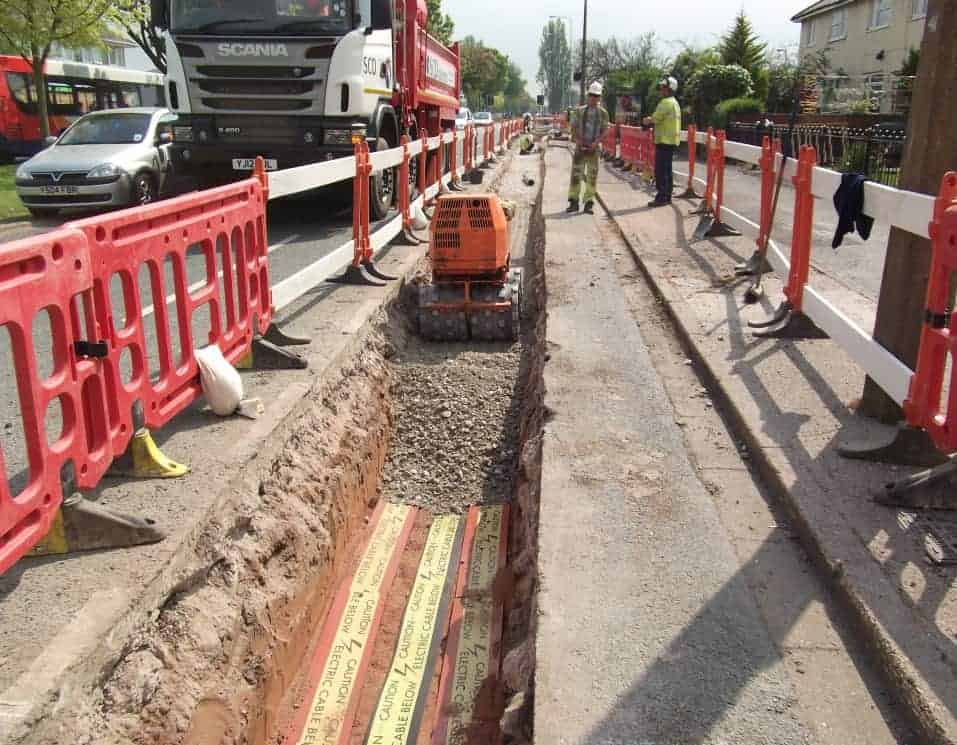
Both Tape Tile and Stokbord cable covers are used to protect LV-HV cables and cable ducts installed by the ‘open cut’ trench method – the cable protection products are intended, during any future excavation work, to give a clear visual warning of the presence of underground cable, cable joints or cable ducts. The cable identification is compliant with ENATS Standard 12-23 and meets the impact requirements of BS2484.
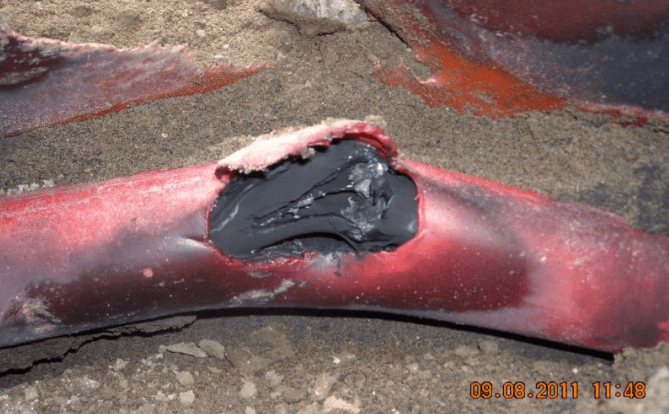
Pictured: High Voltage 11kV Cable Strike – an excavator has impacted onto a 11kV high voltage power cable penetrating the cable sheath and XLPE insulation to cause a power outage. Lack of planning on development projects increases the possibility of serious injuries to operatives and greatly increase cost to projects. On site cable records and use of cable fault locators should ensure worker safety and prevent accidental damage and strikes to high voltage cables.
Damage to underground cables can have serious repercussions such as damage to anyone working on or near the cables or a power blackout such as that experienced in Londonderry, December 2013.
LVLow Voltage | MV Medium Voltage | HV High Voltage Cable Protection
Why Use Stokbord?
Centriforce Stokbord cable covers are suitable for underground high voltage cable protection (22kV, 33kV, 66kV, 132kV and up to 400kV). The 4 thickness variations of Stokbord covers are 6, 9, 12 and 18mm. This coupled with the fact that Stokbord is easy to fabricate ensures Centriforce Stokbords are the ideal product for protecting underground cables.
Stokbord Cable Cover Application
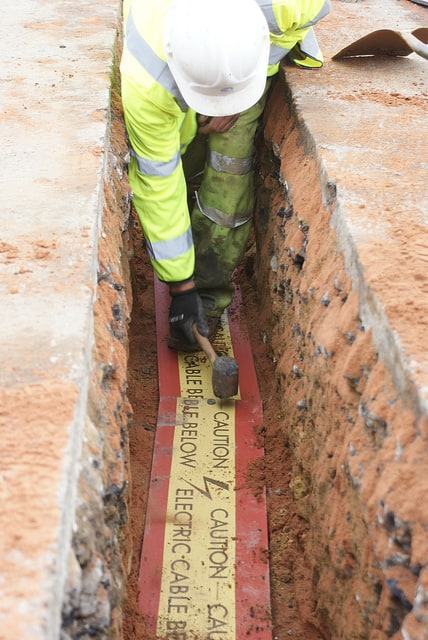
Centriforce Stokbord Cable Covers are fully jointed, laid overlapped and connected with plastic jointing pegs to provide safe high voltage underground cable protection.
Centriforce Stokbord cable covers feature a red background with yellow top tape containing visible warning “Caution Electric Cable Below” – Stokbord cable covers meet BS2482 impact requirements for underground cable cover protection.
Not only does this protect from any impact to the cables that would be made by excavation, it also shows exactly where cables are laid. The locating of cables is therefore simplified.
The features and benefits of Centriforce Stokbord makes the performance of the products far superior to steel and concrete cable covers / tiles /plates.
Stokbord Cable Covers – Benefits At A Glance
Stokbord covers provide the clear warning to 3rd parties of underground buried cables
Cable covers can be custom made with sizes to suit medium/high voltage cable trenches
Contains bold warning text and company logo for clear MV-HV cable identification
Damages to cables reduced – cost of repairs, HV jointing and supply disruption reduced
Lightweight and easy to install Stokbord cable covers irrespective of weather conditions
Durable with good impact resistance for MV HV EHV cable protection
Rotproof and resistant to soil conditions for burial in underground cable trench
Plastic Cable Covers v Concrete Cable Covers
Cable Protection
Installation Of Cable Trench Covers & Cable Protection Tiles
All cables and ducts laid into cable trench should be over-protected by a cable protection cover or tape depending upon the highest voltage cable to be protected within the cable duct – typically in the UK the following cable protection tapes and covers are used for LV, MV and HV cables.
Marker tile tapes or Stokbord covers are installed over the cable in the appropriate trench drawings – usually there is no requirement to install either above approved cable ducts installed using trenchless techniques (i.e. directional drill) but either may be installed if it is deemed that additional MV-HV cable protection is required.
When Tape Tile is used it should be cut cleanly and installed so that the medium/high voltage cable is fully covered along the whole length of the installed cable duct.
Thorne & Derrick International distribute the most extensive range of Cable Pulling & Cable Laying Equipmentto enable the installation of low, medium and high voltage power cables into underground trench or duct – products also supplied for fibre optic blowing, subsea trenching, offshore umbilical installations and pulling armoured cables onto cable tray.
Contact us for 3M Electrical, ABB, Alroc, AN Wallis, CATU Electrical, Cembre, Centriforce, CMP, CSD, Elastimold, Ellis Patents, Emtelle, Euromold, Filoform, Furse, Lucy Electric & Zodion, Nexans, Pfisterer, Polypipe, Prysmian, Roxtec, Sicame, WT Henley.
klauke ekm60unv – universal cutting, crimping & punching tool The Klauke EKM 60 UNV is a versatile battery powered hydraulic universal tool engineered that can be used as a battery powered cable crimping tool and battery operated cable cutting tools that comes...
INDUSTRIAL LABEL PRINTING SOLUTIONS When clear, durable and professional identification is required across control panels, cable systems, production facilities and industrial installations, print quality, reliability and ease of use are critical. Cembre industrial label printers are designed to support...