Cable Crimping – Lugs & Tools
DIN Standard – Crimping & Compressing Aluminium Cable Lugs & Connectors
September 4th, 2018
DIN Standard – Crimping & Compressing Aluminium Cable Lugs & Connectors
-
uploaded by Chris Dodds - Thorne & Derrick Sales & Marketing Manager
Thorne & Derrick International, based in the UK, are leading suppliers of cable crimp lugs and associated crimping tools for Low, Medium & High Voltage Cables and Power Systems – this series of articles by Klauke discusses the theory and practise of installing compression type cable lugs and connectors.
Klauke cable lugs and crimping tools are used by Jointers, Linesmen, Panel Builders and Electrical Engineers to install underground cables and overhead line conductors on power, transmission and distribution networks including LV MV & HV systems, 11kV-33kV.
➡ Download 2018 Klauke Cable Lugs catalogue and see the complete range of tools for cutting and crimping cables.
In this Article we cover the following:
- Hexagonal crimping: the most common type of crimp for cable lugs and connectors
- Indent crimps – the traditional electrical cable crimp profile
- Intensive indent crimping – permanent and “deep acting” connection will be achieved
- Quad point crimps: centric force application and no crimping dies are needed
- Gastight oval crimps are being used predominantly in aggressive environments
Aluminium Cable Lugs & Crimping According To DIN
Best Practise for Installation
Material properties of aluminium cable are very different from those of copper cables and conductors. For safe electrical connections, solely compression cable lugs or connectors manufactured from aluminium are to be used. In addition, due to certain specific material properties the installation procedure has to be carefully observed.
The advantages of aluminium are increasingly coming to the fore in LV MV HV power distribution applications, due to the lower material weight and simple handling.
Power utilities tend to install more and more aluminium cables, for instance medium/high voltage ring main units for urban power supplies.
In principle, it is recommended to use solely high quality aluminium compression cable lugs with tube dimensions according to DIN Standard & DIN 46329 and aluminium connectors with tube dimensions according to DIN 46267 Part 2. Products of renowned cable lug and connector manufacturers such as Klauke are made from premium electrolytic aluminium alloy.
- DIN 46329 Cable Lugs – Compression Connections, Ring Type, For Aluminium Conductors. Standard by Deutsches Institut Fur Normung E.V. (German National Standard), 07/01/1983.

The barrier design with oil stop prevents leakage of oil from the paper insulated conductor.
These cable lugs feature a constant material thickness, exact diameter and a correct fit which ensures simple installation and absolute safety. Standard cross sections range from 10sqmm up to 500sqmm.

Installation of compression cable lugs and connectors for aluminium conductors is very different from installation of copper conductors. Failure of vital installation procedures can lead to a severe lack of safety and power outages.
Special sized cross sections are available up to 1000sqmm, for instance for subsea cables with high transmission capacities in the onshore and offshore wind and renewable energy sectors. Aluminium compression cable lugs feature a barrier design (according to DIN 46239) which allows installation on oil impregnated, paper insulated cables and consequently provides a firm water/oil block.
Aluminium Conductors & Cables
Aluminium conductors are available in four different types which in some cases require special installation procedures. These are as follows – should you require technical guidance, clarification or advice on crimping of aluminium cables and correct cable lugs and relating tools to use please do not hesitate to contact us:
- RE = Solid Round Conductors
- SE = Solid Sector Conductors
- RM = Round Stranded Conductors
- SM = Sector Stranded Conductors

Different types of aluminium conductors
These abbreviations can be found on aluminium compression cable lugs to make sure the correct cable lug is used with the appropriate aluminium conductor.
All markings on aluminium compression cable lugs are in conformity with those on copper cable lugs and indicate the manufacturer, dimensions and type of product.
For example marking “KL 18 10-70 /rm/sm 95 re/se” denotes:
- KL: manufacturer (in this case Klauke)
- 18: die set code
- 10: metric bolt size (bolt M 10)
- • 70: nominal cross section of conductor in sqmm
- rm/sm: for round stranded and sector stranded conductors
- 95: nominal cross section of conductor in sqmm
- RE/SE: for solid round conductors and solid sector conductors
Important: The nominal cross sections of SE and RE conductors are always one cross section size above the cross sections of SM and RM aluminium conductors.
This is due to solid conductors having a smaller diameter than their stranded equivalent type. Special attention should be given to the crimp tool and die set code.
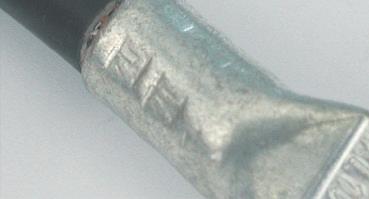
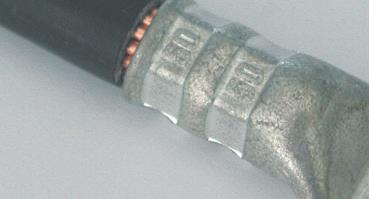
For a professional installation the crimping dies of the appropriate crimping tool must be matched with the code of the cable lugs. Die codes on crimping dies are mirror-inverted – after the crimping operation the die code is clearly visible for quality control and documentation.

Imprint of die code “18” on the cable lug (above) indicates the crimping die used. Completed crimp (below) with marking “18” on the cable lug refers to the correct crimping die.
For a professional installation hexagonal crimping dies (according to DIN 48083 Part 4) are recommended.
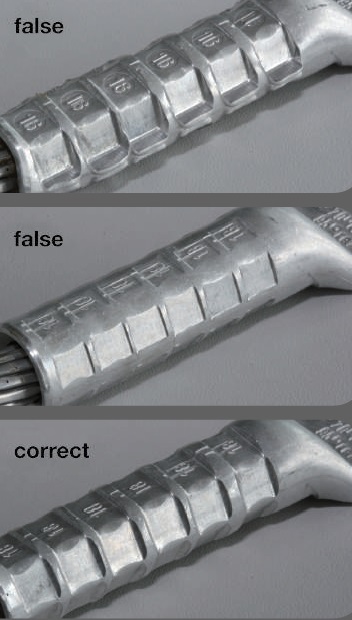
Over compression (above) is the result of a crimping die which is too small, whilst under compression (middle) is caused by the use of a crimping die which is too large. The picture below shows a correct crimp using an appropriate crimping die.
The visible signs of a correctly crimped lug are the same for copper connectors as they are for aluminium.
In order to achieve a professional installation – with no over or under-crimping – the use of the appropriate cable crimping tool is essential.
An incorrect installation can result in increased joint resistance and even in fire.
To avoid such consequences Klauke recommends to use the same manufacturers tool as the lug or connector. This ensures a Matched Crimping System.
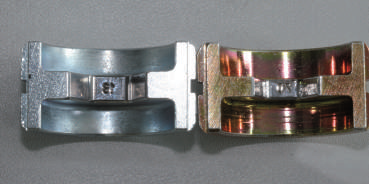
For instance the specific dies for aluminium cables have a crimping ‘bite’ width of 7mm, which is 2mm wider than for copper lugs and connectors.

The contact surface (bite width) of crimping dies for aluminium cable lugs (left) are 2 mm wider than their copper equivalent (right).
The reason for this is that wider compression areas result in better conductivity and therefore compensate for the poorer electrical properties of aluminium. In order to determine the different dies required Klauke manufacture the aluminium dies in silver and the copper dies in a yellow gold colour.
Compound for Aluminium Connectors
Cable lugs and connectors for aluminium are supplied with a special compound within the barrel.

Compounds with additives like corundum generate a “grinding effect”.
During crimping, this compound destroys the non-conductive oxide layer on the aluminium in the crimping area increasing the contact properties and ensuring the correct electrical connection. In addition the cable lug compound prevents entry of oxygen and consequently avoids any further oxidation.

The compound seals the joint and prevents oxidation.
To maintain the functional properties brand-name cable lugs are sealed with a plastic plug to prevent the compound from drying out and leaking from the cable lug.

Plastic plugs prevent compound from drying-out and leaking during storage.
Compounds for aluminium connectors contain additives such as corundum, a material similar to sand, which exhibits high resistance and hardness, temperature stabilising properties and extreme wear and corrosion resistance. A grinding effect is generated during crimping which cracks the hard oxide layer on the cable.
In addition, the compound aids the dynamic friction between the cable conductor and sleeve, which prevents jamming of materials and helps to provide a clean contact surface. When used on stranded conductors, the oxide inhibitor compound is distributed between the individual wires or cable strands during the crimping process and seals them against oxygen and moisture ingress.
It is also important to understand that aluminium crimp connections installed using compound perform much better when subjected to high current loads than those without compound.
To guarantee a safe connection, at high or low loads, Klauke recommends compression cable lugs and connectors with compound.
Installation of Aluminium Compression
Cable Lugs & Connectors
In order to accommodate the special characteristics of aluminium material, the following five installation steps are essential:
- Remove insulation of aluminium conductor
- Clean the blank conductor ends with a wire brush to remove an oxid film and to provide a clean surface
- Insert the conductor into the cable lug or connector to the recommended length
- Some compound will emerge from the mouth of the cable lug or connector which is now hermetically sealed to prevent further oxidation of the conductor
- Start the hexagonal crimping operation with a suitable crimping tool
- Important: Sector shaped conductors need to be pre-rounded with appropriate crimping dies
- Remove any excess compound emerging from the lug or connector
Please note: All DIN compression cable lugs show markings on the outside of the lug barrel for the correct crimp position and consequently number of crimps required. This is dependent on if the installer is using narrow or wide crimping dies.

Markings on the cable lugs indicate number and position of crimps as per manufacturers recommendation.
Always crimp in the direction of the conductor.

Start the first crimp at the lug end and progress towards the conductor to ensure that compacted material expands in this direction.
Aluminium & Copper Cable Lugs
A further important technical issue is the correct method of connecting aluminium and copper conductors – contact us for the jointing, connection and splicing of dissimilar conductor cables.
Further Reading
Review other Blogs in this series of articles about Cable Lugs, Crimping Cables & Tools:
Cable Lugs – Crimping Applications & Standards
Copper Cable Lugs For Special Applications
Indent Crimping Of Cables – Benefits & Limitations
Cable Lugs & Crimps – Hexagonal v Indent Methods of Crimping
Cable Lugs & Crimping Using The Hexagonal Crimp Method
Copper & Aluminium – Crimping CU-AL Cables
Electrically Driven Crimping Tools For High Volume Applications
LV MV HV Cable Accessories & Substation Electrical Equipment
Thorne & Derrick are Specialist Distributors of leading manufacturers of Cable Accessories, Jointing & Installation Equipment.
LV MV HV cable accessories used to joint, terminate, connect, cleat and gland power cables to air and gas insulated substations, transformers, switchgear and overhead line networks.
Hover over our Interactive Electricity Grid to learn more about our product ranges.
LV 600/1000V ◊ MV 11kV 33kV ◊ HV 66kV 132kV
 |
 |
 |
 |
 |
 |
 |
 |
 |
 |
Substation & Overhead Line Electrical Safety Equipment
Manufactured by CATU Electrical to enable the safe construction, maintenance and repair of underground cables and overhead lines network up to EHV (400kV).

T&D - CABLES ♦ JOINTS ♦ TERMINATIONS ♦ CONNECTORS ♦ GLANDS ♦ CLEATS ♦ CRIMPS & LUGS ♦ DUCT ♦ SEALS ♦ ARC FLASH PPE
EARTHING ♦ FEEDER PILLARS ♦ JOINTERS TOOLS ♦ CABLE CUTTING & CRIMPING TOOLS ♦ COLD SHRINK ♦ HEAT SHRINK ♦ FUSES
Cable Lugs & Crimping Tools Using The Hexagonal Crimp Method
September 3rd, 2018
Cable Lugs & Crimping Using The Hexagonal Crimp Method
uploaded by Chris Dodds - Thorne & Derrick Sales & Marketing Manager
Hexagonal Crimping Of Cables
Thorne & Derrick International, based in the UK, are leading suppliers of cable crimp lugs and associated crimping tools for Low, Medium & High Voltage Cables and Power Systems – this series of articles by Klauke discusses the theory and practise of installing compression type cable lugs and connectors.
Klauke cable lugs and crimping tools are used by Jointers, Linesmen, Panel Builders and Electrical Engineers to install underground cables and overhead line conductors on power, transmission and distribution networks including LV MV & HV systems, 11kV-33kV.
➡ Download 2018 Klauke Cable Lugs catalogue and see the complete range of tools for cutting and crimping cables.
In this Article we cover the following:
- Hexagonal crimping is suitable for both copper and aluminium conductors
- A professional hexagonal crimp generally requires use of crimping dies which match sizes of conductors and connecting material
- The classification of manufacturer specific crimping dies and cable lugs is rather regulated by the cross section of the cable
- The primary application of standardised hexagonal crimps is with electric utilities within a range from 10kV up to 30kV
- Depending on the tool narrow or wide cable crimps can be used
Hexagonal crimps for aluminium and copper
In daily practice hexagonal crimping is the most common kind of crimping of cable lugs and cable connectors for medium/high voltage power cables and systems.
The reason is very simple – this type of crimp is suitable for both copper and aluminium conductors. Hexagonal crimps can be found in panel building industries as a manufacturer specific crimp and also as a DIN standard lug crimp for example in utilities (aluminium and copper conductors including 11kV and 33kV power cables).
Technically the hexagonal crimp is characterised by a centrical and constant force effect applied during the crimping operation from all sides and creating a larger contact area.
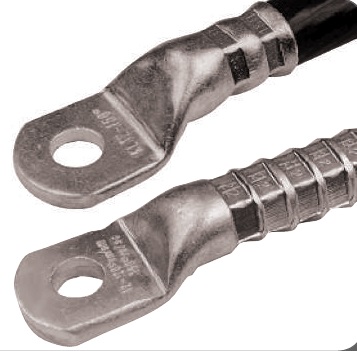
Hexagonal crimps are suitable for both copper (above) and for aluminium (below)
The individual strands of the conductors are being deformed homogeneously in their entirety without any damage. The results are good electrical properties of these connections.
Mechanical and electrical properties of tubular and DIN compression cable lugs are being defined by the IEC 1238 part 1. It defines the requirements that an electrical connection has to fulfil for a permanent safe operation within intended applications.

The cross section of a hexagonal crimp performed with a manufacturer recommended tool shows the uniform positioning of conductors in the cable lug
Apart from mechanical pull out tests also electrical durability tests are included. The field of application of hexagonal crimps comprises the processing of conductors as per:
VDE 0295 Classification
- Class 1: round solid conductors
- Class 2: round stranded conductors
- Class 5: round fine stranded conductors
- Class 6: round finest stranded conductors

Conductor types acc. to DIN VDE 57295: round solid, round stranded, fine stranded, compacted
In addition hexagonal crimps per DIN 46235 and DIN 44267 can also be used for processing of non-tension and full tension connections of aluminium cables per DIN 48201 Part 1 of aluminium ropes per DIN EN 50182.
The correct Crimping tool
For processing cable lugs per DIN 46235 crimping dies with die codes per DIN 48083 can be used. This combination enables hexagonal crimps per DIN 46235 and 46267. For hexagonal crimps of standard tubular cable lugs it is suggested to strictly observe manufacturers tool recommendations.
Hexagonal crimps are exposed to high loads. For this reason only high quality tools should be used which in addition feature special functions guaranteeing correct and safe crimps. Battery powered crimping tools of the latest generation give an acoustic warning if the required crimping force has not been reached.
High quality mechanical crimping tools can only be opened when the crimping operation has been completed. Until then an integrated locking device blocks the tool – a totally completed cable crimp is important as the required compression of the crimp material is only reached at the end of the crimp phase.
Preparation For a professional crimp
A professional hexagonal crimp generally requires use of crimping dies which match sizes of conductors and connecting material. That means that cable lugs and connectors need to correspond to the dimensions of the conductor and crimping die.
 Incorrect Crimping |
 Incorrect Crimping |
 Correct Crimping |
| Incorrect and correct crimps in comparison: An incorrect crimp (crimping,middle: low force crimping, and usage of incorrect crimping tools can result in an increase in joint resistance and may jeopardise the installation) | ||
An incorrect combination can lead to low compression – excess compression crimps with potentially fatal consequences: Faulty cable crimps and lugs can lead to increased contact resistance with rise of temperatures which in the worst case can cause fire.

Incorrect or materials processed with in-appropriate tools can cause heavy defects on installations resp. electrical equipment

Cable lugs of poor quality and/or processing may cause fire
For this reason manufacturers of branded electrical and cable accessory products such as Klauke recommend for crimping operations their cable lugs and connectors solely use of their own appropriate crimping tools. High quality crimping dies can be recognised by a polished surface with rounded edges.

Example of a crimping die with polished profile
These crimping dies are precisely manufactured and guarantee a constant and neat deformation of copper or aluminium. Prior to the cable crimping operation the electrical engineer or cable joint must ensure that the conductors need to be brushed to achieve a metallic clean surface and that oxide layers have to be removed from the aluminium cables.
While stripping cable conductors it has to be observed that some are not being damaged and that bared length is more or less identical with insertion length of cable lug or connector. Crimping dies need to be clean and metallic bright. To avoid the incorrect die selection Klauke differentiates in colour, silver stands for aluminium dies and yellow gold for copper die sets.
Left: crimping die for aluminium, silver coloured; right: crimping die for copper (yellow-gold colour)
Tip: Klauke recommends to start crimping operations on cable lugs always from the palm towards the cable. In this case the compressed material can slide towards the cable end which hasn’t been crimped.

A cable lug or connector always needs to be crimped under consideration of the crimping direction and use of appropriate tools
Manufacturer specific hexagonal crimps
For hexagonal crimping operations we distinguish between two versions:
- The hexagonal crimp as per DIN 48043 Part 4
- The manufacturer specific hexagonal crimp
Within the standard copper range the so called manufacturer specific hexagonal crimps are used for cable types as per VDE 0295 class 2.

Permissible – manufacturer specific hexagonal crimp
Manufacturers with a reputation for quality such as Klauke offer hexagonal crimping dies for processing standard copper tubular cable lugs as per EN 13600 and approved cable conductor connections as per IEC 1238.
These cable lugs are being used for instance in the construction of electrical control cabinets because of design and smaller dimensions. To accomplish a professional crimp it is of great importance to use high quality tools. Only using such tools guarantee that a sufficient degree of compression is being achieved to insure optimum contact properties.
To achieve an IEC approved connection it is necessary that all components used match each other – this includes cable lug, crimping tool and suitable die set.
This concerns the cable lug and appropriate conductor but also the suitable appropriate crimping die and crimping tool – resulting in a safety engineered system.
The classification of manufacturer specific crimping dies and cable lugs is – other than with DIN standard crimps – not controlled by die codes; it is rather regulated by the cross section of the cable specified in sqmm.

Manufacturer specific crimp with indication of cross section
Every manufacturer is responsible for the electrical durability of connections being processed with their products – specified tests have to be provided as evidence.
As a professional and safe hexagonal crimping is dependent from an exact matching of crimping dies and cable lugs Klauke recommends for crimping their cable lugs solely use of their own tools as well. In case of special applications it is advisable to involve the preferably identical manufacturer of both tools and cable lugs.
Brand manufacturers will perform – if required – for the specific application pull out tests (accelerated tests) as per IEC and where applicable also tests of the electrical contact resistance and recommend depending on the results adequate tools and materials.
Hexagonal crimps for aluminium & copper
In particular when it comes to international projects and processing of specific cable types for instance in China or India IEC or customer specific standards can be complied with in terms of safety.
Standardised hexagonal crimping
The primary application of standardized hexagonal crimps is with electric utilities within a range from 10 kV up to 30 kV. The reason is the very homogeneous crimping which produces a consistent electrical field and consequently has a positive impact as to an unwanted field scattering.
Other than with indent crimps hexagonal crimps do not show any mechanical indent of material which in case of electrical field control needs to be balanced with a conductive compound.

Mainly for electric utilities: DIN standardised hexagonal crimp
Copper cable lugs as per DIN 46235 and copper connectors as per DIN 46267 part 1 can be crimped with crimping dies as per DIN 48083 T4.
For aluminium cable lugs as per DIN 46329 and compression connectors as per DIN 46267 part 2 and other aluminium connectors and cable lugs with appropriate tube dimensions as well hexagonal crimping dies as per DIN 48083 part 4 can be used.
Hexagonal profiles as per DIN comply with the dimensional specifications of DIN cable lugs and are standardized within given tolerances.
However, there are no specs given as to the crimp width which is either 5mm for copper or 7mm for aluminium. Identification marks on DIN cable lugs give important notes as to manufacturer, dimensions and design of cable lugs, which indicates the crimping tool resp. crimping die as necessity for crimping operations conforming to standards.
This inscription is found behind the manufacturer code.
For instance KL18 stands for
- KL: manufacturers code (in this case Klauke)
- 18: tool resp. die code
For a professional completion of a standardised crimp the tool code is decisive: The tool code of crimping die used has to conform with the tool code of the cable lug.

The imprinted tool code “18” on the cable lug (above) gives information on the crimping die to be used. The completed crimp (below) with imprint “18” on the cable lug proves that the correct crimping die was used
The die code is engraved mirror-inverted on the crimp surface of the crimping die and once crimping operation has been completed it is visible on the cable lug.
Tool codes correspond approx. with the tube dimensions of the cable lugs. For copper die codes range from 5 up to 58; this corresponds to cross sections from 6sqmm up to 1000sqm. In the same way hexagonal crimping dies for aluminium and appropriate tube dimensions of these cable lugs and connectors are standardised.

Tool code on the cable lug and imprinted code verify a correct crimp
Wide or narrow crimps
Depending on the tool narrow or wide crimps can be used. On a cable lug of 50sqmm cross section for instance one has the alter-native to do two narrow crimps or one wide crimp.

Narrow crimp (above) and wide crimp (below)
Tools with a crimping force of up to 6t (60kN) are suitable solely for narrow hexagonal crimps of 5mm width on copper. Tools with a crimping force of more than 12t (120kN) are suitable for wide crimps according to manufacturers instruction.
Usually the electrician prefers narrow crimps as tools are lower in weight and easier to handle. For cable assembly, however, wide crimps are preferred as they reduce the number of crimps required and consequently save time.
For standard tubular cable lugs mostly narrow crimps are being used. Mechanical and battery powered tools – lower in weight – and up to 60kN are being applied.
A special feature is with aluminium cable lugs: To compensate the lower conductivity of aluminium compared with copper the narrow crimp in this case is 7mm.
Also important: The DIN standard does not prescribe a specific crimp width either for copper or for aluminium.
This information is given by the manufacturer by means of wide and narrow markings on DIN compression cable lugs. It should be observed that cable lugs resp. connectors and tools including crimping dies come from one single source, e.g. a brand manufacturer.

Crimp marking indicate to narrow resp. wide crimping
Indent crimps
Old, but proved and tested: indent crimping constitutes the oldest type of crimping operations in electrical installations. In panel and control cabinet construction even today it is a widely used method of crimping copper – as classical indent crimp and “W” indent crimp.
Further Reading
Review other Blogs in this series of articles about Cable Lugs, Crimping Cables & Tools:
Cable Lugs – Crimping Applications & Standards
Copper Cable Lugs For Special Applications
Indent Crimping Of Cables – Benefits & Limitations
Cable Lugs & Crimps – Hexagonal v Indent Methods of Crimping
DIN Standard – Crimping & Compressing Aluminium Cable Lugs & Connectors
Copper & Aluminium – Crimping CU-AL Cables
Electrically Driven Crimping Tools For High Volume Applications
LV MV HV Cable Accessories & Substation Electrical Equipment
Thorne & Derrick are Specialist Distributors of leading manufacturers of Cable Accessories, Jointing & Installation Equipment.
LV MV HV cable accessories used to joint, terminate, connect, cleat and gland power cables to air and gas insulated substations, transformers, switchgear and overhead line networks.
Hover over our Interactive Electricity Grid to learn more about our product ranges.
LV 600/1000V ◊ MV 11kV 33kV ◊ HV 66kV 132kV
|
|
|
|
|
|
|
|
|
|

Substation & Overhead Line Electrical Safety Equipment
Manufactured by CATU Electrical to enable the safe construction, maintenance and repair of underground cables and overhead lines network up to EHV (400kV).
T&D - CABLES ♦ JOINTS ♦ TERMINATIONS ♦ CONNECTORS ♦ GLANDS ♦ CLEATS ♦ CRIMPS & LUGS ♦ DUCT ♦ SEALS ♦ ARC FLASH PPE
EARTHING ♦ FEEDER PILLARS ♦ JOINTERS TOOLS ♦ CABLE CUTTING & CRIMPING TOOLS ♦ COLD SHRINK ♦ HEAT SHRINK ♦ FUSES
Copper Cable Lugs For Special Applications
September 3rd, 2018
Copper Cable Lugs For Special Applications
-
uploaded by Chris Dodds - Thorne & Derrick Sales & Marketing Manager
Thorne & Derrick International, based in the UK, are leading suppliers of cable crimp lugs and associated crimping tools for Low, Medium & High Voltage Cables and Power Systems – this series of articles by Klauke discusses the theory and practise of installing compression type cable lugs and connectors.
Klauke cable lugs and crimping tools are used by Jointers, Linesmen, Panel Builders and Electrical Engineers to install underground cables and overhead line conductors on power, transmission and distribution networks including LV MV & HV systems, 11kV-33kV.
➡ Download 2018 Klauke Cable Lugs catalogue and see the complete range of tools for cutting and crimping cables.
In this Article we cover the following:
- Crimping cables according to Class 5 & Class 6 DIN 57295 using Klauke “F” cable lugs
- Tube diameter is matched to the conductor size to guarantee a professional cable crimp
- Cable lugs for switch cabinets with special narrow palm cable lugs
- Crimping copper cables and conductors using stainless steel and nickel cable lugs
A well known problem for every electrician or cable jointer is trying to insert a stranded or fine stranded conductor into the cable lug or cable splice and some wires cannot be inserted. To avoid this problem renowned manufacturers offer specialist application connectors and cable lugs for the jointing and termination of LV MV HV cables.
Cable Lugs, Strandings & Conductors
With these specialist application cable lugs all types of cables can be used – the design and construction of the cable lug to be selected is determined by the cable stranding and conductor type. The cable conductor characteristics of cable types are as classified in the DIN Standard 57295.
Class 1 is a solid/round conductor providing both the smallest diameter and largest cross-sectional area (CSA in sqmm) – this is the simplest conductor but mechanically weak with solid conductors prone to breakage after several bending cycles. The cable conductors are categorised into Classes based on the total number of strands per conductor – the higher the Class, the more strands in the conductor:
- Class 1 Round single / solid conductors
- Class 2 Round multi-stranded conductors – typically 7 or 19 strands
- Class 5 Fine stranded conductors (Multi-stranded general flexible use)
- Class 6 Fine stranded conductors (Extra multi-stranded dynamic use)
DIN 57295: DIN VDE 0295:1980-09; VDE 0295:1980-09
Conductors of Cables & Flexible Cords For Power Installation (VDE Specification)
Conductor types acc. to DIN VDE 57295: round solid, round stranded, fine stranded, compacted
Cable Lugs For Fine & Very Fine Stranded Conductors
The above mentioned problem of spliced cables per Class 5 and Class 6 according to DIN 57295 is being avoided when using Klauke “F” type series cable lugs. These lugs are designed for processing larger cross section conductors in voltage applications up to the short circuit tested rating of the cable lug.
Compared with standard tubular cable lugs the “F type” lugs have a larger tube diameter – the cable lugs have a flared entry which eases cable location into the barrel of the lug.

Unprofessional and individually matched cable lugs can create serious safety defects in electrical installations.
The advantages are obvious – “F type” cable lugs ensure an easy and safe insertion of the conductor, the unravelling of the cable strands is avoided and the complete conductor fits into the cable lug prior to compression using appropriate crimping tools and die sets.
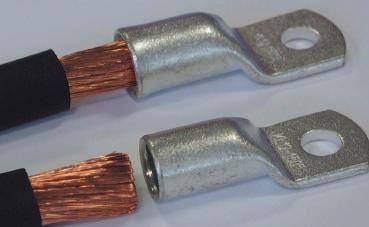
Cable lugs “F type” for fine stranded conductors for easy insertion with no splicing
This is also a safety-related issue – a reduction of the cross section area of the cable conductor caused by not inserting all the strands is being avoided and the complete cross section of the cable is maintained. Markings on the F-type cable lug barrel provide information of the product, e.g. manufacturer, dimension and design.
Marking “KL 12 150 F” indicates:
- KL: Manufacturer Klauke
- 12: Metric bolt size for connecting bolt: size M12
- 150: Cross section of conductor in sqmm
- F: Tubular cable lug design and construction
For professional crimping of F-type cable lugs the indent or quad point crimping method is recommended with the appropriate crimping tools and the correct indent profile.

F-type cable lug shows professional indent crimp
To avoid over or under compression the correct tooling is a pre-requisite. An incorrect crimping connection can result in increased joint resistance leading to an increase in temperatures and in the worst case in fire.
Klauke recommends use of their own crimping tools to achieve and guarantee professional crimps according to VDE standards. In addition to “F-type” cable lugs some manufacturers offer appropriate butt-connectors for splicing, extension and repair of cable conductors.
They also feature a flared entry and larger tube dimensions. A central restriction insures uniform insertion of the cable ends, and insure the crimping recommendations for F-type lugs are adhered to.
“F-type” cable lugs and butt connectors conform to the normative requirements of the EN 13600 standard and are manufactured from electrolytic copper for excellent conductivity.

A cross sectional view of an indent crimp (with manufacturers recommended tool) shows the even arrangement of conductor in the lug
For corrosion protection the cable lugs are available tin plated from cross sections ranging between 10sqmm up to 300sqmm. In addition to the normal design “F-type” cable lugs are also available as 45° resp. 90° angled versions as well as inspection holes to check whether the conductor is fully inserted prior to crimping-up the lug using the cable tool.
As with all other connections these products are subject to test standard IEC 1238 Part 1, which guarantees a safe electrical and mechanical connection has been achieved. Cable lugs manufactured by Klauke are subject to a special annealing process to help relieve material stresses and hardness.
This reduces the chance of material fracture and is an additional safety feature. The quality of cable lugs can often be recognised by visual characteristics. A burr free lug, a flat palm and a cleanly machined end are indicative of a high quality product.
Note: IEC 61238-1:1993 Is Now Withdrawn. Compression & Mechanical Connectors For Power Cables With Ccpper Or Aluminium Conductors – Part 1. Contact T&D.
Cable Lugs For Solid Conductors
For processing and crimping solid conductors (Class 1 DIN VDE 57295) the use of tubular cable lugs “E” type is recommended which are also manufactured from electrolytic tin plated copper. Their tube diameter is matched to the conductor size to guarantee a professional cable crimp.

Professional crimp on a solid conductor with matched tube dimension
Application is in all areas where solid conductors are being mostly used, e.g. manufacture of switchgear, transformers and engines.
A hexagonal indent crimping is being recommended – again it has to be observed that both cable lugs and crimping tools come from the same manufacturer.
Cable lugs for solid conductors can be recognized by their smaller tube diameter and the marking “E”. For example: KL 10 50 E.
Cross sections usually range from 6sqmm up to 50sqmm. The range is being completed by butt-, T- and cross connectors having the appropriate internal tube diameters.
Cable Lugs For Switch Cabinets
In many cases working area in switch cabinets is very tight and connecting conductors to high-power switchgears can be a problem In case of larger cross sections standard cable lugs do not fit into the compact connecting terminal.

Special cable lugs for switch cabinets (type SG) for safe connection also of conductors
For such applications many manufacturers have designed special narrow palm cable lugs (Klauke SG cable lugs) which fit comfortably.

Direct comparison of standard cable lugs (left) and cable lugs with narrow palm for switch cabinets
The narrow palm lug is also thicker than standard cable lugs ensuring the same amount of electrolytic copper has been used.
Despite a narrower palm no performance is lost. Thus these cable lugs therefore comply with a professional connection for stranded conductors according to DIN- VDE Class 2 as typically used in switch cabinets.
A hexagonal or indent crimp is recommended – conductor cross sections range from 35sqmm up to 300sqmm. The hole dimensions comply with industry sizes of connecting terminals, e.g. 6, 8, 10, 12 and 16mm.

Professional crimp on stainless steel cable lug for application in ambient temperatures of up to 400°C
Versions with inspection holes are also available – it is dangerous and incorrect to file the palm of a normal cable lug to the size of the connecting terminal. Such manipulation can result in increased temperatures and fire in the worst case.

Shows the thicker palm of SG cable lugs for switch cabinets, using the same amount of
copper as used in a standard cable lug.
Stainless steel cable lugs
for aggressive environments
Especially for adverse environments and for crimping copper conductors stainless steel and nickel tubular cable lugs have been designed. Stainless steel cable lugs are particularly acid and corrosion resistant and are typically used in chemical industries in areas exposed to sea water i.e. the earthing of masts on sailing yachts.
An additional benefit of these cable lugs is the temperature resistance. Consequently these lugs can be used in ambient temperatures up to 400°C.
At higher temperatures of up to 650°C – common in the construction of furnaces – nickel cable lugs represent the best solution. Both stainless steel and nickel cable lugs can be used for all common cable types.

A correctly crimped stainless steel cable lug used for applications where the environment can reach 400º C
Cross section ranges from 0.5sqmm up to 95sqmm. Generally an indent crimp is recommended. The same applies for stainless steel and nickel butt connectors with barrier.
Further Reading
Review other Blogs in this series of articles about Cable Lugs, Crimping Cables & Tools:
Cable Lugs – Crimping Applications & Standards
Indent Crimping Of Cables – Benefits & Limitations
Cable Lugs & Crimps – Hexagonal v Indent Methods of Crimping
Cable Lugs & Crimping Using The Hexagonal Crimp Method
DIN Standard – Crimping & Compressing Aluminium Cable Lugs & Connectors
Copper & Aluminium – Crimping CU-AL Cables
Electrically Driven Crimping Tools For High Volume Applications
LV MV HV Cable Accessories & Substation Electrical Equipment
Thorne & Derrick are Specialist Distributors of leading manufacturers of Cable Accessories, Jointing & Installation Equipment.
LV MV HV cable accessories used to joint, terminate, connect, cleat and gland power cables to air and gas insulated substations, transformers, switchgear and overhead line networks.
Hover over our Interactive Electricity Grid to learn more about our product ranges.
LV 600/1000V ◊ MV 11kV 33kV ◊ HV 66kV 132kV
|
|
|
|
|
|
|
|
|
|
Substation & Overhead Line Electrical Safety Equipment
Manufactured by CATU Electrical to enable the safe construction, maintenance and repair of underground cables and overhead lines network up to EHV (400kV).
T&D - CABLES ♦ JOINTS ♦ TERMINATIONS ♦ CONNECTORS ♦ GLANDS ♦ CLEATS ♦ CRIMPS & LUGS ♦ DUCT ♦ SEALS ♦ ARC FLASH PPE
EARTHING ♦ FEEDER PILLARS ♦ JOINTERS TOOLS ♦ CABLE CUTTING & CRIMPING TOOLS ♦ COLD SHRINK ♦ HEAT SHRINK ♦ FUSES
Klauke Cable Lugs & Crimping Tools | 2018 Catalogue Download
September 3rd, 2018Klauke
Thorne & Derrick | Distributed from Stock | Approved Supplier | UK & Export Sales
Klauke cable lugs are electrical compression connectors including: copper tube cable lugs and connectors (straight, angled crimp connectors for copper stranded and aluminium solid conductors), insulated cable lugs and connectors, stainless steel cable lugs and connectors, nickel cable lugs and connectors and DIN spec compression cable lugs and connectors.
➡ See below the current issue Klauke Catalogue – contact our Sales Team for prices, technical support or to place an order for cable lugs or installation tooling for cutting and crimping cables manufactured by market-leader Klauke.
Klauke cable lugs and crimping tools are used by Jointers, Linemen, Panel Builders and Electrical Engineers to install underground cables and overhead line conductors on power, transmission and distribution networks including LV MV & HV systems, 11kV-33kV.
➡ See our complete range of Cable Lugs, Crimps & Connectors LV MV HV.

Cable Lugs – Crimping Applications & Standards
August 29th, 2018
Cable Lugs – Crimping Applications & Standards
-
uploaded by Chris Dodds - Thorne & Derrick Sales & Marketing Manager
Thorne & Derrick International, based in the UK, are leading suppliers of cable crimp lugs and associated crimping tools for Low, Medium & High Voltage Cables and Power Systems – this series of articles by Klauke discusses the theory and practise of installing compression type cable lugs and connectors.
Klauke cable lugs and crimping tools are used by Jointers, Linesmen, Panel Builders and Electrical Engineers to install underground cables and overhead line conductors on power, transmission and distribution networks including LV MV & HV systems, 11kV-33kV.
➡ Download 2018 Klauke Cable Lugs catalogue and see the complete range of tools for cutting and crimping cables.
In this Article we cover the following:
- Compression cable lugs according to DIN 46235 for crimping solid, stranded, fine stranded and finest stranded copper conductors
- Copper tube cable lugs “standard design” made from electrolytic copper (EN 13600)
- Compression cable lugs DIN 46235 terminals not for solid conductors
- Selection of the correct lug very much depends on the cable type
- International Standard IEC 1238 Part 1 – electrical and mechanical properties of cable lugs
Although cable connections are relatively low cost in comparison to price-per-metre of cable and often a project afterthought the importance of specifying and installing the correct type of lug is critical to safe and reliable performance of LV MV HV Power Systems – a poor cable connection can result in an increased joint resistance and even in fire. Worse still, fatality.

Incorrect tools and cable crimps cause increased temperatures and fire.
In this blog T&D will show you the correct cable crimping procedure. There are hundreds of different versions of cable lugs available.
For the electrical engineer and cable jointer it is very difficult to choose from this broad range the correct lug for each specific application.
The following article gives an overview of the different types of lugs for copper conductors and details the facts which will guarantee a safe and permanent electrical connection.
In principle we differentiate between 3 types of cable lugs:
- Compression lugs according to DIN 46235
- Standard tubular lugs
- Sheet metal solderless terminals according to DIN 46234
Compression cable lugs according to DIN 46235
DIN Standard 46235 defines the application, dimensions and marking of cable lugs – this standard allows use of these lugs for compression of solid, stranded, fine stranded and finest stranded copper conductors and cables.

3 types of lugs: DIN cable lugs, standard tubular cable lugs and sheet metal terminals (from left to right)
Markings on the product provide the installer with information relating to the origin and application of the DIN 46235 cable lugs, which also applies for standard tubular cable lugs.

DIN crimp cable lugs show the required number of crimps stipulated by the manufacturer: Marking “KL 22 12 – 150”
- KL: indicates manufacturer (in this case Klauke)
- 22: Die set code (only for compression lugs DIN 46235)
- 12: Metric bolt size for connecting bolt: size M12 (12mm hole diameter)
- 150: Cross section of conductor in sqmm
In addition, these lugs indicate the number of required crimps. For installing, the DIN standard recommends crimping dies according to DIN 48083, Part 1, 3 and 4 for solid, stranded and fine stranded conductors.
For braided ropes the standard refers to the information of the manufacturer.
Klauke generally recommends the use of hexagon crimping dies according to DIN 48083, Part 4 for installing of compression lugs DIN 46235 – the range of cable conductor cross sections is from 6sqmm up to 1000sqmm, bolt sizes range from 5mm up to 20mm.
Electrolytic copper according to EN 13600 is mandatory.
For corrosion protection the compression cable lugs – also standard tubular cable lugs and terminals – are tin plated to protect against oxidisation.
Copper tube cable lugs “standard design”
Apart from DIN cable lugs, many manufacturers also offer standard tubular cable lugs, also made from electrolytic copper according to EN 13600. As far as sizes are concerned, standard tubular lugs are mostly shorter than DIN lugs and also differ in tube dimensions.
- DIN EN 13600 Copper & Copper Alloys – Seamless Copper Tubes For Electrical Purposes; German version EN 13600:2013

DIN compression cable lugs are longer than standard tubular cable lugs
However, since these lugs are also subject to test standard IEC 1238 Part 1 the durability of electrical and mechanical connection is not affected.
All lugs – irrespective of type – can only be crimped properly when a suitable cable crimping tool is used. Incorrect tools or an unprofessional crimp can result in increased joint resistance, increased temperatures and even fire.

Standard tubular cable lugs (left) have different tube dimensions to DIN crimp cable lugs (right)
To eliminate this risk Klauke recommends the crimping of their lugs with their tools – this is a matched crimping systems avoid a mixture of brands which are potentially incompatible.
Sheet metal terminals according to DIN 46234
Solderless Terminals
Also for the sheet metal terminals certain DIN standards apply regarding application, dimensions and marking.
Other than compression cable lugs DIN 46235 terminals are designed only for crimping of stranded, fine and very fine stranded conductors – not for solid conductors.
|
Incorrect Crimping |
Incorrect Crimping |
Correct Crimping |
| Incorrect and correct crimps in comparison: An incorrect crimp (crimping,middle: low force crimping, and usage of incorrect crimping tools can result in an increase in joint resistance and may jeopardise the installation) | ||
Which cable lug suits which application?
Cross section ranges from 0.5sqmm up to 240sqmm, bolt sizes from 2mm to 16mm.
Among others terminals they can be found in electrical control cabinets and vehicles of public transportation services, such as rail carriages and rolling stock.
Sheet metal terminals are also made from electrolytic copper according to EN 13600. But there is a difference in the basic material – compression standard tubular lugs are produced from copper tubes while solderless terminals are made from copper sheets.
Terminals show a soldered seam as the DIN standard prescribes a closed tube.
The DIN standard does not specify crimping tools – Klauke recommends their self-designed indent crimping tools.
Useful Information
The selection of the correct cable lug very much depends on the cable type. For cables according to DIN 57295 the following lugs can be used:
- Cables Class 1, 2, 5 and 6: Compression lugs DIN 46235
- Cables Class 2: Standard tubular lugs
- Cables Class 2, 5 and 6: Terminals
In practice it can happen that flexible class 5 and 6 cable conductors do not fit into the appropriate cable lug. For such cases, Klauke recommends the so called F-cable lugs which have a larger inner diameter and feature a flared entry. Indent crimping is recommended.
For installing the DIN lugs, crimping tools with die codes according to DIN 48083 Part 4 have to be used.
Electrical & mechanical properties
The International Standard IEC 1238 Part 1 applies to electrical and mechanical properties of cable lugs. The requirements for a permanent and safe electrical connection for the intended application are detailed in this standard.
Both a mechanical pull-out test and an electrical durability test are defined.
A test cycle simulates the application in practice: the connection is being heated 1000 times up to 120°C to imitate the morning voltage peak in-rush in the public power supply system.
Also high current tests are being carried out on the cable lugs at temperatures of 250°C.
The responsibility of adherence to these safety rules lies with every manufacturer of cable lugs. For this reason the manufacturers specify the appropriate cable type to be used with their lugs. Apart from normative standards, renowned manufacturers stipulate additional quality requirements.

F-Cable lugs with flared entry represent an option when cables of class 5 and 6 will not fit into normal cable lugs.
Klauke cable lugs are subject to an “annealing” process to condition the material from tension and hardness and to reduce the risk of fracture. F-Cable lugs with flared entry represent an option when cables of class 5 and 6 will not fit into normal lugs.
This process increases the durability and provides greater protection for the lug against vibration. This is another reason why Klauke recommend use of high-quality cable lugs from well known manufacturers.

The longer tube of Klauke cable lugs (above) guarantees a high quality connection.
The quality of lugs can often be recognised by visual characteristics: burr free cable lugs with flat palm and a cleanly machined end are signs of a high quality electrical connector.

High Quality Klauke Cable Lugs
Further Reading
Review other Blogs in this series of articles about Cable Lugs, Crimping Cables & Tools:
Copper Cable Lugs For Special Applications
Indent Crimping Of Cables – Benefits & Limitations
Cable Lugs & Crimps – Hexagonal v Indent Methods of Crimping
Cable Lugs & Crimping Using The Hexagonal Crimp Method
DIN Standard – Crimping & Compressing Aluminium Cable Lugs & Connectors
Copper & Aluminium – Crimping CU-AL Cables
Electrically Driven Crimping Tools For High Volume Applications
LV MV HV Cable Accessories & Substation Electrical Equipment
Thorne & Derrick are Specialist Distributors of leading manufacturers of Cable Accessories, Jointing & Installation Equipment.
LV MV HV cable accessories used to joint, terminate, connect, cleat and gland power cables to air and gas insulated substations, transformers, switchgear and overhead line networks.
Hover over our Interactive Electricity Grid to learn more about our product ranges.
LV 600/1000V ◊ MV 11kV 33kV ◊ HV 66kV 132kV
|
|
|
|
|
|
|
|
|
|
Substation & Overhead Line Electrical Safety Equipment
Manufactured by CATU Electrical to enable the safe construction, maintenance and repair of underground cables and overhead lines network up to EHV (400kV).
T&D - CABLES ♦ JOINTS ♦ TERMINATIONS ♦ CONNECTORS ♦ GLANDS ♦ CLEATS ♦ CRIMPS & LUGS ♦ DUCT ♦ SEALS ♦ ARC FLASH PPE
EARTHING ♦ FEEDER PILLARS ♦ JOINTERS TOOLS ♦ CABLE CUTTING & CRIMPING TOOLS ♦ COLD SHRINK ♦ HEAT SHRINK ♦ FUSES