This article was originally posted in February 2016 to our mothballed website, www.cablejoints.co.uk
Electrical Stress
Today, we received a surprising email from Douglas Page.
Doug would not admit it but he is an acknowledged expert in the jointing and termination of EHV cables. Yes, you are Doug.
Doug has been in the industry since 1984 and is currently Work Methods and Training Instructor, EHV and HV Cable Splicer, Environmental Health Technician at Hydro One.
Expert and competent at jointing and terminating Extra High Voltage Cables (HPOF, XLPE and LPOF) and using leading Medium & High Voltage Cable Accessories from manufacturers including 3M, Raychem and Pfisterer.
This surprising email read, “a whole bunch of questions in response to recent posts by Thorne & Derrick, have asked me to explain some industry misconceptions. I am in no way trying to instruct, these are just my opinions, but hopefully they will answer some of the strange questions I have been receiving. Let me know what you think, or even if I should go down this road. The problem is, the same misconceptions have been causing cable failures for years”.
We say, steam on down that road Doug – we’ll rocket propel your content via ourLinkedIn Discussion Group and social networks. You are a thought-leader with vast experience and are attracting a definite fan-base. We see that through the Google traffic rushing into www.powerandcables.com from your Posts.
Be as flattered by the attention as we are honoured to have the opportunity to be your online voice.
R.E.S.P.E.C.T to you.
Lets pass you all over to Doug to explain some of those Electrical Stress misconceptions.
Electrical Stress Explained
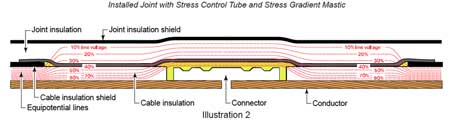
Without an insulation shield, you can see how the voltage leaves the conductor travelling through the insulation, very erratically and effectively seeking ground/earth, creating hot spots and eventually cable failures – basically this is electrical stress.
The creation of an “insulation shield” allows the stress/flux to travel very efficiently and evenly, along the cable, dissipating the “stress” evenly.The problem arises when we remove the insulation shield for cable splicing and terminating.
The abrupt end to the shield allows the different percentages of voltage to escape the insulation at a concentrated point, creating an area of extreme stress, as the voltage seeks ground/earth. This electrical stress again creates intense heat and eventually failure. In a cable splice, we are not trying to eliminate the stress, but rather control it.
In some cable splice kits gradient mastic, and “heat shrink stress control tubes” are used to contain and control the deflection of the flux lines. In other cable joint kits it could be push-on single mass control tubes. In hand tape kits, it is all built with different types of tape, put on in specific order, to very specific measurements.
With cable terminations it is different. We are not trying to control and contain, we are trying to control and dissipate as much electrical stress as possible.
Again this can be achieved in various ways. Mastic and heat shrink stress control tubing, a solid push-on mass, or again hand taping.
The type of cable termination doesn’t matter, they are all trying to achieve the same result. Control and dissipate electrical stress through deflection.
Conclusion
“Hopefully this clarifies some of the cable jointers questions. It doesn’t matter the type of cable or manufacturer, the importance around the quality of work, cannot be stressed enough, if you have a cable splicer telling you that the semi-con removal isn’t important, or the cable doesn’t need to be sanded…look elsewhere for a cable splicer,” concludes Doug.
Thorne & Derrick International are specialist distributors of LV, MV & HV Cable Installation, Jointing, Duct Sealing, Substation & Electrical Equipment – servicing UK and global businesses involved in cable installations, cable jointing, substation, overhead line and electrical construction at LV, 11kV, 33kV and EHV.
Are you suffering performance issues with your HV Cable Systems?
Our clients have been asking us to provide information on 66/69kV class cable systems.
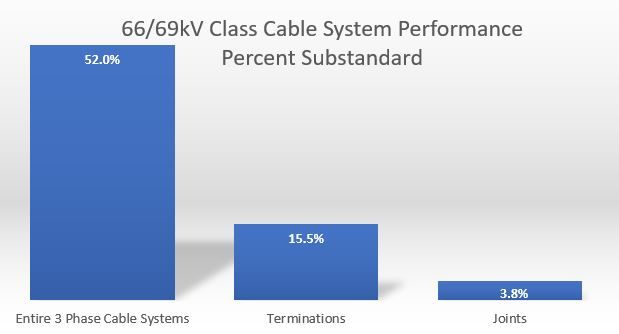
So here is a view from our database of over 200,000 factory comparable (50/60Hz PD with 5pC sensitivity) tests on recently installed 66/69kV cable systems. The data is not pretty.
We have a ways to go to improve performance on these cable systems.
On the basis of a few projects including over 350 cable systems, 52% (from a 3 phase performance stand point) have at least one substandard component.
Terminationsare the worst offenders at 15.5% substandard whereas Joints fair a little better at 3.8% substandard.
We have performed dissections on several occasions. The issues? Installation error.
Posted by Ben Lanz | Director, Technology & Test Systems Availability at IMCORP
Contact us today to discuss your Jointer Training requirements – client customised Competency Training is provided by Thorne & Derrick International at Nexans UK Centre of Jointer Excellency in the UK.
Thorne & Derrick are national distributors of LV, MV & HV Cable Installation, Jointing, Substation & Electrical Equipment – servicing businesses involved in cabling, jointing, substation, earthing, overhead line and electrical construction at LV, 11kV, 33kV, 66kV and EHV. Supplying a complete range of power cable accessories to support the installation and maintenance of low/medium and high voltage voltage power systems:
Thorne & Derrick | Connectors Distributed from Stock | UK & Export Sales
The technology of shearbolt connectors for current transmission has developed quickly – the principle of shearbolt technology was first introduced in the early 1980s when manufacturers sold the first types of low voltage LVbolted connectors. The next step was adopting shearbolt technology for use in low voltage cable applications, where required torque moment was a pre-set parameter machined into the bolt. Based on positive field experience, shearbolt connector technology was adapted for use in medium voltage applications as well. But cable accessories up to 42kV require concentric connector bodies and smooth outer surface, without sheared off bolts standing proud and no sharp edges at the connector and bolts.
In the 1990s, connector manufacturers introduced different types of multiple shear bolts, allowing a requested torque moment to a particular cable cross-section while ensuring that bolts shear off flat with the outer circumference of the connector body. At the same time, IEC 601238-1 was established to replace former local standards and set higher requirements in terms of contact ageing. The most important advantage of bolted contacts is that one connector type applies for different cross-sections and conductor materials. This created a user-friendly and reliable connector, simplifying allocation of conductor cross-section to connector. Those same principles and connector body design have been adapted and optimized to cover cross-sections of up to 3000sqmm and even for HV/EHV applications.
By Fak Hardt
Head of Product Portfolio & Cable Accessory Development, Pfisterer Holding, Germany
Mr. Hardt is an Electrical Engineering professional.
He has had more than 24 years of experience in manufacturing as R&D-Manager for connectors and fittings with Pfisterer as well as in development of underground power cables and accessories. He has in-depth knowledge of related production processes, quality and environmental management and holds patents for bolted technology and ring connector technology. Pfisterer is a leading independent manufacturer of cable, connectors, insulators and overhead line accessories for sensitive interfaces in energy networks. The Group is headquartered in Winterbach, near Stuttgart in southern Germany.
Pfisterer Sicon | Shearbolt Connectors
Thorne & Derrick are national distributors of LV, MV & HV Cable Installation, Jointing, Substation & Electrical Equipment – servicing businesses involved in cabling, jointing, substation, earthing, overhead line and electrical construction at LV, 11kV, 33kV, 66kV and EHV. Supplying a complete range of power cable accessories to support the installation and maintenance of low/medium and high voltage voltage power systems:
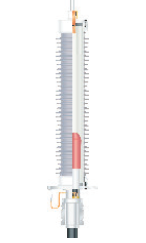
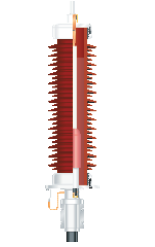
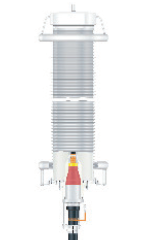
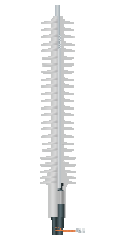
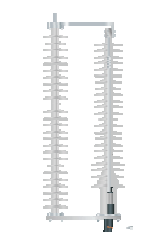
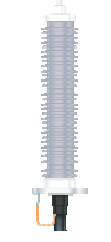
Südkabel are global leaders in manufacturing Extra High Voltage EHV cable joints and cable terminations for XLPE insulated cables also offering an outdoor termination portfolio including the dry type solutions.
The outdoor cable terminations are available between 72.5kV-132kV offering both the self supporting and rigid dry type solution – a Jointer Training Serviceis also available by contacting Thorne & Derrrick for further information.
➡ The following tables provides an overview of the range of Südkabel Cable Terminations available for the connection, support and sealing of high voltage cables.
OF decoupling
rotatable base plate
arcing horn
PD sensor
OF decoupling
rotatable base plate
arcing horn
PD sensor
OF decoupling
rotatable base plate
arcing horn
PD sensor
OF decoupling
OF decoupling
OF decoupling
rotatable base plate
arcing horn
PD sensor
About Südkabel
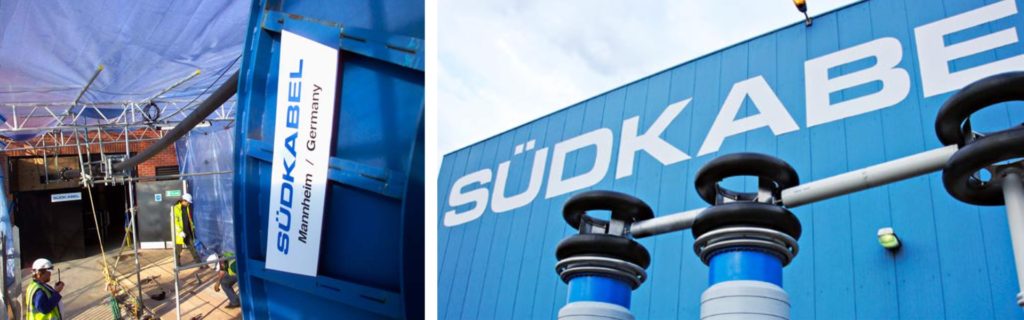
At Südkabel, we are proud of our heritage and everything that has been developed and achieved in Mannheim for more than 100 years. After all, we don’t just produce high quality cables and accessories, but also accomplish pioneering work – particularly in the field of XLPE technology.
This progress is supported by people with a wide range of qualifications and experience. They all distinguish Südkabel’s image. They all drive the company forward and always work in the interest of their customers.
THORNE & DERRICK
Thorne & Derrick are national distributors of LV, MV & HV Cable Installation, Jointing, Substation & Electrical Equipment – servicing businesses involved in cabling, jointing, substation, earthing, overhead line and electrical construction at LV, 11kV, 33kV, 66kV and EHV. Supplying a complete range of power cable accessories to support the installation and maintenance of low/medium and high voltage cable systems:
New Connection Technology For Single-Strand Insulated Cables By PFISTERER
High-voltage power cables increasingly utilise conductor designs that significantly reduce skin and proximity effects.
This enables more power transmission with the same cross-section. The individual strands of these conductors are insulated from each other (enamelled)and are often arranged in segments (Milliken type).
This conductor structure complicates the cable connection process.
PFISTERER has developed FrontCon, which uses a completely new connector principle to significantly simplify and shorten installation.
New connection technology
Connecting single-strand insulated cable conductors is a time-consuming process that only works to a limited extent: separate the individual strands, strip them one by one, then rearrange them as far as possible in the original form – without damaging any of the strands. Despite best efforts, the original conductor structure is not achieved at the installation site. Moreover, removing the insulation means losing the benefit of single-strand insulated cables at the end of the conductor. PFISTERER has completely rethought the connection of single-strand insulated conductors.
Shorter Installation Time
80% Shorter Installation Time
With FrontCon, PFISTERER has developed a solution that significantly reduces the time required and creates a defined connection via the front face of the cable. Installation takes only around 2 hours – not longer than for conventional cables with standard connections.
At the same time, possible damage when stripping the individual strands is prevented. That significantly reduces the risk of installation errors.
Compact Design
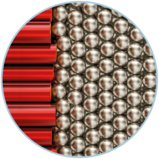
FrontCon is installed directly on the end of the cable – no work is required on the individual strands. Specially developed contact balls make contact with the front faces of the individual strands. Together, these contact balls behave like a liquid. They compensate for slight unevenness at the conductor end, and ensure that the same contact forces are applied across the whole conductor cross-section.
Power flows via the conductor front face and the contact balls. This enables a very short and compact contact system for large conductor crosssections.
Proven contact system for HV cable fittings
FrontCon is available as a connection technology for CONNEX cable connectors and IXOSIL terminations, as well as for cable connections in MSA cable joints and type tested with specific cables. The first cable projects have now been in operation for several years.
The contact system can be adapted for any fittings, enabling reliable and cost-effective solutions in cable systems. It can be installed vertically or horizontally. The range covers copper cables up to a cross-section of 2,500 mm².
Other cable connection solutions can be implemented on request.
HV Cable Fittings
Pfisterer Frontcon Benefits:
Reliable contact on the front face of the conductors
Very short installation time
Insulation does not have to be removed from individual strands
Compact design
Safe and simple installation
Conductor structure is preserved
How Frontcon works
FrontCon is installed directly on the conductor end. The cable is sawn off straight, and the cable insulation is removed. The pressure-stable contact system clamps centrically onto the conductor.
Contact balls are poured into the connector. Tightening the pressure screw presses the balls against the front face of the conductor ends. Reliable contact is established.
A built-in spring mechanism compensates for settling losses. This ensures that contact forces and low transmission resistances are maintained at different temperatures and throughout the full service life.
Stockists & Suppliers
The range of PFISTERER cable plugs, joints, terminations fittings and accessories offers solutions for virtually all MV & HV Cable Connection applications – PFISTERER accessories use silicone as an insulating medium due to the excellent properties that it possesses.
THORNE & DERRICK
Thorne & Derrick are national distributors of LV, MV & HV Cable Installation, Jointing, Substation & Electrical Equipment – servicing businesses involved in cabling, jointing, substation, earthing, overhead line and electrical construction at LV, 11kV, 33kV, 66kV and EHV. Supplying a complete range of power cable accessories to support the installation and maintenance of low/medium and high voltage cable systems:



 The problem arises when we remove the insulation shield for cable splicing and terminating.