Thorne & Derrick | Cable Pulling & Laying Equipment Stockists and Suppliers
Cable Pulling
The following information based upon a document produced by UK DNO, Scottish & Southern Electricity Networks, provides information and guidance on New Connections and best practise for cable pulling and laying and when installing LV (Wavecon | Concentric), 11kV (3 Core | Single Core) and 33kV (Single Core) cables into underground cable trenches.
The cable pulling equipment for ensuring safe and compliant installation of LV-HV cables up to 33kV is briefly outlined – should you require any further information or technical support please contact us.
All work carried out and cable pulling equipment used must be compliant with SSE technical guidance (TG-PS-881) available from the SSEN website.
It is also recommended that contractors and clients review the ‘Practical Guide to Streetworks’ before undertaking any excavations prior to installing LV-HV cables to form part of new connections.
The following cable trench section shows the position of cable and the cable duct in the ground – it is important that the top of any apparatus is at these depths as a minimum, this includes the top of the cable duct. In addition to the cable or duct there is a requirement for 75mm finefill material on all sides. Cable marker tape or cable tiles/covers must be installed 150mm above the top of the apparatus, this needs to have SSEN branding on.
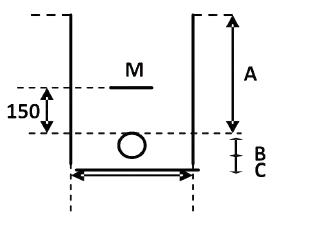
This table shows the minimum depths to top of apparatus (A within the diagram above)
| Minimum Apparatus Depth |
Unmade Ground, Verges & Footway (mm) |
Carriage (Road) (mm) |
Agricultural (mm) |
| Cables LV |
450mm |
600mm |
1000mm |
| 11kV Cables HV |
600mm |
750mm |
1000mm |
| 33kV Cables HV |
800mm |
900mm |
1100mm |
Minimum Excavation depth required = (A) minimum depth of apparatus + (B) outside duct/cable size + (C) 75mm of sand bedding.
Please note that (M) represents the cable marker tile (for 33kV cables use Stokbord covers) or cable protection tape for all other installations including 11kV cables and cable joint protection.
Please note: Where there are sudden changes in surface type (e.g footway to carriageway), excavations should always be at the greater of the depths required.
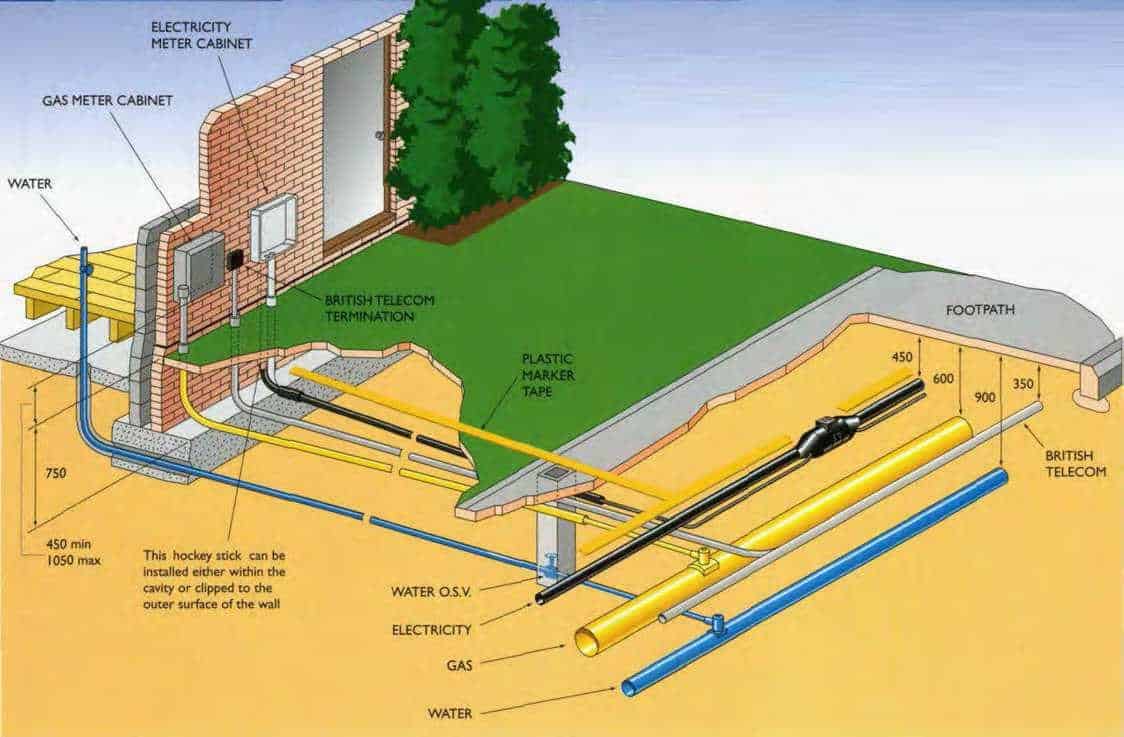
New Housing Service Cable Installation Guide
Experience has shown that by using a service tube the disturbance to the site is reduced when the electricity supply is connected.
The service tube can be laid in the same cable trench as the other services are shown, with an identifying plastic cable marker tape installed above to give advanced warning of service cable location on private property.
External meter cabinets
The external meter cabinets must be positioned in agreement with SSE to provide unrestricted access.
The preformed ‘hockey sticks’ can be installed either within the cavity or clipped to the outer surface of the wall below the meter cabinet.
White ‘hockey sticks’ must be used on the outer surface of walls. The service tubing must be securely coupled to the ‘hockey sticks’. The cabinets are only large enough to house SSE service and connection equipment.
Clients must fit own main switches on an inside wall so that the length of interconnecting cable does not exceed 3 metres.
This cable must only enter through the bottom of the cabinet, using the right hand hole, when viewed from the front.
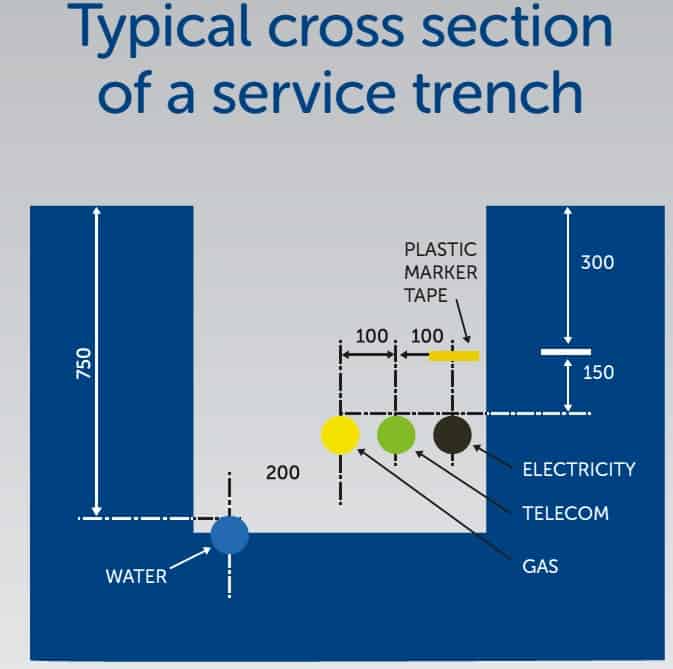
Typical Cross Section of A Service Trench
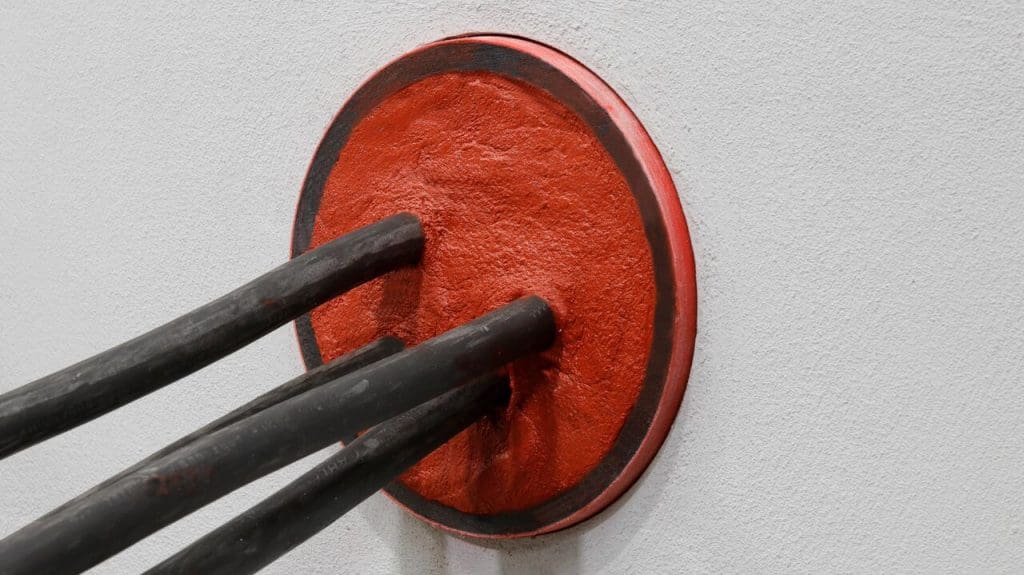
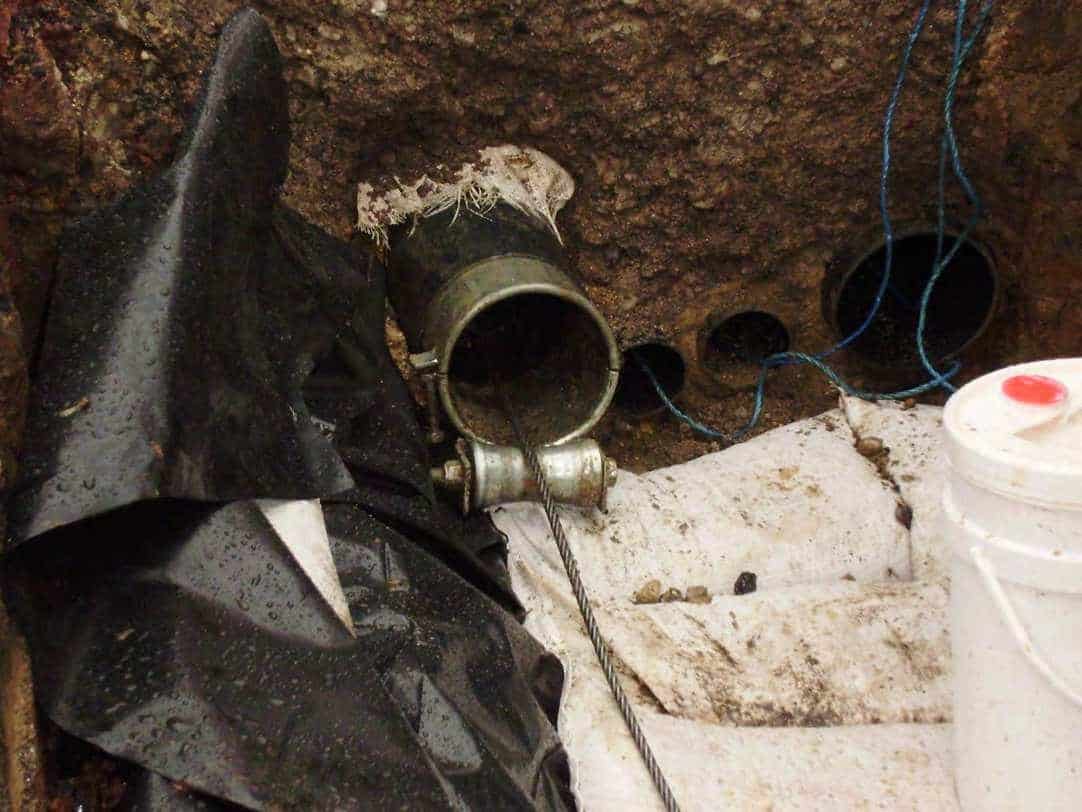
Duct Seals – contact us for duct sealing solutions and products to provide sealing against water (flood prevention) to copper and ducted low, medium and high voltage power cables.
Installation of Cable ducts
For the installation of ducted schemes the use of Black electric cable ducts only (see table below for approved suppliers) are permitted for use.
Clients should consider the type of cable ducts intended to use before ordering as excavations will be different depending on which cable duct supplier you use – the minimum cable bending radius must also be considered by referring to the manufacturers specification and selecting the appropriate cable pulling equipment to include cable rollers, socks, drum jacks and cable winches.
Emtelle cable duct range includes a smooth bore type of ducts which have rigid preformed bends at differing angles. When pulling and laying cables it is important that angles or bends should not be placed too close together otherwise cable pulling tensions will become greater than the manufacturers guidelines during the installation process.
Winch Cable installation
All cable must be installed not exceeding the manufacturers recommended cable pulling tensions – this applies to low, medium and high voltage power cables. Contractors must familiarise themselves with these cable pulling loads before hiring the equipment to ensure that these loads are not exceeded.
For all Cable Pulling applications contractors should use the following cable laying equipment and products:
In addition to cable trench installations, for ducted cable schemes you will also need;
For 33kV single core cables it is recommended that the contractor put colour indicators on each cable for identification – the cable installer must securely anchor the cable drums and the cable winch at either end and ensure that the LV-HV cable does not come into contact that could inflict cable sheath damage.
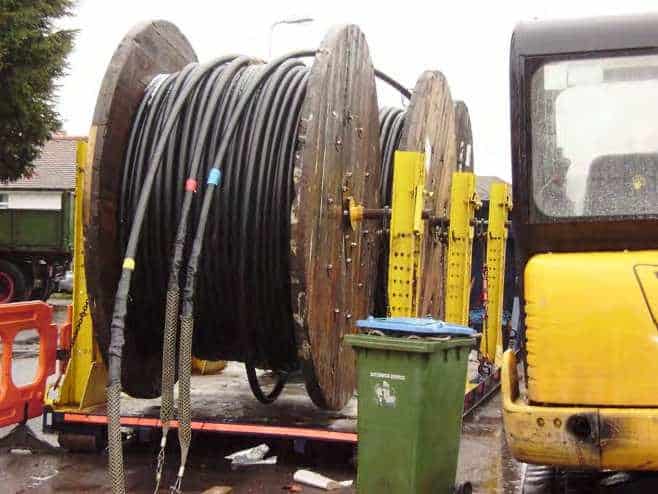
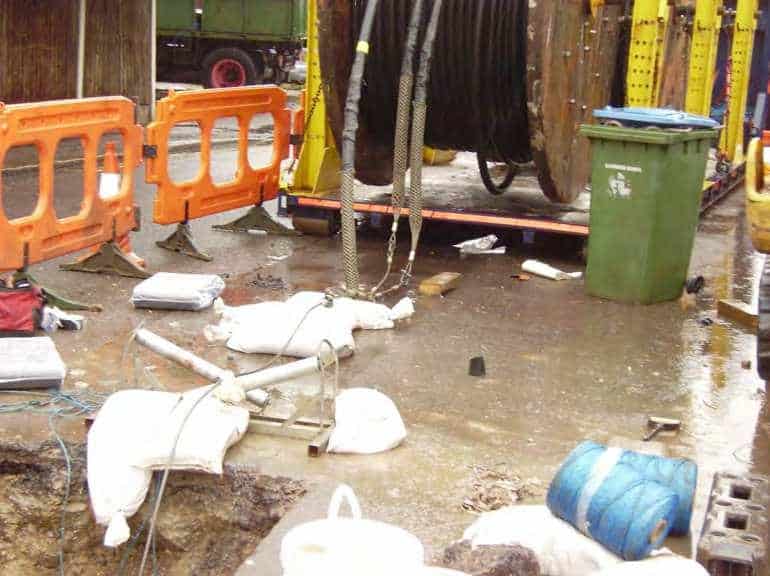
Cable Socks – high tensile strength galvanised steel cable socks provide support and grip for LV-HV cable pulling into duct or laying into trench.
Cable Pulling Equipment
Cables, Duct, Duct Seals & Cable Tiles Approved Equipment
| Item |
Manufacturer |
Manufacturing Location |
Notes |
| LV Concentric Cables |
Tratos |
UK |
|
| Cabelte |
Portugal |
|
| LV Wavecon Cables |
Prysmian |
Wrexham UK |
|
| Hellenic |
Greece |
|
| 11kV Three Core Cables |
Nexans |
Hannover, Germany |
Aluminium stranded & solid conductors 11kV |
| Prysmian |
Wrexham UK |
|
| 11kV Single Core Cables |
Tele-Fonica Kable |
Poland |
Copper or aluminium stranded for all conductor sizes
Solid aluminium up to and including 300sqmm conductors 11kV |
| Prysmian |
Wrexham UK |
|
| Nexans |
Hanover, Germany |
|
| 33kV Single Core Cables |
NKT |
Cologne, Germany |
Copper or aluminium stranded for all conductor sizes 11kV or
Aluminum stranded for all sizes or solid aluminium up to and including 300sqmm |
| Tele-Fonica Kable |
Poland |
|
| Prysmian |
Wrexham UK |
|
| Nexans |
Hanover, Germany |
|
| Cable Duct |
Polypipe Civil Ltd |
UK |
|
| Emtelle UK Ltd |
UK |
|
| Cable Tile |
Centriforce |
UK |
|
| Cable Warning Tape |
Centriforce |
UK |
|
| Plastic Tape Tile |
Centriforce |
UK |
|
| Duct Seals |
TE Connectivity |
UK |
Rayflate Inflatable Cable Duct Seals |
| WT Henley |
UK |
Services Ducts (Green Plastic Compound) |
| Winn & Coates (Denso) |
UK |
Denso Mastic
Denso Tape |
| CSD Cable Sealing System |
UK |
CSD RISE Cable Duct Sealant System |

Joints | Terminations | Glands | Cleats | Cables | Tools | LV MV HV 11kV 33kV
Cable Laying & Pulling Equipment
Thorne & Derrick distribute an extensive range of Cable Laying & Pulling Equipment to enable the safe installation of utility power cables including LV Waveform and MV-HV Power Cables 11kV/33kV – full range of cable spiking tools available to ensure LV-HV power cables are dead prior to jointing or cable termination works.
➡ Further reading: Cable Pulling Equipment – A Cable Duct Laying Guide From BT Openreach

Thorne & Derrick | Cable Pulling & Laying Equipment Stockists and Suppliers
Cable Pulling
The following information produced courtesy of a BT Openreach document provides a quick guide to duct laying and the Cable Pulling Equipment required to install cables into underground cable ducting.
Where the Openreach cable duct crosses a carriageway adjoining kerbs must be temporarily marked to note positions. Openreach duct needs to be laid on an outer edge of the service trench to enable box building. The contractor will need to insert a draw rope through the duct and secure it to the marker posts at both ends of the crossing. The appropriate Plug Duct 4B socket end and 4C Spigot must be fitted.

PVC Cable Duct For Underground Telecom Cables | Openreach
Duct beneath a carriageway crossing must be laid at a depth of 600mm from the cover of the final surface levels. For engineering reasons (National Joint Utilities Group NJUG) it must be separated from other services laid in parallel by 600mm (to permit Openreach to install underground joint boxes without the need for bends). Cable marker no.2 is needed at the site entrance boundary to ensure link up identification for cable contractors.
The latest information on the positioning of utilities, mains and plants can be obtained from the National Joint Utilities Group.

Cable Ducting
- All cable runs must be laid as straight as possible for installation into duct using correct cable pulling equipment
- If required bend the cable ducts or use pre-formed duct bends supplied by Openreach
- There can be no more than one pre-formed 90° cable duct bend in any single run of duct
- Pre-formed 90° cable duct bends cannot installed in any duct linking two joint boxes
- Footpath or service strip ducting must be laid at 350mm depth of cover
- All space alongside the cable duct must be backfilled with granular fill to a minimum thickness specified by Openreach
- For all Single Dwelling Units (SDU) cable duct must be terminated on the external surface of the property
- The duct termination point shall be in a location that will allow unrestricted access for any future maintenance activity
- All cable ducts must be provided with a draw rope after installation, unless it’s agreed locally to substitute the draw rope with a cable
- Please notify the field based coordinator (FBC) when the duct has been laid and is ready for inspection.
Typical issues with carriageway road crossings
- Insufficient depth
- Proximity to other services
Impact of issues
- Renew duct – this may delay any first occupation date or subsequent occupation dates.
Avoiding Damage to the Openreach Underground Network
Openreach has an extensive underground network of ducted cables that can be located inside or on the perimeter of a site. The network is vulnerable to excavation related damage unless appropriate measures are taken. The precautions for avoiding damage to an underground utility plant are contained within the Health & Safety Guide No. 47: Avoiding Danger From Underground Services (download below).
This document stresses the need for available utility plans on site and the use of safe digging practices.
Third-party damage to the Openreach network can be expensive for that party to repair.
- Direct cost – the cost of repair
- Operational cost – delays associated with repair
- Social cost – loss of service to emergency services/centres or the vulnerable in society
💡 TIP: Use Openreach “Click Before You Dig” service – a proven record of minimising the potential for damage and cost.
If you locate damage on site you should contact your FBC immediately.
If outside the perimeter of your site and has the potential to be a danger to the general public please contact Openreach by calling 0800 023 2023, Option 1, Option 1.
Duct Seals – contact us for duct sealing solutions and products to protect and provide sealing against water (flood prevention) to copper and fibre ducted cables.
Cable Pulling Equipment
Thorne & Derrick distribute an extensive range of Cable Pulling & Laying Equipment to enable the safe installation of fibre and copper cables within the telecommunications industry. Safely installed cables reduces operational and maintenance requirements to the network and reduced service interruption to telecom cables, wires, ducts, cabinets and exchanges – products include cable spiking tools, conduit rods, cable lubricant, cable socks and rollers.
➡ Further reading: Cable Pulling Equipment – A Cable Laying, Duct & Installation Guide From SSE