Arc Flash Protection
Overcoming Arc Flash Hazards
July 30th, 2019
Overcoming Arc Flash Hazards
Arc Flash Hazards
-
Blog Written By Patrick Mynett -
CEO / High Voltage Specialist at HV Training and Consulting Pty Ltd

"Every worker can go home at night after a day at work"
Thorne & Derrick International would like to thank Pat Mynett for allowing us to publish his article Overcoming Arc Flash Hazards.
Pat is CEO at HV Training and Consulting Pty Ltd and is a High Voltage Specialist.
In 2014, Pat Mynett decided there was room in the market for another RTO to provide quality electrical training. Especially from a person with recent industry experience, whose main interest was in the electrical safety of workers and the welfare of the plant. Arc flash safety training was a glaring omission in the industry so he developed, wrote and registered a nationally accredited arc flash course for those who work in an arc flash hazard zone.
This is Part 3 in a series of articles about the dangers of arc flash – over the course of these articles we have discussed the definitions, dangers, statistics, causes, prevention and protection against arc flash.
- Introduction to Arc Flash
- Arc Flash – The Electrician’s Insidious Companion
- Overcoming Arc Flash Hazards
Arc Flash
An arc flash can cause minor injuries, third degree burns and potential death as well as other injuries including blindness, hearing loss, nerve damage and cardiac arrest. Fatal burns can occur when the victim is several feet from the arc. Serious burns are common at a distance of 10 feet – arc flash can generate heat 4 times greater than the surface of the sun.

The Energy In An Uncontrolled Arc Flash
Arc Flash is the result of a breakdown in insulation which in turn causes an excessive flow of current between phase and earth, phase to neural or phase to phase. This current flow may be thousands of amps, that is why arc flash fault current is measured in kilo Amperes (kA).
The energy released from an arc flash is governed by the systems voltage, the generation capacity available, the impedance to the source and the time the fault is on the system.
Arc flash is made up of molten metal, plasma, intense heat, intense light, gas, intense sound, and pressure waves, all released in milliseconds.
Arc Flash Energy In Perspective
To get some idea of the energy that can be released: a 415 volts system with 5000 amps/ 5kA of fault current flowing for 500 milliseconds or 2500 amps/2.5kA flowing for 1 second, it would have a similar energy release as one stick of explosive.
A 200kVA transformer’s fault current at the 415-volt terminals can be up to 6170 amps.
A 100kVA transformer’s fault current at the 415-volt terminals can be up to 3085 amps.
Both having the capacity to produce the energy shown in the paragraph above.
How Is The Energy From An Arc Flash Measured?
Firstly, the energy at the arc flash source, is different from the energy received from an arc flash. It all depends on where you stand. So, the energy received depends on the distance to the arc flash source.
The energy received from the arc flash is called Incident Energy.
It is measured in calories per centimetre squared, (cal/cm2).
Incident Energy is: The amount of energy impressed on a surface, a certain distance from the source, generated during an electrical arc event.
So What Actions Can Initiate An Arc Flash
You will notice that all of the below, are actions that happen very frequently but only a very few ever initiate an arc flash. They are not normally the cause, there is usually other contributing factors,
1: Opening or closing a circuit breaker
2: Racking a circuit breaker in or out (see picture below)
3: Working live
4: Opening or closing a switch
5: Opening or closing an isolator
6: Dropping tools
7: Testing
8: Replacing parts
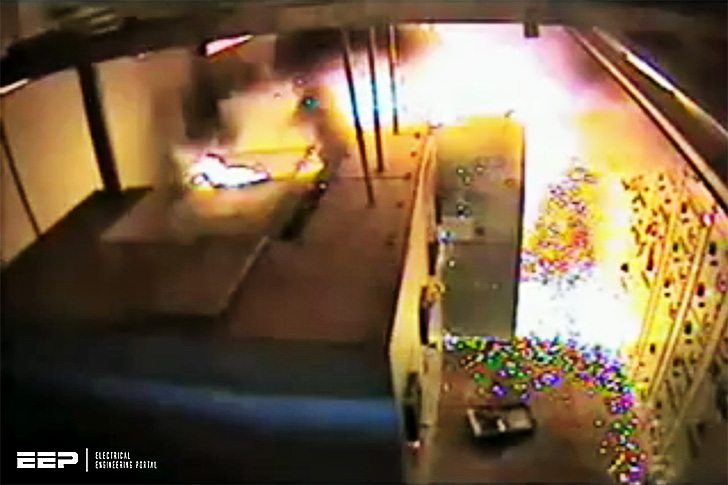
What Initiates & What Causes An Arc Flash
Are Different In Many Cases
Because the initiating actions, are actions that are all part of normal operations carried out frequently by many electrical workers, very little thought is given to the action itself.
Just as an example: A circuit has been modified. (AS/NZS 3000 specifies the circuit must be tested before re-energisation) yet many ignore this testing. The circuit breaker is closed without thought and there is a fault with the modification. The closing of the circuit breaker initiates an arc flash at the modification. If the circuit breaker has not been maintained, it may not clear the fault as per the trip settings time, it may not clear the fault at all, or another arc flash may occur at the circuit breaker.
Initiation Causes
1: Closing a circuit breaker – Closing onto a short circuit, the circuit breaker is under rated
2: Racking a circuit breaker in – Racking in a closed-circuit breaker onto a load
3: Closing a switch – Closing onto a short circuit and the upstream protection is incorrect
4: Opening an isolator – Opening an isolator with load on the circuit
5: Dropping tools – Working in a live switchboard with uninsulated tools
6: Testing using a non-rated multimeter with the settings on the wrong function
7: Replacing parts – Long tails make contact with live parts
8: Working live ignoring legislation, such as peer pressure not to turn the supply off
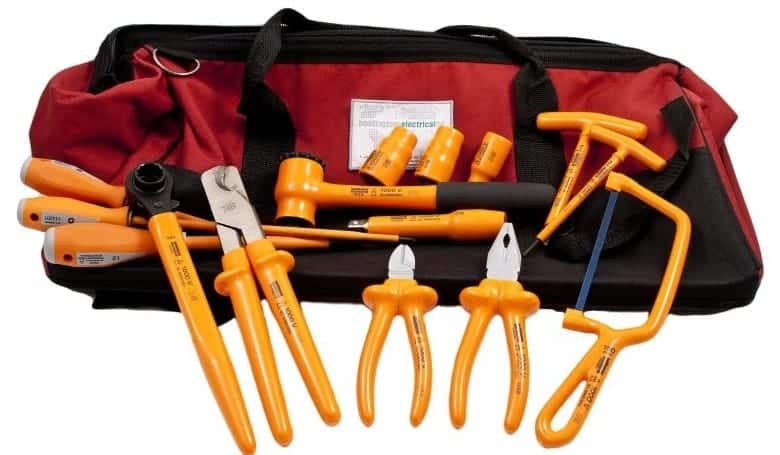
➡ Protecting Cable Jointers & Electrical Engineers When Working Live On Cables & Switchgear – comprehensive ranges of insulating matting and insulated tools.
Causes Can Often Be Traced To Human Performance
Let’s look at some human performance issues.
Not concentrating, “I’ve always done it this way,” rushing to finish the job, taking short cuts, ignoring standard procedures, lack of knowledge etc.
One of the biggest issues with arc flash, is the lack of knowledge. Most electrical workers have heard of arc flash and have some idea of the results but have little understanding of arc flash hazards and mitigation of the hazards.
A few years ago, it was taken as an occupational hazard that electrical workers would occasionally get injured or die from exposure to an arc flash. This should not be the case today as arc flash is now a recognised foreseeable occupational hazard.
Where Do We Stand Under Law?
Australian Health and Safety law is quite specific about occupational hazards.
Australian Model Work Health and Safety Regulations: Chapter 3 General Risk and Workplace Management
34 Duty to identify hazards
A duty holder, in managing risks to health and safety, must identify reasonably foreseeable hazards that could give rise to risks to health and safety.
35 Managing risks to health and safety
A duty holder, in managing risks to health and safety, must:
(a) eliminate risks to health and safety so far as is reasonably practicable; and
(b) if it is not reasonably practicable to eliminate risks to health and safety—minimise those risks so far as is reasonably practicable.
As arc flash is now a foreseeable occupational hazard, so there is a duty to manage these hazards. Yet many companies choose to either ignore or play lip service to arc flash hazards.
Understanding Arc Flash Comes From Quality Training
Training workers is one area where little is happening.
Some large companies consider a familiarisation session of one hour as adequate training.
To cover training adequately takes 5 to 7 hours to cover what is required. Training should include; what arc flash is, Legislation & Standards, definitions, incident energy, causes of arc flash, PPE selection and requirements, arc flash risk management.
Protect Yourself Against Arc Flash
Arc flash protection is provided by specialist clothing and garments for “head-to-toe” protection.
Enhanced and effective arc flash protection is safely achieved by wearing layers of protective clothing and garments manufactured from inherent fibres and which feature specific Arc Flash resilient components. Without the correct high-quality garments arc protection levels will be compromised.
➡ Further Reading
- Arc Flash Clothing & Protection For Safe Windfarm & Wind Turbine Working
- Arc Flash Clothing – PPE To Protect Highways, Street Lighting & Utility Contractors
- Eliminate Arc Flash To Minimise Downtime & Repair Costs At The Circuit Breaker
- Do Insulating Gloves Provide Arc Flash Protection?
- Can Arc Flash Clothing Save Utility Workers Lives?
- Electrical Safety – Arc Flash Accidents & Electrocution In LV-HV Installations
- Arc Flash Calculation – Selecting Clothing & PPE To Protect Lives Against Arc Hazard
THORNE & DERRICK SPECIALIST ELECTRICAL DISTRIBUTOR
LV ♦ MV ♦ HV
T&D distribute the most extensive range of LV, MV & HV Cable Jointing, Terminating, Pulling & Installation Equipment – we service UK and international clients working on underground cables, overhead lines, substations and electrical construction at LV, 11kV, 33kV and EHV transmission and distribution voltages.
- Key Products: MV-HV Cable Joints & Terminations, Cable Cleats, Duct Seals, Cable Transits, Underground Cable Protection, Cable Jointing Tools, Feeder Pillars, Cable Ducting, Earthing & Lightning Protection, Electrical Safety, Cable Glands, Arc Flash Protection & Fusegear.
- Distributors for: 3M, ABB, Alroc, Band-It, Catu, Cembre, Centriforce, CMP, Elastimold, Ellis Patents, Emtelle, Furse, Lucy Zodion, Nexans Euromold, Pfisterer, Polypipe, Prysmian, Roxtec.

LV – Low Voltage Cable Joints, Glands, Cleats, Lugs & Accessories (1000 Volts)

MV HV – Medium & High Voltage Cable Joints, Terminations & Connectors (11kV 33kV EHV)

Cable Laying – Underground Cable Covers, Ducting, Seals & Cable Pulling Equipment
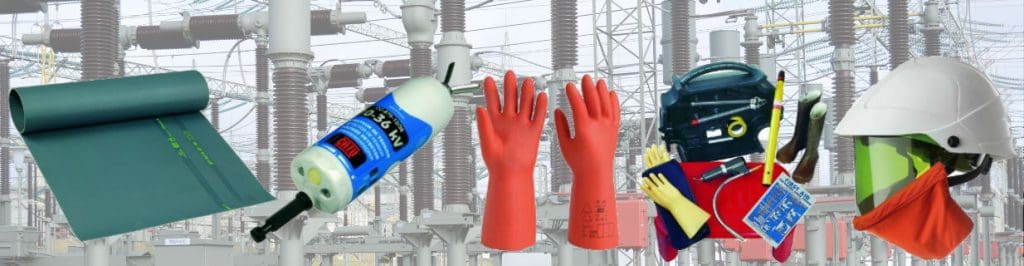
T&D, CATU Electrical Safety & Arc Flash Protection Specialists for SAP’s, Linesmen, Jointers & Electrical Engineers – Largest UK Stockist
INVITATION
Thorne & Derrick invite you to join LinkedIn’s largest LV-HV Electrical Discussion Group : Low & High Voltage Power, Cabling, Jointing & Electricals. Discussion subjects include cable installations, cable jointing, substation, overhead line and electrical construction at LV, 11kV, 33kV and EHV. Network, engage and promote your profile, company or products with over 10,000 influencers.


Arc Flash Learning & Resources

Thorne and Derrick are proud to be distributors of ProGARM arc flash coveralls and protection.
We can help – should you require arc flash calculators or advice on the type of clothing and protection available please do not hesitate to contact us.




Arc Flash Clothing & Protection For Safe Windfarm & Wind Turbine Working
November 22nd, 2018
Arc Flash Clothing & Protection
-
uploaded by Chris Dodds - Thorne & Derrick Sales & Marketing Manager
Arc flash
Arc flash accidents are not nearly as rare as you would think and the hazards they create are severe. In wind turbines, these hazards are magnified.
Installing and maintaining wind turbines can be a tricky job and it is important to understand the importance of staying safe and Protecting Lives by wearing arc flash clothing including an arc flash helmet, insulating boots and arc flash gloves.
In fact, most employers wouldn’t dream of permitting their teams on site without adequate protection and workers themselves are more than clued up when it comes to the latest electrical safety equipment requirements.
However, the same can’t be said when it comes to the potentially fatal risk posed by an Arc Flash – a relatively misunderstood, but extremely common type of electrical explosion facing those working on onshore or offshore, private or commercial wind turbine projects.
Arc Myth Busted: Did you know most arc flash accidents occur in LV systems?
Especially legacy switchgear and switchboards undergoing the The Three R’s – retrofit, refurbishment or repair. Modern technology Low, Medium & High Voltage Electrical Equipment with integral insulated arc-free busbar assemblies, arc flash relays and arc quenching switchgear, such as manufactured by Eaton, minimises but does not eliminate the risk of arc flash completely.
Of course, the best way to avoid arc flash is to de-energise – nevertheless, Arc Flash can occur on power systems inadvertently made live while undergoing maintenance under planned isolation procedures.

Image: Safety Management Services, Inc.
A Wind Turbine Arc Flash Incident
The Clear & Present Danger
Although no injuries were reported – thankfully – the devastation inflicted to the wind turbine pictured below is extreme, to the point of destruction. That turbine is beyond repair.
Now imagine just for a moment if the wind turbine had been manned or the incident had involved manpower – the feasibility of providing urgent medical treatment to an injured worker in a nacelle at high level is complicated. Often, the physical workplace location of the wind turbine prevents rapid rescue and emergency intervention due to remoteness and accessibility – quite often offshore. By September 2018, the UK wind power sector consisted of 9,088 wind turbines with a total installed capacity of over 20.1 gigawatts: 12,222 megawatts of onshore capacity and 7,907 megawatts of offshore capacity.
Technicians from Vestas, the company that oversees the maintenance of the turbine, attended site in April 2018 to complete a damage assessment. An expert from the company, who specialises in examining wind turbines that have experienced major malfunctions and fires, began an investigation into how the fire occurred.
An engineer hired as part of the insurance claim eligibility process was able to look at the wind turbine and investigate the cause of the fire. According to the engineer’s findings, the turbine experienced an arc flash that caused an electrical fire.
Officials with Vestas have declared the nacelle a total loss, though the tower and foundation are reusable, and will be providing the client with the costs for options ranging from decommissioning of the wind turbine to replacement of the unit.
Clean-up at the site to remove the damaged nacelle occured over the summer but is not expected to be completed before the end of the year.
So don’t ignore The Arc – a few attributable costs of arc flash induced outages and downtime:
- Revenue loss incurred from inability to generate electricity. £100K’s-ish. Minimum.
- Outage period until repairs are complete. Weeks? Months??
- Replacement of damaged or destroyed equipment. Financially, don’t think about it.
- Consequential reputation damage. Immeasurable.
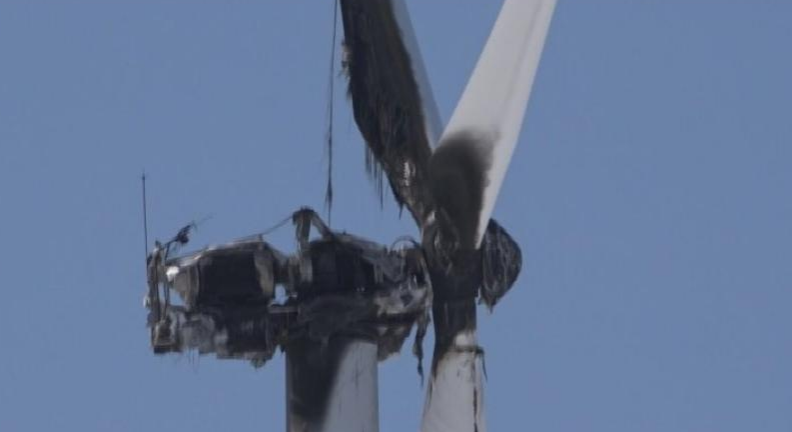

Image: Crown Estates
What Is An Arc Flash?
Hotter than the sun (around 20,000°C) and louder than a bullet, an Arc Flash is when an arcing fault releases dangerous levels of radiant energy, which vaporises metal that spews from the arc. The air is super-heated causing pressure waves that can propel individuals across rooms and create a deadly molten shrapnel.
It goes without saying; the extreme temperatures of an Arc Flash can burn clothing and human skin within fractions of a second, even if the operative is situated five or six metres away from the Arc Flash event. It can also result in an explosive pressure wave that can throw workers across the room and a sound blast that can rupture eardrums.
An Arc Flash event is also accompanied by a bright flash which can cause temporary or even permanent blindness.
Treatment for those that survive an incident can require years of skin grafts, hospital stays and rehabilitation – they may never recover sufficiently to regain their lifestyle, so it’s safe to say that choosing the appropriate PPE is key when it comes to Arc Flash safety.
Posing A Risk
Electrical in nature, Arc Flash poses a substantial risk to those working in the wind industry which is constantly growing in importance due to its potential to contribute significantly to our national energy needs.
When working on wind turbines or windfarms, Arc Flash incidents can occur in both low voltage environments as well as high voltage, with particular reference to the following incidents…
- Opening energised electrical cabinets and verifying zero energy (testing dead)
- Securing and removing lock out and tag out (LOTO) devices
- Conducting trouble shooting on energised equipment and parts
- Working on near or exposed live conductors
- Breaking ground to install turbines
It is worth noting that the above incidents are of broadly the same severity whether the turbine is part of a large commercial windfarm or one of the growing number of small scale turbines installed by businesses.
How To Protect Yourself Against Arc Flash
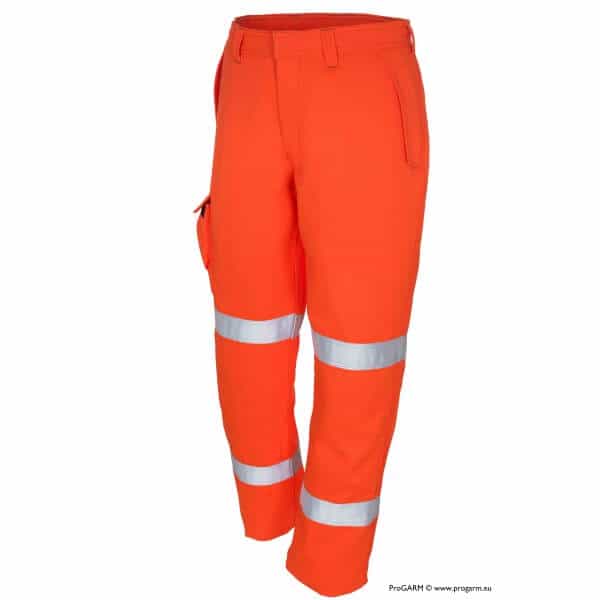
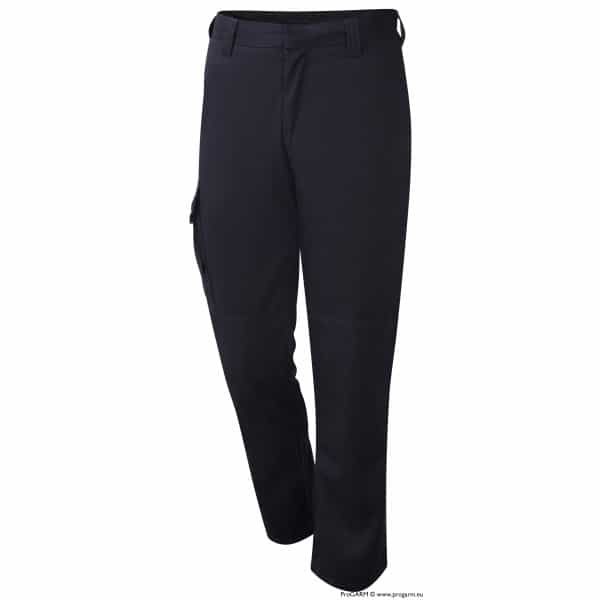
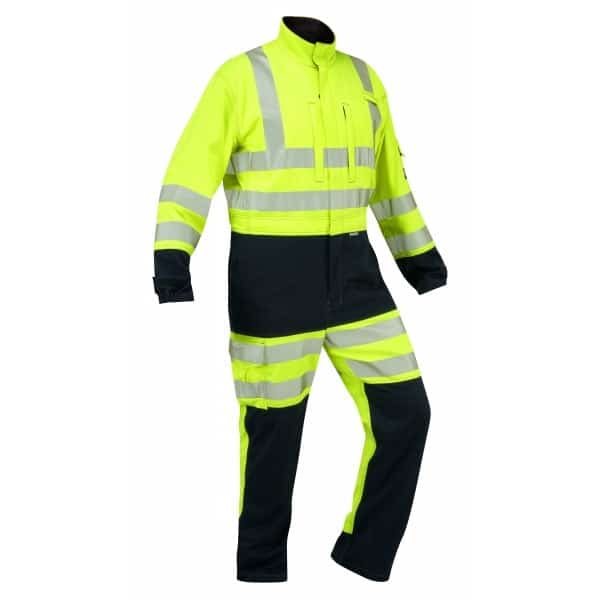
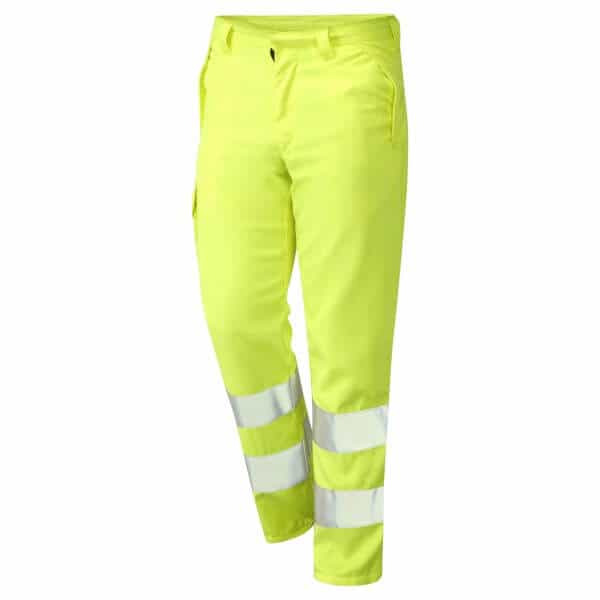
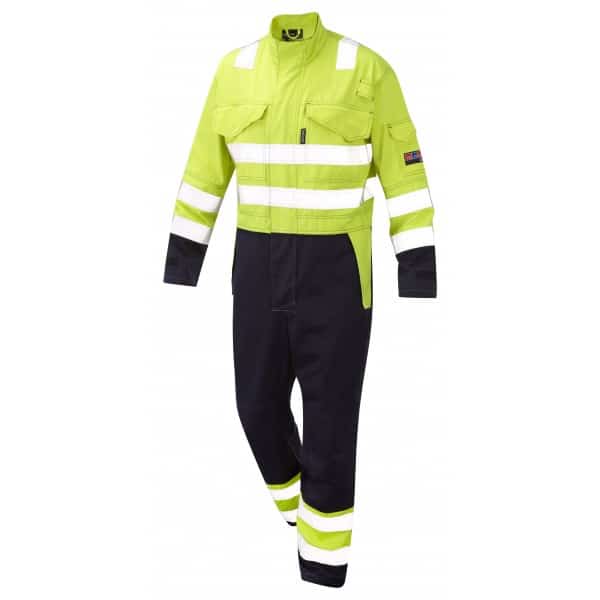
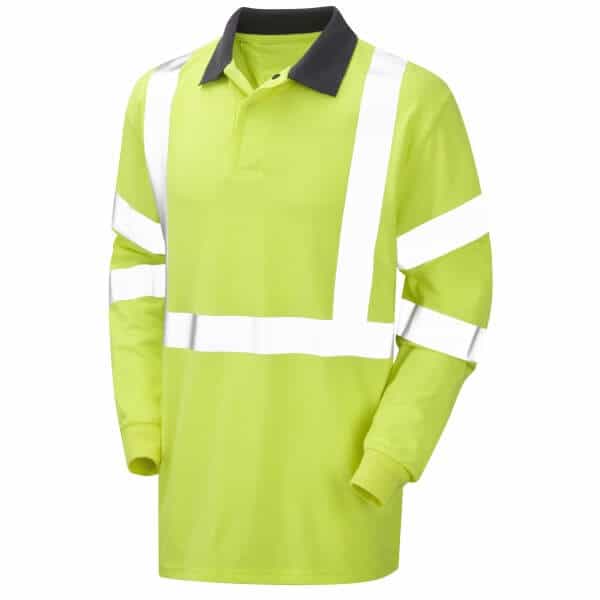
Arc Flash protection is found in specialist clothing and garments for “head-to-toe” protection – everything from arc flash coveralls to arc flash trousers.
Enhanced and effective arc flash protection is safely achieved by wearing layers of protective clothing and garments manufactured from inherent fibres and which feature specific Arc Flash resilient components. Without the correct high-quality garments, arc protection levels will be compromised.
In addition to quality, it’s important to consider the longevity of the garment – depending on how it’s manufactured it may lose its effectiveness. Always look for products that feature Arc Flash protective qualities in the thread, as opposed to just a sprayed material, which will lose its impact over time.

Arc Flash Risks & How To Prevent Them – Wind Turbines & Windfarms
Overview of Arc Flash Clothing | Contact us to discuss your garment and PPE requirements, we can mitigate risk with guidance on safe working practices and by providing appropriate worker clothing that offers advanced Arc Flash Protection that saves lives every day. Whether working on underground cables or overhead lines, here is a selection of workwear clothing – contact us to discuss your requirements;
>> Download Your Guide To Here <<


HV Cable Joints, Terminations & Connectors | Approved Stockists & Distributors | 3M Electrical (Cold Shrink) | Nexans (Euromold JTS MONO) | Pfisterer (CONNEX SEANEX) | 11kV 33kV 66kV Medium & High Voltage Cable Accessories
Can Arc Flash Clothing Save Utility Workers Lives?
November 17th, 2017
Arc Flash Clothing – For Jointers Working On Low & High Voltage Power Cable Systems
Yes. Here is the evidence.
by Chris Dodds T&D - estimated reading time 5 minutes
Utility Workers & The Risk Of Arc Flash
Utility workers stand in the frontline of electrocution and arc flash risk – facing daily hazard whether in the cable trench, joint bay, substation or working in front of switchboard panels.
Jointers, Linesmen, SAP’s and Civil Engineers should all be protected against the working dangers of arc flash – according to the UK Health & Safety Executive workers engaged in the location, identification and excavation of of buried services should be ensure adequate protective clothing is used when working around underground cables:
HSG47 Excerpt
Injuries to workers are typically caused by the explosive effects of arcing current, also known as arc flash, and by the associated fire or flames that can result when a live cable is penetrated by digging tools (typically “shovels and spades”) – the risk is elevated where medium/high voltage cables are trenched and backfilled but not protected using 11kV/33kV cable covers.
Arc flash can also occur when a cable is crushed severely enough to cause internal contact between the cable conductors, or metallic cable sheathing and one or more conductors.
Injuries are severe – potentially fatal – burns to the hands, face and body: electric shock is possible but less likely.
Incidents can also arise from cables, connections and cable terminations which have been damaged but left unreported and unrepaired, or which have deteriorated with age.

Avoiding Danger From Underground Services UK HSE HSG47 – download full copy.
Here utility workers are shown live-line working from an aerial lift on overhead conductors from the bucket truck.

Insulating Matting | Voltage Detectors | Insulating Gloves | Insulating Sticks | Phase Comparators | Portable Earthing | Substation Safety Kits MV HV
Arc Flash – The Evidence
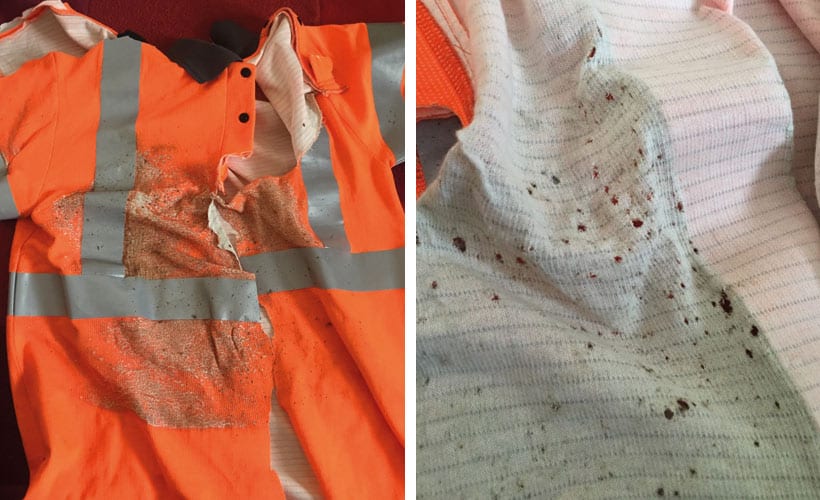
Pictured below are ProGARM arc flash polo shirts post-arc blast impact.
Clearly the garment has quelled the arc flash due to the inherent flame retardancy of the clothing fabric. The cause of the arc flash was triggered by an LV jointer using a Jack Hammer in the vicinity of an underground low voltage cable.
The strike to the 3 phase 120sqmm CNE utility cable caused an arc flash which if not protected against using appropriately rated clothing would have inflicted serious skin injury and burns to the cable jointers chest and arms.
Typical risks include: fuse replacement and maintenance on feeder pillars and link boxes, live cable jointing, underground cable excavation and switching operations in substations at low, medium and high voltages.
As well as correctly specified levels of arc flash clothing protection utility workers should ensure appropriate levels of protection against electrical shock hazard by wearing suitable insulating gloves, arc flash gloves and insulating boots according to the voltage and risk.
Cable Strikes & Arc Flash Risk
Failure to implement and follow the HSG47 Guidelines can cause fatal injury to workers striking buried electricity cables operating at LV MV HV – workers have been electrocuted and engulfed in flames coming into accidental contact with 11,000 volt (11kV) underground cable where sites have not been scanned for live buried cables by cable avoidance tools.
Cable strike incidents can be avoided when work is properly planned and supervised in accordance with HSG47.

Image: Lee Richard – LR Power Services
The photographs are compelling evidence of the electrical safety requirement to protect cable jointers whether working on LV, MV or HV power 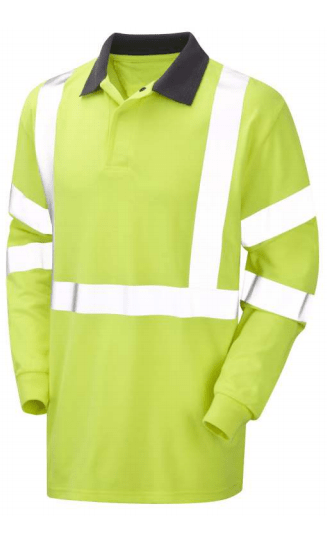 cables, overhead lines or substations.
The investment in clothing is an investment in worker protection and ultimately life.
Naturally, all ProGARM arc flash clothing is vigorously tested in the laboratory and to witness real life evidence of the protection provided underlines the need to take arc flash seriously.
Mark Lant, an Arc Flash Technical Expert at ProGARM comments: “Obviously, we’d prefer it if Arc Flash incidents never occurred. However, the fact is they do, and we’re pleased to see our arc flash polo shirt performing as effectively in the field as it did in the lab. We wish the cable jointer a speedy recovery from his other injuries.”
Arc Flash Clothing & Electrical Safety Tests
Arc flash clothing and garments are tested to European norms and standards:
- EN ISO 11612: 2008 (A1 B1, C1) – ISO 11612:2008 Protective Clothing – Clothing to protect against heat and flame
- EN1149-5: 2008 Pt 5: 2008, Pt 3: 2004 (Charge Decay) – Protective Clothing – Electrostatic Properties
- EN ISO 20471: 2013 Classs 3 – High Visibility Clothing – Test Methods & Requirements
- IEC 61482-2: 2009 Class 1 – Clothing Protection For Thermal Hazards Of An Electric Arc

Electric arc flash occurs during fault conditions when a current flows through an air gap between conductors – this inflicts catastrophic devastation upon switchgear MV HV

High Voltage Substations – pictured the catastrophic effects on 11kV switchgear and cables of an arc flash incident
Can An Arc Flash Occur While Ground Digging?
1. On average 8-10 cable strikes are reported in the UK every day
2. Over 90% of LV-HV underground cables in the UK are unmarked
3. Over 1,000 electrical incidents reported to the HSE in the UK every year
4. 25 of these are fatalities (HSE)
5. Fines can be an excess of £2 million
Arc Flash Learning & Resources
Thorne and Derrick are proud to be distributors of ProGARM arc flash coveralls and protection.
We can help – should you require arc flash calculators or advice on the type of clothing and protection available please do not hesitate to contact us.
Arc Flash Calculation – Selecting Clothing & PPE To Protect Lives Against Arc Hazard
September 20th, 2017-
by Chris Dodds T&D - estimated reading time 8 minutes

“30,000 Arc Flash Incidents per year” Source: ISHN
We recently asked Hugh Hoagland (Managing Partner at ArcWear & e-Hazard.com) to recommend the 3 most effective and reliable software packages for Calculating Arc Flash Risk & Hazard in accordance with NFPA 70E and IEEE 1584.ƒ1
e-Hazard USA are the industry leader in electrical safety training based on the latest NFPA 70E Standard providing arc flash testing, electrical safety and arc flash training for companies across the globe.
Hugh recommended the following Arc Flash Hazard, Risk Assessment, Clothing & PPE software packages: SKM, Easy Power and Kinetrics – we overview them and provide further information links to all 3 including free demonstration packages.
Arc flash clothing and PPE requirements are often panic rather than planned purchases – most often contractors are over-spending on arc flash protective clothing only to arrive on site to carry out work tasks requiring manual dexterity in cumbersome arc flash suits of armour. Hampered, overheating and under pressure to work safely in high voltage substations.

Electrical engineers must wear appropriate level of arc flash protection when working on low, medium or high voltage electrical switchgear, panels and equipment.
Consequently, it is rare for a specific site risk assessment or arc flash hazard calculation to have been carried out. Contractors therefore default to a “worst case” scenario with decision making clouded by the online plethora of inconsistent product recommendations often motivated more by commercial intent rather than the provision of worker safety.
We hope this information will enable better forward planning by contractors to minimise arc flash hazards by selecting the most appropriate level of protective clothing and utilising an arc flash sofware calculator.
As leading UK distributors of arc flash clothing, we are committed to supporting the observance and implementation of electrical safety and managing arc flash risk in hazardous and high voltage working environments.

Arc Flash | Jackets | Coveralls | Trousers | Sweatshirts | Helmets | Gloves ProGARM
Arc flash can occur during live cable jointing, phasing in operations, racking in and out of switchgear, reclosing of electrical switchgear onto a fault, switchgear failure, excavating near live cables or accidental contact with live conductors during maintenance.

1. SKM Systems Analysis
Arc Flash Hazard Calculator
ArcCalc calculates the incident energy and arc flash boundary for any point in a power system be it low, medium or high voltage.
Minimum and maximum arcing short circuit currents are calculated using broad tolerances to provide conservative results with estimated system data.
ArcCalc saves time by automatically determining trip times from the protective device settings. Incident energy, arc flash boundaries and Arc Flash PPE clothing are calculated following the NFPA 70E and IEEE 1584 standards. More information.
SKM Arc Flash Tutorial & Arc Flash Assessment
2. Easy Power
Arc Flash Analysis Software
Easy Power arc flash software provides the most comprehensive productivity configuration for conducting arc flash analysis and ensuring full compliance with OSHA and NFPA 70E requirements.
Whether you’re designing electrical power systems, analyzing arc flash hazards, selecting suitable arc flash clothing or implementing an electrical safety program, this is software configuration can assist. More information – Download Free Demo.
EasyPower Arc Flash Analysis Intro : Automated Power System Design and Analysis
3. Kinetrics 
ARCPRO™ Arc Hazard Assessment, Clothing & PPE Selection
ARCPRO™ has become the industry’s most widely-used application for computing arc hazards and selecting protective clothing for single arc situations, particularly for High Voltage Transmission and Distribution applications not addressed by other methods.
Kinectrics ARCPRO™ calculates the thermal parameters of electrical arcs and is designed to provide users with data regarding heat exposure, total heat flux and heat energy on a surface at various distances from an electric arc.
The software is used to predict the potential arc hazard in a particular work environment and provide basis for specifying the appropriate level of PPE and clothing to protect against arc flash hazards. More information.
Arc Flash Incident (Property of CATU Electrical)
ƒ1 IEEE Std 1584-2002 (Guide for Performing Arc-Flash Hazard Calculations) is a standard of the Institute of Electrical and Electronics Engineers that provides a method of calculating the incident energy of arc flash event – purchase copy of IEEE 1584.
Arc Flash PPE – The Last Line Of Defence
“PPE is the last item on the list when putting in place arc incident control measures. Your arc flash risk assessment should measure the severity of the hazard (incident energy levels) and then look how that incident energy can be minimised. You should then consider what activities you carry out that could expose you to any residual arc flash risk that may be controlled with PPE”, Paul Hopton (Principal Electrical Consultant at Electrical Safety UK Limited).
◊ Can Arc Flash Clothing Save Cable Jointers Lives?
Arc Flash Learning & Resources
Thorne and Derrick are proud to be distributors of ProGARM arc flash coveralls and protection.
We can help – should you require arc flash calculators or advice on the type of clothing and protection available please do not hesitate to contact us.
Electrical Safety UK
ESUK is a specialist company concerned with the safe management of risk associated with all LV & HV electrical work activities. Having pioneered the European approach to Arc Flash Hazard assessment and management, ESUK have a proven track record in ensuring that clients comply with their local law in the most cost effective way.
THORNE & DERRICK are national distributors of LV, MV & HV Cable Installation, Duct Sealing, Jointing & Substation Electrical Safety Equipment – we service UK and global businesses involved in cable installations, cable jointing, substation, overhead line and electrical construction at LV, 11kV, 33kV and EHV.
Since 1985, T&D have established an international reputation based on SERVICE | INTEGRITY | TRUST.

Invitation
Thorne & Derrick invite you to join LinkedIn’s largest LV-HV Electrical Discussion Group : Low & High Voltage Power, Cabling, Jointing & Electricals. Discussion subjects include cable installations, cable jointing, earthing and lightning protection, substation, overhead line and electrical construction at LV, 11kV, 33kV and EHV. Network, engage and promote your profile, company or products with over 10,000 influencers.