T&D are frequently asked to provide advice and training recommendations to ambitious cable jointers intending to up-skill from MV-HV (6.6kV, 11kV, 33kV) to EHV transmission and distribution voltage levels (typically 132kV, 230kV, 400kV).
So, we decided to ask G&W Electric (USA), a leading global supplier of electric power equipment – since 1905 G&W have manufactured world-class transmission and distribution cable accessories including cable terminations and cable splices for XLPE, PILC, low and high pressure, fluid and gas filled, self-contained and pipe type cable systems.
“We have training programmes to certify Cable Jointers to install G&W cable splicing and terminating products. We usually carry out such training in our headquarter, Bolingbrook, IL, USA. Based on the resume/experience of the cable jointer, we will design a specific program on all of our extruded cable accessories (usually 230kV, outdoor termination, GIS/GUS termination and cable joint), which can last 1-2 weeks. After the jointer training, we will issue certificate (with or without G&W supervision on site). For those certified with supervision, we will go to the site with the jointer during the real project. If the cable jointer’s work meets our requirement, we will update the certificate without supervision. For anyone interested in our training program, they can reach me at [email protected],” replied Kai Zhou (Product Development Engineer at G&W Electric Co.).
Overview of G&W Cable Accessories
In 1905 G&W introduced the first disconnectable cable terminating device.
Over 100 years later, G&W continues to create technical innovations that have improved performance and reliability. With over 100 years experience, G&W is the name you can trust for quality cable accessories. With sales representation worldwide, G&W has a proven track record for success. G&W cable accessories are designed to accommodate cables from all manufacturers and can be created to accommodate any customer cable system. The optional mechanical shrink feature offers an easier and faster installation while reducing possible damage during installation. G&W also offers installation supervision and installation training, which can be customised to suit the audience.
Subscribe now to our POWER NEWSLETTER– a monthly email circulation packed with news, projects, videos, technical tips, training information, promotions, webinars, career opportunities and white papers.
Includes access to our popular JOINTERS BLOGwith contributions from utility professionals, linesmen and cable jointers working on MV HV EHV cables and overhead lines typically at 11kV, 33kV, 66kV and up to 132kV.
15,000+ Subscribers. ➡
Images Courtesy:Richard Mason – EHV Jointer for Onshore & Offshore work up to 245kV (SMSTS) – Global Cabling Services Ltd
GCS Jointing
GCS Jointing is a trading name of Global Cabling Services Ltd and was founded in 2015 when Richard Mason (Director GCS Jointing – Global Cabling Services Ltd), decided to leave a major power utilities contractor after many years of quality service. Richard is an EHV Jointer with over 25 years of experience – with a practical approach to HV EHV projects the work GCS undertake is often installed and supervised on site by Richard personally. GCS Jointing is recognised as a specialist HV and EHV Cable Jointing and Cable Installation Sub-Contractor within the onshore and offshore utilities, oil-gas and clean energy industries.
Cable Sealing Ends
Cable Sealing Ends
The cable termination consists of an insulator installed on a box body made of aluminium castings. The box body consists partly of insulating material, which provides an insulated installation for high voltage power cables. The base part is to be installed on a supporting bracket. For 420kV a corona shield and a post insulator kit PIU 420 B/G are included with the cable sealing end. The elecrical stress control component is a premolded rubber stress cone. The insulator has sheds of short-long type and is filled with synthetic insulating oil.
The composite insulator design includes grey silicone rubber sheds and a fiberglass reinforced epoxy resin hollow core. It is light-weight and less sensitive for outer damages. The porcelain insulators are available in brown on request. A bolt clamp in the top fitting is used to connect the conductor to the top bolt. Top bolt and bolt clamp are included in the kit. For the maximum permitted diameter over the cable oversheath and the diameter over prepared XLPE cable insulation – the cable sealing end provides a fixed connection point once lifted into place to secure the cable termination.
Skilled Cable Jointers
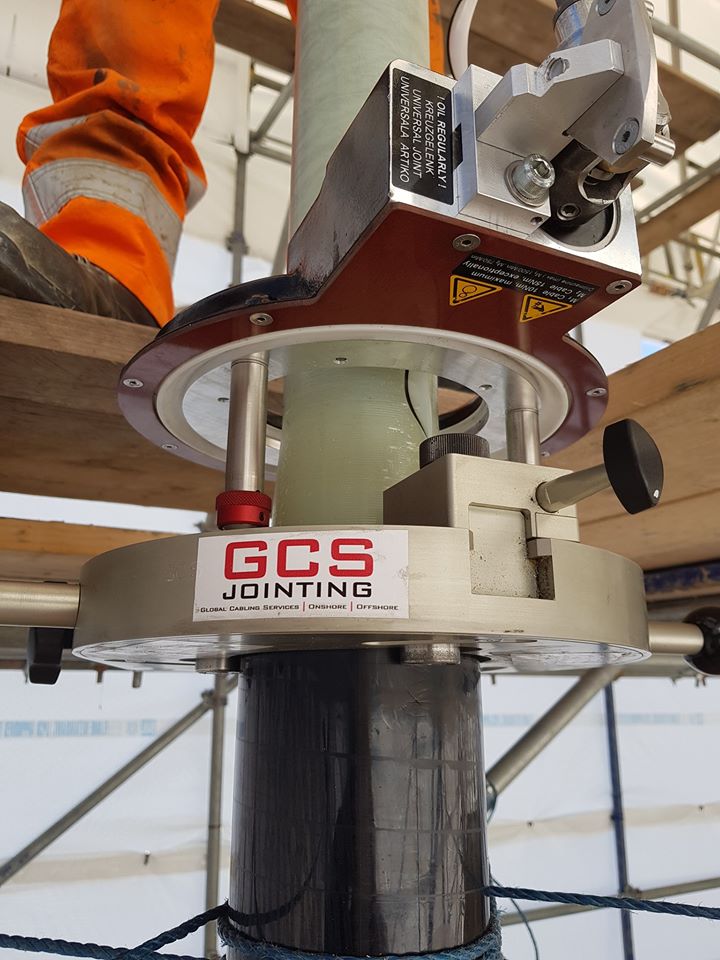
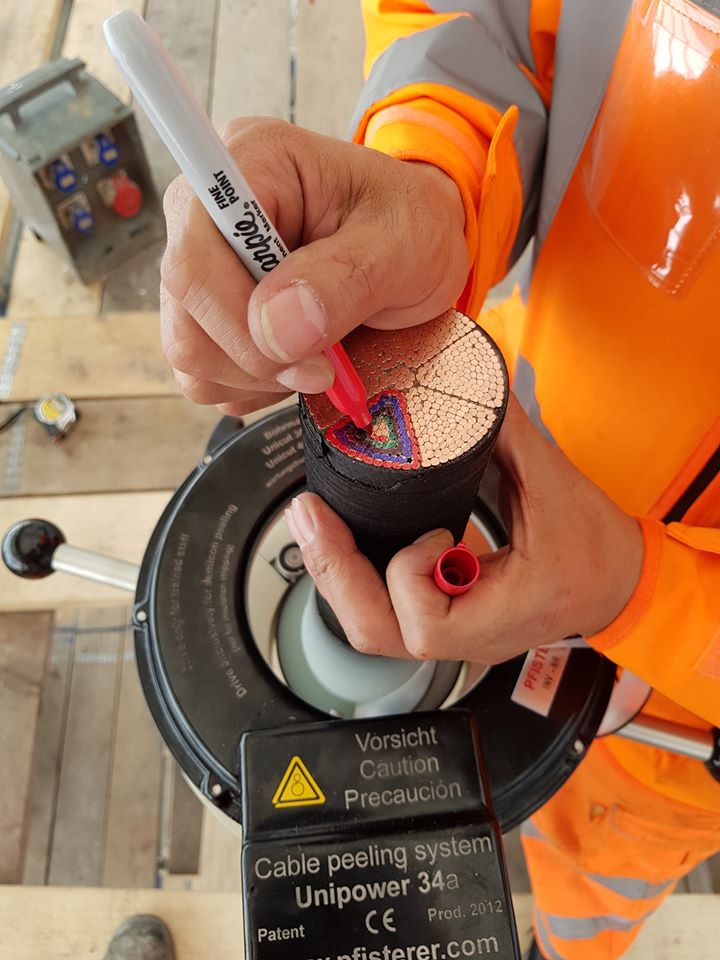
Workmanship and Competency in the installation of MV HV cable accessories, including Joints and Terminations, is regarded as critical to the performance and reliable of power cable systems – skilled workmanship during installation by the Jointer is very important when considering and reducing the risk of future cable failures. When preparing HV cable several layers need to be removed or treated without damaging other layers, this requires the highest levels of skills, training and knowledge about how to handle specialist Jointers tools for this application. Knowledge about the critical steps in cable accessory assembling provides the best foundation for successful and safe installation.
ABB
ABBpioneered high voltage gas-insulated switchgear (GIS) more than 50 years ago and is a global leader offering a full-range product portfolio with voltage levels from 72.5kV to 1200kV matching current and future requirements for modern switchgears and power grids.
As a market leader in high voltage GIS technology, ABB has a global installed base of more than 35,000 bays. In a power system, switchgear controls, protects and isolates electrical equipment to boost the reliability of power supply.
GIS is a compact metal encapsulated switchgear consisting of high voltage components such as circuit-breakers and disconnectors.
Jointers blog
Subscribe now to our POWER NEWSLETTER– a monthly email circulation packed with news, projects, videos, technical tips, training information, promotions, webinars, career opportunities and white papers.
Includes access to our popular JOINTERS BLOGwith contributions from utility professionals, linesmen and cable jointers working on MV HV EHV cables and overhead lines typically at 11kV, 33kV, 66kV and up to 132kV.
15,000+ Subscribers. ➡
Underground Substation Cable Sealing
Underground Substation Cable Sealing
Product Category:Duct Seals Application: Protection of Metro & Rail Systems Against Moisture & Flood Sector: Rail Product Installed:Filoseal+HD
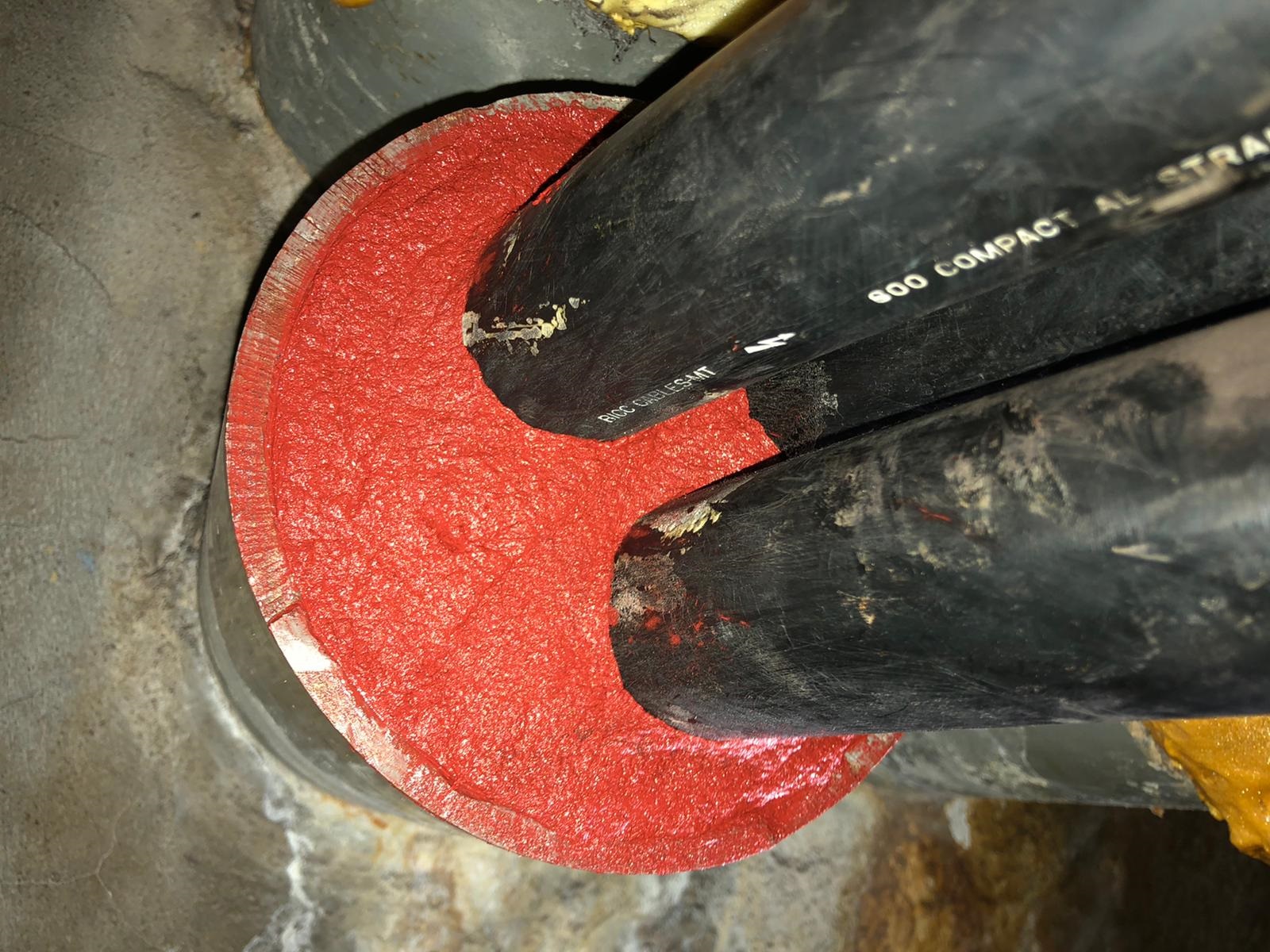
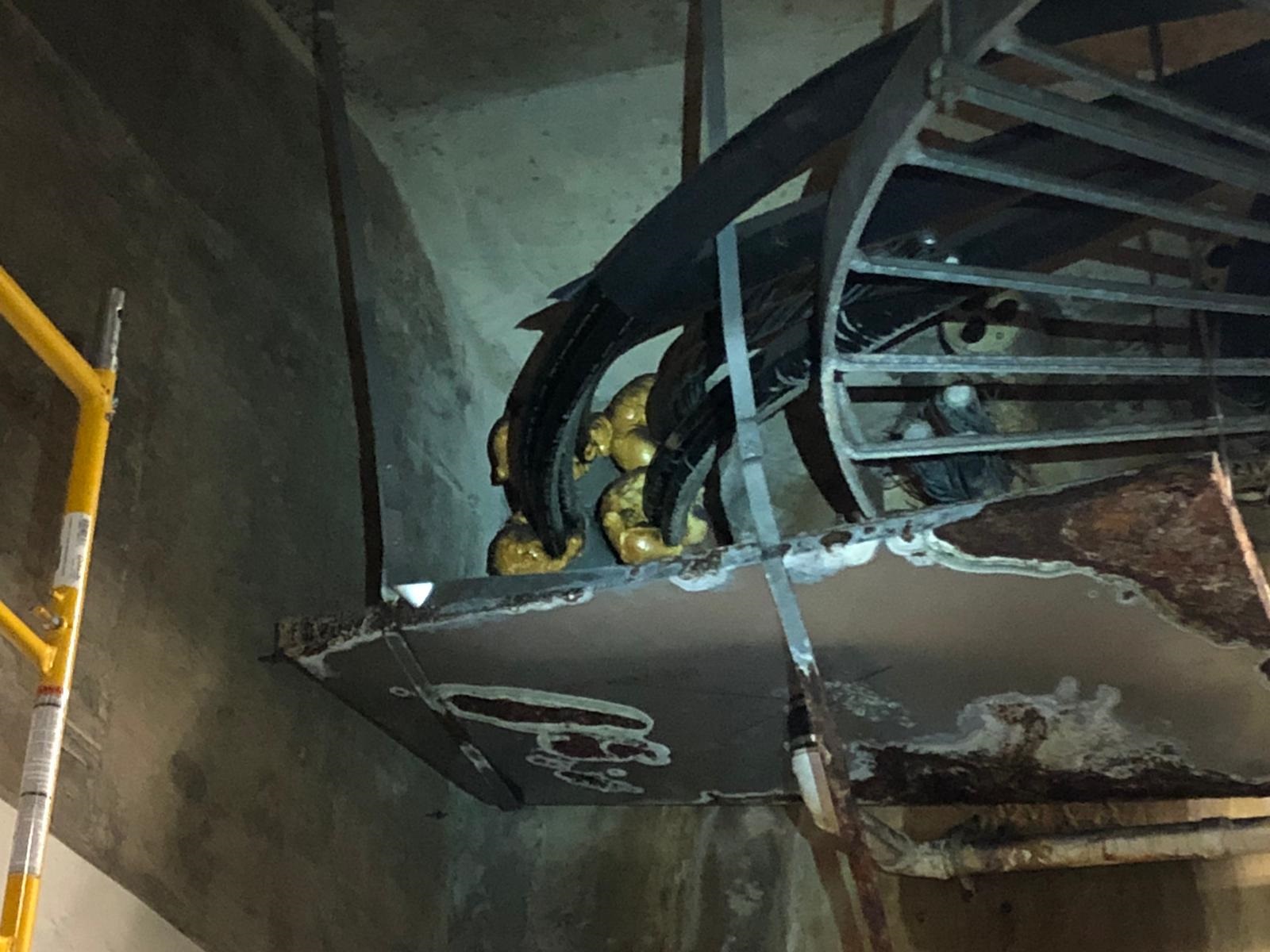
Here are several site installation photographs of a cable sealing and substation asset protection project in the USA.
The MV medium voltage cables are installed 20 meters underground in a substation that is providing electrical power distribution to a subway metro station.
This is one of many sites where they have ongoing moisture problems associated with floodwater and environmental conditions.
Using FiloSeal+HD the client improved the environment inside the substation, reducing moisture, which was their electrical and substation protection objective.
One of the main issues with this project was cable separation of the 35kV power cables which are installed in triplexformation.
FiloSeal+HD uses hexagonal-shaped tubes to support and separate the MV cables, which is one of the many reasons, this Utility decided to select and specify Filoform.
Cable Sealing System – FiloSeal+HD + Water Blocking System
Cables – 600MCM, 35kV TR-XLPE, Triplexed Cables
Cable Duct Size – 160mm (6″)
As you can see, the visual element is far neater and professional, while also providing the following features:
Up to 2 bar Pressure Resistance (Gas & Water)
Flexible, one component, sealing compound – resistant to rats
Resistant to Hydrogen Sulphide/Methane and aggressive gases
Non-Hazardous – complies with 2011 NEC Articles 225.27, 230.8, 300.5(G), 300.7 (A) on Raceway Seals, and 501.15 (B)(2)
Suitable for renovations – the cable duct seals can be installed retrospectively
Since 1985 Thorne & Derrick based in the UK have been specialist distributors of LV, MV & HV Cable Installation, Jointing, Substation, Arc Flash Clothing & Electrical Safety Equipment – customers include UK and worldwide contractors, specifiers, traders and end-users involved in medium and high voltage cable installations, cable jointing, substation, overhead line and electrical construction.
MV HV | Medium & High Voltage Power Products, Tools, Cables & Electrical Equipment
uploaded by Chris Dodds (Sales & Marketing Manager - Thorne & Derrick International)
Silver Fox Fox-In-A-Box®
Silver Fox are the leading UK manufacturer of cable labels and also the world’s most advanced labelling system for wires and cables, their Fox-In-A-Box.
Thorne & Derrick are Main Distributors forSilver Fox and can provide expert technical recommendations, installer training and competitive product supply from stock for cable labels to suit LV MV HV power, telecom, data, signal, network and fibre optic cables.
Labelling Features & Benefits
High specification and rigorously tested labels for cables with high resistance to salt mist spray, heat, flame, chemicals, gases (H2S) and UV for onshore and offshore environments – with fire safety testing and certification to BS 6853 for Toxic Fume and Smoke Density Emission to suit LSZH cable labelling applications.
Quality Tested
LSZHZero Halogen Smoke, Toxic Fumes & Oxygen Index Tested
Network Rail Approved
London Underground Approved
Low Temperature -40°C 1000 Hours
High Temperature 70°C 1000 Hours
Chemical | Solvent Resistance Test
H2S Sour Gas Exposure
UV Weathering ISO4982 Part 3 Method A Cycle 1
Productivity
25,000 cable labels printed in 4 hours
Versatility
11 types of cable labels with FIAB
Durability
8000 hours accelerated UV age-tested permanent
Simplicity
Quick + easy to install – “turn time into profit”
Image: ABB. Silver Fox cable labels are used throughout the utility and power generation markets to provide permanent and legible cable labelling of LV HV power, control and service cables in switchgear, control panels and substations.
This is ideal for users who just want to cut and paste information then print the cable labels. Should they want to do more then there is a seamless upgrade path from the Basic to the Advanced or Professional levels ready to go.
This means that the initial investment is not wasted, the upgrade price is the current incremental cost between the levels, plus a small administration fee.
To make it easier, all levels of software have internal videos. From these, the user can learn how to run the software in just 5 minutes by watching the video.
No internet access is needed!
All Silver Fox Thermal Labels are printed using OneSoftware, One Printer andOne Ribbon
3 Options
The Fox-In-A-Box® cable label system is available in three levels which offer increased software functionality for the DTP1/300 thermal printer – Basic,Advanced and Professional.
The Basic Fox-In-A-Box® allows users to create their own thermal cable labels, whilst the Advancedpackage adds the ability to accept or merge one or more columns in CSV files and to split the wire or cable label into more than one line.
It also allows the user to override the auto-font sizing and manually set this as required and to print from 2 rolls at the same time halving the label printing time and the print ribbon capacity.
The Professionalmodel adds further functionality allowing the user to view and select individual or groups of cells for importing, duplicate cable ID’s, amend the number of labels required for each cable ID or produce cross ferruling ID and even print both ends of a wire at the same time.
Additionally, the Professional Fox-In-A-Box® can print bar codes and QR codes and import graphics for use such as printing warning signs on cable labels.
➡ Basic
Entry Level starter pack with Labacus® Innovator Basic software to print all of the thermal range of Silver Fox cable labels, the software also includes templates for all our laser range
Cut and paste from spreadsheets straight into the software
Automated USB port identification
Seamlessly change between cable label types
➡ Advanced
Mid-range cable labelling pack includes Labacus® Innovator Advanced Software.
All functionality of the Basic plus:
From CSV Spreadsheet – Import single columns/merge multiple columns
Multiple line labels
Choose your own font size
Print 2 rolls of heat-shrink/non-shrink at same time
➡ Professional
Top end solution cable labelling system includes Labacus® Innovator Professional Software.
All functionality of the Advanced plus:
Full spreadsheet view/import
Select specific cells
Produce cross ferrules
Variable quantity duplication for each cable ID
Bar Codes and QR Codes
Import graphics and logos onto labels for asset management
T&D are proud to support UK manufacturing and develop new business opportunities in the power, rail, renewable, oil and gas and industrial market sectors.
“Everybody at Silver Fox are looking forward to working even closer with the Sales Team at Thorne and Derrick to build further on our already successful working partnership.”
“Since 1985 Thorne and Derrick have been a proactive, hard-working and well-respected distributor of LV MV HV Cable Installation, Jointing, Substation & Electrical Eqpt, who are committed to professional customer support. We are proud to include them as part of our distribution network,” comments Tammy Page, Marketing Manager (Silver Fox).
Silver Fox are leaders in UK manufacturing of cable labelling solutions, delivering innovative, durable and efficient systems for Data & Telecoms, Electrical, Transportation and Energy industries worldwide.
Thorne & Derrick International are specialist distributors of LV, MV & HV Cable Installation, Jointing, Duct Sealing, Substation & Electrical Equipment – servicing UK and global businesses involved in cable installations, cable jointing, substation, overhead line and electrical construction at LV, 11kV, 33kV and EHV.
Panduit Cable Cleats For Short Circuit Protection
Cable Cleats v Cable Strapping Bands
A Whitepaper Republished Courtesy of Panduit
by Chris Dodds | Sales Marketing Manager Thorne & Derrick
Cable Cleats v Cable Strapping Bands
Misconceptions
Recent articles in the industry suggest that a cable banding system is not capable of withstanding the electromechanical forces between the conductors in the event of a phase to phase fault. There is also a perception that a band type cleat product will cut the outer insulation of the cable under fault conditions.
This paper challenges these misconceptions and offers a more logical, engineered route to the correct specification of a cable fixing system. The reasoning is backed up and proven by independent third-party analysis and testing.
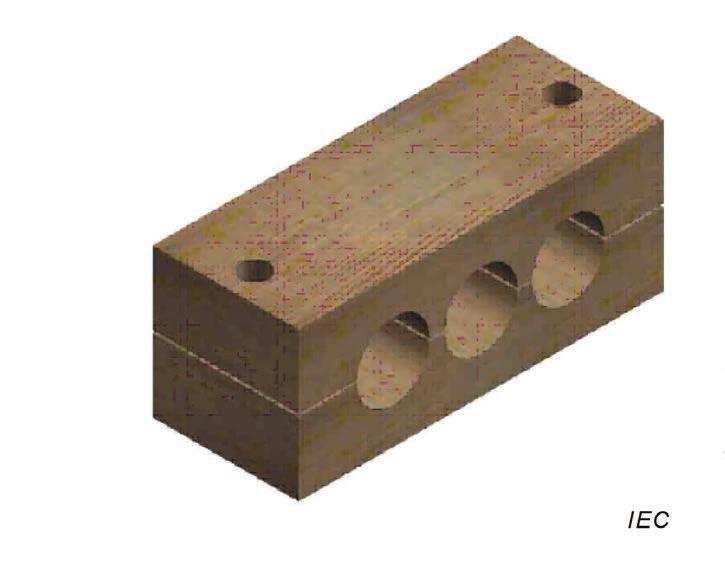
Traditional cable cleats started to appear in 1940’s and 1950’s predominantly in the U.K and Germany. These early cable fixing products were constructed from a variety of materials including timber, die cast aluminium and injection moulded polymers.
Due to the relatively weak or brittle mechanical properties of these materials the designs tended to be ‘over engineered’ to achieve the strength and performance required.
Figure 1
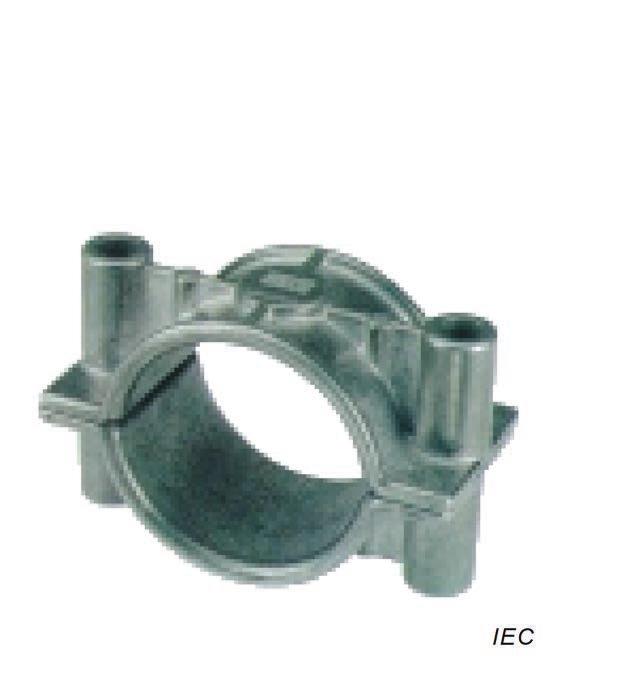
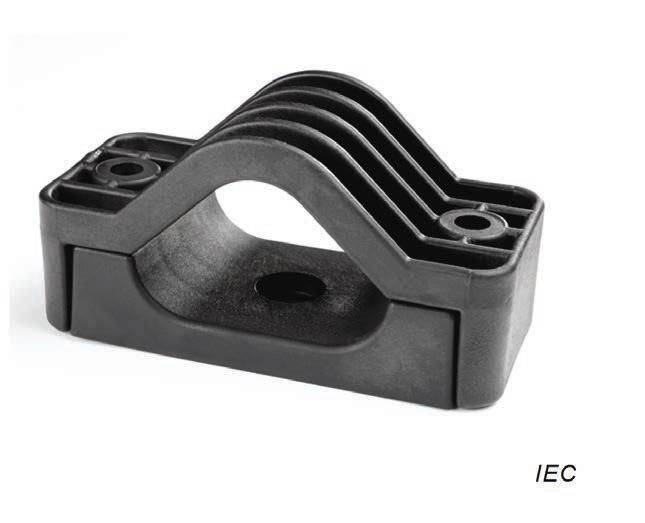
Figure 1. A Traditional Cable Cleat (Panduit 2-Hole Cable Cleat Used)
In more recent years, galvanised mild steel and 316 stainless steel options were developed which offered improved strength but still had a very bulky form factor. Early designs made in these materials offered a finished cable cleat which was twice the width and twice the height of the cable(s) being retained.
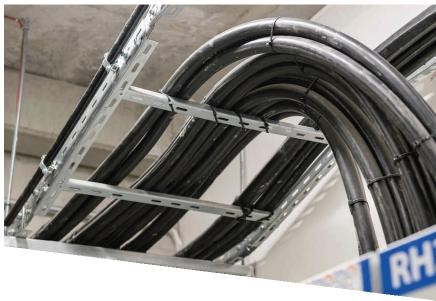
This was acceptable in single run applications e.g. when fastened sparingly to a wooden pole for utility applications, but when used in a cable ladder or tray application with multiple cable runs or within a substation where space and weight need to be carefully considered, the early designs did not meet requirements. Bulky cleat designs are not optimal.
However, recently introduced designs, materials and technologies have allowed Panduit to develop a high-end range of Strap Band products which meet or exceed the performance of a traditional cleat design when testing in accordance with IEC 61914:2015 by a third party lab. (Figure 2)
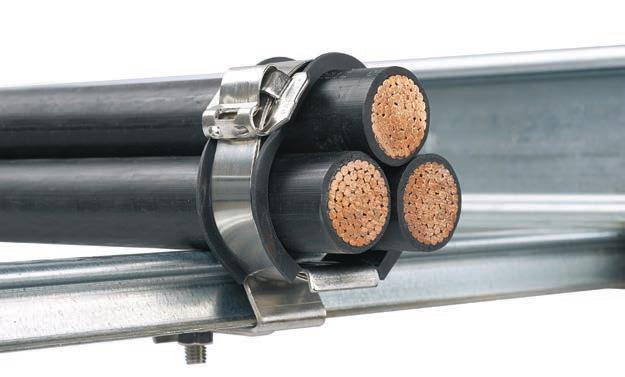
Figure 2 – A Highly Engineered Banding System – Note Integral Cushion Sleeve
What is a ‘Cable Cleat’?
Although the standard does require the manufacturer to describe a material type, it does not exclude any specific material, dictate any minimum dimensions or physical attributes. Annex A (informative) in the IEC cable cleat standard provides examples of various cable cleats which include products made from timber, steel and plastic.
There is a variety of designs and methods of ‘securing cables’, designs start at 15mm wide and go up to 150mm wide.
Defined by the IEC International standard, a cable cleat is simply: “A device designed to secure cables when installed at intervals along the length of the cables1”
1 International Electrotechnical Commission (2015). International Standard Ed. 2.0 2015-11.
Examples of Cable Cleats
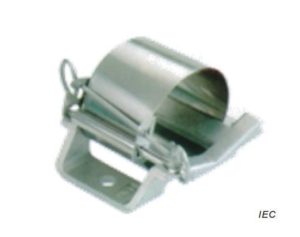
Figure A.1 – Strap Cleat
Figure A.2 – Aluminium
Figure A.3 – Stainless Steel Cleat
Figure A.4 – Wood
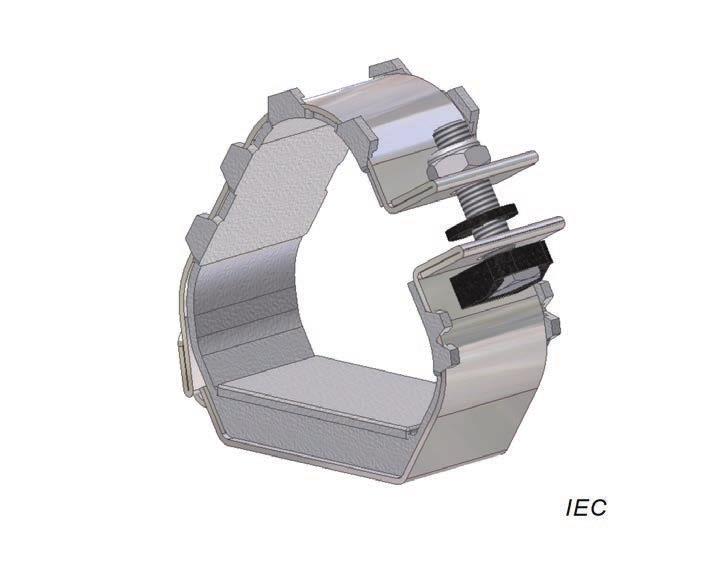
Figure A.5 – Glass Filled Polymer
Providing that the manufacturer tests and declares certain performance criteria, a ‘cable cleat’ can be any shape, size or material.
Hence, for example, a 19mm wide cable banding system can be used to secure cables in line with the IEC Cable Cleat standard providing it undergoes all the required tests and that they are carried out in accordance with the standard.
The term ‘cable tie’ is commonly used to describe a ‘strap cleat’ system which is not correct.
A light duty stainless steel tie or an injection molded ‘zip’ tie has many uses and play a vital role on many cable routing installations, but they must not be confused with a high-end strap cleat solution which can withstand immensely high electro-mechanical forces and are resistant to corrosion and ultra violet degradation.
What is the appropriate IEC International standard?
The IEC standard was originally a European standard, BSEN 50368:2003, which was improved and adopted over time by the International Electrotechnical Commission and the first version of IEC 61914 was published in 2009.The standard was further improved, and the current version of IEC 61914 released in 2015.
What specific tests does the IEC 61914:2015
Cable Cleat standard require?
The standard provides harmonised testing procedures for the following aspects:
Temperature rating (-60˚C to +120˚C)
Adequate resistance to flame propagation (very similar to UL 94)
Lateral load testing (at maximum declared temp)
Axial load testing (at maximum declared temp)
Impact resistance (at lowest declared temp)
Corrosion resistance
UV resistance
Resistance to electromechanical forces – the ability to withstand one short circuit event two short circuit events in succession
2015 Revision standardizes cable diameters for testing and permits clients to compare performance between manufacturers
2 International Electrotechnical Commission (2015). International Standard Ed. 2.0 2015-11.
What does the NEC code say about cable cleats?
In the United States the National Electric Code (NEC) Art 392.20 states “Single conductors shall be securely bound in circuit groups to prevent excessive movement due to fault-current magnetic forces3”.
While this section of the code dictates that the conductors must be bound securely to protect against fault-current magnetic forces, it does not specify how to secure the conductors nor recommend test methods to ensure products meet the force requirements.
Therefore, it is recommended that the IEC 61914:2015 standard is followed to comply with NEC Art 392.20.
Short circuit testing requirements of IEC 61914:20154 – an overview
IEC 61914:2015 focuses on this most demanding aspect of testing compliance, short circuit testing, the manufacturer is required to test in accordance with section 9.5 of the standard which gives guidance for a suitable set up. The cables, which must be of a certain type and outside diameter, must be restrained at a minimum of five positions along the cable run.
The cables must be fastened to a surface defined by the manufacturer, and this is usually a standard cable ladder, with rungs every 300mm.
The cables are then subjected to a three-phase short circuit consisting of an initial peak current and then a decaying R.M.S. of a duration of not less than 0.1s.
The accredited test laboratory must include the following information in the published test report:
The manufacturers catalogue references
The assembly details showing:
The number of restraints and their spacing
The cable centre to centre spacing
Cable conductor diameter, insulation thickness, external diameter and markings
A pre-test photograph of the set-up and a post-test photograph commenting on the condition of the restraints
The test duration
The ambient temperature
For cleats which are classified to 6.4.4 (one short circuit):
There shall be no failure that will affect the intended function of the cable of holding the cables in place.
All restraints shall be intact with no missing parts
There shall be no cuts or damage visible to normal or corrected vision to the outer sheath of each cable, caused by the restraints
And for cleats which are classified to 6.4.5 (two short circuits)
The restraints shall comply with all the requirements shown above for the first hit, but then in addition, after the second hit, a voltage withstand test is performed by applying a minimum test voltage of 2.8kV d.c. or 1kV a.c. for a period of 60 (+5/-0) seconds.
The test is administered between the cable cores, which should be connected together and the mounting frame. The cable jackets, restraints and mounting frame should be pre-wetted with sufficient water to facilitate a current leakage path along the outer jacket for 2(+1/-0) minutes before the test begins. The cables shall meet the requirements of the voltage withstand tes without failure of the insulation.
3National Electrical Code 2017 Edition (2017).
4International Electrotechnical Commission (2015). International Standard Ed. 2.0 2015-11.
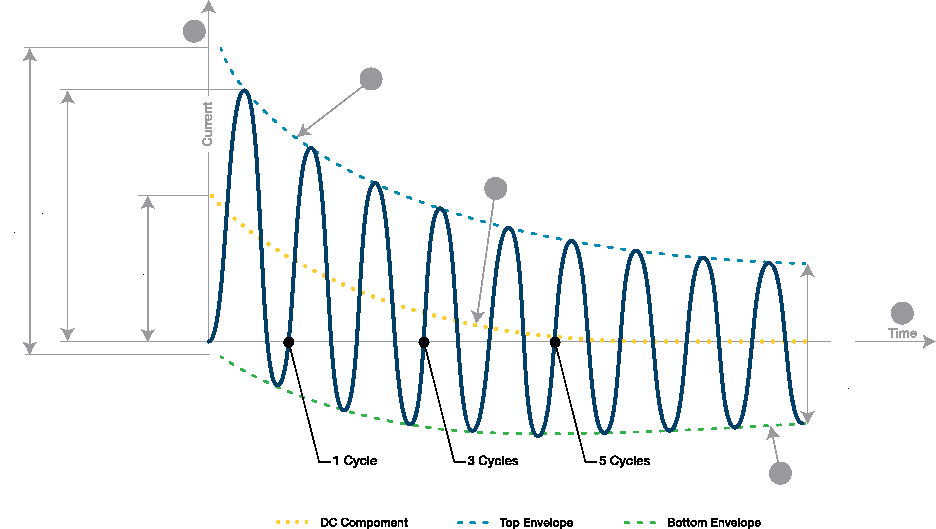
Key
1
Current
2
top envelope
3
decaying d.c. component, id.c. of the short-circuit current
4
bottom envelope
5
Time
A
initial value of the d.c.component, id.c. of the short-circuit current
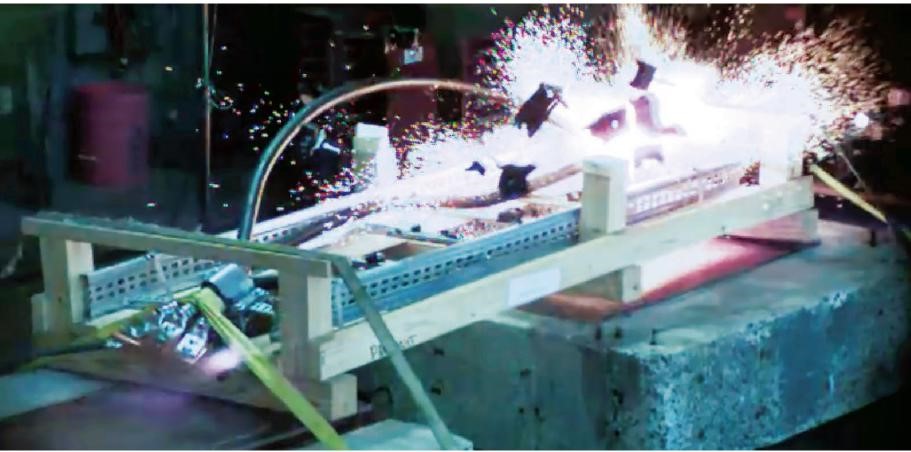
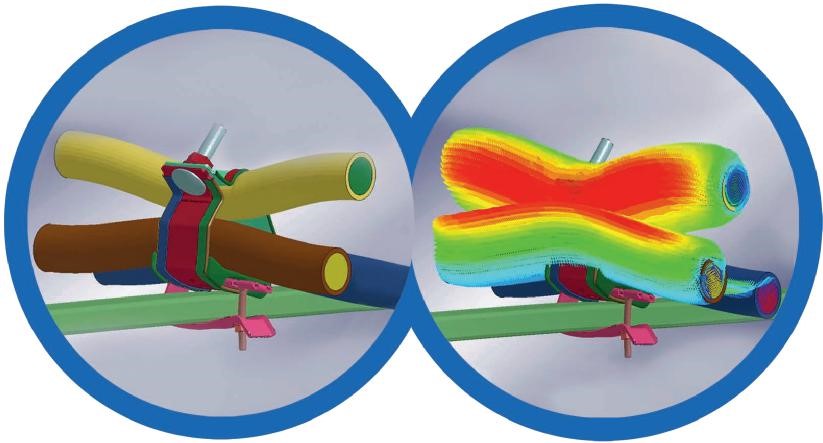
The electromagnetic forces during a fault can be enormous and occur instantaneously at the peak of the fault, i.e. the first quarter cycle (5ms on a 50Hz system and 4ms on a 60Hz system).
Considering the pass criteria described above it is not easy to obtain a successful result.
However, further to extensive research and development Panduit now have scores of successful short circuit rated banding systems. Depending upon the project requirements, Panduit has a fully tested, full approved banding solution to accurately match the specific needs of the project.
Misconception #1 – a cable banding system cannot restrain the forces during a fault
Recent articles in the industry press suggest that a cable banding system is not capable of withstanding the electromechanical forces and a series of video clips show an incorrectly specified cable tie installation failing during fault. The issue here is that the tested product was not suitable for the intended installation.
It might well have been the case that this weaker tie was specified by the system designer, and here lies the true problem, an incorrect specification. The product used in the test was never designed to withstand these forces; a correctly specified and engineered banding system certainly would.
Cable Strap Banding System
To suggest that a strap banding system is not suitable for short circuit rated installations is incorrect and is out dated information. The cable system designer must make sure that the fault levels have been accurately calculated and then specify a fixing system which meets that requirement and complies fully to IEC 61914:2015.
Misconception #2 – a banding system has sharp edges and will cut the installer during installation / damage the cable during fault conditions
As described previously, to achieve a successful short circuit test is difficult. After both the first and second short circuits each cable at every restraint position is inspected by test laboratory personnel; there can be no cuts or damage to the outer jacket.
Furthermore, after the second short circuit the laboratory carry out the voltage withstand test to check for current leakage and any hidden damage which may have occurred underneath the band itself.
Panduit’s extensive range of cable strapping and banding products have full certification to both classifications of short circuit test. The use of a protective sleeve moulding, common on many cleat types, and the use of rolled edge banding material ensures the cable is protected regardless of fault level.
To suggest that this type of product is not suitable for short circuit rated installations because it will damage or cut the cable or cause cuts and injury to personnel is incorrect and out dated information.
Other advantages of Panduit’s Banding Systems
When compared to a ‘traditional’ design of cable cleat the banding system has a much larger range taking ability. This is a huge advantage from a purchasing and stock keeping perspective; quite often one part number from a Banding System covers the same range take as perhaps four or five ‘traditional’ cleat part numbers.
A banding system takes up minimum space when installed around the cables. This is a very important factor when space is limited e.g. across the width of a ladder rung or when available height is limited e.g. between layers of ladder runs.
A fault rated band will be typically less expensive to buy and quicker to install.
A large quantity of banding system products takes up much less physical space on site before installation compared to ‘traditional’ cleat systems. This also leads to less packaging, less waste and generally a lower carbon footprint.
Panduit’s global network of distributors ensures local product inventory, product support, and a wide range of logistical services no matter where a project is. As an added level of support, Panduit also offers an optional engineering review, including physical documentation such as test reports, product brochure, drawings, and data sheets.
The Panduit strap cleat system is considerably lighter than the traditional cleat alternatives offering huge advantages for transportation and moving around site.
The Panduit strap cleat system can be used on a variety of cable configurations and layouts, including single (multi-core) cables, trefoil, quadrafoil, and a whole variety of special cable layouts and arrangements.
Panduit has more than 60 years of experience working with electrical design engineers, electrical contractors, and safety engineers and continuously reinvests in R&D. To date, Panduit has secured more than 2,000 patents, including several for cable cleats alone. With operations in 35 countries and customers in 120, Panduit distributes products, provides design expertise, and supplies technical support to customers on an international scale. Panduit is committed to helping organizations become more productive and profitable, and is always striving to put its partners ahead of their competition.
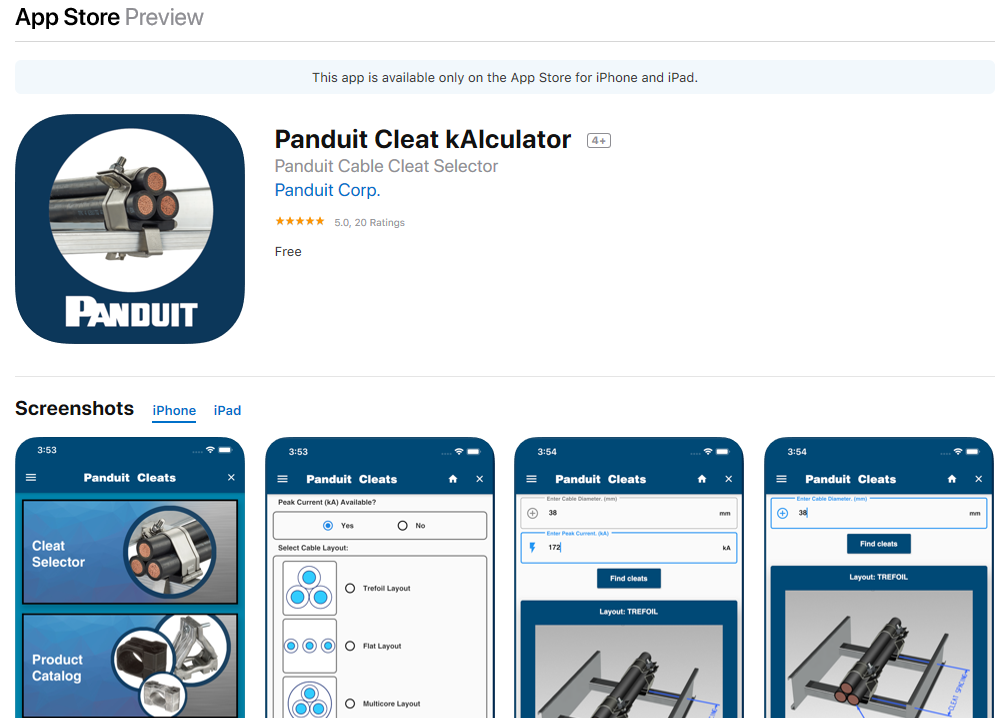
Choosing the correct cable cleat to protect you unique project will assure optimal performance, reliability, and qualiity. Panduit is proud to introduce the new Cleat kAlculatorTM App for IOS and Android
To simplify this selection decision, three easy steps allow users to:
Select a cable layout
Input cable out diameter
Input peak short circuit current
Panduit at the Forefront of IEC 61914
The below video explains how a short circuit event should be avoided at all costs.
However if they do occur regardless of how much prevention. When it does occur we need to ensure that the cables, infrastructure and facility are safe as well as the personnel by installing a proper cable cleat.
IEC 61914 2015 standard applies to cable cleats used in a cable tray to secure power cables. Standard outlines and structures how to properly test, design and install a cable cleat to prevent a short circuit.
Panduit has a vast range of cable cleat solutions allowing cables to stay covered if a short circuit fault occurs. This reduces the impact of disruption and damage to people and buildings.
Designed to make installation simpler when working in arduous environments in a many different applications, Panduit can find a product solution to meet your requirements as well as offering job productivity, reliability and safety.
Why Panduit Cable Cleats?
The industry’s first solution that has streamlined the selection process, tested to IEC standards bringing the vision of creating an engineering specifiable products to the EPC and Contractor firms.
Tested to IEC 61914:2015, the latest and most globally recognised cable cleat testing standard
Simple and intuitive design leads to increased productivity
Industry-unique mounting brackets and installation tools
Compatible with a variety of ladder racks and cables
THORNE & DERRICK
Thorne & Derrick are national distributors of LV, MV & HV Cable Installation, Jointing, Substation & Electrical Equipment – servicing businesses involved in cabling, jointing, substation, earthing, overhead line and electrical construction at LV, 11kV, 33kV, 66kV and EHV. Supplying a complete range of power cable accessories to support the installation and maintenance of low/medium and high voltage voltage power systems:
klauke ekm60unv – universal cutting, crimping & punching tool The Klauke EKM 60 UNV is a versatile battery powered hydraulic universal tool engineered that can be used as a battery powered cable crimping tool and battery operated cable cutting tools that comes...
INDUSTRIAL LABEL PRINTING SOLUTIONS When clear, durable and professional identification is required across control panels, cable systems, production facilities and industrial installations, print quality, reliability and ease of use are critical. Cembre industrial label printers are designed to support...















 Automated USB port identification
 Select specific cells