3M Cable Joints & Terminations
3M Scotch Tapes – PVC Vinyl Electrical Tapes
July 26th, 2018
A series of How-To videos for repairing, jointing and terminating cables using 3M Cold Shrink & Scotchcast products.
-
uploaded by Chris Dodds - Thorne & Derrick Sales & Marketing Manager
Scotch Tapes
This video by 3M Electrical shows the benefits of 3M Scotch Electrical Tapes.
3M Scotch tapes are used to cable joint, splice, repair damaged cables, seal and protect cables against abrasion, fire and corrosion – this includes protection of LV-HV (11kV-33kV) cables and connections.
Please contact T&D should you require assistance with selecting the correct 3M Scotch tape.
The 3M video explains the benefits of using Scotch electrical tape over alternative tapes.
Extreme Heat or Cold Applications For Scotch Tapes
Watch the video to see how Scotch tapes perform and endure installation and service conditions at temperatures down to 0°F and up to 220°F temperatures with cracking or unwinding. Scotch tapes will not degrade overtime when subject to temperature extremes, weathering, moisture or chemicals.
3M Scotch tapes demonstrate strong adhesion and excellent durability ensuring they are ideal for permanent jobs such as insulating and protecting electrical cable connections – once wound properly it remains wound.
3M Scotch tapes can also be used in zero degree temperatures and withstands high temperature up to 220ºF unlike other vinyl electrical tapes which would crack and unwind.
A greater stretch and tape elasticity provides a smooth, professional wrap and the coloured coded and fade resistant design ensures permanent and clear cable identification using 3M Scotch vinyl electrical tapes.

Scotch Tapes Manufactured By 3M Electrical For Professionals
The Scotch brand of PVC vinyl electrical tapes, manufactured by 3M Electrical, provide distinct competitive advantages over unbranded poor quality tapes which may have a superficial low price but actual high cost associations – since plastic vinyl tapes hit the mass-market in the 1940’s 3M Scotch has been the choice brand of the professional electrician for tapes with excellent electrical and mechanical properties.
For instance, 3M Scotch Super 33+ is the market-leading “fit and forget” vinyl electrical tape for providing cable protection, insulation and repair in industrial and hazardous area installations – this includes chemical (resists acids and alkalies), offshore (resists abrasion and corrosion) and industrial outdoor (resists UV ultraviolet light) applications.
As standard Scotch 33+ is coloured black so for colour-coding, phase marking and identification applications go with 3M Scotch 35 – same product specification as Scotch 33+ but with a colour spectrum of red, yellow, blue, brown, grey, white, green, orange and violet.
For cold weather and extreme low temperature applications select 3M Scotch 88 for continuous service down to 0 Degrees Celsius – Scotch 88 by 3M features excellent pliability and adhesion.
A varnished cambric tape is “off-the-shelf” for high puncture and cut-through resistance with Class A thermal stability – contact sales and ask about 3M Scotch 2510 for further information.
The protection of medium/high voltage cables and joints demands heavy-duty electrical tapes – substandard and under specified tapes pose risk and danger to power systems and life. Here, upgrade your tape choice to 3M Scotch 22, recommended by 3M Electrical for outer sheath and cable jacket protection or repairs to high voltage power cables and joints with rubber or polymeric cables. That’s XLPE and EPR in “cables-speak”.
Where cost is King but a good quality and general purpose PVC electrical tape is required contact us to place an order for 3M Temflex 1500.
All 3M Electrical Tapes are super stretch and strong for holding power in place without fail.
Due to the physical properties of 3M Scotch the tapes provide moisture-tight, chemical resistant electrical sealing of cables, connections and cable joints.
So overall, Thorne & Derrick distribute an extensive range of electrical tapes including fire proofing tapes with arc protection, see 3M Scotch 77 and high specification fire resistant tapes manufactured by Nexans.
Further details on the complete range of 3M Scotch Electrical Tapes can be found here:
- 3M Scotch Insulation Tapes
- 3M Scotch Self Amalgamating Tapes
- 3M Scotch Mastic Tapes
- 3M Scotch Corrosion & Fire Protection Tapes
- 3M Scotch Glass Cloth Tapes
- 3M Scotch 24 Tape – Electrical Shielding Earthing Tape
- 3M Scotch 25 Tape – Electrical Shielding Earthing Tape

Cold Shrink – invented by 3M over 40 years ago and now the preferred technology for heat-free jointing, terminating, sealing and abandonment of LV HV cables
We hope you find this video informative and educational, contact T&D for technical support, quotations and stock availability for 3M Scotch Electrical Tape.
➡ Visit 3M Electrical for further information about joints, terminations, tapes and insulation to seal, repair, splice and connect LV MV HV cables.

Cold Shrink | Joint | Terminate | Seal | Repair | Splice | LV MV HV Cables | 3M
-
-
- 3M Electrical Products Stocked By Thorne & Derrick International
-
Damaged Cables – Strikes & Products To Repair Cable Damage
June 27th, 2018
Damaged Cables – Some Cable Repair Solutions & Products
-
uploaded by Chris Dodds - Thorne & Derrick Sales & Marketing Manager
In this following post we highlight several causes of cable damage to low voltage underground power cables courtesy of a selection of case studies from SP Energy Networks.
We also explain and demonstrate product solutions for the repair of damaged cables.
Damage to live underground cables during excavation works is the cause of an increasing number of accident which can result in severe burn injuries to workers and disruption to consumer electricity supplies.
Occasionally such accidents prove fatal. Frequently such accidents were avoidable.
Cable damage is usually caused by excavating machines – hand held tools such as pneumatic drills, crowbars, pins, picks and forks also expose workers to potential sources of danger when digging around underground cables.
Thorne & Derrick have been distributors for 3M Electrical since 1985 and can provide a range of reliable and easy to install Cable Repair Products – this includes Scotch Tapes, Scotchcast Joints and Cold Shrink Tubes to provide effective re-instatement of cable sheath jackets on all types of LV MV HV cables in onshore and offshore locations with safe or hazardous area workplace classifications.

Cable Repair Products
3M Electrical
Scotch Tapes, Scotchcast Joints
& Cold Shrink Tubes
Depending on the cable location and workspace restrictions, both physical and atmospheric, a cable repair solution can be provided by 3M Electrical – most commonly their 3M HDCW heat shrink wrap-around cable repair kit is used to repair both LV and 11kV/33kV cables distributing medium/high voltage electricity. Due to the ease of installation, water-tight sealing and versatile range taking capability of heat shrink cable repair kits coupled with relative low-cost efficiency compared to cable replacement the 3M HDCW range has been adopted by contractors for sheath repairs on LV-HV cables.
Where hot-working is not permitted due to the presence of flammable gas and access to an open end of the cable circuit is achievable, on de-energised or isolated cable circuits, the range of cold shrink tubings can be used to achieve primary electrical insulation for all solid dielectric (rubber and plastic) insulated wire and cable splices rated to 1000 volts.
Alternatively, if the installed cable cannot be accessed at mid-circuit a taped cable repair can be used. Where the the cable damage has penetrated into the cable armour a cable joint would be recommended – suitable resin cable joints are available for both industrial non-hazardous and hazardous area cable joints.
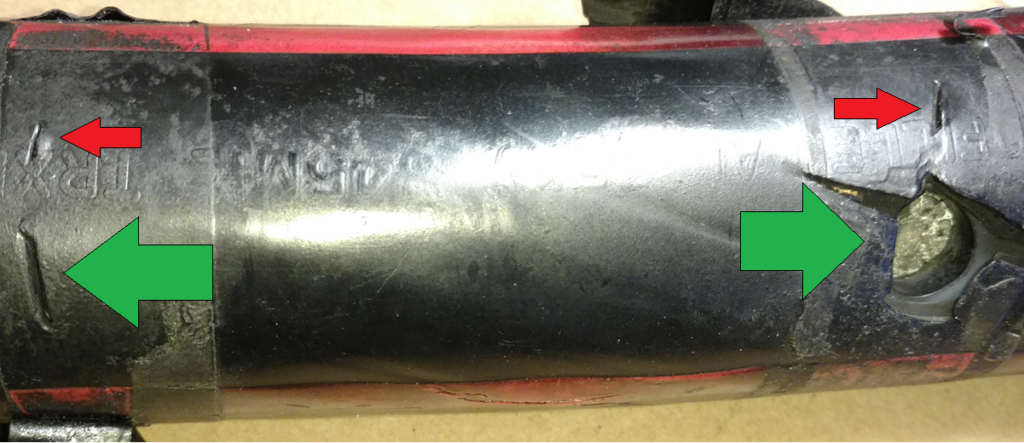
See the following LinkedIn Post from IMCORP – based in the USA but with global operations IMCORP provide the best diagnostic services for medium/high voltage power cable systems and utility asset management systems. Here they show how PVC insulation tape has been applied to attempt to cosmetically patch the damage but not recover the insulation or protection level required to prevent future cable failure. So the tape has concealed the damage but not repaired the problem.
Cable Repair Despair
Damaged Cable Case Studies
1 Low Voltage Mains Cable Damaged With Underground Moling Appliance
Image 1 highlights a situation when a moling device came into contact with a low voltage (.3(4) PILC) mains cable, the operatives task was to install an underground pipe at the locus. Cable damage during excavation works and new installations on underground cables and buried utility pipes is a common cause of power cuts and outages.
During the works the moling device inadvertently came into contact with the cable causing a loss of electricity supplies to customers. This cable construction is an older type cable called PILC (Paper Insulated, Lead Covered) – looking at the PILC cable it can clearly be seen that the outer skin of the cable is covered in taped armour, this type of cable was widely used on the underground electricity network.
SP Energy Networks cable records were supplied to the operatives by the contractor and were accurate, cable locator on site, depth of cable 600mm. The investigation into this incident found that contact with the electricity cable was avoidable if adherence to HSG47 had been implemented.
In conclusion, setting a moling device in the direction of underground electricity cables is not recommended – this type of action could lead to serious injuries.

Image 1
2 Low Voltage Mains Power Cable Damaged In Cable Trench
Image 2 shows latent cable damage to a low voltage mains cable which was not reported to ScottishPower when the cable jointing contractor installed the cable ducting over the electricity cables.
Customers in the area were experiencing loss of supplies to their properties and ScottishPower engineers located the loss of supply problem to the above location.
As the damaged cable was not reported to ScottishPower the situation resulted in damage to the newly installed cable ducting – a situation that could have been avoided if the cable strike had been reported when it happened, as they installed the ducting on top of ScottishPower apparatus.
Please note: separation between underground utilities is important to avoid damage to other utilities apparatus. Reporting cable strikes at the time of occurrence will avoid inconvenience to customers and reduce costs to third parties. Prior to any underground cable excavations taking place cable records should always be consulted. Always assume cables are present and live until proved otherwise.

Image 2
3 Low Voltage Waveform Cable Strike & Damaged By Excavator
Image 3 clearly demonstrates the impact on the underground ScottishPower network when an excavator came into contact with a low voltage cable (4 Core 240sqmm Waveform BS7870). The contractor’s task was to carry out excavations to install underground drainage apparatus with ScottishPower cable records and cable locator on site.
Contractors on site had installed the cables previously and were clearly aware of the location of the cable route. During the excavations to progress the drainage works the high voltage cable was located, however an excavator came into contact with the low voltage cable, despite a ScottishPower sub-station being situated in close vicinity to the works taking place.
Fortunately on this occasion no injuries were sustained to the operatives. Excavations require to be planned professionally to avoid cable strikes/serious injuries such as electrocution or arc flash blast to operatives.

Image 3
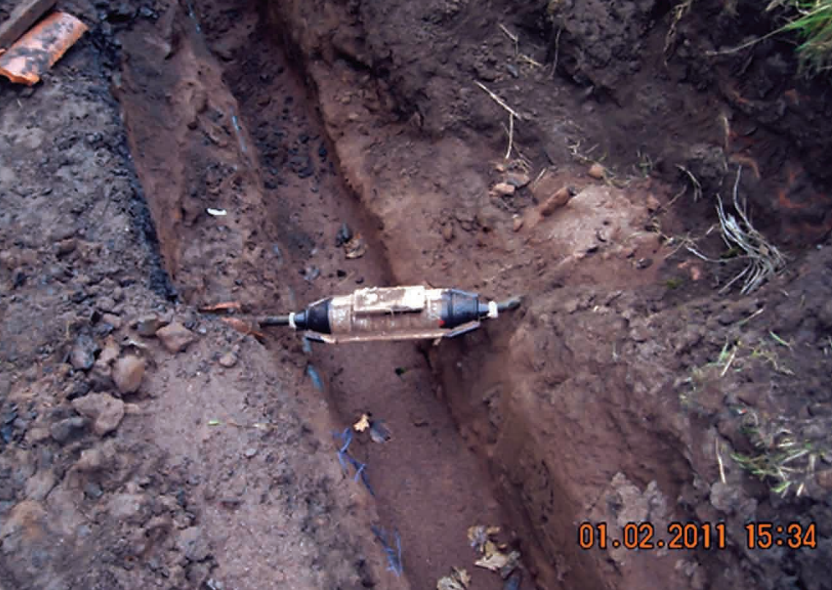
4 Low Voltage Service Cable Repair & Cable Strike Damage
Image 4 highlights a repair to a ScottishPower low voltage service cable. The cable was evident on the contractor’s cable records – however the operatives still managed to strike the cable with a mini-excavator with the potential to cause injuries to himself and his colleagues as well as serious cable damage.
Prior to main excavations taking place trial holes should always be carried out to locate the line and depth of all utilities throughout the project. Before the use of a mechanical excavator takes place a risk assessment should always be carried out to confirm that it is safe to progress the works with the mini excavator/JCB/track machine etc.
5 Low Voltage Cable Damage By Mini Excavator Strike
Image 5 highlights the consequences of utilising a mini excavator in close proximity to a low voltage cable.The low voltage cable strike occurred when the operatives were carrying out excavations to install kerbing in a grassy area.
In this case the cable strike was entirely preventable, if the contractor/operatives had adhered to HSG47 the cable strike would not have occurred. Engaging an excavator prior to hand excavating / locating underground services is a clear case of non adherence to HSG47 with the real possibility of serious injuries to personnel. To avoid cable strikes to the LV HV underground cable network seek advice prior to excavations commencing.
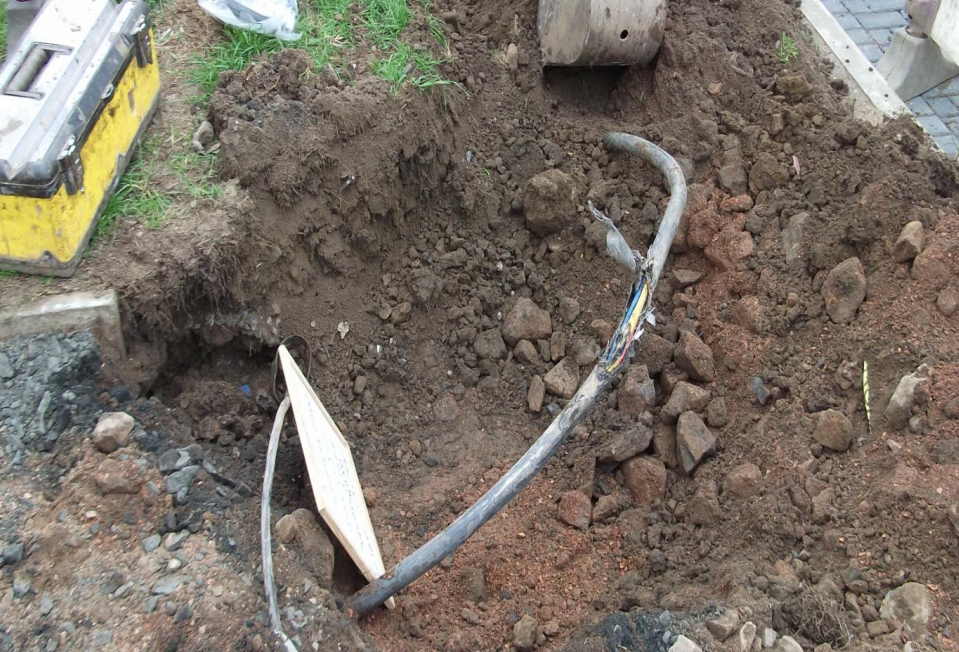
Image 5
6 Low Voltage Cable Damaged At Tee Cable Joint
Image 6 highlights a low voltage cable strike to ScottishPower’s underground electrical network. The service cable, 0.225(2) was damaged at the lead tee joint, this type of cable is an older type cable wrapped in taped armours. The task for the operatives at this location was to install street-lighting ducting for the local authority. The cable strike was not reported to ScottishPower at the time of the incident occurring, for some reason the operatives on site presumed that the cable was out of use, the cable was in fact live. When a cable strike has taken place the correct course of action is to evacuate the excavation immediately, secure/protect the area and report the incident to the Network Operator.

Image 6

Specialist Distributors Of LV MV HV Electrical Equipment
We supply Product Categories: Duct Seals | Cable Cleats | Cable Glands | Electrical Safety | Arc Flash Protection | Cable Jointing Tools | Cable Pulling | Earthing | Feeder Pillars | Cable Joints LV | Joints & Terminations MV HV

Ellis Patents | Nexans Euromold | Pfisterer CONNEX | Prysmian – Distributors
Why Would I Choose A Cable Abandonment Kit Over A Cable End Cap?
June 25th, 2018A series of How-To videos for repairing, jointing and terminating cables using 3M Cold Shrink & Scotchcast products.
-
uploaded by Chris Dodds - Thorne & Derrick Sales & Marketing Manager
Cable Abandonment Kit or Cable End Cap?
This video by 3M Electrical explains why you would choose a cable abandonment kit over a cable cap.
3M cold shrink cable abandonment kits (live cable end seals) are used to temporarily or permanently seal power, control and instrumentation cables – this includes the abandonment of redundant or decommissioned low voltage offshore, marine and shipwiring power, control and instrumentation cables in both safe and hazardous area workplace locations, such as Zone 1 or Zone 2 according to ATEX Directive.
Unlike cable end caps the cable abandonment kits include a copper earth braid system for the safe grounding off cables in the event of future planned or accidental energisation of the electrical cable circuit – the cable sheath and cores should be covered and protected with copper earth braid and bonded using constant force springs to effectively short-circuit the cable system if energised. Copper binder wire and shielding braid is used to abandon and ground the individual cable cores – this is demonstrated in the 3M Training video below.
Cold Shrink – invented by 3M over 40 years ago and now the preferred technology for heat-free jointing, terminating, sealing and abandonment of LV HV cables
We hope you find this video informative and educational, contact T&D for technical support, quotations and stock availability for 3M Cold Shrink Cable Abandonment Kits.
➡ Visit 3M Electrical for further information about joints, terminations, tapes and insulation to seal, repair, splice and connect LV MV HV cables.
Cold Shrink | Joint | Terminate | Seal | Repair | Splice | LV MV HV Cables | 3M
- 3M Electrical Products Stocked By Thorne & Derrick International
How To Apply 3M Cold Shrink Tubing
June 25th, 2018A series of How-To videos for repairing, jointing and terminating cables using 3M Cold Shrink & Scotchcast products.
-
uploaded by Chris Dodds - Thorne & Derrick Sales & Marketing Manager
3M Cold Shrink Tubing
This video by 3M Electrical shows how to apply 3M Cold Shrink Tubing safely.
3M Cold Shrink Tubing is a series of open-ended, tubular rubber sleeves, which are factory expanded and assembled onto a removable core – the cold shrink tubes are supplied for field installation in a pre-stretched condition without requirement to use any activation or installation tools.
Cold shrink tubes are available in both EPDM rubber and silicone.
The 3M video shows how to install the tubing by unwinding the removable core allowing the tube to shrink and form a waterproof cable seal. Cold Shrink is quicker, easier and safer to install than heat shrink tubing alternatives.
Cold Shrink – invented by 3M over 40 years ago and now the preferred technology for heat-free jointing, terminating, sealing and abandonment of LV HV cables
We hope you find this video informative and educational, contact T&D for technical support, quotations and stock availability for 3M Cold Shrink Tubing.
➡ Visit 3M Electrical for further information about joints, terminations, tapes and insulation to seal, repair, splice and connect LV MV HV cables.
Cold Shrink | Joint | Terminate | Seal | Repair | Splice | LV MV HV Cables | 3M
- 3M Electrical Products Stocked By Thorne & Derrick International
How To Use Cold Shrink Cable Caps For Permanent Cable Abandonment
June 25th, 2018A series of How-To videos for repairing, jointing and terminating cables using 3M Cold Shrink & Scotchcast products.
-
uploaded by Chris Dodds - Thorne & Derrick Sales & Marketing Manager
Cold Shrink Cable Caps
This video by 3M Electrical shows how to apply 3M Cold Shrink End Caps safely.
3M Cold Shrink end cable caps environmentally seal and mechanically protect exposed low and high voltage cable ends using no specialist tools, mastics or tapes – manually applied the cable caps are safe and fast to install in the field for immediate protection of unsealed cable ends against water ingress.
The 3M video explains how a Cable Abandonment Kit can be used to safely abandon a cable either permanently or temporarily. The Cold Shrink kit ensures that if the cable is accidentally re-energised it remains safe.
Cold Shrink – invented by 3M over 40 years ago and now the preferred technology for heat-free jointing, terminating, sealing and abandonment of LV HV cables
We hope you find this video informative and educational, contact T&D for technical support, quotations and stock availability for 3M Cold Shrink Cable End Caps and Cable Abandonment Kits.
➡ Visit 3M Electrical for further information about joints, terminations, tapes and insulation to seal, repair, splice and connect LV MV HV cables.
Cold Shrink | Joint | Terminate | Seal | Repair | Splice | LV MV HV Cables | 3M
- 3M Electrical Products Stocked By Thorne & Derrick International