New Connection Technology For Single-Strand Insulated Cables By PFISTERER
High-voltage power cables increasingly utilise conductor designs that significantly reduce skin and proximity effects.
This enables more power transmission with the same cross-section. The individual strands of these conductors are insulated from each other (enamelled)and are often arranged in segments (Milliken type).
This conductor structure complicates the cable connection process.
PFISTERER has developed FrontCon, which uses a completely new connector principle to significantly simplify and shorten installation.
New connection technology
Connecting single-strand insulated cable conductors is a time-consuming process that only works to a limited extent: separate the individual strands, strip them one by one, then rearrange them as far as possible in the original form – without damaging any of the strands. Despite best efforts, the original conductor structure is not achieved at the installation site. Moreover, removing the insulation means losing the benefit of single-strand insulated cables at the end of the conductor. PFISTERER has completely rethought the connection of single-strand insulated conductors.
Shorter Installation Time
80% Shorter Installation Time
With FrontCon, PFISTERER has developed a solution that significantly reduces the time required and creates a defined connection via the front face of the cable. Installation takes only around 2 hours – not longer than for conventional cables with standard connections.
At the same time, possible damage when stripping the individual strands is prevented. That significantly reduces the risk of installation errors.
Compact Design
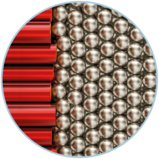
FrontCon is installed directly on the end of the cable – no work is required on the individual strands. Specially developed contact balls make contact with the front faces of the individual strands. Together, these contact balls behave like a liquid. They compensate for slight unevenness at the conductor end, and ensure that the same contact forces are applied across the whole conductor cross-section.
Power flows via the conductor front face and the contact balls. This enables a very short and compact contact system for large conductor crosssections.
Proven contact system for HV cable fittings
FrontCon is available as a connection technology for CONNEX cable connectors and IXOSIL terminations, as well as for cable connections in MSA cable joints and type tested with specific cables. The first cable projects have now been in operation for several years.
The contact system can be adapted for any fittings, enabling reliable and cost-effective solutions in cable systems. It can be installed vertically or horizontally. The range covers copper cables up to a cross-section of 2,500 mm².
Other cable connection solutions can be implemented on request.
HV Cable Fittings
Pfisterer Frontcon Benefits:
Reliable contact on the front face of the conductors
Very short installation time
Insulation does not have to be removed from individual strands
Compact design
Safe and simple installation
Conductor structure is preserved
How Frontcon works
FrontCon is installed directly on the conductor end. The cable is sawn off straight, and the cable insulation is removed. The pressure-stable contact system clamps centrically onto the conductor.
Contact balls are poured into the connector. Tightening the pressure screw presses the balls against the front face of the conductor ends. Reliable contact is established.
A built-in spring mechanism compensates for settling losses. This ensures that contact forces and low transmission resistances are maintained at different temperatures and throughout the full service life.
Stockists & Suppliers
The range of PFISTERER cable plugs, joints, terminations fittings and accessories offers solutions for virtually all MV & HV Cable Connection applications – PFISTERER accessories use silicone as an insulating medium due to the excellent properties that it possesses.
THORNE & DERRICK
Thorne & Derrick are national distributors of LV, MV & HV Cable Installation, Jointing, Substation & Electrical Equipment – servicing businesses involved in cabling, jointing, substation, earthing, overhead line and electrical construction at LV, 11kV, 33kV, 66kV and EHV. Supplying a complete range of power cable accessories to support the installation and maintenance of low/medium and high voltage cable systems:
This is an introduction to applications and an engineering design approach for the proper use of Roxtec multi-cable transit devices within onshore oil, gas and petrochemical facilities. This paper demonstrates improved safety and improved project delivery when cable transit devices are included into owner and EPC design scopes.
International standards for cable transit devices and common safety demands are presented, including the use of Roxtec cable transit devices for vapor-tight barriers, blast-rated structures, fire walls, pressurized buildings, and simple ingress protection against environmental elements.
Incorporating Roxtec transits into owner-level and engineering-level design standards, is demonstrated to provide project savings that include reducing contractor work-hours, detail design time, and reduced field maintenance time. Proper multi-cable transit design and installations are also shown to increase project safety and operational uptime.
Introduction
Components and Assembly Overview For Multi-Cable Transit Devices
Applications For Roxtec Cable Transit Devices In Onshore Facilities
Work Process & Design Approach For Roxtec Devices
Details Required For Proper Specification Of Roxtec Devices
Hazardous Areas & Explosive Atmospheres (Gas & Dust) | Ex e and Ex tb Explosion Protection Certified by ATEX & IECEx | Zone 1/21 & Zone 2/22
Conclusion
Roxtec modular cable transit seals are based upon a rubber design with seals that are constructed of a number of removable layers to secure a watertight, gas tight and fire proof seal around the cable or pipe – the range includes rectangular transits and round transits to fit a variety of pipes and cable sizes.
Buildings & E-houses
Wall entries
Floor entries
Underground entries
Control rooms
Analyzer shelters
Substations
Remote instrument buildings (RIB)
Field auxiliary rooms (FAR)
Local equipment rooms (LER)
Terminal Boxes, Cabinets & Enclosures
Remote I/O cabinets
Hazardous locations (Ex e)
Ordinary locations
Electric heat tracing systems
Automation and control cabinets
DCS panels
Motor control cabinets
Safety instrumented systems (SIS)
Fire and gas detection control cabinets
Machine monitoring systems
Lighting panels
Thorne & Derrick are distributors for Roxtec, the leading manufacturer of sealing solutions for cables and pipes, – protecting cables and pipes in the process industry sector against water, gas and fire.
Further Reading
Sealing Pipes & Cables in the Hazardous Area & Process Industries Using Roxtec
Specialist Distributors of Industrial & Hazardous Area Equipment to provide Power, Heat, Light & Ventilation to the explosive atmospheres and process industries.
An integrated design approach to a modular process equipment package is discussed. By incorporating the electrical, instrumentation and control equipment on the same platform as the process equipment, a higher level of modular integration is achieved.
The benefits include a reduced number of on-site equipment terminations and the ability to precommission equipment prior to installation resulting in lower installed costs. The area classification, installation and cable transit barrier requirements for an integrated modular design approach are reviewed.
Introduction
Standard Modular Process Package Concept
Integrated Modular Process Package Concept
Piping and Cable Transit Barriers
Hazardous Areas & Explosive Atmospheres (Gas & Dust) | Ex e and Ex tb Explosion Protection Certified by ATEX & IECEx | Zone 1/21 & Zone 2/22
Conclusion
Roxtec modular cable transit seals are based upon a rubber design with seals that are constructed of a number of removable layers to secure a watertight, gas tight and fire proof seal around the cable or pipe – the range includes rectangular transits and round transits to fit a variety of pipes and cable sizes.
Buildings & E-houses
Wall entries
Floor entries
Underground entries
Control rooms
Analyzer shelters
Substations
Remote instrument buildings (RIB)
Field auxiliary rooms (FAR)
Local equipment rooms (LER)
Terminal Boxes, Cabinets & Enclosures
Remote I/O cabinets
Hazardous locations (Ex e)
Ordinary locations
Electric heat tracing systems
Automation and control cabinets
DCS panels
Motor control cabinets
Safety instrumented systems (SIS)
Fire and gas detection control cabinets
Machine monitoring systems
Lighting panels
Thorne & Derrick are distributors for Roxtec, the leading manufacturer of sealing solutions for cables and pipes, – protecting cables and pipes in the process industry sector against water, gas and fire.
FURTHER READING
Sealing Pipes & Cables in the Hazardous Area & Process Industries Using Roxtec
Specialist Distributors of Industrial & Hazardous Area Equipment to provide Power, Heat, Light & Ventilation to the explosive atmospheres and process industries.
Data Center optimisation requires a reliable infrastructure to address power, cooling, assets, and connectivity challenges. In the below blog Panduit highlight why cable cleats are critical in supporting these vital goals.
In the information age, data centers and their task of continuous, safe storage of data make them critical facilities. If the data center isn’t reliable, productivity decreases immensely. Data centers house the organization’s most vital and proprietary assets. Hence, they are crucial to the continuity of daily business operations and the power required to operate the data racks in the data centers.
A study by Uptime Institute, an advisory organization, focused on improving the performance, efficiency, and reliability of business-critical infrastructures, surveyed 1,600 owners and operators in the data center sector. Ten percent (10%) of all respondents said their most recent significant outage cost more than $1 million.
Also, nearly 34% of all respondents have had a severe outage in the past three years, causing operators’ substantial problems. (1) Hence why Cable Cleats help to provide uninterrupted, safe power in the operations of data centers.
Assurance and Insurance Bundled Together
IEC International Standard defining a Cable Cleat
What is a Cable Cleat? Defined by the IEC International standard, a cable cleat is simply “A device designed to secure cables when installed at intervals along the length of the cables”. (2)
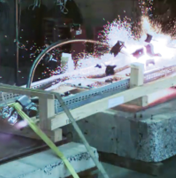
When it comes to a power distribution system, the potential damage from a short circuit fault can be catastrophic ― resulting in an arc flash event at a piece of equipment or power cables whipping about violently. These types of events pose a serious safety hazard to anyone nearby at the time it occurs, either during the initial power-up or afterward.
However, worker safety and equipment damage concerns are minimized by adhering to proven engineering design criteria and meeting documented codes and standards requirements. The best way to protect personnel and equipment near power cables during a short circuit fault is to restrain the cables.
The technology used in the creation of infrastructure projects continues to receive substantial investment. Still, according to a March 2020 survey by Panduit and EC&M, the majority of electrical engineers and electrical contractors are struggling to collectively understand the full benefits of cable management in electrical design—and the risks of ignoring it. Short circuit calculations aren’t being performed, and proper cable management solutions aren’t being specified.
The result is that nearly half of the survey’s engineer respondents (48 percent) indicate that cable cleats currently protect none of the power cable they specify. Only 44 percent of electrical contractor respondents specify cable cleats’ use on their power cable designs and puts the safety, productivity, ROI, and future scalability of entire projects at risk. Seventy-two percent of contractors still depend on plastic zip or cable ties to secure cables, and another 20 percent don’t use any cable fixing system. This leaves infrastructure and workers unprotected from potentially deadly damage. (3)
NEC 392.20(C)
Example of a Short Circuit test
In the U.S., NEC 392.20(C) is the National Electrical Code that governs the safety of the cable installations in cable tray. NEC Article 392.20(C) states: “Parallel connected single conductor cables shall be securely bound in circuit groups to prevent excessive movement due to fault current magnetic forces.” (4). While NEC 392.20(C) includes language for securing cables during a short circuit fault, it does not specify how to design the proper containment system to meet those forces. Often the lack of clear guidelines on short circuit protection in the NEC results in inadequate or no cable containment to protect against short circuit events in tray cable installations.
Europe has been utilizing cable tray systems for several decades and leads the industry in design standards and best practices. As such, the IEC 61914:2015 standard provides the testing methodology and process to ensure the reliability of cable cleats and ultimate protection in the event of a short circuit event. Cable in cable trays is only a safe and viable solution when paired with the right cable cleat solution to protect against short circuit events.
Unfortunately, NEC 392.20(C) does not currently provide adequate guidance on how to securely contain cables in the event of a short circuit when routing cables in a cable tray. To protect electrical infrastructure when using power cables in a tray, installing an IEC 61914:2015-compliant cable cleat is the best option when facing a peak short circuit fault.
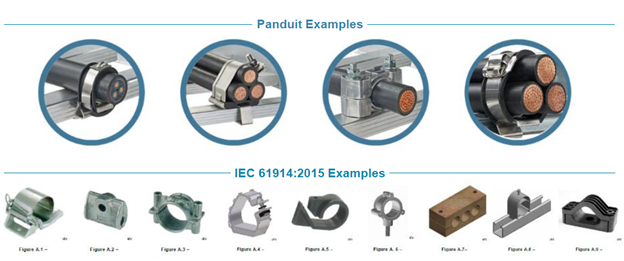
Cable Cleat Examples – Panduit IEC 61914 2015
An Undefined Standard
All of Panduit’s electrical cable cleats have been third-party validated to meet IEC 61914:2015.
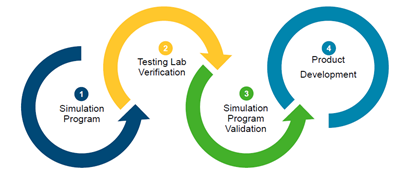
Because they exceed safety requirements of current U.S. electrical codes, they help future-proof your project against subsequent standards harmonization. Panduit’s cable cleat solutions were designed to withstand the stress of a short circuit event using a state-of-the-art ANSYS simulation software to model the dynamic forces at play.
Panduit’s Design & Testing Process
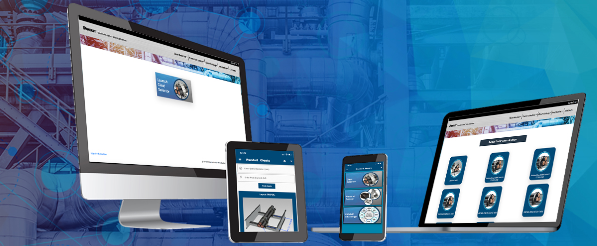
Also, our design and testing process has led to the development of the Cleat kAlculator™ mobile and desktop app. Many engineers do not specify cable cleats in part due to the necessary, but time-consuming fault calculations required. The Cleat kAlculator™ streamlines the process significantly by allowing engineers, designers, and installers to determine the correct cable cleat simply by inputting the cable layout, cable diameter, and peak short circuit current.
Panduit’s Cleat kAlculator Mobile & Desktop App
Data center optimization requires reliable infrastructure to address power, cooling, assets, and connectivity challenges. Protecting personnel and equipment should be an organization’s number one priority. With proper specification and installation of cable cleats, these solutions will support the critical goals.
Thorne & Derrick International, based in the UK, are Official Distributors for the Panduit range of cable tiesand tools for industrial and hazardous area management of data, telecoms, control, instrumentation and power LV MV HV cables in industrial and hazardous area industries including oil/gas, petrochemical, rail, renewable, construction and mining/quarrying industries – this includes stainless steel cable ties used to clamp and cleat cables located in medium/high voltage MV HV onshore and offshore substations.
Thorne & Derrick are national distributors of LV, MV & HV Cable Installation, Jointing, Substation & Electrical Equipment – servicing businesses involved in cabling, jointing, substation, earthing, overhead line and electrical construction at LV, 11kV, 33kV, 66kV and EHV. Supplying a complete range of power cable accessories to support the installation and maintenance of low/medium and high voltage voltage power systems:
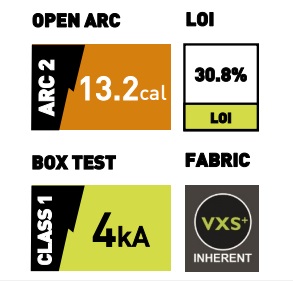
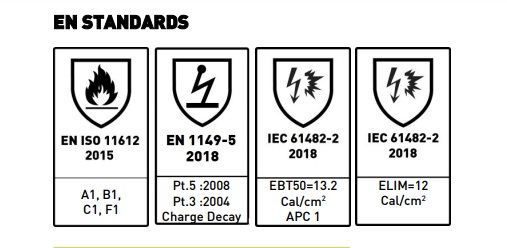
ProGarm have always been ahead of the game when it comes to arc flash protective clothing design and their new product the arc flash protection hoodie is no different. The 5530 hoodie doesn’t only provide arc flash protection to 13.2cal/cm² but also is stylish, comfortable and practical to wear.
This premium hooded sweatshirt features a warm neck design, ideal for working outside as well as a drawstring hood. Constructed from ProGarm’s very own 320gms VXS+ Jersey fabric with a brushed inner fleece lining for warmth, it also features ribbed waistband and cuffs for a great fit and the usual front pockets too – great for storing mobile phones.
This 13.2cal/cm2 arc flash protection hoodie has also been layered and tested with the ProGarm 7cal/cm² 5280 Arc Flash Polo Shirt and the combination delivered results of Class 2 and 31.0cal/cm² protection.
The 5530 arc flash hoodie – already a winner, scoring 9.2 out of 10 in a recent user trial.
In stock and available for immediate delivery, T&D have sizes S-4XL.
Arc Flash 5530 Protection Hoodies
Arc Flash Hoodie 5530
Features & Benefits
13.2 cal (ATPV) to provide Arc 2 protection (combine it with 7cal 5280 polo shirt for 31cal protection!)
Supersoft fabric makes it comfortable to wear and easy to work in
Snug neckline and draw string hood help with cold and arc flash protection
100% inherent fabric means that protection won’t wash out or diminish over time
Lifetime Seam Guarantee shows our confidence in the quality of the product
Brushed fleece inner for Winter warmth
VXS+ blend for natural feel, comfortable and soft
Breathable with good moisture management
5cm stretch rib hem – best fit around waist and cuffs
Colour matched to other navy ProGARM arc flash garments
Thorne and Derrick are proud to be distributors of ProGARM arc flash coveralls and protection.
We can help – should you require arc flash calculators or advice on the type of clothing and protection available please do not hesitate to contact us.
Thorne & Derrick are national distributors of LV, MV & HV Cable Installation, Jointing, Substation & Electrical Equipment – servicing businesses involved in cabling, jointing, substation, earthing, overhead line and electrical construction at LV, 11kV, 33kV, 66kV and EHV. Supplying a complete range of power cable accessories to support the installation and maintenance of low/medium and high voltage power systems: