Cable Cleats
CMP Cable Cleats NEW | Quadruplex Cables & Quad Formation Cables
February 12th, 2019
cmp Cable Cleats
CMP have developed a new quad cable cleats range that have been designed, constructed, tested and third party certified in accordance with IEC 61914:2015.
Cable cleats within the quad range manufactured by CMP are designed for a variety of industries including the data centre, energy, utility and rail market where high performance and a compact design of cable cleat is critical for the retention of cables in quadrafoil formation in the event of a short circuit fault situation.
‘Saturn’ quad cable cleats are designed to safely restrain single cables in quad (or quadrafoil) formation without sustaining damage to the cables or cable management system in the event of short circuit fault conditions.

Single Cables In Quad Formation
For quadruplex cable, CMP has developed the QPSS cable cleat, with an integrated C-Clamp and bolt, which provides installers with versatility of installation.
The QPSS type of cable cleat has a high short circuit rating of 135kA and can be installed in a range of applications where quadruplex cable is utilised, including data centres.

Combined Quadruplex Cables | CMP Cable Cleats
For further information on CMP Saturn QSDSS and the CMP Quadplex QPSS Metal Cable Cleats please click the links.

LV, MV & HV Jointing, Earthing, Substation & Electrical Eqpt
Thorne & Derrick International are specialist distributors of LV, MV & HV Cable Installation, Jointing, Duct Sealing, Substation & Electrical Equipment – servicing UK and global businesses involved in cable installations, cable jointing, substation, overhead line and electrical construction at LV, 11kV, 33kV and EHV.
THORNE & DERRICK Product Categories: Duct Seals | Cable Cleats | Cable Glands | Electrical Safety | Arc Flash Protection | Cable Jointing Tools | Cable Pulling | Earthing | Feeder Pillars | Cable Joints LV | Joints & Terminations MV HV
Triplex Cleats – Selection Guide for Cleating 11kV BS7870 Part 4.10 Cables
July 25th, 2018
Distributors for Ellis Patents Cable Cleats
- uploaded by Chis Dodds – Thorne & Derrick Sales & Marketing Manager
The following post is provided to enable the selection of cable cleats to suit a standard UK DNO utility cable for medium/high voltage power systems – this type of MV HV cable commonly referred to as “Triplex” cable has increasingly replaced conventional BS6622 11kV 3 core XLPE insulated cable.
Triplex cable consists of 3 x single cores in a “twisted” spiral formation – this non linear cable orientation must be recreated into a circular formation using Triplex cable surrounds.
It is essential to effectively cable cleat Triplex cables to containment to ensure safe and reliable cable restraint in the event of a short-circuit situation – to simplify the cable cleat selection process it is a basic requirement to consider the calculated short-circuit fault current rating, installation environment and overall outside diameter of the 3 x single core cables when combined in Triplex formation.
The short circuit calculation would normally be the responsibility of the Electrical Design Engineer and can be calculated using a formula as recommended by IEC61914 the international standard which specifies requirements and tests for cable cleats and intermediate restraints used for securing cable in electrical installations.

Triplex Cables 11kV BS7870 4.10
Specification: 11kV Triplex, Solid Aluminium Conductor, Triplex Extruded Conductor Screen, XLPE Insulation, Fully Bonded Semi-con Screen, Copper Wire Screen, Longitudinal Water Blocking Tape, MDPE Cable Sheath, 6350/11000V to BS7870 Part 4. Sheath colour: Red.
Based on the following 11kV Triplex specification we can recommend and supply 3 types of cable cleat
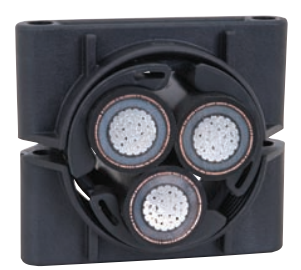
- Ellis Patents 2F Cable Cleat (Plastic)
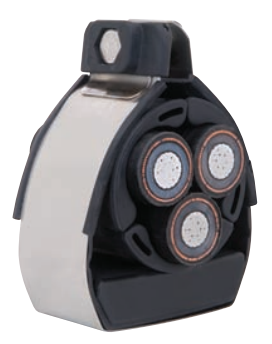
- Ellis Patents Vulcan+ Cable Cleat (Stainless Steel)
- Ellis Patents Emperor Cable Cleat (Stainless Steel)
| Voltage | Conductor Type | Conductor Sqmm | Nominal Conductor Diameter | Dia Over Insulation mm | Dia Over Semi-con Screen | Dia Over Cable Sheath | Diameter In Triplex Formation | Triplex Liner | 2F Cleat | Vulcan Cleat | Emperor Cleat |
| 11kV | Solid Aluminium | 95sqmm | 10.65mm | 18.95mm | 23.03mm | 27.17mm | 58.24mm | SFT26 | 2F+10 | VRT+04 | ES58-66 |
| 11kV | Solid Aluminium | 185sqmm | 14.9mm | 23.25mm | 27.33mm | 31.67mm | 68.24mm | SFT31 | 2F+1200 | VRT+06 | ES65-73 |
| 11kV | Solid Aluminium | 300sqmm | 19.0mm | 27.3mm | 31.38mm | 36.12mm | 77.83mm | SFT36 | 2F+1201 | VRT+07 | ES73-85 |
♦ Important: Manufacturers cable dimensional data and tolerances can vary by significant % factors hence critical measurements can be inconsistent – always provide manufacturers cable specification complete with construction information to ensure supply of correct cable cleats. Above is provided for guideline purposes only – check with Thorne & Derrick.
Based on the above cable dimensions we can supply the range of cable cleats listed below.
Triplex Liner & Cable Surrounds
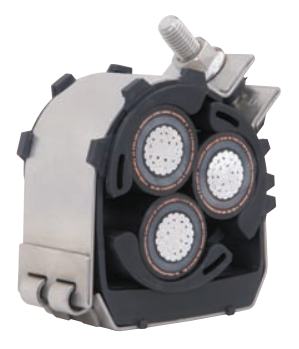
Ellis Patents Triplex cable surrounds are manufactured from LSF Zero Halogen Polymeric material and used within single cable cleats to secure triplex cables – the cable liner surrounds have a maximum short circuit test level of 76kA when used with Ellis Patents 2F cable clamps and 600mm cleat spacings.
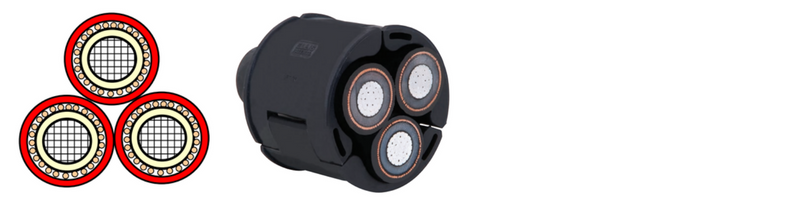
Triplex Cleats
The following table provides an overview of the Ellis Patents range of Triplex cable cleats depending on levels of short circuit fault protection required by the clamps.
More Cable Cleats Reading

Ellis Patents Cable Cleats
Stainless Steel Cable Cleats – Preventing Galvanic Corrosion Of Cable Fixings
March 20th, 2018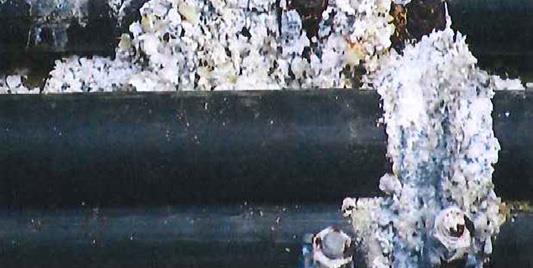
-
Uploaded By Chris Dodds – Thorne & Derrick Sales & Marketing Manager
Cable Cleats
In the following article we provide an evidence based specification case for stainless steel cable cleats where levels of atmospheric corrosion preclude use of other cable fixing materials.
One of the most important issues to consider when specifying cable cleats is the risk of material corrosion – not just as a result of the installation environment, but also from other metals which the cable cleat is in contact with.
Galvanic corrosion occurs when dissimilar metals are placed in contact with each other in the presence of an electrolyte. There are two factors that affect the rate of galvanic corrosion, the first is the distance between the two metals in the galvanic series.
The further apart the two metals are in the galvanic series, the greater the risk of galvanic corrosion – with the metal higher up the list (more anodic) being the one whose rate of corrosion is accelerated.
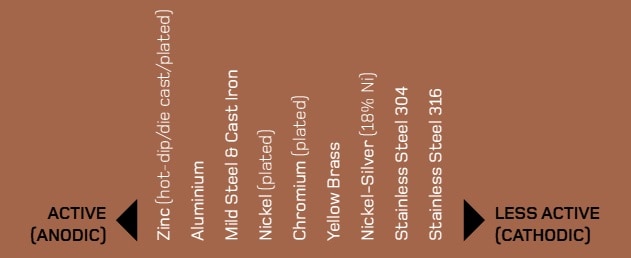
Galvanic Series
The second factor to consider is the relative surface areas of the different metals.
If the more anodic (higher up the list) metal has a smaller surface area than the metal it is in contact with, the difference in surface area causes the rate of corrosion of the anodic metal to increase.
Conversely, if the more anodic metal has a much larger surface area than the cathodic metal, it may be sufficient for the effects of galvanic corrosion to be discounted. In terms of cable cleat selection, the surface area of the cleat is generally significantly smaller than the structure it is mounted on.
Therefore, if it is made from a metal that is more anodic than its support structure it will be susceptible to galvanic corrosion.
Conversely, if the cable cleat is more cathodic than its support structure, there is little risk of galvanic corrosion.
Using this criteria, if galvanised ladder is the support structure, and there are no other significant factors, it is safe to use stainless steel or aluminium cleats. However, if the support structure is stainless steel, separation should be provided if aluminium or galvanised cleats are used.
Galvanic corrosion is not easily predictable and can be influenced by the type of electrolytes present such as salt water or fresh water containing impurities. In general terms when guarding against galvanic corrosion, the safest course of action is to separate dissimilar metals with polymer separation washers.
This separation should be carried out between the cable cleat and its mounting surface and the cleat’s mounting fixing.
All Ellis cable cleat products constructed from dissimilar metal are designed in a way that completely avoids bimetallic contact. As a result of this you can be confident that cable cleats will have a service life measured in decades.

Emperor Cleats – stainless steel cable cleats for single or trefoil cleating of cables with highest levels of short-circuit protection. Max S/c Test Level 235kA | 225mm Cleat Spacings.
Stainless Steel Cable Cleats
All Ellis stainless steel cable cleats are produced from 316L austenitic stainless steel.
In general, cable cleats are manufactured from austenitic stainless steel due to its non-magnetic and corrosion resistant properties – the former ensuring the cable cleat will not induce eddy currents or localised heating of the LV-HV cable.
Austenitic stainless steel does become a little magnetic as a result of work hardening when processed. This magnetism can barely be detected with a magnet and so is not significant from an eddy current perspective.
304 austenitic stainless steel, often referred to as A2, is one of the most commonly used stainless steels. It has excellent corrosion resistant properties in most circumstances, although is susceptible in atmospheres where chlorides are present, making it unsuitable for use in coastal or marine environments.
316 austenitic stainless steel, often referred to as A4, contains Molybdenum, which provides resistance against chlorides. 316 is often referred to as marine grade stainless steel due to its suitability for use in coastal and offshore applications.
If unsure a simple chemical test can determine whether Molybdenum is present and so differentiate between 304 and 316 types of stainless steel.
There are many different types of stainless steel, but there are two principal variants when it comes to cable cleats. 304 and 316 stainless steel are available in low carbon variants, namely 304L and 316L. These variants are immune to sensitisation (grain boundary carbide precipitation).
Any cable cleat which is manufactured from stainless steel and includes welding in the manufacturing process should be made in a low carbon (L) variant.
Should you require any further assistance in the selection or specification of stainless steel cable cleats for LV Low Voltage, MV Medium Voltage or HV High Voltage cables please do not hesitate to contact us.

Vulcan Cleats – stainless steel cable cleats for single or trefoil cleating of cables with moderate levels of short-circuit protection. Max S/c Test Level 132kA | 300mm Cleat Spacings.
Cable Cleat Coatings
The corrosion resistance properties of stainless steel are a result of chromium, which reacts with oxygen and forms a self-healing impervious layer of chromium oxide on the surface of the steel.
In most circumstances the chromium oxide layer is extremely durable and helps in resisting galvanic corrosion. However, in certain installation locations, such as railway tunnels, the oxide layer can be continuously penetrated.
This occurs due to trains frequently applying their brakes, which releases mild steel dust into the atmosphere that then settles on the stainless steel. If moisture is present, then corrosion occurs at an exaggerated rate. In such circumstances, if regular washing is not feasible, use of aluminium as an alternative to stainless steel products and/or coating processes are strongly recommended.
Ellis Patents offers special coatings to suit specific cable installation environments – e.g. our London Underground Approved electrostatic plastic coatings.
Cable Cleat Fixings
Closure fixings on cable cleats are fundamental to the loop strength of the cable cleat and its short-circuit withstand capability.
All Ellis Patents 316L stainless steel cleats use 316 fixings, which are manufactured to a precise and specific tensile strength. Fixings are sourced directly from approved manufacturers and any fixing on any cleat is directly traceable back to the batch quality records at that manufacturer.
Galvanised Steel
Contracts often require a guarantee regarding the life expectancy of a cleat. If the installation is designed correctly and all other corrosion issues have been considered this is a relatively simple exercise for stainless steel products. With galvanized steel, life expectancy is determined by the thickness of the zinc coating.
The resistance of galvanizing to atmospheric corrosion depends on a protective film that forms on the surface of the zinc. When the newly coated steel is withdrawn from the galvanizing bath, the zinc has a clean, bright, shiny surface. With time a corrosion process occurs which produces a dull grey patina as the surface reacts with oxygen, water and carbon dioxide in the atmosphere.
This leads to the formation of a tough, stable, protective layer, which is tightly adherent to the zinc. As the corrosion process is continuous, the thickness of the zinc layer reduces over time and it is the speed of this reduction that is used to accurately predict the life span of the cable cleat.
Corrosion Rates for the UK
Permission to use the information relating to galvanising was granted by the Galvanizers Association for galvanised steel. If a galvanised steel cable cleat is specified for use in a zone 3 area then the corrosion rate is 1.5 microns (µm) per year.
If the contract for this specification states a required life expectancy of 40 years, then the initial galvanising thickness will need to be a minimum of 60 µm in order to meet the required longevity.
Zinc corrosion rates are represented by 5 categories indicated by the colour codes below:

Zinc Corrosion Rates

Corrosion Rates for the UK
Cable Cleats Blogs
- IEC 61914 – Cable Cleats & Short Circuit Protection Calculations
- Fire Resistance & Cable Cleats – Surviving Fire, Flame & Extreme Heat
- Cable Cleats – London Underground 1-085 Standard For Fire Safety Performance
LV, MV & HV Jointing, Earthing, Substation & Electrical Eqpt
Thorne & Derrick International are specialist distributors of LV, MV & HV Cable Installation, Jointing, Duct Sealing, Substation & Electrical Equipment – servicing UK and global businesses involved in cable installations, cable jointing, substation, overhead line and electrical construction at LV, 11kV, 33kV and EHV.
THORNE & DERRICK Product Categories: Duct Seals | Cable Cleats | Cable Glands | Electrical Safety | Arc Flash Protection | Cable Jointing Tools | Cable Pulling | Earthing | Feeder Pillars | Cable Joints LV | Joints & Terminations MV HV
Cable Cleats – London Underground 1-085 Standard For Fire Safety Performance Of Materials
March 19th, 2018
-
Uploaded By Chris Dodds – Thorne & Derrick Sales & Marketing Manager
Cable Cleats
Thorne & Derrick a leading specialist distributor of cable cleats provide some information pertaining to the London Underground 1-085 Standard For Fire Safety Performance Of Materials – the purpose of the document download below is to define the requirements for the fire safety of materials, in terms of flammability, smoke emission and toxic fume emission, installed on the London Underground (LU) network.
Thorne & Derrick are Main Distributors for Ellis Patents – several ranges of Ellis Patents cable cleats are currently featured on the London Underground (LUL) Intranet system used by specifiers and buyers working on LUL projects.
Non-metallic cable hangers are also available for the support, retention and suspension of rail cables within tunnels meeting the requirements of the 1-085 specification.
Independent testing confirms conformance to the 1-085 standard including toxicity, limited oxygen and smoke emission.
- Ellis Patents Alpha Cable Cleats – Aluminium Trefoil Cleats Product Register 360
- Ellis Patents Emperor Cable Cleats – Stainless Steel Single & Trefoil Cleats Product Register 362
- Ellis Patents Vulcan+ Cable Cleats – Stainless Steel Single & Trefoil Cleats Product Register 361
- Ellis Patents Phoenix Cable Cleats – Fire Rated & Resistant Cable Cleats Product Register 1661
- Ellis Patents Non-Metallic One Hole Cable Clamps – Product Register 363 364
- View the complete range of Ellis Cable Cleats

Cable Cleats | Ellis Patents Vulcan | Alpha | Phoenix | Flexi-Strap | Triplex Cable Cleats
London Underground 1-085
This standard specifies the requirements for materials installed in underground rail locations with regard to:
a) Flammability (including the risk of explosion)
b) Smoke emission
c) Toxic fume emission
➡ Should you require any assistance with the selection of cable cleats or cable accessories compliant with London Underground 1-085 Standard please do not hesitate to contact us.
Cable Cleats Blogs
- IEC 61914 – Cable Cleats & Short Circuit Protection Calculations
- Fire Resistance & Cable Cleats – Surviving Fire, Flame & Extreme Heat
- Stainless Steel Cable Cleats – Preventing Galvanic Corrosion Of Cable Fixings
LV, MV & HV Jointing, Earthing, Substation & Electrical Eqpt
Thorne & Derrick International are specialist distributors of LV, MV & HV Cable Installation, Jointing, Duct Sealing, Substation & Electrical Equipment – servicing UK and global businesses involved in cable installations, cable jointing, substation, overhead line and electrical construction at LV, 11kV, 33kV and EHV.
THORNE & DERRICK Product Categories: Duct Seals | Cable Cleats | Cable Glands | Electrical Safety | Arc Flash Protection | Cable Jointing Tools | Cable Pulling | Earthing | Feeder Pillars | Cable Joints LV | Joints & Terminations MV HV
Fire Resistance & Cable Cleats – Surviving Fire, Flame & Extreme Heat
March 16th, 2018
Cable Cleats – Undergoing Fire Resistant Testing
-
Uploaded By Chris Dodds – Thorne & Derrick Sales & Marketing Manager
Cable Cleats
There are currently no European or IEC standards for fire rated cable cleats or clamps, although there are requirements within other standards that can be followed to prevent unsuitable cable cleats being specified and installed.
The international standard IEC 61914 requires non-metallic and composite cleats to have adequate resistance to flame propagation only.
UL94, the standard for Safety of Flammability of Plastic Materials for Parts in Devices and Appliances, is a plastics flammability standard that classifies plastics according to how they burn in various orientations and thicknesses.
Adherence to its V-0 rating for polymer cable cleats should be demanded by specifiers.
For information UL94’s V-0 rating means that burning stops within 10 seconds on a vertical specimen; drips of particles allowed as long as they are not inflamed.
The use of the description LSF (Low Smoke & Fume) is common terminology with regard to polymers, but is misleading as it doesn’t relate to any published standard and so can be interpreted in a wide variety of ways.
To ensure complete assurance of performance in a fire, all Ellis Patents plastic cable cleat products have undergone testing at the Building Research Establishment (BRE) in line with the London Underground 1-085 Standard specification with regard to:
- Smoke emission
- Limited oxygen index
- Toxicity of fumes
The appropriate cleats are listed in the London Underground Approved Products Register.
Identification numbers are 360, 361,362, 363, 364, 365 and 1661.
A great deal of focus is placed on fire rated (FP) cables and their performance in fire, but very little attention is given to the cable fixings used to secure these cables.
Given that FP cable is typically rated for operation in temperatures ranging from 850°C to 950°C then the use of plastic cable cleats or clamps is clearly inappropriate.
Even aluminium only has a melting point of 660˚C, which means it would fail to support FP cables in a fire. To counteract this shortcoming, Ellis manufactures the Phoenix range of cable cleats for use with FP cables. Independently tested by Exova Warrington fire and BRE, all products in the Ellis Patents range are proven to perform to the same level as the FP cables ensuring continuous operation in the event of fire.
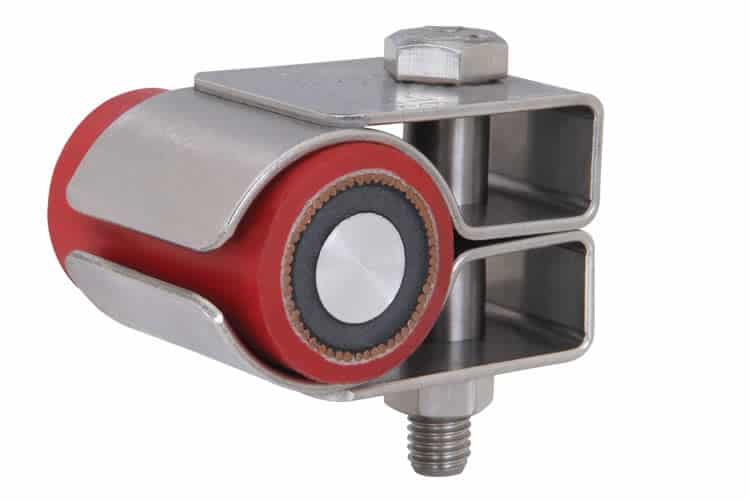
Ellis Patents Phoenix Cable Cleats – Fireproof & Fire Rated
Cable Cleats Blogs
- IEC 61914 – Cable Cleats & Short Circuit Protection Calculations
- Cable Cleats – London Underground 1-085 Standard For Fire Safety Performance
- Stainless Steel Cable Cleats – Preventing Galvanic Corrosion Of Cable Fixings
LV, MV & HV Jointing, Earthing, Substation & Electrical Eqpt
Thorne & Derrick International are specialist distributors of LV, MV & HV Cable Installation, Jointing, Duct Sealing, Substation & Electrical Equipment – servicing UK and global businesses involved in cable installations, cable jointing, substation, overhead line and electrical construction at LV, 11kV, 33kV and EHV.
THORNE & DERRICK Product Categories: Duct Seals | Cable Cleats | Cable Glands | Electrical Safety | Arc Flash Protection | Cable Jointing Tools | Cable Pulling | Earthing | Feeder Pillars | Cable Joints LV | Joints & Terminations MV HV