Uploaded by Chris Dodds - Thorne & Derrick Sales & Marketing Manager
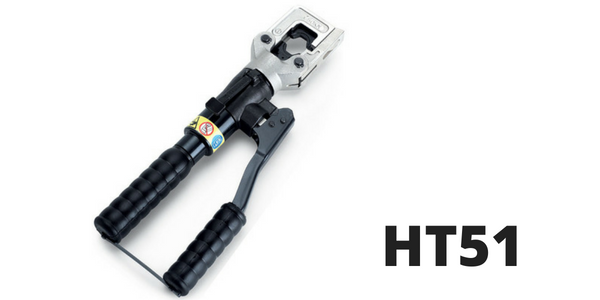
Cembre HT51
Thorne & Derrick International are Main UK Stockists and Suppliers of Cembre tools including crimping and cutting types for all constructions of LV MV HV cable including medium/high voltage 11kV/33kV power cables.
The following short article provides useful instructions about how pure air bubbles correctly from the Cembre hydraulic circuit in relation to model HT51 cutting tool – built in safety valve also by-pass the oil supply when maximum pressure has been reached.
The following excerpts are taken from the Operating Manual of Cembre HT51 hydraulic crimping tool – however this information applies to the following tool model variants Cembre HT51-KV (insulated version).
Cembre HT51 crimping tool is lightweight and ideal for use in working confined switchgear and other LV-HV cable jointing, splicing and terminating applications.
The hydraulic crimping tool features spring loaded handles allowing the Cembre die sets to be advanced with one hand – the other hand is free to position the electrical connector or cable lugs prior to crimping.
For competitive prices, stock availability and technical advice about the Cembre HT51 tool please do not hesitate to contact us.
Purging Air Bubbles From Cembre HT51 Crimping Tools
HT51 Crimping Tool Position For Maintenance Operations
Air in the hydraulic circuit may affect the performance of the crimping tool. For example no lower die advancement, slow advancement of the lower die and lower die pulsating would all cause issues.
If this is the case proceed as follows:
4.1) To Purge Air Bubbles From Hydraulic Circuit
a – Hold tool upright in a vice with handles open (Fig 3).
b – Unscrew the main handle (04) from the body (13) to expose the rubber oil reservoir (03).
c – Remove reservoir cap (02).
d – Operate moveable handle (36) several times, in order to advance the tool ram (16).
e – Press the pressure release lever (44) to retract the ram (16), discharge oil pressure from the circuit and return all oil to the reservoir.
f – Repeat points (d – e) five times, to ensure all air bubbles in the hydraulic circuit are purged into the reservoir.
g – Remove all air from reservoir.
If the oil level is low top up as directed below.
h – Fit reservoir cap (02).
i – Assemble main handle (04) to tool body.
If the tool continues to malfunction return the tool for service.
Oil Top Up
Every six months check the oil level in the reservoir. If necessary, top up the oil level to the upper lip of the reservoir and remove all air from the reservoir (as described above).
Always use clean recommended oil – AGIP ARNICA 32 or SHELL TELLUSTX 32 or equivalent for HT51 and AGIP ITE360 or ESSOTRANSFORMER P60 or equivalent for HT51-KV
♦ Warning: Do not use old or recycled oil
♦ Warning: Do not use hydraulic brake fluid
HT51-KV tool contains oil with a high insulating power so it is imperative that you don not pollute it with other types of oil!
Cembre HT51 supplied with protective carrying case, tool manual and crimp die sets
Uploaded by Chris Dodds - Thorne & Derrick Sales & Marketing Manager
Cembre B-TC950
Thorne & Derrick International are Main UK Stockists and Suppliers of Cembre tools including crimping and cutting types for all constructions of LV MV HV cable including medium/high voltage 11kV/33kV power cables.
The following short article provides useful instructions about how to correctly use the Cembre model B-TC950 cutting tool – prolonged use of the cordless hydraulic cutting tool can cause bluntening of the blades when cutting conductors, wires and cables.
The following excerpts from the Operating Manual of Cembre B-TC950 – however this information applies to the following tool model variants B-TC950A B-TC950E B-TC950T.
Cembre B-TC50 is a battery operated cable cutting tool suitable for diameters up to 95mm outside diameter and features their new Li-Ion 18V 4 Ah batteries providing improved cutting speed and cutting force with double-speed action for jointing and terminating copper or aluminium type cables.
For competitive prices, stock availability and technical advice about the Cembre B-TC950 tool please do not hesitate to contact us.
Instructions For Use – Model B-TC950
CEMBRE B-TC950
Locking lever
Upper cable cutting blade
Lower cable cutting blade
Handle grip
Operating button
Pressure release button
Battery
Battery capacity indicator
Battery check button
Battery release
LED worklight
Ring for shoulder strap
♦ Warning: Before starting any work, check the battery charge and recharge if necessary.
Follow the instructions in the battery charger user manual.
The tool can be easily carried using either the handle or the shoulder strap attached to rings (12).
To replace the battery, remove it by pressing the release button (10) then insert the new battery, sliding it into the guides until it locks.
Cutter Head Rotation
For ease of operation the tool head can rotate through 335° allowing the operator to work in the most comfortable position.
♦ Warning:Do not attempt to rotate the cutting head when the hydraulic circuit is pressurised.
Setting
Figure 3 & 3a Insert the conductor between the blades up to the cutting point
Insert the conductor between the blades, up to the desired cutting point (Fig. 3). For a running conductor, press the locking lever (1) and open the tool head (Fig 3a).
Fully retract the lower blade (3) before attempting to open the tool head. With the conductor on the lower blade (3), close the tool head and fully secure the lever (1).
♦ Warning: Before commencing the cutting operation ensure that the lever (1) is fully secured: partial closure may damage the tool head.
Cutting Blade Advancement
Press the operating button (5) (Ref. to Fig. 3) to activate the motor-pump. The ram will gradually move forward until the lower blade (3) touches the conductor.
To halt the advancement release the button (5) and the motor will cut out.
♦ Warning: Make sure the blade is exactly positioned on the desired cutting point otherwise re-open the blade following instructions and reposition it.
Cable Cutting
Firmly hold the tool and operate the button (5) to gradually move the lower blade (4) to cut through the conductor.
When the cut is performed release the button (5) to ensure the maximum pressure relief valve isn’t activated.
LED Worklights
Whilst the tool is in operation, the work area is illuminated by two high luminosity LED Worklights that switch off automatically at the end of the cycle.
Blade Retraction
By operating the pressure release button (6) the ram will retract and open the lower blade.
Battery Status
Figure 4 Battery Level Indicator
The battery is equipped with LED indicators that indicate the remaining battery life at any time by pressing the adjacent button (9):
4 LEDs illuminated: fully charged
2 LEDs illuminated: 50 % capacity
1 LED flashing: minimum charge, replace the battery
Worklights (11) illuminated combined with an alarm audible when the operating button (5) is pressed (Fig.4) is an indication that the battery voltage has dropped below a minimum safety threshold
Under these conditions the tool will not start and the battery should be replaced or recharged (80 minutes to fully recharge battery).
After each working cycle and the extraction of the battery from the tool, an integrated battery cut-off device will operate after approximately 70 s.
The LED nearest to button (9) will then flash 5 times each 14 s approx. The battery will be reactivated when it is reintroduced into the tool and the operating button is pressed.
Using The Battery Charger
Carefully follow the instructions in the battery charger user manual.
This video by 3M Electrical shows how to apply 3M Cold Shrink tubing safely for underground cable jointing processes and applications.
3M Cold Shrink tubing is a series of open-ended, tubular rubber sleeves, which are factory expanded and assembled onto a removable core – Cold Shrink tubes are supplied for field installation in a pre-stretched condition.
The 3M Electrical video shows how to install the cold shrink tubing and the full underground cable jointing process which is explained below:
Position 3M Cold Shrink outer tube splice body and copper sleeve over the cable
Install connector – a number of the 3M kits come complete with connectors
Many connectors can be used providing they suit the requirements of the cable and fit within the Faraday cage
Once cleaned apply 3M P55 silicone grease leaving the connector until last to avoid contamination and smoothing out the grease to give an even coverage
Move the splice body into place over the connector before unwinding the removable core to install the tube allowing the tube to shrink and form a waterproof seal
Apply a layer of 3M Scotch Seal 5313 Tapeto the end of the joint – a comfortable and durable mastic with excellent moisture and environmental seal
Now tape over with the 3M Scotch 2228 Mastic Tape – a conformable self amalgamating temperature stable mastic
Then reposition the copper sleeve over the joint fixing in place with 3M Constant Force Springs
Move the first 3M Cold Shrink Tube into place ensuring one end of the joint is completely covered
Apply 3M Scotch 2228 Mastic Tape in preparation for the last protection tube
Finally install the second 3M Cold Shrink Outer Protection Tube making sure to overlap the previous protection tube
Cold Shrink – invented by 3M over 40 years ago and now the preferred technology for heat-free jointing, terminating, sealing and abandonment of LV HV cables
We hope you find this video informative and educational, contact T&D for technical support, quotations and stock availability for 3M Cold Shrink Tubing.
➡ Visit 3M Electrical for further information about joints, terminations, tapes and insulation to seal, repair, splice and connect LV MV HV cables.
3M Cold Shrink cable caps environmentally seal and mechanically protect exposed low, medium and high voltage cable ends using no tools, mastics or tapes.
The 3M video shows how cables ends can be quickly and simply sealed – simply position the end cap over the cable end and unwind the core to install the Cold Shrink cap onto the exposed cables.
Cold Shrink – invented by 3M over 40 years ago and now the preferred technology for heat-free jointing, terminating, sealing and abandonment of LV HV cables
We hope you find this video informative and educational, contact T&D for technical support, quotations and stock availability for 3M Cold Shrink Cable End Caps.
3M Electrical Products Stocked By Thorne & Derrick International
BS EN 62305
AN Wallis manufacture earth tapes from high conductivity copper to ensure LPS designs and installations conform to latest Britsh and International standards
Uploaded by Chris Dodds - Thorne & Derrick Sales & Marketing Manager
BS EN 62305
The Part 2 of BS EN 62305 provides a comprehensive mathematical model to evaluate and manage the risk posed by lightning strikes and measures to alleviate the risk associated with earthing system designs.
The risk assessment is extremely time consuming to calculate by hand so Wallis, working in conjunction with their distributor Thorne & Derrick International, can offer to do the assessment using bespoke computer software.
The basics of the calculation can be briefly explained as follows taking into account:
The Sources of Lightning
S1: flashes to a structure
S2: flashes near a structure
S3: flashes to a line
S4 flashes near a line
The Likely Damage
D1: injury to living beings by electric shock
D2: physical damage
D3: failure of electrical and electronic systems
The Likely Losses
L1: loss of human life (including permanent injury)
L2: loss of service to the public
L3: loss of cultural heritage
L4: loss of economic value (structure, content, and loss of activity).
The following Table 2 from BS EN 62305 explains the link between Sources, Damages & Losses.
Table 2 – BS EN 62305
Sources of damage, types of damage and types of loss according to the point of strike:
Lightning Flash
Structure
Source of Damage
Type of Damage
1 Type of Loss
S1
D1D2D3
L1, L4aL1, L2, L3, L4 L1b, L2, L4
S2
D3
L1b, L2, L4
S3
D1D2D3
L1, L4a,L1, L2, L3,L4 Lib, L2, L4
S4
D3
L1b, L2, L4
Note:
a) Only for properties where animals may be lost.
b) Only for structures with risk of explosion and for hospitals or other structures where failures of internal systems immediately endangers human
Risk: The risks to be evaluated in a structure may be as follows
R1: risk of loss of a human life (including permanent injury)
R2: risk of loss of service to the public
R3: risk of loss of cultural heritage
R4: risk of loss of economic value.
Risk Management
Basic Procedure
The following procedure shall be applied:
Identification of the structure to be protected and its characteristics
Identification of all the types of loss in the structure and the relevant corresponding risk R (R1 to R4); evaluation of risk R for each type of loss R1 to R4
Evaluation of need of protection, by comparison of risk R1, R2 and R3 with the tolerable risk RT
Evaluation of cost effectiveness of protection by comparison of the costs of total loss with and without protection measures. In this case, the assessment of components of risk R4 shall be performed in order to evaluate such costs.
Structure to be considered for risk assessment includes
The structure itself
Installations in the structure
Contents of the structure
Persons in the structure or in the zones up to 3 m from the outside of the structure
Environment affected by damage to the structure.
Protection does not include connected lines outside of the structure.
Tolerable Risk RT
The calculated risks R1, R2 & R3 shall be compared with tolerable risk. The permissible values for the tolerable risk are mentioned in the Table 4 BS EN 62305.
Table 4 – Typical values of tolerable risk RT
Types of Loss
RT (y-1)
L1
Loss of human life or permanent injuries
10-5
L2
Loss of service to the public
10-4
L3
Loss of cultural heritage
10-4
If R < RT, lightning protection is not necessary. If R > RT, protection measures shall be adopted in order to reduce R RT for all risks to which the structure is subjected.
The manual calculations are time consuming. It is recommended to use available Lightning Protection Risk Management Software to perform these calculations – contact T&D.
Thorne & Derrick International
Contact us to discuss all your Substation Earthing, Cable Jointing & Terminating requirements for the installation of LV MV HV cables, copper earthing tapes and infrastructure including switchgear, transformers and electrical equipment up to 33kV.
klauke ekm60unv – universal cutting, crimping & punching tool The Klauke EKM 60 UNV is a versatile battery powered hydraulic universal tool engineered that can be used as a battery powered cable crimping tool and battery operated cable cutting tools that comes...
INDUSTRIAL LABEL PRINTING SOLUTIONS When clear, durable and professional identification is required across control panels, cable systems, production facilities and industrial installations, print quality, reliability and ease of use are critical. Cembre industrial label printers are designed to support...