Blog
Replacing Cembre Cable Cutting Tool Blades – Model HT-TC051
June 8th, 2018
Cable Cutting Tool
-
Uploaded by Chris Dodds - Thorne & Derrick Sales & Marketing Manager
Cembre HT-TC051
Thorne & Derrick International are Main UK Stockists and Suppliers of Cembre tools including crimping and cutting types for all constructions of LV MV HV cable including medium/high voltage 11kV/33kV power cables.
The following short article provides information about how to replace cutter blades (lower and upper) on the Cembre model HT-TC051 cutting tool – prolonged used of the tool can cause bluntening of the blades when cutting conductors, wires and cables.
For competitive prices, stock availability and technical advice about the Cembre HT-TC051 tool please do not hesitate to contact us.
Where hydraulic cable cutting tools loose their cutting edge it is recommended that the blades are replaced to enable the continuation of clean and efficient cutting.
In this case Thorne & Derrick and Cembre recommend proceeding as follows:
How To Replace Cutter Blades
Cembre Cable Cutting Tools
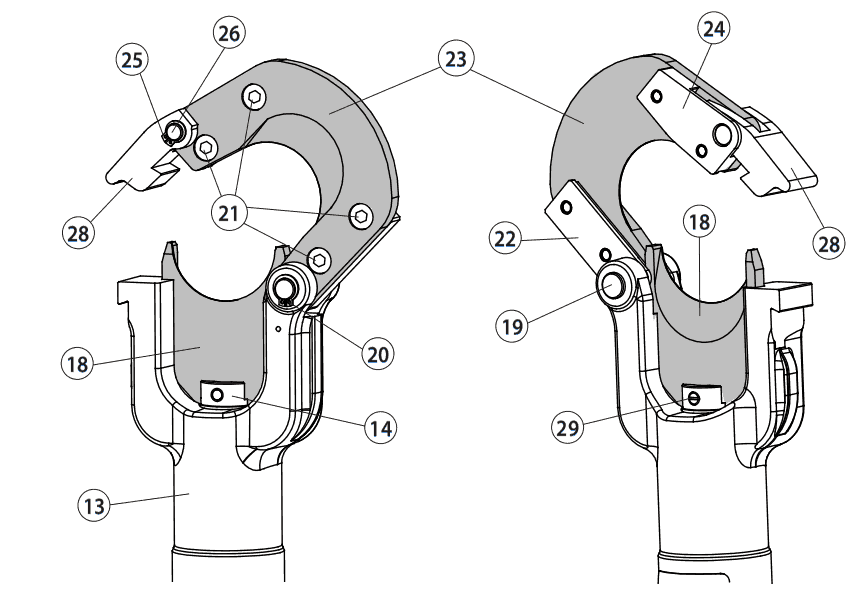
The following instructions should be read in conjunction with the image below.
Lower Cable Cutting Blade
Release latch (28) and open the cable cutter tool head
Operate moveable handle to advance the lower cutter blade (18) until holding screw (29) is visible on the ram (14)
Using a flat blade screwdriver remove the holding screw (29) and release the lower cutter blade (18)
Insert the new blade and fit the holding screw
♦ Warning: Before closing the cutter head release the oil pressure and retract the lower blade (18), otherwise the tool head assembly may hit and damage the lower cutting blade.
Upper Cable Cutting Blade
Release latch (28) and open the cable cutter tool head
Remove circlip (20 and extract the head pin (19) enough to release the cutting tool head assembly
Remove circlip (25) and pin (26) to release the latch (28)
Remove the latch spring from the upper cutter blade
Unscrew the 4 screws (21), remove the left hand guide (22), the right hand guide (24) and release the cutter blade (23)
Fit the left and right hand guides to the new cutter blade – place the spring into its seat and refit the latch
Fit the blade assembly to the head (13) fully insert the pin (19) and secure with the circlip (20)
➡ See also: Maintenance For Cembre Cable Cutting Tool – Model HT-TC051

LV Lugs & Connectors – complete range of copper crimp connectors suitable for use with joints and terminations for low voltage cables | Cable Lugs | Cable Splice Connectors | Aluminium Lugs | Aluminium Splices | Bi-Metallic Cable Lugs

Cutting & Crimping Tools

HV Lugs & Connectors – complete range of copper crimp connectors suitable for use with joints and terminations for medium/high voltage cables | Cable Lugs | Transformer Lugs | 2 Hole Lugs | Pin Stalk Connectors | Through Connectors | 11kV 33kV
Thorne & Derrick
Key Product Categories: Duct Seals | Cable Cleats | Cable Glands | Electrical Safety | Arc Flash Protection | Cable Jointing Tools | Cable Pulling | Earthing | Feeder Pillars | Cable Joints LV | Joints & Terminations MV HV
Maintenance For Cembre Cable Cutting Tool – Model HT-TC051
June 8th, 2018Cembre Cable Cutting Tool
-
Uploaded by Chris Dodds - Thorne & Derrick Sales & Marketing Manager
Cembre HT-TC051
Thorne & Derrick International are Main UK Stockists and Suppliers of Cembre tools including crimping and cutting types for all constructions of LV MV HV cable.
The following short article provides information about the general maintenance of the Cembre model HT-TC051 cutting tool.
Air in the hydraulic circuit may affect the performance of the hydraulic cable cutting tool e.g. no advancement or slow advancement of the lower cutting blade, lower blade pulsating.
For competitive prices, stock availability and technical advice about the Cembre HT-TC051 tool please do not hesitate to contact us.
In this case Thorne & Derrick and Cembre recommend proceeding as follows:
How To Purge Air Bubbles
From Hydraulic Circuit
Cembre Cable Cutting Tool
- Hold cable cutting tool upright in a vice with handles open (Fig 1)
- Unscrew main handle (03) from tool body (12) to expose the rubber oil reservoir (02)
- Remove reservoir cap from the Cembre tool
- Operate moveable handle several times in order to advance the ram
- Press the pressure release handle (58) to retract the ram (14), discharge oil pressure from the circuit and return all oil to the reservoir
- Repeat points (1-5) five times to ensure all air bubbles in the hydraulic circuit are purged into the reservoir of the tool
- If the oil level is low, top up the oil level
- Remove all air from reservoir (02) and fit cap (01)
- Assemble the main handle (03) to cutting tool body
♦ Oil Top Up – every 6 months check the oil level in the reservoir. If necessary, top up the oil level to the top lip of the reservoir and remove all air from reservoi.
- Always Use Clean Recommended Oil
- Do Not Use Oil Or Recycled Oil
- DO Not Use Hydraulic Brake Fluid
If the Cembre tool continues to malfunction and not cut cables safely or accurately return the hydraulic tool for service/repair.

Fig 1 – Maintenance of Cable Cutting Tools
➡ See also: Replacing Cable Cutting Tool Blades – Model Cembre HT-TC051
LV Lugs & Connectors – complete range of copper crimp connectors suitable for use with joints and terminations for low voltage cables | Cable Lugs | Cable Splice Connectors | Aluminium Lugs | Aluminium Splices | Bi-Metallic Cable Lugs
Cutting & Crimping Tools
HV Lugs & Connectors – complete range of copper crimp connectors suitable for use with joints and terminations for medium/high voltage cables | Cable Lugs | Transformer Lugs | 2 Hole Lugs | Pin Stalk Connectors | Through Connectors | 11kV 33kV
Thorne & Derrick
Key Product Categories: Duct Seals | Cable Cleats | Cable Glands | Electrical Safety | Arc Flash Protection | Cable Jointing Tools | Cable Pulling | Earthing | Feeder Pillars | Cable Joints LV | Joints & Terminations MV HV
Care & Maintenance Of Separable Cable Connectors For High Voltage Power Systems
June 7th, 2018
-
Uploaded by Chris Dodds - Thorne & Derrick Sales & Marketing Manager
Thorne & Derrick International, were recently asked by an installer of MV HV Power Cables & Systems to comment on the condition and service performance of some screened separable connectors into medium/high voltage switchgear. The contractor had suffered a succession of switchgear cable termination failures and there was uncertainty about trouble-shooting the root cause – whether poor workmanship from the cable jointers or improper routine maintenance were the main cause. The contractor understood that the MV-HV terminal of the separable connector, pictured below Interface C bushing, should be treated once or maximum twice a year with silicone grease.
As Main Stockists & Distributors for the Nexans Euromold range of cable joints, terminations and connectors for high voltage power systems we decided to ask their Technical Manager for a response.

Reply from Mick Dawn – Nexans Technical Manager (Nexans Power Accessories NPA)
These are not Nexans connectors, they are Tyco separable connectors. However, I will comment on the silicone grease suggestion as it would also be relevant to Nexans and other manufacturers of MV HV screened separable connectors. There is no reason to “treat” the contact within the separable connector with grease. In fact, Nexans expressly state in our installation instructions that lubricant is not present on threaded parts as this may interfere with achieving the correct torque. The purpose of the contact is the safe transfer of electrical power between the MV-HV cable and the electrical equipment and applying grease will not facilitate any improvement in that operation and may well contribute to failure as grease between current carrying components may well lead to a high resistance contact and considerable heat generation. If the separable connector has failed then this could be down to any number of factors and if necessary a fault investigation can be carried out and generally a rational explanation can be deduced as most of the connector will still be available for examination. Even if there has been significant heat damage due to poor connection then it is usually still possible to determine a cause of failure.
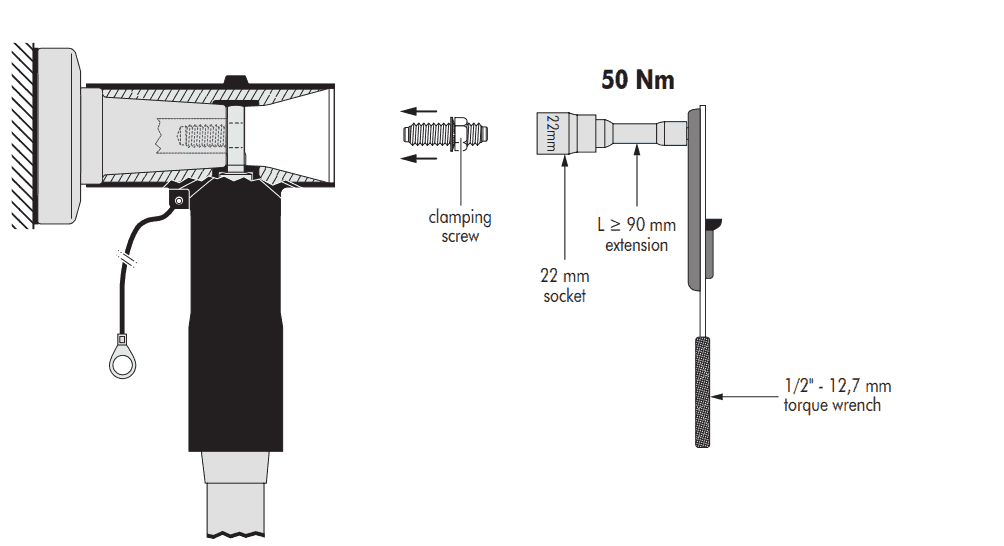
➡ The following image taken from Nexans Connectors – Installation Instruction Separable Tee Connectors (Type C Interface) Document
The image shows the insertion of the clamping screw into the threaded hole of the bushing. A torque wrench is used by the jointer with a socket wrench 22 and tighten exerting 50 Nm (5 kgm or 36,9 foot-pounds) of torque. In order to achieve the correct applied torque ensure that there is no lubricant on the threaded parts.
Nexans Connectors – Type C Bushings

Thorne & Derrick MV HV Joints | Terminations | Connectors
Thorne & Derrick
Key Product Categories: Duct Seals | Cable Cleats | Cable Glands | Electrical Safety | Arc Flash Protection | Cable Jointing Tools | Cable Pulling | Earthing | Feeder Pillars | Cable Joints LV | Joints & Terminations MV HV
Tinned Copper Earth Bars – How To Specify The Correct Earth Bar
June 6th, 2018
Earth Bars – manufactured from 50x6mm Tinned Hard Drawn Copper Bar
-
Uploaded by Chris Dodds - Thorne & Derrick Sales & Marketing Manager
Earth Bars
Advantages & Applications Of Tinned Copper
The following article has been written to provide some basic advice and reasoning for the specification of Tinned v Standard Copper Earth Bars when designing earthing systems for LV MV HV building services and substation protection exposed to wet conditions during normal operation.
Copper is used in the manufacture of Earthing & Lightning Protection Systems due to the high thermal and electrical conductivity, ease of manufacture, high recyclability and good corrosion resistance of the material. Copper, a noble metal that occurs naturally in its elemental form, is almost totally impervious to corrosion from soils found worldwide.
But it would be misleading to infer that copper will not corrode.
Tinned copper is a type of copper coated with a thin layer of tin used to provide protection to earth bars against the tarnishing and corrosive effects of oxidisation, commonly referred to as rusting.
The thin layer of tin effectively shields the copper surface of the earth bar inhibiting oxidisation – preventing air from reacting with the copper in the presence of atmospheric moistures. Put simply – no air, no oxide, no corrosion.
The copper tinning process provides enhanced protection against climatic variations and atmospheric conditions without significant reduction in the functionality and electrical conductivity of the copper metal.
Oxidised copper surfaces display poor conductivity compared to clean and smooth tinned copper which prolongs the service life of the earth bar at comparatively low added-on cost.
Tinned copper is higher cost than non-tinned copper but provides extended service life and field performance compared to standard bare type copper especially in wet condition installations.
These types of earth bars are commonly specified and installed in outdoor locations in the water utility, marine and offshore industries where high levels of atmospheric corrosion caused by environmental factors and moisture levels such as rain, fog and condensation necessitate improved levels of corrosion protection. Outdoor air can act as an electrolyte because it contains a variety of components which can cause corrosion of any metal.
Tinned copper handles wet conditions, high temperatures and humidity to maintain the conductive integrity of the earth bar for electrical engineering applications.

AN Wallis manufacture both standard copper and tinned copper earth bars from 6 way up to 30 way on short lead times in standard, single link or twin-disconnection link design. Image: Wallis 6 Way Earth Bar.
Applications & Necessity Of Tinned Earth Bars
Earth bars are used to provide a convenient common earthing point for electrical installations requiring an Earthing & Lightning Protection System – copper earth bars are available with single or twin disconnecting links which means the earthing bars can be isolated for electrical testing.
Tinned copper earth bars could be used in external applications or where atmospheric conditions are more severe than normal i.e. high humidity or moisture content areas and marine and offshore saline atmospheres.
Tinning protects the copper and protects the earth bars from the formation of copper oxide, tin effectively prevents oxidation.
Earth bars are a standard, efficient and convenient way of providing a common earth point with integral disconnection links permitting safe electrical isolation for testing purposes in the switchroom.
Why Should Earth Bars Be Tinned?
Tin is a soft white metal which can easily be polished, scratch brushed or flow melted to provide a bright finish.
Tin is non-toxic and is not greatly affected by the organic acids. Sulphur compounds do not readily tarnish tin and it is not impaired by either air or water but reacts with hydrochloric acid to form stannous chloride.
Tin is one of the less susceptible metals to corrosion attack consequently tin-plated surfaces of copper earth bars are adequately protected against atmospheric corrosion and hence provides longer life when exposed to corrosive atmosphere installations.
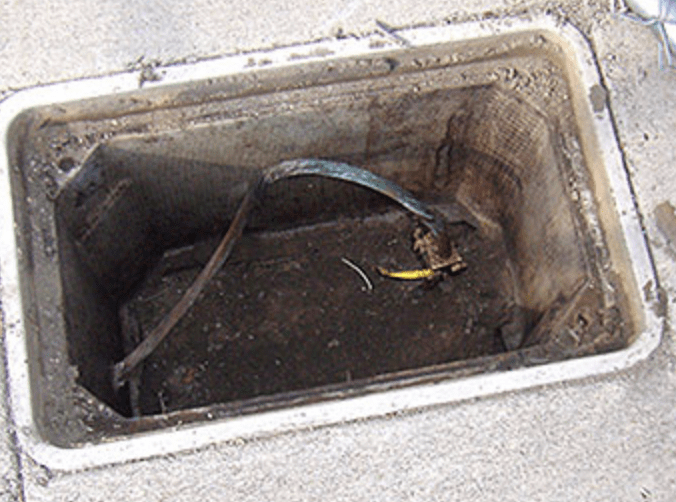
In normal state unaffected by corrosion copper is a rich brown colour – pictured below is an instance of copper oxide (“greening”) showing advanced corrosion to underground earth tapes. Tinning of the earth tapes and copper conductors prevents “greening” of the copper surface – furthermore this copper run-off can be very corrosive to galvanised steel support structures on medium/high voltage substations.
Benefits of a Tinned Earth Bar
- Tinning a copper bar protects against atmospheric corrosion providing longer life when exposed to corrosive atmospheres
- Tinning protects the earth bar against the formation of copper oxide (oxidisation)
- Tinned earth bars are an excellent solution to extend longevity and have reasonably low resistance
- Used in external/outdoors applications or where atmospheric conditions are more severe and aggressive than normal i.e. high moisture content areas, high humidity in both onshore (eg water treatment works) or offshore (oil/gas platforms)
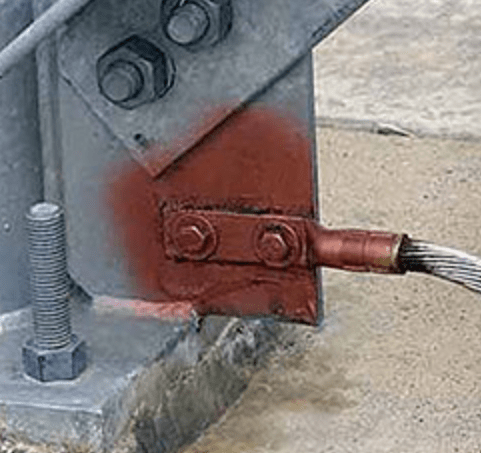
Pictured: Here a tinned AWG 4/0 stranded copper conductor is bolted to a galvanised steel flange of a support column on a high voltage substation. Note the high pressure compression fitting installed using hydraulic crimping tools and protective paint for added protection of the copper cable lugs and conductor against corrosion in above-ground outdoor applications.
➡ T&D together with Wallis can offer a bespoke design service for custom earth bars in both tinned and standard copper construction – sizing, number of cable terminations, fixing materials and bases can be tailored to comply with specific site requirements and drawings are available on request to ensure the earthing bars are suitable.
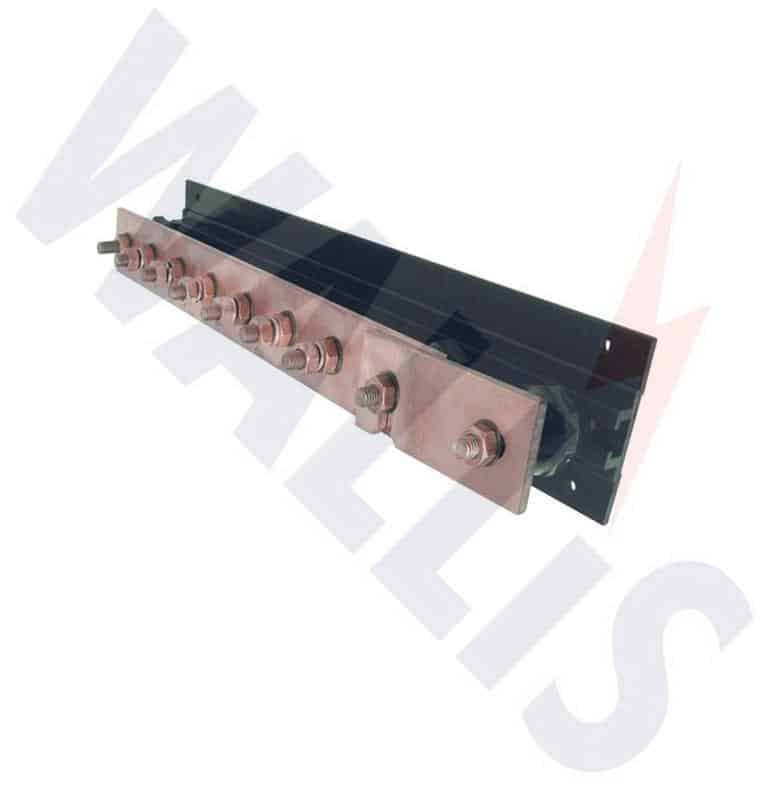
Earth Bars
The following range of Earth Bars without disconnection links are available in both standard copper and tinned copper versions:
| AN Wallis Part Number | Number of Ways/Terminations | Earth Bar Dimensions (length x width x height) | Unit Weight |
| EBC006 | 6 | 400mm x 90mm x 60mm | 2.00kg |
| EBC008 | 8 | 500mm x 90mm x 60mm | 2.30kg |
| EBC010 | 10 | 650mm x 90mm x 60mm | 3.20kg |
| EBC012 | 12 | 750mm x 90mm x 60mm | 4.00kg |
| EBC014 | 14 | 850mm x 90mm x 60mm | 4.90kg |
| EBC016 | 16 | 950mm x 90mm x 60mm | 5.80kg |
| EBC018 | 18 | 1100mm x 90mm x 60mm | 6.70kg |
| EBC020 | 20 | 1250mm x 90mm x 60mm | 7.60kg |
| EBC024 | 24 | 1400mm x 90mm x 60mm | 8.50kg |
| EBC026 | 26 | 1550mm x 90mm x 60mm | 10.30kg |
| EBC028 | 28 | 1650mm x 90mm x 60mm | 11.20kg |
| EBC030 | 30 | 1800mm x 90mm x 60mm | 12.10kg |
Earth Bars With Single Disconnection Link
The following range of Earth Bars with single disconnection links are available in both standard copper and tinned copper versions:
| AN Wallis Part Number | Number of Ways/Terminations | Earth Bar Dimensions (length x width x height) | Unit weight |
| EBC106 | 6 | 485mm x 90mm x 60mm | 2.50kg |
| EBC108 | 8 | 585mm x 90mm x 60mm | 3.00kg |
| EBC110 | 10 | 735mm x 90mm x 60mm | 3.90kg |
| EBC112 | 12 | 835mm x 90mm x 60mm | 4.70kg |
| EBC114 | 14 | 935mm x 90mm x 60mm | 5.60kg |
| EBC116 | 16 | 1035mm x 90mm x 60mm | 6.50kg |
| EBC118 | 18 | 1185mm x 90mm x 60mm | 7.40kg |
| EBC120 | 20 | 1335mm x 90mm x 60mm | 8.30kg |
| EBC122 | 22 | 1385mm x 90mm x 60mm | 9.20kg |
| EBC124 | 24 | 1485mm x 90mm x 60mm | 10.10kg |
| EBC126 | 26 | 1635mm x 90mm x 60mm | 11.00kg |
| EBC128 | 28 | 1735mm x 90mm x 60mm | 11.90kg |
| EBC130 | 30 | 1885mm x 90mm x 60mm | 12.80kg |
Earth Bars With Twin Disconnection Links
The following range of Earth Bars with twin disconnection links are available in both standard copper and tinned copper versions:
| AN Wallis Part Number | Number of Ways/Terminations | Earth Bar Dimensions (length x width x height) | Unit Weight |
| EBC206 | 6 | 570mm x 90mm x 60mm | 3.10kg |
| EBC208 | 8 | 670mm x 90mm x 60mm | 3.70kg |
| EBC210 | 10 | 820mm x 90mm x 60mm | 4.50kg |
| EBC212 | 12 | 920mm x 90mm x 60mm | 5.30kg |
| EBC214 | 14 | 1020mm x 90mm x 60mm | 6.20kg |
| EBC216 | 16 | 1120mm x 90mm x 60mm | 7.10kg |
| EBC218 | 18 | 1270mm x 90mm x 60mm | 8.00kg |
| EBC220 | 20 | 1420mm x 90mm x 60mm | 8.90kg |
| EBC222 | 22 | 1470mm x 90mm x 60mm | 9.80kg |
| EBC224 | 24 | 1570mm x 90mm x 60mm | 10.70kg |
| EBC226 | 26 | 1720mm x 90mm x 60mm | 11.60kg |
| EBC228 | 28 | 1820mm x 90mm x 60mm | 12.50kg |
| EBC230 | 30 | 1885mm x 90mm x 60mm | 13.40kg |
| Temper Designation Standard | Tensile Strength (Ksi) | ||
| Min | Max | Yield Strength (Ksi) Min | |
| 060 Soft | 30 | 38 | … |
| H00 Cold-Rolled 1/8 Hard | 32 | 40 | 20 |
| H01 Cold-Rolled, high yield 1/4 Hard | 34 | 42 | 28 |
| H02 Half Hard | 37 | 46 | 30 |
| H03 Three quarter Hard | 41 | 50 | 32 |
| H04 | 43 | 52 | 35 |
Tin Plating Services For The Electrical & Electronics Industry
The following comments have been kindly provided by Ian Molyneaux of Karas Plating Ltd – the UK’s most respected metal finishing company.
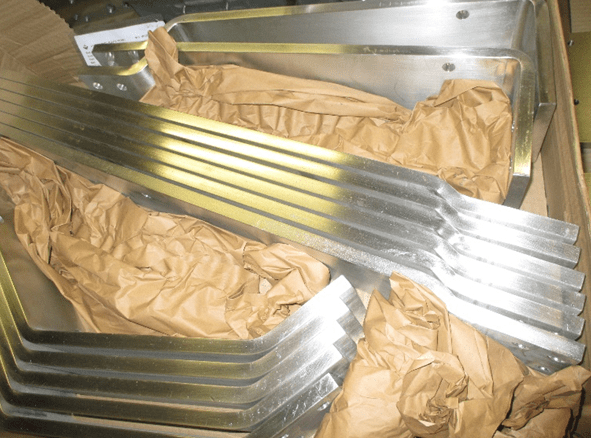
Bright Tin Plating
Tin is a silvery malleable metal that doesn’t get easily oxidized in air and is used to coat other metals to prevent corrosion. The electrical and electronics industry are heavily dependent on tin and tin alloy coatings for solderability most of which is done by electroplating. Tin plated metal is also used for food packaging giving the name to tin cans which are made mostly of steel.
Tin plating is used extensively in the electrical engineering industry to provide protection and to confer solderability. Tin electroplating is also widely used in manufacturing printed circuit boards (PCBs) and electronic components. Most electronic circuit components are made by soldering therefore the surfaces of the conductors being connected are coated in tin or a tin alloy aiding solderability. Additionally tin coating protects the components and connection from corrosion in aggressive atmospheres.
Tin is one of the easiest metals to electro deposit and one of the advantages of electroplating is that no limitation is imposed on the thickness of tin that can be applied. The required thickness can be attained by adjusting the bath parameters and time.
Tin is usually plated with a bright or matt finish. Bright tin is obtained from electroplating solutions containing brighteners, ie. organic additives causing formation of very fine grains of deposit. It has excellent cosmetic appearance.
Matt tin coatings are made in electrolytes with few grain refiners, but without brighteners. It has a dull appearance but the level of internal stresses in matt tin deposits are much less than in that of bright tin.
Bright Tin Plating
Dull Tin Plating
What is the difference between pure tin, bright tin, and matt tin?
Matt tin coatings are made in electrolytes without the addition of brighteners. Matt tin has a dull appearance, but the level of internal stresses in matt tin depositions is much lower than it is in bright tin depositions. Matt tin (in contrast to bright tin) is characterised by low whiskers growing, therefore, it is used in electronics.
Characteristics:
- a dull, semi-bright or satin-bright appearance
- disperse reflectivity
- existence of grains with an average size in the range of a few microns
- the deposit is free of the co-deposited brighteners found in bright tin plating

Dull tin is ideal for electronic or precision components. Deposits give good solder ability even after heat or steam ageing.
Karas Plating can plate onto substrates of aluminium, copper and copper clad aluminium busbars in both bright and dull tin.
Aluminium and copper clad aluminium busbar are generally used for reduction in weight and cost but both are easily tin plated

Contact Karas Plating Ltd : Call FREE today on: 0333 121 0151
AN Wallis Earthing Systems
Earthing and lightning protection manufactured by AN Wallis from high conductivity copper to BS EN 13601 is installed to protect buildings, overhead lines and medium/high voltage substations (MV-HV) against potentially catastrophic damage that can be caused by a lightning strike resulting in short circuiting of power networks.
The Wallis product range includes copper earth rods (solid copper, copper bond and stainless steel types), earth bars, earth tapes, earth clamps and aluminium tapes.
As the leading UK manufacturer of specialist Earthing and Lightning Protection Products, Wallis aims to provide the highest quality products without compromising on price or product performance in a safety critical application.
Quality assurance is integral to Wallis and to ensure this practice continues all earthing and lightning products are manufactured to stringent British and international standards.
Did You Know?
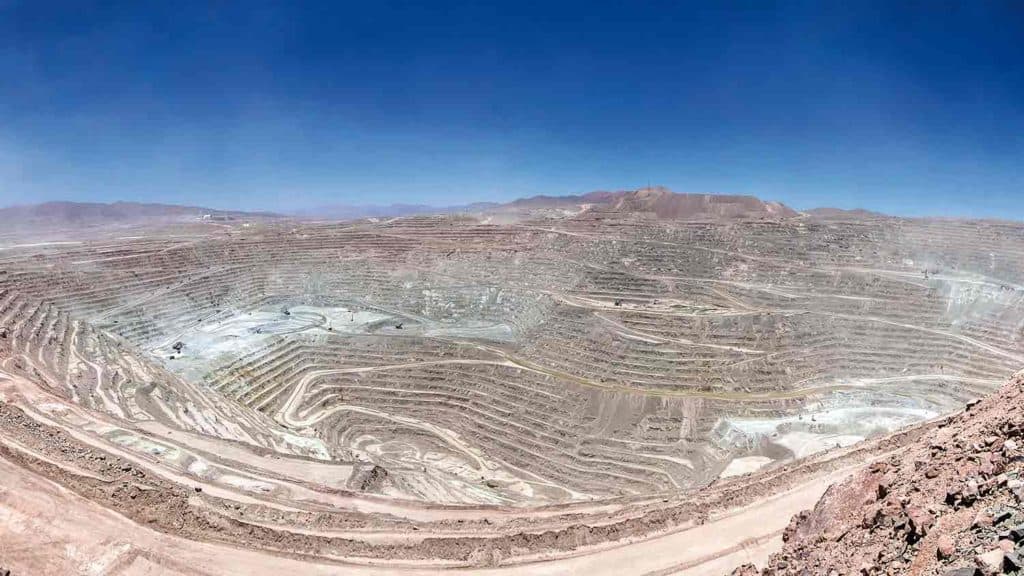
The Escondida copper mine in the Atacama Desert in Northern Chile is currently the world’s largest copper mine by reserve. The copper mine contained more than 32 million tonnes (Mt) of recoverable copper reserves at the end of 2012.
Further Reading
- Earth Tape – The Manufacture of Copper Earthing Tapes
- High Voltage Earthing & Grounding System Design Protecting Lives
- Copper Earthing Tape & Rods Protecting 33kV Substation & Transformer Bund
- Substation Earthing
Specialist Distributors: LV, MV & HV Cable Jointing, Substation & Electrical Eqpt
THORNE & DERRICK are national distributors of LV, MV & HV Cable Installation, Jointing, Duct Sealing, Earthing & Electrical Equipment – we service UK and global businesses involved in cable installations, substation, overhead line and the installation of medium/high voltage cable joints and terminations at LV, 11kV, 33kV and HV.
Contact us for 3M Electrical, ABB, Alroc, AN Wallis, CATU Electrical, Cembre, Centriforce, CMP, CSD, Elastimold, Ellis Patents, Emtelle, Euromold, Filoform , Furse, Lucy Electric & Zodion, Nexans, Pfisterer, Polypipe, Prysmian, Roxtec, Sicame, WT Henley.
Battery Cutting Tools – Cable Cutting Tools Battery Operated
June 5th, 2018
Battery Cutting Tools
➡ Thorne & Derrick International, based in the UK, are the largest stockist and distributor for the Cembre range of battery operated tools for cutting all types of LV MV HV power cables – battery operated type tooling is increasingly replacing conventional hydraulic type tooling for the maintenance and installation of underground power cables and overhead conductor lines.
Browse below to view the complete range of Battery Cutting Tools – should you require any technical advice, recommendations or product demonstrations please do not hesitate to contact us.
Battery Cutting Tools
Contact our Sales Team for competitive quotations and fast delivery from extensive stocks for the complete range of Cembre tools.

Battery Cutting Tools Manufactured by Cembre