Cable Cleats
Ellis Patents Centaur Cable Saddles Support London Power Tunnel 400kV Cables
March 15th, 2019
-
uploaded by - Chris Dodds Thorne & Derrick Sales/Marketing Manager
Ellis Patents Centaur Cable Saddles
Ellis Patents, the world’s leading cable manufacturer of cable cleats, has secured a £1.5million order for its Centaur cable saddles and accessories to secure high voltage cables in National Grid’s London Power Tunnels project.
Cable cleats, saddles and J type hangers can be custom manufactured to accommodate extra high voltage (EHV) power cables and steelwork support fixing.

National Grid London Power Tunnel
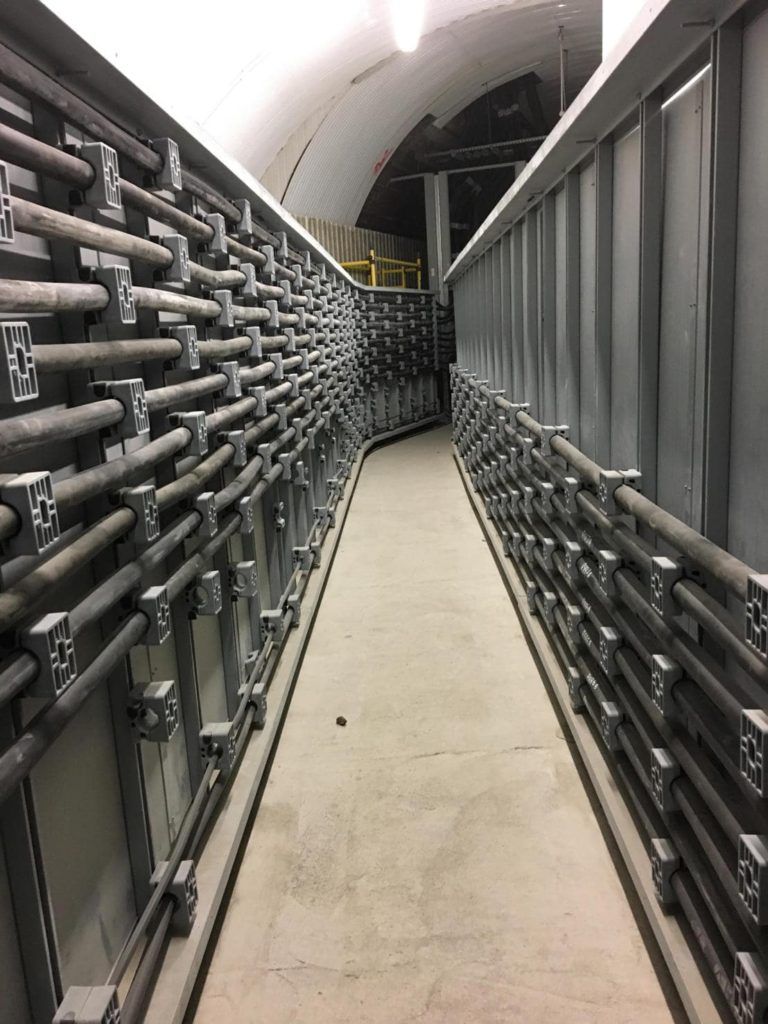
The project will help ensure Londoners continue to enjoy safe and reliable electricity supplies. When complete there will be over 30km of tunnels carrying high voltage cables between substations in Wimbledon, Hackney, Willesden and St John’s Wood.
Ellis’ Centaur cable saddles, which were developed specifically for use with high voltage cables, were specified by Sϋdkabel, the German manufacturers of the cables being installed in the National Grid tunnels. The order was secured on the back of recent work for National Grid and the fact Ellis Patents was able to prove the suitability and safety of its Centaur product for the project’s specification.

High Voltage Cable Cleats (HV EHV 132kV 275kV 400kV Cables) – Ellis Patents Centaur
Richard Shaw, Managing Director of Ellis, said: “This order has given us dual cause for celebration. Firstly, it’s the largest the company has ever won and secondly it demonstrates why we place so much emphasis on research and development.”
Back in 2008 Ellis launched Centaur; a heavy-duty extruded aluminium saddle cleat that had been designed and developed in-house in response to a serious safety issue surrounding the restraint of high voltage cables up to 400kV with a diameter range of 100 to 160mm.

Ellis Patents Centaur Saddle – Hinged Aluminium Overstrap
“At the time neither the British nor European Standards took into account cleats on cables of this size,” explained Richard. “This meant those specifying for such jobs were very much in the hands of the cable cleat manufacturers, who in most cases simply provided warranties for their cable support products.”
“The problem with this was that none of the products available had been short circuit tested, and so the warranties were based purely on calculations and mechanical tests. As such there was no proof the saddle cleats being used would withstand the most testing elements of the job they’d been bought for.”

Ellis Patent Centaur Cable Saddles – Tunnel Cables
Prior to launch, Ellis put the new product through the most rigorous of testing procedures.
Using cable manufactured by ABB in Sweden, the company shipped the Centaur cable saddles and ABB cable to the Netherlands where they were tested to 163 kA peak and 63 kA RMS for one second, in both 3 phase and phase to phase fault scenarios.
“We invested well over £100,000 in designing, developing, testing and bringing Centaur to market,” added Richard. “At the time this was the largest amount we’d ever invested in one new product, but we did so with confidence that it had the potential to solve a major safety issue and fill a gap in a growing market sector – something that has since been proved wholly correct.”
Ellis Patents Centaur Cable Saddle Specifications
 The following selection table provides information to enable the specification or purchase of the correct cable cleat – contact Thorne & Derrick for further technical information, installation advice, samples or to place an order.
| Part Number | Cable Range Dia. | Length Of Cable Saddle |
| Ellis Patents CS100-112/400 | 100mm – 112mm | 400mm |
| Ellis Patents CS108-122/400 | 108mm – 122mm | 400mm |
| Ellis Patents CS120-132/400 | 120mm – 132mm | 400mm |
| Ellis Patents CS128-142/400 | 128mm – 142mm | 400mm |
| Ellis Patents CS140-152/400 | 140mm – 152mm | 400mm |
| Ellis Patents CS148-162/400 | 148mm – 162mm | 400mm |
| Ellis Patents CS100-112/600 | 100mm – 112mm | 600mm |
| Ellis Patents CS108-122/600 | 108mm – 122mm | 600mm |
| Ellis Patents CS120-132/600 | 120mm – 132mm | 600mm |
| Ellis Patents CS128-142/600 | 128mm – 142mm | 600mm |
| Ellis Patents CS140-152/600 | 140mm – 152mm | 600mm |
| Ellis Patents CS148-162/600 | 148mm – 162mm | 600mm |
| Ellis Patents CS100-112/800 | 100mm – 112mm | 800mm |
| Ellis Patents CS108-122/800 | 108mm – 122mm | 800mm |
| Ellis Patents CS120-132/800 | 120mm – 132mm | 800mm |
| Ellis Patents CS128-142/800 | 128mm – 142mm | 800mm |
| Ellis Patents CS140-152/800 | 140mm – 152mm | 800mm |
| Ellis Patents CS148-162/800 | 148mm – 162mm | 800mm |
Ellis Patents Centaur cable saddles consists of an extruded and pressed aluminium saddle and a hinged aluminium overstrap, which incorporates a Low Smoke Zero Halogen Polymeric liner. The curvature of the cable saddle accommodates the thermal expansion of the cable and the ends of the saddle are flared so that the cable never comes into contact with a sharp edge under any circumstances.
INSTALLING CABLE CLEATS
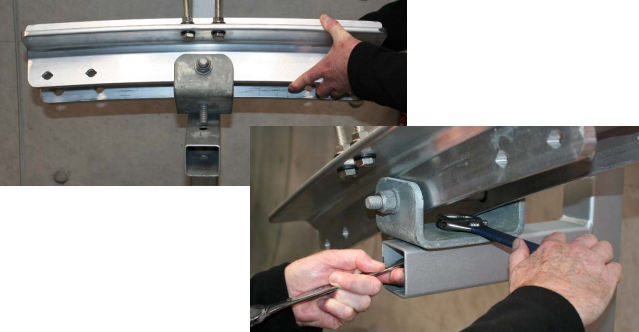
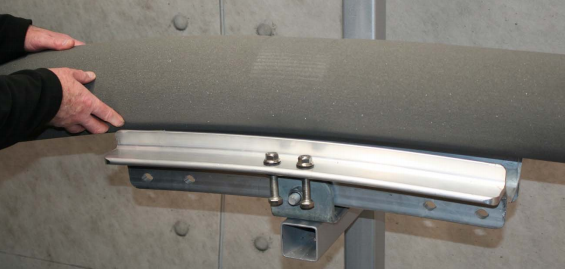
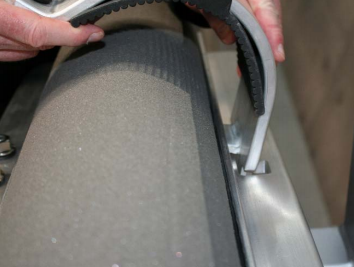
Installation instructions for single way or trefoil cables using Centaur saddles manufactured by Ellis Patents:
 |
 |
 |
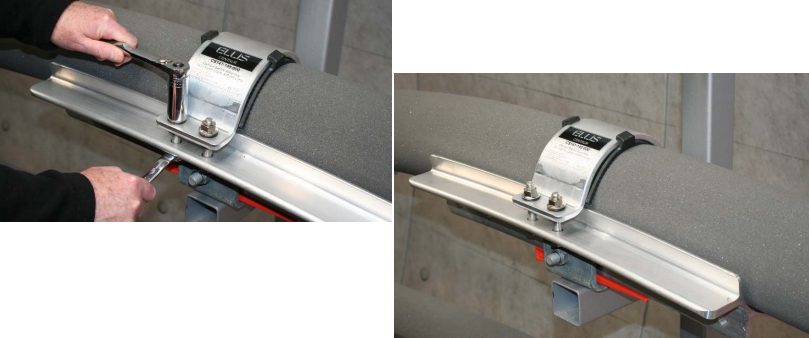 |
| 1. Position the Centaur onto the mounting structure.Tighten the central M16 bolt to the structure using a 24mm socket or spanner set | 2. With care install the cable into the saddle | 3. Attach the strap to the saddle, ensuring that the liner is in place. |
4. Close the strap onto the M12 fixings. Using a 19mm socket or spanner for the head of the set screws and an 18mm socket or spanner for the flange nuts, tighten the strap to an appropriate torque for the cable |
LV, MV & HV Jointing, Earthing, Substation & Electrical Eqpt
Thorne & Derrick International are specialist distributors of LV, MV & HV Cable Installation, Jointing, Duct Sealing, Substation & Electrical Equipment – servicing UK and global businesses involved in cable installations, cable jointing, substation, overhead line and electrical construction at LV, 11kV, 33kV and EHV.
THORNE & DERRICK Product Categories: Duct Seals | Cable Cleats | Cable Glands | Electrical Safety | Arc Flash Protection | Cable Jointing Tools | Cable Pulling | Earthing | Feeder Pillars | Cable Joints LV | Joints & Terminations MV HV

Ellis Patents No-Bolts Cable Cleats Improve Electrical Safety Of Rail Cable Installations
March 7th, 2019
Ellis Patents No-Bolts Cable Cleats Improve Electrical Safety Of Rail Cable Installations
-
uploaded by Chris Dodds - Thorne & Derrick Sales & Marketing Manager
Cable Cleats For Rail Cables
Thorne & Derrick International, based in the UK, stock and distribute the complete range of cable cleats and cable hangers manufactured by Ellis Patents including No Bolt cleats for short circuit retention and cable protection of LV (Low Voltage), MV (Medium Voltage) and HV (High Voltage) rail cable systems in single-way or trefoil installation.
Ellis Patents are market-leading innovators and manufacturers of cable cleats and clamps for high specification and high performance rail cable management systems including fire-resistant cleats with PADS Network Rail approvals.
Ellis Patents has evolved from being a manufacturer of traditional, standard cable cleats to a market leading innovator; solving installation and safety issues for the likes of Siemens and Balfour Beatty – an example was the development of the Ellis No Bolt cleat in response to a significant health and safety concern for the UK’s rail network owner, Network Rail. Here’s the story as told by Richard Shaw (Managing Director – Ellis Patents UK) in Electrical Engineering magazine in March last year.
For a long time we stressed the importance of correctly specified cable cleats, said Richard.
The key fact being that without correct specification all a cable cleat will do is provide a false sense of security. It would be like fitting seat belts to your car that might work.
Our view today is that the market is well aware of the need for correctly specified cleats.
Instead, our focus is now on what, and how we sell – a change that was first born out of a growing demand for project specific solutions.
I firmly believe that the extent of this drive to become the industry innovator can be encapsulated by just one product – the Ellis No Bolts Cable Cleat, which was developed in response to a major safety concern raised by Network Rail.
The Ellis Patents No Bolts Cleat was designed to a specific remit from Network Rail. Contractors had been injured when working live on cables where metallic components in the cable fixings tore through the cable sheath. Network Rail’s design brief for a new-style fixing specified no metal parts and no tools required for installation and maintenance. The No Bolts Cleat was fast-tracked successfully through the development stages using rapid prototyping technology and achieved its Network Rail PADs approval within a year.
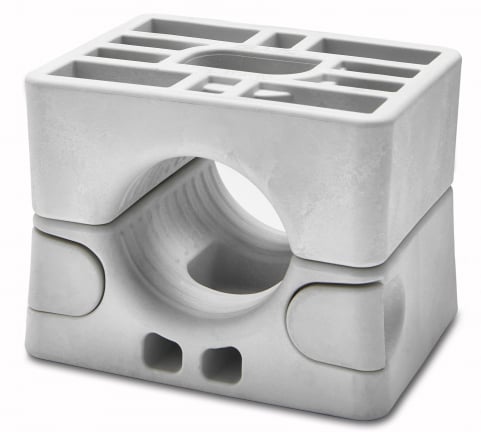
Ellis Patents No Bolts Cable Cleats
The Network Rail problem was to do with outer sheaths of live cables being breached during the installation of cable runs onto existing cleating infrastructure. The nub of the issue was that in order to accommodate new cables and cable cleats, existing cable clamps had to be dismantled, and longer bolts fed through to allow for the stacking of the new cable clamps.
The existing live cable then had to be placed back into the old cable clamps, and it was during this stage of the process that the long bolts were snagging the cable and allowing current to track into the containment system. This resulted in a number of earth faults and at least one engineer receiving a major electric shock.

Ellis Patents No-Bolts Cable Cleats Installation Guide
Having been alerted of the issue our immediate thought was that the best way to resolve the problem was with a stackable cable cleat product, which would allow additional cable runs to be added without any need to disturb existing live cables, explained Richard. And unlike many other new product ideas, this initial thought was never usurped by a better one.
As the name suggests, the Ellis No Bolts cleat has no bolts. Instead it’s fastened with two keepers that lock into the top clamp and secure it into position within the base clamp – a process that is tool as well as bolt free. The stackable nature of the cable cleats is made possible by a recess in the top moulding, and a twist fit foot on the base moulding, which lock together with a simple quarter turn hand operation.
And the design innovation doesn’t stop with the cable cleat’s mechanics. The chosen manufacturing material by Ellis Patents is a high strength nylon specifically formulated to have sufficient low smoke properties to meet London Underground 1-085 specification.
And because of the non-metallic design, the Ellis cleat is impervious to the bi-metallic corrosion that causes problems in any number of harsh environments.
The crowning glory of the whole process was that the Ellis No Bolts cleat became the first cable cleat to be granted Network Rail’s very own PADs approval.

The Ellis No Bolts cleat, from cable cleat and clamp innovator, Ellis Patents is an all polymeric stackable cable management product that is the first ever cable cleat to be granted PADS approval by Network Rail.
- NETWORK RAIL PADS APPROVED CABLE CLEATS
- PADS 0111/120321 18-22mm Cable Cleat – Ellis NBC18-22
- PADS 0111/120332 20-26mm Cable Cleat – Ellis NBC20-26
- PADS 0111/120323 24-30mm Cable Cleat – Ellis NBC24-30
- PADS 0111/120324 28-34mm Cable Cleat – Ellis NBC28-34
- PADS 0111/120325 32-39mm Cable Cleat – Ellis NBC32-39
- PADS 0111/120133 37-47mm Cable Cleat – Ellis NBC37-47
- PADS 0111/120134 45-55mm Cable Cleat – Ellis NBC45-55
Ellis Patents take enormous pride in their innovative approach to cable cleat product development, and the way we are now seen as market innovators in all of our export markets, added Richard. The Ellis No Bolts cleat really is the perfect example of what we can achieve. Not only does it meet a specific customer requirement, it also tackles and addresses an installation and maintenance issue that affects LV MV HV electrical installations across the world and delivers the best possible commercial solution for such installations.
Since its launch, the Ellis No Bolt cable cleat has been named Innovative Industrial Product of the Year at the Electrical Industry Awards, and Business Innovation of the Year at the York Press Business Awards – the cable cleats are now being specified by rail network owners on a regular basis and was recently specified in the UK for the first time for use in the £800 million Wessex Rail Alliance’s Waterloo and Southwest upgrade project.
LV, MV & HV Jointing, Earthing, Substation & Electrical Eqpt
Thorne & Derrick International are specialist distributors of LV, MV & HV Cable Installation, Jointing, Duct Sealing, Substation & Electrical Equipment – servicing UK and global businesses involved in cable installations, cable jointing, substation, overhead line and electrical construction at LV, 11kV, 33kV and EHV.
THORNE & DERRICK Product Categories: Duct Seals | Cable Cleats | Cable Glands | Electrical Safety | Arc Flash Protection | Cable Jointing Tools | Cable Pulling | Earthing | Feeder Pillars | Cable Joints LV | Joints & Terminations MV HV
Cable Hooks & BS7671 18th Edition Wiring Regulations – Essential Changes Explained
March 1st, 2019
Steel Cable Hooks | Power Cable & Trailing Cable Support | BS7671 Regulations
-
uploaded by Chris Dodds - Thorne & Derrick Sales / Marketing Manager
Cable Hooks
by Tidi-Cable
The 18th Edition of the IET Wiring Regulations (BS7671) is effective as of January 1, 2019.
That means construction site managers, health and safety managers, electricians and electrical contractors need to be fully compliant and up-to-date with the new BS7671 wiring regulations – especially in relation to how cables are supported in the event of a fire whether using cable hooks, ties or hangers.
The new 18th Edition wiring regulations include updates designed to reduce the risk of death from the placement of hanging cables. The aim is to improve installation safety using the adequate placement of metal clips, hooks or cable hangers to support hanging power or trailing cables – this includes adequate, reliable and safe support for single and multi-core armoured (SWA) cables according to BS5467.
Other updates in BS7671 include new RCD protection requirements and recommendations for installing Arc Fault Detection Devices (AFDDs).
If you’re a construction site manager or a health and safety consultant or manager, it pays to be fully aware of the new wiring regulations – especially if you’re responsible for cable fixing installation across a site.
Electricians or electrical contractors installing, hanging or suspending electrical cabling will need to meet full wiring regs compliance by January 1, 2019.
This article explains what the new 18th Edition wiring regulations mean in terms of fixing and suspending electrical cables.

Picture by Hampshire Fire and Rescue. Via BBC.
BS7671?
Why Have The 18th Edition Wiring Regulations (BS7671) Been Changed?
BS 7671 (IET Wiring Regulations) sets the standards for electrical installation in the UK and many other countries. The IET co-publishes BS7671 with the British Standards Institution (BSI) and is the authority on electrical installation.
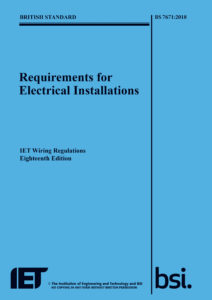
Known as Regulation 521.10.202, the aim of the new wiring regulations regarding the fixing of hanging LV cables is to reduce the risk posed by suspended cables in the event of a fire – typical cable hanging methods include hangers, hooks or conventional Ty-Raps, cable ties.
The change of wiring regs follows the tragic death of two firefighters at Shirley Towers in 2010 who became entangled in fallen cables.
Two firefighters also lost their lives in 2005 at Harrow Court Tower Block where one of the firefighters had become fatally entangled in fallen electrical cables.
The 18th Edition wiring regulations aim to avoid similar incidents. This is especially true with high-rise building developments, where fires have devastating potential – a priority for construction site managers or a health and safety consultant or managers.
The risk of fire on construction sites should also be a consideration when managing cables.
Although not common, when construction sites fires occur the materials exposed and contained within a site mean that fire can spread rapidly. Knowing how cables can be better managed can reduce to risk to workers on site as well as emergency service crews.
What Do The 18th Edition Wiring Regulations (BS7671) Require?
The new wiring regs come into effect in January 1, 2019.
The 18th Edition states that plastic fixings cannot be used as the sole use of holding up and hanging of cables. However, the IET states:
“Suitably spaced steel or copper clips, saddles or ties are examples that will meet the requirements of this regulations.” This means that plastic fixings such as hooks, hangers or cable ties can be supplemented with metal types – but that electricians and electrical contractors cannot rely exclusively on plastic clips, saddles or ties.
Temporary Cables
The 18th Edition wiring regulations apply to all types of cable installation and not just escape routes such as fire exits.
Regulation 521.10.202 now requires cables to be adequately supported against their premature collapse in the event of a fire. It applies to all types of cable that could fall in the event of a fire.
This means that cables fixed against a wall (that don’t cover a doorway) can be supported fully by plastic fixings as if the cable fell in a fire, it would fall to the corner of the corridor and not trap anyone.
What Type Of Cable Supports Does The 18th Edition Wiring Regulations Allow?
This part is left open to interpretation – Regulation 521.10.202 calls for ‘adequately supported’ cables – and we feel that it would be better if the IET would clarify with a clear definition of what ‘adequately supported’ means.
However, experts consider the new wiring regs call for metal cable supports to ensure compliance. This includes all cable supports such as cable trays, baskets, hangers and hooks.
Does The 18th Edition Ban The Use Of Plastic Cable Fixings?
Plastic fixings are not banned and can be widely used throughout the industry as a cost-effective way to manage cables. However, plastic cabling fixings can no longer be used as the sole means of securing cables in place. This will affect the sole use of products such as:
- Cable ties
- Cable clips
- Cable hangers
- Plastic conduit (with plastic fixings)
- Plastic trunking
- Plastic fixings holding up cable tray
- Plastic cable hooks and hangers
Existing plastic cable management solutions will need to be supplemented by metal fixings to ensure they’re not the ‘sole means of supporting’ cables.

Plastic Cable Ties Holding Up Cables
Does The 18th Edition Wiring Regulations Apply To Existing Cable Installations?
The Regulations apply to the design, erection and verification of electrical installations, as well as additions and alterations to existing electrical cable installations.
The good news for construction site managers and health & safety consultants/managers is that existing installations that have been installed in accordance with earlier editions of the Regulations do not need to be replaced.
This change is not retrospective and any installations fitted before 1st January may still be compliant.
The new regulations have been welcomed by the fire services. According to Charlie Pugsley of the London Fire Brigade’s Fire Investigation Team:
“We believe it’s essential [521.10.202] because … we’ve lost three firefighters in the course of firefighting operations, where the clips have become damaged by fire and cables have dropped and then crews have become entangled. We feel this is a really good, positive step to improve safety for our officers and also for the public”.

How has Tidi-Cable prepared for the 18th Edition wiring regulations (BS7671)?
Tidi-Cable is fully supportive of the 18th Edition wiring regulations.
Tidi-Cable has developed a range of metal cable supports and fixings to help ensure construction site managers responsible for electricians and electrical contractors are fully compliant of the new wiring regs.
The range of steel cable supports and fixings are re-usable, strong and effective for installing and pulling cables on construction sites.
Tidi-Cable have been developing these new products over the past 12 months in preparation for the new regulations – the high-quality cable fixing and hanging ranges are safe, easy-to-use and cost-effective while meeting 18th Edition wiring regulations.
Tidi-Cable have a range of products including Tidi-Hooks and Tidi-Hangers suitable for construction sites, factories, festivals, events and other industry sections – the S shaped cable hooks provide temporary cable support to construction site cable installations.

Tidi-Cable Tidi-Hooks
Tidi-Cable has been at the forefront of manufacturing cable management solutions for over six years and feel that the below additions to the range further secure their position in the cable support and fixings market. Benefits include:
- Full 18th Edition wiring regulations compliance. The new product range is 18th Edition compliant. Steel cable fixings and supports can be used either completely in the place of plastic products or use to supplement them.
- Heavy duty cable fixings. The added benefit of the metal cable supports is the versatility to support and fix heavier items such as armoured cables, pipework and compression hoses that often need to be managed properly to keep sites safe.
- Temporary and permanent installation. The steel cable supports are ideal for both temporary and permanent cables. Cable supports been created to manage temporary power and lighting distribution in order to keep leads safely above head height, and to help eliminate slip, trip and fall risks.
- Cable security. Pulling cables has its own problems and using hooks historically can be problematic in that cables often fall out of hooks. The customers asked for versions where cables can be contained more within a hook. Tidi-Cable are pleased that in the development of the new fire proof range they have addressed this issue by creating systems that keep cables secured in place.
Safe cable management is a priority at Tidi-Cable and Thorne & Derrick International.
As construction site managers, health and safety managers or electrical contractors looking to comply with 18th Edition wiring regulations, our products are compliant, trusted, easy-to-use and cost-effective.
With more sectors needing electrical cable management – from theatres to music venues with increased power and lighting demands – our ranges will ensure you meet the new wiring regulations.
LV, MV & HV Jointing, Earthing, Substation & Electrical Eqpt
Thorne & Derrick International are specialist distributors of LV, MV & HV Cable Installation, Jointing, Duct Sealing, Substation & Electrical Equipment – servicing UK and global businesses involved in cable installations, cable jointing, substation, overhead line and electrical construction at LV, 11kV, 33kV and EHV.
THORNE & DERRICK Product Categories: Duct Seals | Cable Cleats | Cable Glands | Electrical Safety | Arc Flash Protection | Cable Jointing Tools | Cable Pulling | Earthing | Feeder Pillars | Cable Joints LV | Joints & Terminations MV HV
Stainless Steel Cable Cleats
February 14th, 2019
Cable Cleats Manufactured from Stainless Steel by Ellis Patents
Cable Cleats
-
uploaded by Chris Dodds - Sales & Marketing Manager
Thorne & Derrick International, based in the UK, stock and distribute the most extensive range of Stainless Steel Cable Cleats manufactured by Ellis Patents and Prysmian.
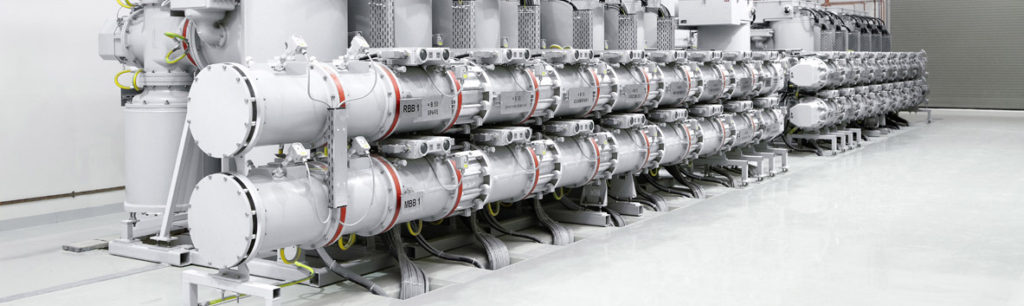
➡ Review the ranges of non-corrosive cable cleats manufactured from stainless steel provide retention of LV (Low Voltage), MV (Medium Voltage) and HV (High Voltage) cables for single, trefoil, quad and bundled applications – typically used to cleat and clamp cables in contaminated and industrial installations including hazardous area locations with potentially explosive atmospheres.
Specialist cable cleats for fire resistant, zero halogen and Triplex type cables are available.
To select and specify the correct cable cleat for single cable applications consider: i) cleat spacing ii) cable diameter iii) peak short circuit current calculated according to IEC61914 and the installation environment – these factors could include ambient temperature, atmospheric corrosion, humidity, water, vibration, dust and solar radiation.
Why Stainless Steel ?
316 & 304 Grades of Stainless Steel
In general, cable cleats are manufactured from austenitic stainless steel due to its non-magnetic and corrosion resistant properties – the former ensuring the cable cleat won’t induce eddy currents or localised heating of the LV MV HV cable.
Austenitic stainless steel does become a little magnetic as a result of work hardening when processed. This magnetism can barely be detected with a magnet and so is not significant from an eddy current perspective.
There are many different types of stainless steel, but there are two principal variants when it comes to cable cleats.
304 austenitic stainless steel, often referred to as A2, is one of the most commonly used stainless steels. It has excellent corrosion resistant properties in most circumstances, although is susceptible in atmospheres where chlorides are present, making it unsuitable for use in coastal or marine environments.
316 austenitic stainless steel, often referred to as A4, contains Molybdenum, which provides resistance against chlorides. 316 is often referred to as marine grade stainless steel due to its suitability for use in coastal and offshore applications. If unsure a simple chemical test can determine whether Molybdenum is present and so differentiate between 304 and 316.
04 and 316 stainless steel are available in low carbon variants, namely 304L and 316L. These variants are immune to sensitisation (grain boundary carbide precipitation).
Any cable cleat which is manufactured from stainless steel and includes welding in the manufacturing process should be made in a low carbon (L) variant.
In a previous Blog we provided an evidence based case for stainless steel cable cleats where levels of atmospheric corrosion preclude use of other cable fixing materials.
Should you require technical specification support or a commercial quotation in order to place an order please do not hesitate to contact us.

Vulcan Cable Cleats With Twist Foot Design From Ellis Patents
February 13th, 2019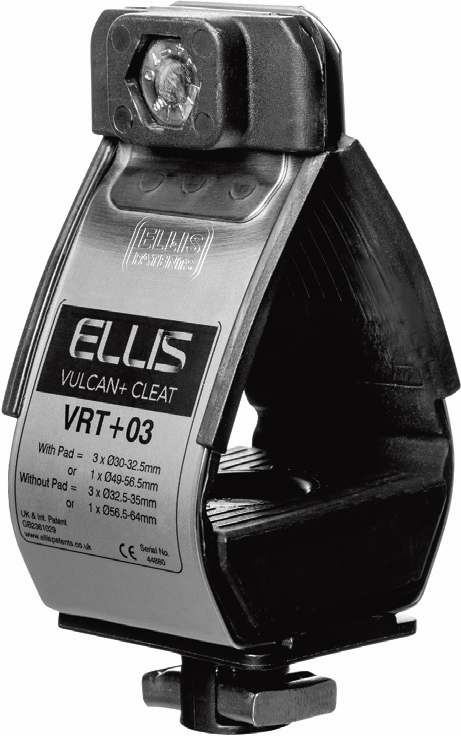
-
uploaded by Chris Dodds - Thorne & Derrick
Cable Cleats
Let Steve Walton (Chief Engineer) walk and talk you through the latest new product development by leading cable cleats manufacturer Ellis Patents – the established range of Vulcan+ cable cleats are available in a complete range of multiple sizes to suit trefoil, single, quad or bundled cables distributing electricity at LV (Low Voltage), MV (Medium Voltage) and HV (High Voltage).
The cable cleats provide a short circuit fault current protection level of 132kA when spaced at 300mm according to IEC61914 calculations.
Vulcan Cleats
The NEW Twist Foot Design from Ellis Patents provides reduced installation times and labour savings when installing cable cleats – traditionally the Vulcan cable cleat range required the additional inventory and purchase of fixing kits (cleat fasteners, washers and channel nuts) however with the new redesign the cable cleat is supplied pre-assembled for immediate site installation.
The increased speed of cable cleat installation is achieved by the integral Twist Foot base – just Fit, Twist & Tighten.
Twist Foot offerings come pre-loaded/ assembled with an isolation plate (integral barrier to mitigate bi-metallic corrosion issues) and cleat fixings to allow rapid installation of cable cleats in to standard channel (41×41 & 41×21).
No more dropped objects when installing Cable Cleats and Fixings in hazardous environments.
Stephen Walton, Ellis’ chief engineer, said: “Ellis Patents pride ourselves on having a market leading product range, and a global reputation as the number one cable cleat manufacturer, but we are not a company that will ever rest on its laurels. We are always looking at ways to enhance our current offering or add to it with innovative new solutions – and the twist-foot Vulcan+ is a perfect example of this approach.”
“We’ve taken an already extremely successful product and developed it in a manner that broadens its appeal; not just in terms of channel usage, but also by turning it into a truly quick-fit, easy to order cable cleat solution.”
The twist-foot fixing mechanism operates by simply placing the Vulcan+ cleat into the channel and twisting it 90 degrees. It is suitable for trefoil cables ranging in diameter from 19 to 58mm, and single cables between 30 and 104mm.
3 Times Faster
Watch the following product demonstration of Vulcan Cable Cleats – the time trial of conventional Vulcan v. advanced Vulcan with Twist Foot.
Contact us should you require further information to assist with the specification or supply of any types of cable cleats for all power distribution applications, including cable saddles for supporting Transmission & Distribution cables providing 132kV Extra High Voltage electricity supply.
This video demonstrates the speed efficiency of using Ellis Patents cable cleats in conjunction with Vantrunk Speedway Ladder.

Ellis Patents Cable Cleats
Cable Cleats Blogs
- IEC 61914 – Cable Cleats & Short Circuit Protection Calculations
- Fire Resistance & Cable Cleats – Surviving Fire, Flame & Extreme Heat
- Triplex Cleats – Selection Guide for Cleating 11kV BS7870 Part 4.10 Cables
- Stainless Steel Cable Cleats – Preventing Galvanic Corrosion Of Cable Fixings
LV, MV & HV Jointing, Earthing, Substation & Electrical Eqpt
Thorne & Derrick International are specialist distributors of LV, MV & HV Cable Installation, Jointing, Duct Sealing, Substation & Electrical Equipment – servicing UK and global businesses involved in cable installations, cable jointing, substation, overhead line and electrical construction at LV, 11kV, 33kV and EHV.
THORNE & DERRICK Product Categories: Duct Seals | Cable Cleats | Cable Glands | Electrical Safety | Arc Flash Protection | Cable Jointing Tools | Cable Pulling | Earthing | Feeder Pillars | Cable Joints LV | Joints & Terminations MV HV