Cable Cleats
IEC 61914 – Cable Cleats & Short Circuit Protection Calculations
March 15th, 2018
IEC61914 – Calculating Short Circuit Forces To Specify Compliant Cable Cleats
-
Uploaded By Chris Dodds – Thorne & Derrick Sales & Marketing Manager
IEC 61914
Why Specify Cable Cleats?
“A cable cleat is a device designed to provide securing of cables when installed at intervals along the length of the cables”
taken from IEC 61914 Cable Cleats For Electrical Installations
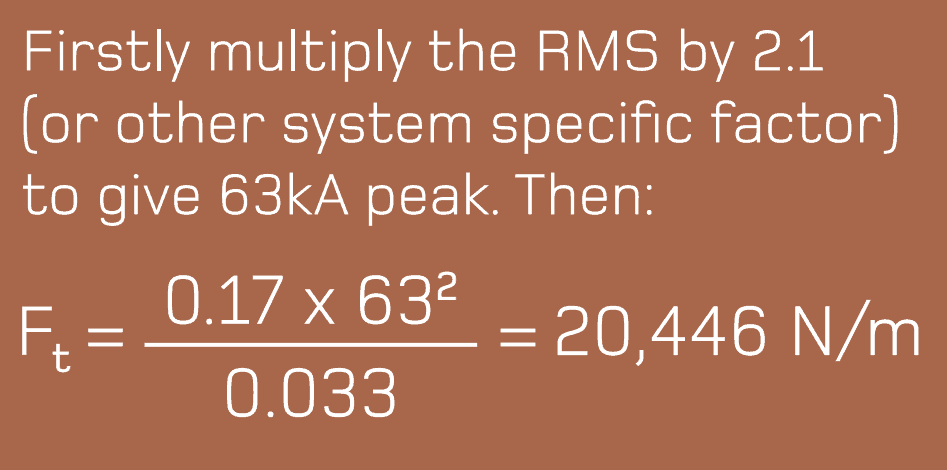
Where the system peak fault current and the cable diameter are known, the formula above, excerpted from the international standard IEC 61914, can be used to calculate the forces between two conductors in the event of a 3 phase fault in order to specify the correct type of cable cleats.
Sub-standard or under-specified cable fixings including cable cleats and cable ties can cause catastrophic damage to infrastructure, power and life – for this no scientific formula exists to calculate the costs of power outage, plus the “nuisance factor”, downtime and consequential losses of reputation. Financially, that cost is immeasurable.
♦ Cable Ties
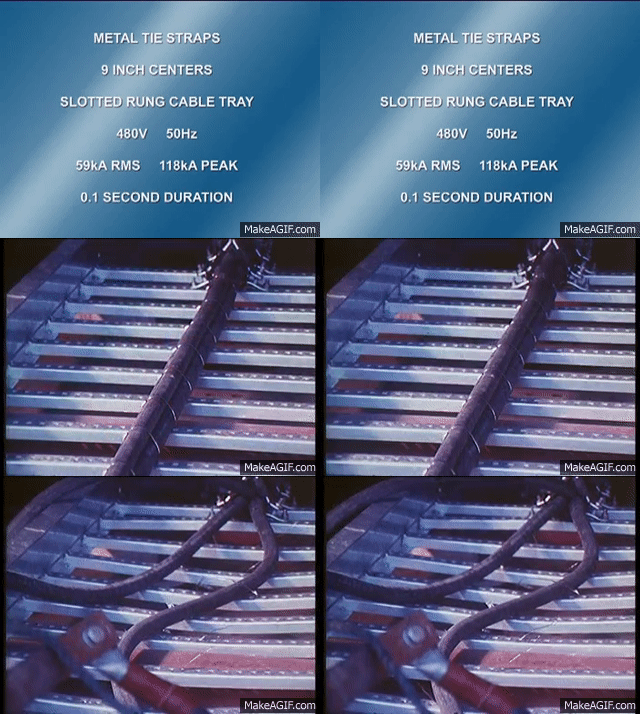
♦ Cable Cleats

Cable cleats are designed and specified to withstand those forces exerted by the cable in the “axial” direction in most types of cable installation, including Flexible Cable Systems and Rigid Cable Systems.
i) Flexible Cable Systems – where the LV-HV cables are “snaked” either vertically or horizontally, the cables can expand and contract freely between the fixing points.
ii) Rigid Cable Systems – where the LV-HV cables are rigidly fixed and longitudinal thermo-mechanical force is withstood by the combination of the stiffness of the cable, the cable cleat, reaction force and the rigidity of the support structure.
IEC 61914:2009 specifies requirements and tests for cable cleats and intermediate restraints used for securing cable in electrical installations.
Cable cleats provide resistance to electromechanical forces where declared – this standard includes cable cleats that rely on mounting surfaces specified by the manufacturer for axial and/or lateral retention of cables.
IEC61914 applies to the management and safe retention of all cable configurations and voltages (LV Low Voltage | MV Medium Voltage | HV High Voltage) including bundled, quadrafoil (quad cleats) or single cables installed in 3 phase formation using trefoil cable cleats.
Electrical design engineers and specifiers specify power cables from which the maximum anticipated short circuit load can be calculated.
This data enables the calculation of the force between the cable conductors in a short-circuit situation – cable cleats installed to cable containment (whether cable tray, ladder or basket) are in turn specified at the correct spacing to contain potential short-circuit forces generated by the low/high voltage power cable system.
The aspects of construction and performance covered by IEC 61914 include:
- Material type – i.e. metallic, non-metallic or composite
- Minimum and maximum declared service temperatures
- Resistance to impact at the minimum declared operating temperature
- The ability of the cleat to withstand axial slippage forces
- Resistance to electro-mechanical forces – i.e. the ability of the cleat to withstand the forces between the cables in the event of a short-circuit
- Resistance to UV and corrosion
- Flame propagation
The strength of a cable cleat is often determined using a mechanical tensile test.
However, the results may be misleading because the force is applied in a slow and controlled manner, which does not replicate fault conditions.
In a short-circuit fault the forces are applied almost instantaneously and oscillate in every direction. Experience shows that a cleat that survives a mechanical tensile test at a given force will not necessarily survive a short-circuit test, even if forces are the same.
IEC 61914:2009 also provides formulae to enable the theoretical forces between conductors in the event of a short circuit to be calculated.
➡ Buy A Copy of IEC 61914 from the IEC Webstore.
Cleat Calculations
Where:
• Ft = maximum force on the cable conductor in Newton/metre (N/m)
• Ip² = peak short-circuit current in the kiloamp (kA)
• S = distance between the centrelines of the conductors in metres (m)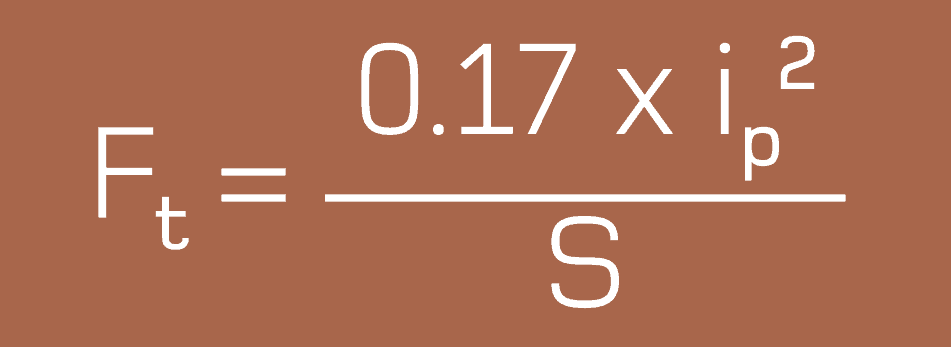
Once the Ft in N/m has been determined then the force for each potential cable cleat can be calculated.
For Example
Metric cable ladder typically has rungs at 300mm intervals, so cable cleat spacing is usually a multiple of this distance. So, Ft x 0.3 gives the force a cleat will see if spaced at 300mm, Ft x 0.6 for 600mm etc.
Ft x cable cleat spacing can then be compared to the maximum recommended mechanical loop strength of the cleat and then the cleat type and spacing can be selected.
Loop Strength of Cable Cleats
| Cable Type | Loop Strength (LS) |
| Alpha | 15,000N |
| Vulcan+, Protect and Standard Duty Flexi-strap | 36,000N |
| Emperor, Colossus and Heavy Duty Flexi-strap | 63,000N |
| Centaur Saddle and Clamps | 85,000N |
The formula uses peak current, however this is often unavailable with a Root Mean Square (RMS) value given instead – to calculate the peak current from the RMS, IEC 61914-1 Low Voltage switchgear and controlgear assemblies is commonly referred to, which uses the following multiples:
- 10 – 20kA = 2
21 – 50kA = 2.1
51kA = 2.2
Cable Cleat Calculations
Example 1
Peak fault: 110kA
Installation: Cable Ladder
Cables in trefoil with an outside diameter of 38mm.
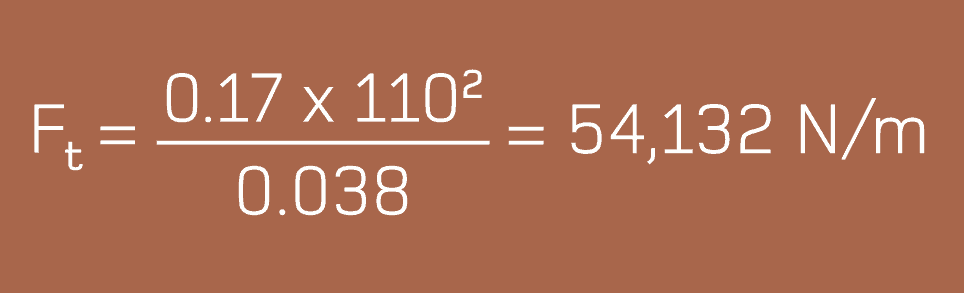
| Ft2 x Cleat Spacing | Required Loop Strength |
| 0.3 for 300mm | 16,240 N per cleat |
| 0.6 for 600mm | 32,480 N per cleat |
| 0.9 for 900mm | 48,718 N per cleat |
| 1.2 for 1200mm | 64,958 N per cleat |
This force per distance can then be compared to different cleat loop strengths to ascertain the appropriate cleat and spacing requirements for specification. In this example, the Ellis
recommendation was for Vulcan+ cleats (LS: 36,000) spaced every 600mm, or Emperor cleats (LS: 63,000) every 900mm.
The overall length of the LV-HV cable run will determine the total number of cable cleats required – the spacing requirements for cleats is subject to cable formation, diameter and short circuit rating but quantity of cable cleats is a factor of the cable circuit length.
Example 2
RMS fault: 30kA
Installation: Cable Ladder.
Cables in trefoil with an outside diameter of 33mm

Cable cleated in trefoil formation using stainless steel cable cleats
| Ft2 x Cable Cleat Spacing | Required Loop Strength |
| 0.3 for 300mm | 6,134 N per cleat |
| 0.6 for 600mm | 12,268 N per cleat |
| 0.9 for 900mm | 18,401 N per cleat |
| 1.2 for 1200mm | 24,535 N per cleat |
As with Example 1, force per distance can be compared to the cable cleat loop strengths and the appropriate cleat and spacing specified.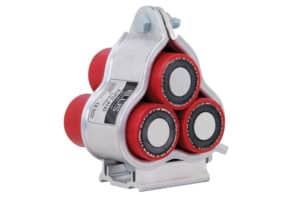
In this example, Alpha cleats (LS: 15,000) spaced every 600mm are the best option.
Before a cleat and spacing are finalised, two other factors should be considered irrespective of the short-circuit level.
1) It is strongly recommended that a system employs a fault rated cleat or restraint at a maximum spacing of 1500mm.
2) On bends and risers it is recommended that the maximum cleat spacing is 300mm.

Ellis Patents – The Cable Cleat Specialists. Standard & Customised.
IEC 61914 has provided a standardised method for conducting a short-circuit test and a definition of the criteria for a pass. It does though allow for a significant degree of latitude and so caution must be employed when interpreting results. Note should also be taken of the full report as opposed to just its headline page.
Short-Circuit Testing
There is a major difference between the short-circuit withstand requirements of a cable and the short-circuit withstand of a cable cleat.
The former is concerned with cable degradation as a result of temperature rise (thermal stress heating), while the latter is concerned with cable retention as a result of electromechanical forces.
Typical installation specifications that have been derived from the thermal withstand of the cable would require a short-circuit withstand of 63kA for 1 second or 40kA for 3 seconds.
A short-circuit test for a cable cleat does not consider this heating effect, and instead concentrates entirely on the destructive electro-mechanical forces at peak, followed by a short term decaying RMS.
The international standard IEC 61914 requires a short-circuit test duration of just 0.1 second. This equates to five complete cycles, by which time the true strength of a cable cleat will be known.
IEC61914 notes “a cable cleat is provided with a means of attachment to a mounting surface but does not rely on an unspecified mounting surface for the retention of the cables. Examples of mounting surfaces that may be specified are ladder, tray, strut or rail, wire and beam. Where declared, cable cleats provide resistances to electromechanical forces.”
Ellis Patents Cable Cleats
All Ellis Patents cable cleats have been tested for both axial and lateral loads – this ensures the cleats will support the weight of all cable voltages including LV Low Voltage, MV Mediujm Voltage or HV High Voltage.
➡ See the complete range of Ellis Patents Cable Cleats


♦ Further Reading
CIGRE Technical Brochure TB194 – Mechanical Forces in Large Conductor XLPE Cables
CPD Course
Learn More About Cable Cleats
Ellis Patents the world’s leading cable cleat manufacturer has taken its UK accredited Continuing Professional Development (CPD) course – Cable cleats: a device for short circuit protection– online so that it can be used by engineering professionals, wherever they are in the world, as part of their on-going programme of career development and learning.
Mod 1. Introduction – includes a brief history of standards plus the importance of detailed specification to ensure the correct cable cleats and fixings are chosen for the environmental conditions and applications.
Mod 2. Electrical Theory – learn more about short circuit faults, why they occur and their impact on cable systems. Also, how to calculate the forces involved and therefore how to ensure the correct strength of cable cleats are specified.
Mod 3. Materials – different cable applications require different solutions. Learn how sunshine, pollution and marine environments can cause problems if the wrong cable cleat materials are specified. How to avoid bimetallic issues and how to prevent corrosion. The importance of fire safety and low emissions is also studied.
Mod 4. Testing Cleats – some exciting video clips of when things go wrong, and of good engineering practice. Appreciate the international standards that apply to cable cleat design and the rigorous procedures involved.
Mod.5 Cable Cleat Applications – an overview of some cable cleating applications and interesting special cable fixing projects.



LV, MV & HV Jointing, Earthing, Substation & Electrical Eqpt
Thorne & Derrick International are specialist distributors of LV, MV & HV Cable Installation, Jointing, Duct Sealing, Substation & Electrical Equipment – servicing UK and global businesses involved in cable installations, cable jointing, substation, overhead line and electrical construction at LV, 11kV, 33kV and EHV.
THORNE & DERRICK Product Categories: Duct Seals | Cable Cleats | Cable Glands | Electrical Safety | Arc Flash Protection | Cable Jointing Tools | Cable Pulling | Earthing | Feeder Pillars | Cable Joints LV | Joints & Terminations MV HV
BICON Cable Cleats
March 5th, 2018
BICON
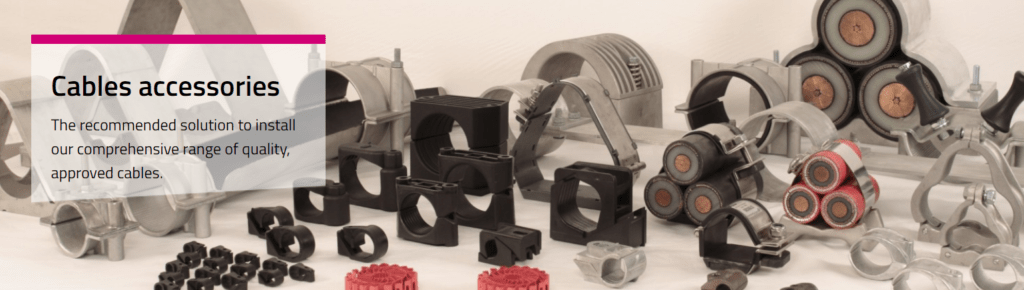
BICON cable cleats form part of the LV-HV cable accessory product range manufactured by Prysmian – this also includes cable glands, cable lugs, cable joints and cable terminations.
T&D distribute the complete range of BICON cable cleats and clamps including plastic nylon (LSF), aluminium and stainless steel Multicleats for supporting LV, MV, HV cables installed on all types of cable containment including basket, ladder or tray in plant rooms, electricity substations and electrical building services infrastructure.
Cable cleats are used to protect electrical building services, power supply and infrastructure by providing effective short circuit restraint in fault current situations – cleats are available for single, double and multiple cable applications.
Where single core cables must be clamped in a three phase arrangement trefoil cable cleats can be used to provide effective short circuit protection.
BICC
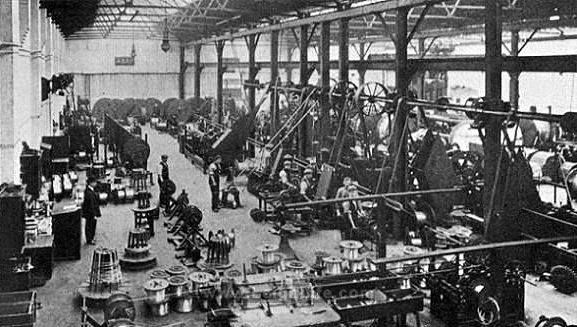
British Insulated Callender’s Cables (BICC) was a 20th-century British cable manufacturer formed in 1945 by a merger of Callender’s Cable & Construction Company Limited and British Insulated Cables – in 1975 the company was renamed BICC Ltd.
The BICON brand originates from BICC Components.
The BICON product range is the result of 100+ years of LV-HV cable accessory development and quality engineering started by BICC and continued in the 21st Century by Prysmian Cables and Systems Ltd, UK.
The full range of BICON brand cable accessories include Prysmian cable cleats, glands, joints and connectors for sectors including utilities, construction, rail, infrastructure and oil and gas industries. These are marketed under the BICON brand, manufactured by Prysmian and distributed by Thorne & Derrick.
Cable Cleats
Cable cleats are installed to provide short circuit protection to electric cables distributing power at low, medium and high voltage – a complete range of cable cleats are available to support the installation of power, control and instrumentation cables in single, trefoil, quad or bundled arrangement to cable containment in commercial, industrial and hazardous area locations including 11kV/33kV substations.
Single Way Cleats | Trefoil Cleats | Fire Resistant Cleats plus a complete range of aluminium cable cleats ➡ 2 Bolt | Hook | Claw

View the complete range of BICON Cable Cleats ➡
Prysmian Multicleats – 3 Simple Steps To Cable Cleat Installation
February 27th, 2017
Prysmian BICON Multicleats – Cable Cleats
-
by Chris Dodds T&D - estimated reading time 5 minutes
Cleats
T&D are Prysmian cable cleats stockists and distributors committed to supporting the correct installation of all BICON brand products – the following short post outlines the recommended installation procedure for Prysmian Multicleats which are specified to provide short-circuit containment of LV, MV and HV power cables.
Prysmian Multistrap is a stainless steel cable strap complete with a tensioning clip, securing pin and winding key – can be used for single, bundled or trefoil cleats including 11kV/33kV single core high voltage substation cables.

BICON. A Prysmian brand.
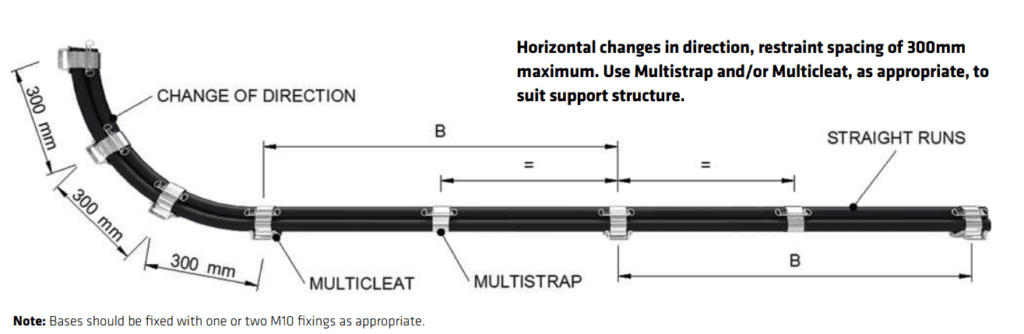
Multistraps are used as an intermediate cable restraint between Multicleats – positioned centrally between a pair of Multicleats to provide additional protection to medium/high voltage power cables in the event of a short-circuit.
The Multicleat cable cleats are commonly used to support and clamp 11kV/33kV power cables in industrial installations, hazardous areas and high voltage substations.
Aluminium cable cleats are also available for cleating cables onto containment in LV-HV substations and electrical building services where corrosion exposure levels are lower.
Multicleats
1. Fasten Prysmian BICON Multicleat base to cable support with M10 fixings. Loop Prysmian Multistrap through cable cleat base and around cables. Standard Duty Multicleats = 2 loops. Heavy Duty Multicleats = 3 loops.
2. Pull slack Prysmian Multistrap into outer loop. Insert split pin from right hand of Multicleat around outer layer of Multistrap about 10mm from end. Push plastic shear torque adaptor fully onto the end of the split pin and attach 13mm socket wrench. To tension the Prysmian Multistrap around the cables, rotating key anti-clockwise with the socket wrench until the adaptor shears.
3. Remove the shear torque adaptor and wrench. Swing the key over and engage in slots in clip.
The Prysmian Multicleat and Multistrap is correctly installed – compatible with most cable containment types including cable ladder and tray systems.

Prysmian BICON Multicleat Installation Steps
For further Multicleat & Multistrap technical specification, selection details and information see the following Slideshare.
To ensure sufficient cable support the Prysmian Multistrap MUST be used at the mid-point between Multicleats on all horizontal or vertical straight cable runs – here the Multicleats are shown cleating single core 33kV cables in trefoil arrangement however the strap-type cable cleats are suitable for single, multiple or bundled cable configurations.
Contact Thorne & Derrick for technical support or specification advice to ensure the correct cable cleat / cable strap arrangement according to the fault rating, installation application and environmental location.
Also from Prysmian ➡ Cable Joints | Cable Glands | Cable Cleats | MV HV Terminations Joints Connectors 11kV 33kV
THORNE & DERRICK SPECIALIST ELECTRICAL DISTRIBUTOR
LV ♦ MV ♦ HV
T&D distribute the most extensive range of LV, MV & HV Cable Jointing, Terminating, Pulling & Installation Equipment – we service UK and international clients working on underground cables, overhead lines, substations and electrical construction at LV, 11kV, 33kV and EHV transmission and distribution voltages.
- Key Products: MV-HV Cable Joints & Terminations, Cable Cleats, Duct Seals, Cable Transits, Underground Cable Protection, Copper Earth Tapes, Cable Jointing Tools, Feeder Pillars, Cable Ducting, Earthing & Lightning Protection, Electrical Safety, Cable Glands, Arc Flash Protection & Fusegear.
- Distributors for: 3M, ABB, Alroc, Band-It, Catu, Cembre, Centriforce, CMP, Elastimold, Ellis Patents, Emtelle, Furse, Lucy Zodion, Nexans Euromold, Pfisterer, Polypipe, Prysmian, Roxtec.

LV – Low Voltage Cable Joints, Glands, Cleats, Lugs & Accessories (1000 Volts)

MV HV – Medium & High Voltage Cable Joints, Terminations & Connectors (11kV 33kV EHV)

Cable Laying – Underground Cable Covers, Ducting, Seals & Cable Pulling Equipment
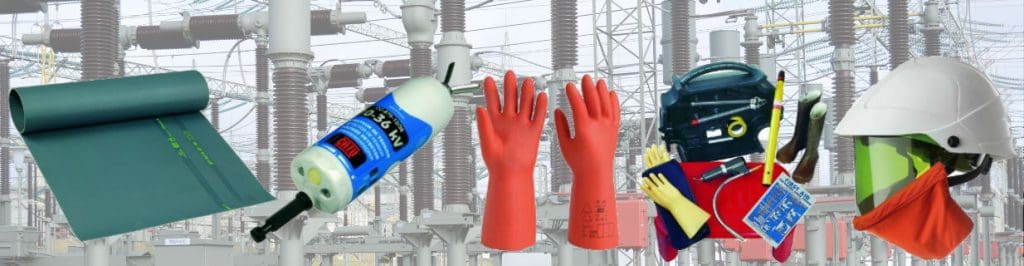
T&D, CATU Electrical Safety & Arc Flash Protection Specialists for SAP’s, Linesmen, Jointers & Electrical Engineers – Largest UK Stockist
INVITATION
Thorne & Derrick invite you to join LinkedIn’s largest LV-HV Electrical Discussion Group : Low & High Voltage Power, Cabling, Jointing & Electricals. Discussion subjects include cable installations, cable jointing, substation, overhead line and electrical construction at LV, 11kV, 33kV and EHV. Network, engage and promote your profile, company or products with over 10,000 influencers.


Balata Polyester Cable Straps – Balfour Beatty Rail – T&D UK
September 23rd, 2015
Balata Cable Straps To Support Rail Cables (LU & Network Rail Approved)
Project Application : Tunnel Cable Support for Power Cables
Product : Balata Straps
Scope : Supply off 10,000 LU-NYBAL-1 Balata polyester cable straps for the new DC Traction Sub Station & Tunnel Cables in West Ham, London UK.
Client : Balfour Beatty Rail
Country : UK
Sector : Rail
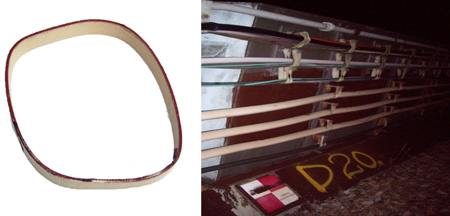
Balata Polyester cable straps are designed as a secure and reliable cable supporting method which is LU London Underground and Network Rail approved – the cable straps are specified to provide surface and sub-surface cable support in overground and underground locations on the UK rail infrastructure; this includes trackside substations, underground tunnels and bridge crossings. The inherently flame retardant cable straps, specified by London Underground (TfL) since 1965, provide superior aging and stable electrical characteristics suitable for installation in damp and dusty locations at both trackside and tunnel locations.


LV MV HV Jointing, Earthing, Substation & Electrical Eqpt
Rail Cable Accessories, Electrification & Installation Equipment
Thorne & Derrick stock and distribute an extensive range of 400V-33kV Rail Cable Accessories & Power Distribution Sytems including feeder pillars to contractors undertaking Low Voltage Power Distribution, HV Electrification & Substations, DC Traction & Networks, OLE and Track Feeder Cable Renewals – complete range of Network Rail PADS approved track terminations, cable joints, cable repair and connection products up to 25kV, including 3M Cold Shrink, Pfisterer CONNEX and Nexans Euromold products.
Full range of Cable Pulling Equipment & Products to ensure safe and efficient of rail cables in to cable ducts and containment infrastructure including cable troughs.