Feeder Pillars, Power Management & Control Equipment
Uploaded By - Chris Dodds (Thorne & Derrick Sales & Marketing Manager)
Guest Post By - Giles Davidson (Area Sales Manager at Lucy Zodion Limited)
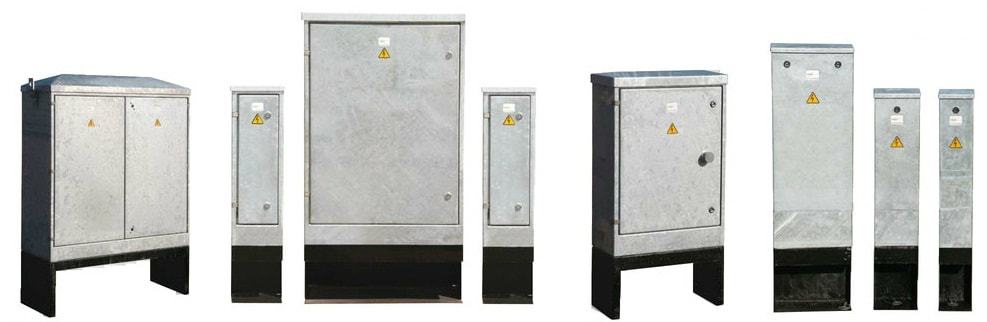
Lucy Zodion were approached by the client (Eagle) to manufacture a galvanised steel feeder pillar from their Fortress range to supply three electric vehicle charging points within the clients own site – the double door feeder pillars are designed to provide robust and reliable distribution of low voltage electrical power.
The initial plan was for the EV charging points to be fitted to the wall of the building.
Lucy Zodion suggested that the side walls of the feeder pillar could be utilised to provide the three IP67 sockets, which lessened the upheaval to the site with less civil engineering, electrical and cabling work required.
The client also wanted to be able to provide electrical isolation via each socket from within the feeder pillar but also needed to ensure that only authorised personnel could do this.
To achieve this Lucy Zodion fitted the new Hasp and Staple lock system so the client could fit a padlock as pictured below.
To complete the project the electric vehicle power pillars were painted to the clients specific RAL paint colour specification.
The design, procurement, assembly and testing was all completed in time and the customer saved money on the project.
Lucy Zodion bespoke feeder pillars with customised design and pre-wired solutions, tailored to the customers’ requirements without compromise.
Feeder Pillars – Electric Vehicle (EV) Power Supply Pillars
Feeder Pillars For Electric Vehicles With Padlockable Vandal Resistant Protection
Feeder Pillars
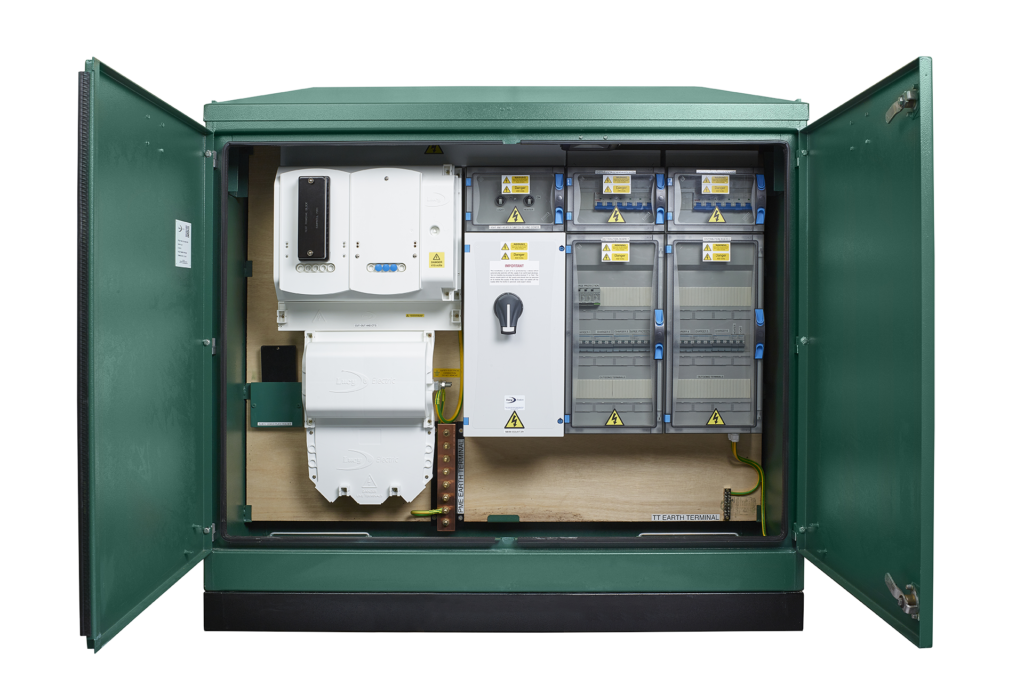
T&D together with Lucy Zodion are able to offer a range of feeder pillar enclosures and cabinets that are robust, durable and secure providing weatherproof and padlockable vandal resistant protection. Feeder pillars are available as standard empty enclosures or custom manufactured low voltage pre-wired electrical distribution equipment consisting of a robust galvanised steel pillar with vandal resistant lockable doors housing LV electrical switchgear and control systems.
EV Electricity Supply Pillar in production at Lucy Zodion incorporating CTCU and surge protection – the feeder pillar also uses Matt:e’s O-pen technology devices which eliminates the need for earth mats or rods.
Electric Vehicle Charging Supply Pillars – Lucy Zodion are empowering EV with pre-wired feeder pillar and electricity distribution solutions. Lucy Zodion develop EV solutions considering the charge speeds each charge point is capable of, from fast to super, to ensure the client receives the most suitable and compatible option. The standard range of pre-wired supply feeder pillars for EV charging come in four sizes and can supply power for up to 54 fast charge points, 12 rapid charge points and 2 super. Additional components can be integrated as optional extras, for smart and adaptive power distribution solutions.
T&D distribute the most extensive range of LV, MV & HV Cable Jointing, Terminating, Pulling & Installation Equipment – we service UK and international clients working on underground cables, overhead lines, substations and electrical construction at LV, 11kV, 33kV and EHV transmission and distribution voltages.
Cable Type: BS6622 Single Core XLPE Insulated AWA Armoured Cables
Cable Jointer: Neill Burns HV/LV Cable Jointer at BICS Ltd
By: Dan Rapley (Shrink Polymer Systems – Manufacturer of LV / MV Cable Joints, Terminations, Cable Accessories)
Working alongside their Specialist Distributor Thorne & Derrick has enabled Shrink Polymer Systems to support them and their clients on UK and international LV MV HV Cable Jointing & Installation projects up to 33kV.
Thorne & Derrick based in the UK are leading suppliers LV MV HV Cable Jointing, Installation, Earthing, Substation & Electrical Equipment.
Collaborating together as a team we have been able to offer cable jointing guidance, solutions and provide an abundance of bespoke cable joint and splicing solutions for some very unique and non-standard cable combinations and constructions, including Okonite and flexible trailing joints for Protolon cables.
Our decades of experience through LV-HV cable accessory testing, product knowledge and assisting on site engineers and cable jointers has allowed us to discover and produce quality products to facilitate specific jointing applications for subsea power cables (inclusive of fibre optic cores), LSF fire resistant cables and BS/IEC standard XLPE, EPR, PILC, or PICAS medium/high voltage power cables – this includes trifurcating, transition and trifurcating-transition jointing kits for the connection of modern technology polymeric insulated Triplex cables to traditional paper insulated lead covered cables (PILC).
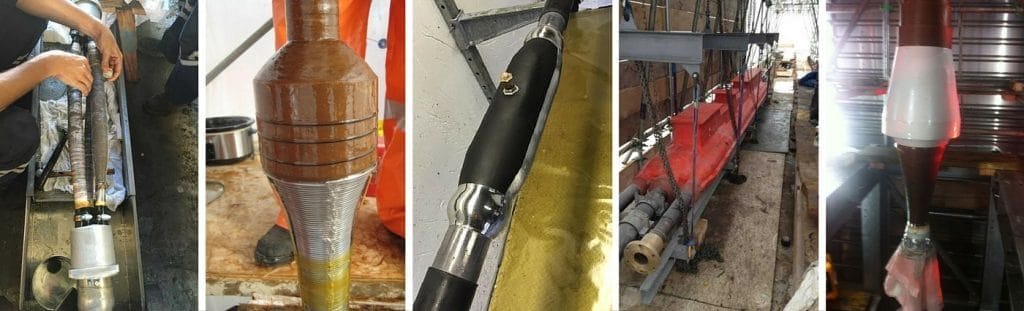
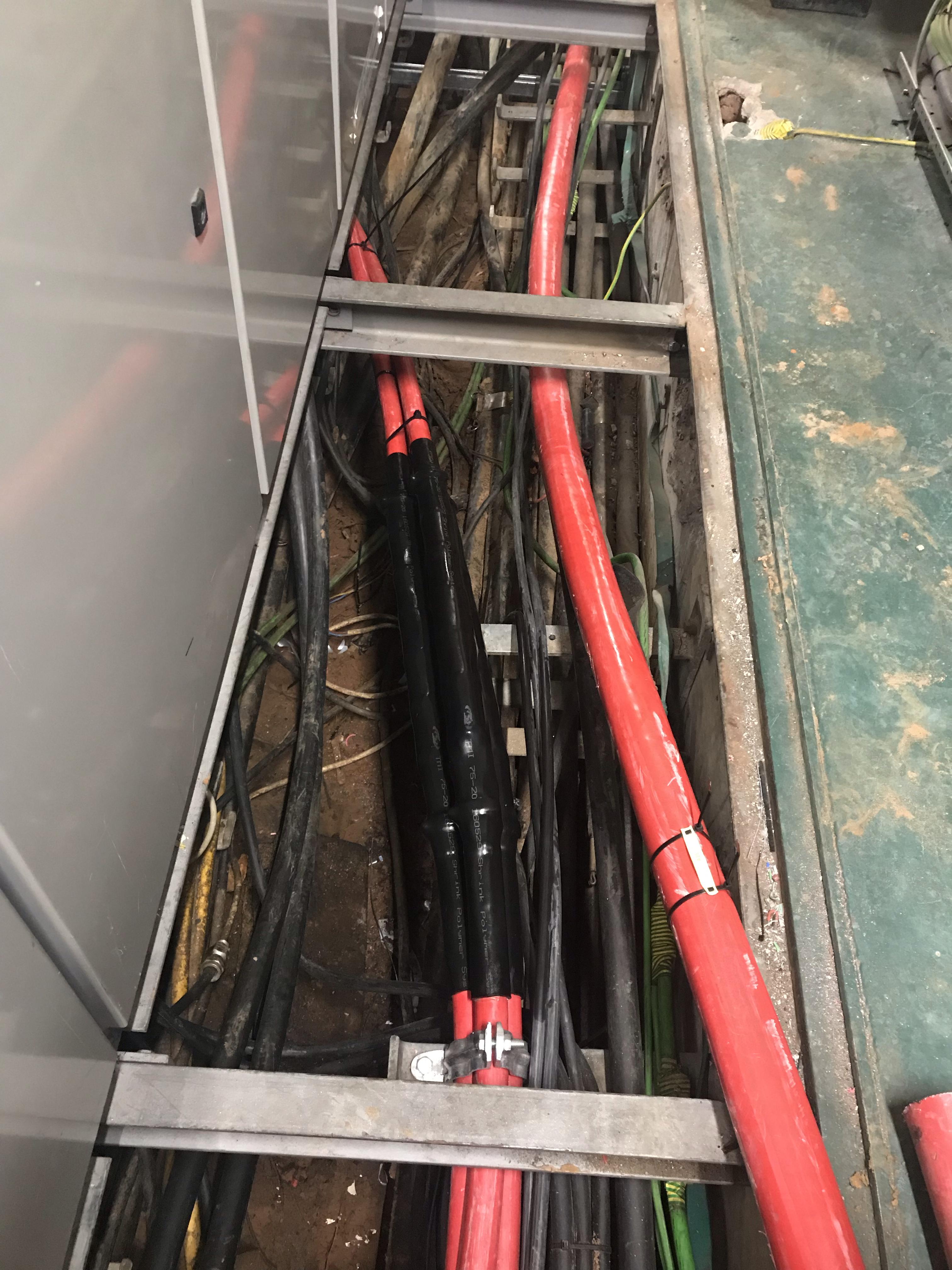
Pictured below are 3 single phase Shrink Polymer Systems single core XLPE armoured 11kV cable joints installed in a very tight cable duct with confined space working and restricted working space for the jointer to position and set the cables prior to heat shrinking the joints.
Note the outer protection, heavy wall, heat shrink tubes have been fully shrunk to the outer cable sheath of the 11kV power cable with no raised or “unshrunk” edges.
There are no scorches or heating damage to the heat shrink outer sleeve demonstrating excellent flamework by the jointer when using the gas torch – the flame must always be on the move never applying heat to the same area for too long.
The armour cage for the AWA has been neatly fitted to provide earth continuity of the cable armour using armour earth clamps.
The cable joint’s slim and short length design has assisted the cable jointer to enable the 11kV circuit to be jointed and installed between the two steel beams in challenging worksite conditions – trefoil cable cleats are installed to protect and restrain the 11kV cables in the event of a short circuit situation.
Neill had never used SPS cable joints before but is one of the many Jointers who have been able to benefit from Thorne and Derrick’s excellent customer service to be able to arrange “same day kit and despatch” of our heat shrink jointing products.
Contact Thorne & Derrick to provide competitive prices, technical support and immediate delivery of LV MV HV Joints & Terminations from extensive stocks to UK and international destinations.
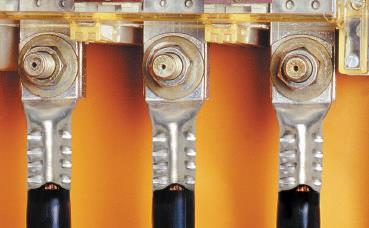
Heat Shrink Straight Joints – jointing 11kV voltage single core cables with XLPE insulation, copper tape screen and aluminium wire armour AWA according to BS6622, the 185sqmm stranded copper conductors were connected using mechanical shearbolt connectors.
T&D distribute the most extensive range of LV, MV & HV Cable Jointing, Terminating, Installation & Cable Pulling Equipment – we service UK and international clients working on underground cables, overhead lines, substations and electrical construction at LV, 11kV, 33kV and EHV transmission and distribution voltages.
To see and follow more Cable Jointing Blogs go to LinkedIn and follow the Thorne & Derrick company page.
Indent Crimping Of Cables – Benefits & Limitations
uploaded by Chris Dodds - Thorne & Derrick Sales & Marketing Manager
Thorne & Derrick International, based in the UK, are leading suppliers of cable crimp lugs and associated crimping tools for Low, Medium & High Voltage Cables and Power Systems – this series of articles by Klauke discusses the theory and practise of installing compression type cable lugs and connectors for use with copper and aluminium conductors.
Klauke cable lugs and crimping tools are used by Jointers, Linesmen, Panel Builders and Electrical Engineers to install underground cables and overhead line conductors on power, transmission and distribution networks including LV MV & HV systems, 11kV-33kV.
W-crimp and indent crimp for different cross-sections
The permitted cable spectrum for indent crimping comprises both Class 2 multistranded copper conductors, as well as Class 5 and Class 6 fine and ultrafine-stranded types in accordance with VDE0295 up to a cross-section of 400sqmm
Klauke F cable lugs for ultrafine and fine-stranded conductors avoid fraying
Practical crimping method for small cross sections below 6sqmm and also in switch cabinet construction up to 1000V
Indent crimping
Well-tried yet reliable?
Benefits & Limitations: the oldest form of electrical connection, indent crimping has proven its worth in countless electrical cable termination applications. Yet for some time now, experts have been repeatedly asking the question: is indent crimping reliable?
Why this uncertainty?
Today, hexagonal crimping is considered to be the technical standard that has generally become established. But indent crimping is considered to be an acceptable and a reliable form of cable crimping that is preferred for switch cabinets of up to 1000V.
Indent crimping is still a reliable form of crimping cables, often used in the construction of switch cabinets up to 1000V.
Indent crimping is a purely manufacturer specific type of crimping.
In other words – the manufacturer must ensure that a standardised cable crimp can be produced using its components. Leading manufacturers demonstrate this through appropriate tests.
In tests to IEC 61238, for example, Klauke proved its crimping tools and cable lugs combined can be used to make connections of equivalent quality to a hexagonal crimp.
Warning: unlike hexagonal crimping, indent crimping is suitable only for processing copper. In terms of technology, indent crimping is set apart by its high degree of compaction.
The greater impact forces, however, cause high material stress. So it‘s important to remember that connections caused by indent crimping are always strain relieved.
Indent crimping allows multistranded, fine-stranded and ultrafine-stranded conductors to be permanently connected
The variants are W-crimp and indent crimp. There are two different versions of indent crimping in use:
the W-crimp for cross-sections from 0.5sqmm to 16sqmm
the indent crimp for cross-sections from 6sqmm to 400sqmm
Types Of Indent Crimp
The W-crimp is ideal for smaller cross- sections, since the material in the region of the two tips of the crimp insert is extremely highly compacted
Indent crimping is especially suitable for cross-sections from 6sqmm to 400sqmm
The W-crimp is preferred for smaller cross sections, since the material in the region of the two tips of the crimp insert is extremely highly compacted. Indent crimping is commonplace and generally accepted for processing small cross-sections, since the hexagon crimp is normally used only from cross-sections upwards of 6sqmm.
For multi-stranded, fine-stranded and ultrafinestranded copper conductors
The permitted cable spectrum for indent crimping comprises both Class 2 multistranded copper conductors, as well as Class 5 and Class 6 fine and ultrafine-stranded types in accordance with VDE0295 up to a cross section of 400sqmm.
Class 1 round single-stranded (rs) conductor (commonly known as solid conductor. Class 2 round multi-stranded (rm) conductor. Class 5 fine-stranded conductor 5 (commonly known as flexible conductor. Class 6 ultrafine-stranded conductor 6 (commonly known as highly-flexible conductor).
Conductor Types
In contrast to the hexagon crimp, thinned conductors can also be reliably crimped without transmission losses by means of indent crimping. The reason – thinned cables have in reality a smaller cross-section than is nominally specified – a specified cross-section of 50sqmm can in actual fact only be around 43smm, for example.
Thinned lines are produced from high-purity copper. Despite its smaller cross-section, this material has identical conductivity characteristics. The benefit to the manufacturer is the reduced material usage and the associated lower costs.
One of the key advantages of indent crimping is this versatility in the wide range of the conductor types to be processed. What’s more, all these conductor types can be indented simply and cost effectively using one tool. Klauke offers a mechanical crimping tool for indent crimp that covers a cross section range of 185sqmm to 400sqmm, for example.
The Klauke mechanical crimping tool K07 for indent crimps covers a crosssection from 185sqmm to 400sqmm
Generally speaking, only mechanical hand crimping pliers are used for indent crimping.
The cable crimping profiles to be used are based on the tube dimensions of cable lug and connector. But because indent crimping is not a standardised form of cable crimping, it is crucial that high-quality materials and crimping tools tested to IEC61238 from the same manufacturer are used.
A professional indent is obtained only from clean workmanship using a suitable tool and matching cable lug. That means the crimping tool must be correctly applied and the indent made up to the end stop of the tool. The same number of indents as for a hexagonal crimp is required. For example, a professional hexagonal crimp of a tubular cable lug with a cross-section of 240sqmm calls for four narrow crimps; an indent likewise requires four crimps.
Just like a hexagonal crimp, the indent crimp for a cable lug with 240sqmm cross section also requires four narrow crimps
With indent crimping too, the cross-section is stamped on the back of the cable crimp for checking. Important in all cases – to avoid under or over-crimping the use of a suitable and well-maintained crimping tool is a basic pre-requisite.
Incorrectly made cable crimps due to an incorrect tool setting for example can increase contact resistance which can in turn cause temperature rises and ultimately cable fires.
Indents made incorrectly due to unsuitable crimping tools, for example, can in the worst case cause a cable fire
Klauke recommends that its cable lugs are crimped using only Klauke tools – this is the only way the electrical engineer or cable jointer is guaranteed the use of matched cable lugs or connectors and tools, which are the prerequisite for a reliable connection.
Also important in this regard Klauke F or R cable lugs (Cu copper standard version) can be used for indent crimping.
F and R-series cable lugs can be used for indent crimping
Klauke F & r series cable lugs
Due to their design F cable lugs for fine stranded and ultrafine-stranded conductors avoid the problem of fraying as they are introduced into the cable lug. These tubular cable lugs have a larger internal tube diameter than standard cable lugs – they also have funnel-shaped widening to better guarantee cable entry into the lug.
F cable lugs have a larger tubular inside diameter than standard cable lugs; they also have a funnel shaped widening
Besides easier handling, this also provides advantages in terms of safety – cross-section tapering due to fraying is prevented and so the cable retains its full cross section.
The funnel-shaped widening of the F cable lugs prevents a cross-sectional tapering of the cable caused by fraying
Suitable for use with Klauke F series tubular cable lugs, various manufacturers also offer joints for conductor extensions or repair purposes. These also have funnel-shaped widening and an enlarged tube diameter. A central impression prevents the two cable ends being inserted unevenly.
Tubular Cable Lug – Commercially Available
In addition to DIN cable lugs, various manufacturers offer standard Klauke R-series tubular cable lugs. Due to their dimensions, these tubular cable lugs differ from DIN cable lugs – they are usually shorter than the DIN designs. But because they are governed by the same test standard this does not affect the durability of the electrical and mechanical connection.
The standard R series tubular cable lugs, which are shorter than DIN cable lugs, guarantee a durable connection when indent crimping is carried out correctly
Conclusion & outlook
Indent crimping remains a standardised and practical crimping method. For small cross sections below 6sqmm in any case and also in switch cabinet construction up to 1000V. If the recommendations given in this article are followed, any uncertainties about their reliability are unfounded.
There is no doubt, however, that the acceptance of indent crimping among experts is not quite what it once was with hexagonal crimping increasingly preferred and specified. It is therefore important to clarify with customers in advance as to whether they allow indent crimping in their technical facilities and plants. The arbor and 4-arbor crimp offer a similar degree of compaction to indent crimping.
These cable crimps even allow the production of gas-tight crimped connections. We will be explaining what is important to note about these types of crimp in a later issue.
Further Reading
Review other Blogs in this series of articles about Cable Lugs, Crimping Cables & Tools:
Thorne & Derrick are Specialist Distributors of leading manufacturers of Cable Accessories, Jointing & Installation Equipment.
LV MV HV cable accessories used to joint, terminate, connect, cleat and gland power cables to air and gas insulated substations, transformers, switchgear and overhead line networks.
Hover over our Interactive Electricity Grid to learn more about our product ranges.
LV 600/1000V ◊ MV 11kV 33kV ◊ HV 66kV 132kV
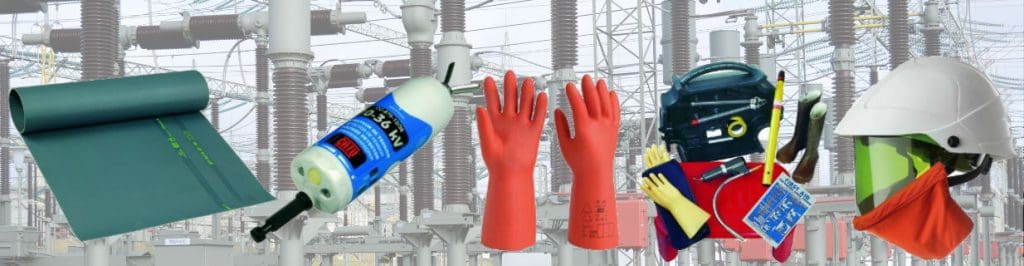
Substation & Overhead Line Electrical Safety Equipment
Manufactured by CATU Electrical to enable the safe construction, maintenance and repair of underground cables and overhead lines network up to EHV (400kV).
uploaded by Chris Dodds - Thorne & Derrick Sales & Marketing Manager
Exothermic Welding
Today, Thorne & Derrick welcomed Jason Leatherland (UK Manager at Aplicaciones Tecnológicas (AT3W) Lightning Protection & Earthing) to their UK office to learn more about their innovative Exothermic Welding System – Apliweld Secure+ is the safest + most efficient system for establishing Exothermically Welded Connections on substation earthing projects in the UK DNO, Power Transmission & Distribution and ICP sectors.
So What’s New?
The market-leading modern technology with remote electronic activation using Bluetooth replaces the conventional exothermic welding system dependent upon a manually applied spark using a Flint Gun for the welding and bonding connection of copper conductors including copper earth rods, cables and earth tapes.
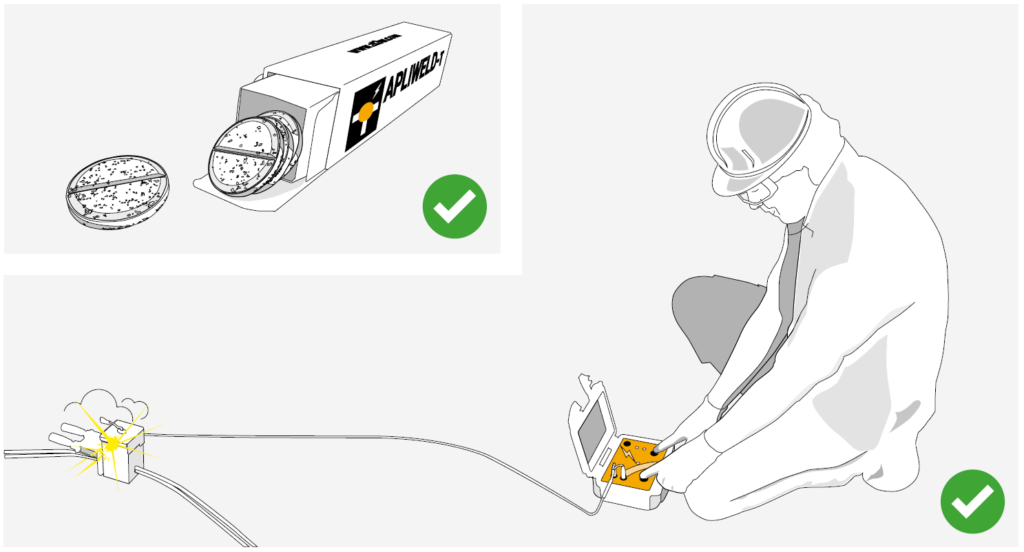
Apliweld Secure+ replaces traditional welding powders (and all of their size variations) with a welding tablet compound activated remotely, by up to a safe 5 metre distance, from the controlled explosion location – the electronic starter reduces risk of burns injuries and improves operational Health & Safety.
Apliweld Secure+ is accepted or in the approval process for use at National Grid, Northern Powergrid, Western Power Distribution, Scottish Power Energy Networks (SPEN) and Electricity North West (ENWL).
AT3W are a Spanish manufacturer and supplier of Earthing & Lightning Protection products and solutions – their unique selling point is their dedication to innovation and R&D within the industry along with their complete product/solution portfolio.
What is Exothermic Welding?
Apliweld exothermic welding is a process that achieves the molecular bonding among two or more metallic conductors by a chemical reaction. This molecular bonding improves mechanical, electrical and anti-corrosion properties compared with any mechanical or clamped connection. Apliweld exothermic welding is the most efficient method to achieve permanent, reliable and high conductivity connections for any LV MV HV substation or installation requiring an earthing system.
Secure Exothermic Welding At Safe Working Distance
APLIWELD Secure+ Exothermic Welding SYstem
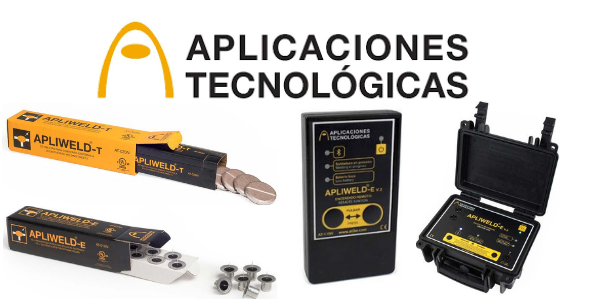
Apliweld Secure+ is the most innovative, efficient and safest method for making electrical earthing connections with exothermic welding and comprises the of following components:
APLIWELD Part Reference
Product Image
Product Description
Technical Characteristics
Benefits
APLIWELD-T Exothermic Welding Tablets
Innovational tablet utilising only 2 sizes to produce all exothermic welded joints. Two references AT-020N, the most common one (valid for 90% of connections )and AT-021N larger size tablets, for use on larger joints.
• Reference: AT-020N
• Tablet dimensions: ø 43 mm.
• Units per pack: 20 tablets
• Packaging dimen.: 52x52x220 mm.
• Total weight: 900 gr.• Reference: AT-021N
• Tablet dimensions: ø 55 mm.
• Units per pack: 20 tablets
• Packaging dimen.: 66x66x200 mm.
• Total weight: 2.000 grams
• Compact and easy to use
• Reduces stock costs
• Improves welding process times
• Increases equipment life-time
• Both electronic and powder starters can be employed
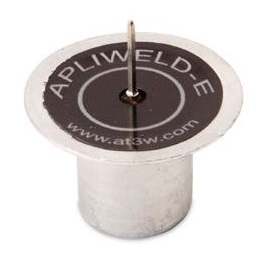
APLIWELD-E Electronic Starter
Not flammable. Electronic starters only ignite through the power supplied by the ignition device.
• Reference: AT-010N
• Dimensions: 26 mm. ø24 mm.
• Units per pack: 10
• Packaging dimen.: 125x105x40 mm.
• Total weight: 87 grams
• Time of reaction: < 10 sec.
• Material: not flammable
• Its safety handle and storage features reduce labour risks
• Safe & easy setup
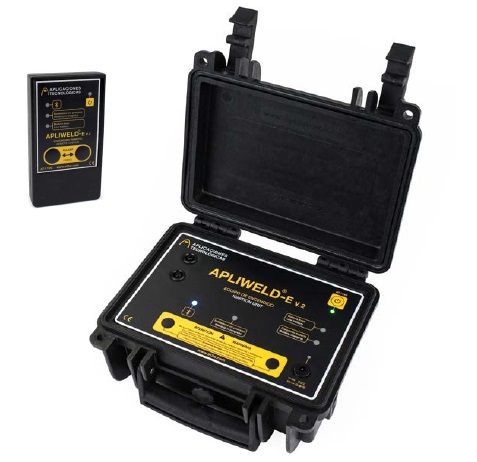
APLIWELD®-E
Electronic Ignition/Starter Device
Ignition box enables controlled and remote electronic ignition of exothermic welding connections in a quick and safe way. Includes: ignition unit (AT-096N), cable (AT-098N), 5 crocodile clips (AT-099N), battery charger and bag carrier.
• Reference: AT-100N
• Power supply:
• Lead acid battery 6V 7Ah
• DC Voltage: 6V DC
• Battery charge: 12-36V DC 500 mA
• Battery life: more than 100 joints
• Battery charging time: 10 hours
• Dimensions: 216x180x102 mm
• Weight: 2300 grams
• Remote control ignition reduces labor risks.
Apliweld Secure +
Benefits
Eliminates the need for numerous variety of exothermic welding size powders
Single welding compound reference for every welded earthing joint or connection
Reduction of stock volume : cost ratio
No shelf life and is non flammable
Much safer to use – electronic ignition unit / Bluetooth starter as opposed to flint gun
Minimises user error – every mould engraved with components/materials to be used
Can be used in windy conditions (zero powder spillage)
Highest possible ignition rates – less material failure
Reduced wastage from cartons, cups etc
Easy to use, reduces costs in labour and training
How to use Apliweld Secure+ Components
AT3W Part Number
Product Image
Product Description
Stage
Process
APLIWELD-T
Welding compound in tablets
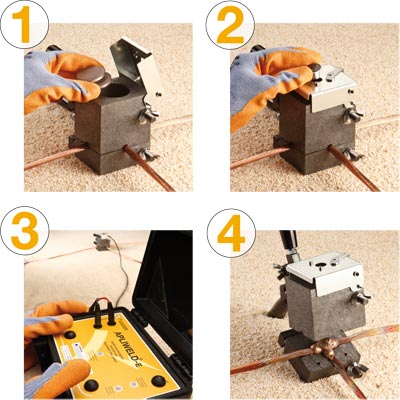
1. Insert the tablets APLIWELD-T
APLIWELD-E
Electronic starter
2. Place and connect the electronic starter APLIWELD-E
APLIWELD-E
Electronic starting device
3. Press both push-buttons on ignition device or Bluetooth remote at the same time
Exothermic Weld
Graphite mould
4. Remove the completed joint from the graphite mould
Specific Exothermic Weld Mould Video
The following video shows the operating procedure for specific mould Apliweld Secure ensuring the process of exothermic welding is efficient.
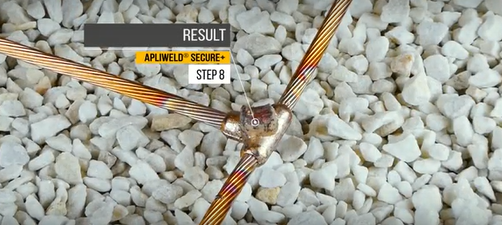
Step 1 – Clean and remove any impurities from the mould or conductors Step 2 – Heat the mould to 120°C before welding or when the mould is not hot enough Step 3 – Fit the copper earth conductors into the mould and close the handle clamps Step 4 – Set the proper number of tablets (see engraved on mould surface) in the crucible Step 5 – Close the mould cover and place the electronic starter. Fix in position using lever Step 6 – Open the Ignition Unit and connect the plugs. Connect the other side of the cable to the lateral part of the mould. Fix the clamp to the spike of the Electronic Starter Step 7 – Keep away from the mould and switch on the Ignition Unit. Press both ignition buttons simultaneously until the exothermic welding process starts Step 8 – Result is below image of an exothermically welded connection
Apliweld Secure – reliable electrical grounding, bonding and connection products for medium/high voltage substation earthing.
Contacts us NOW to arrange a DEMO or to discuss your Exothermic Welding requirements
Innovation, Reduction In Storage Costs & Increased Safety
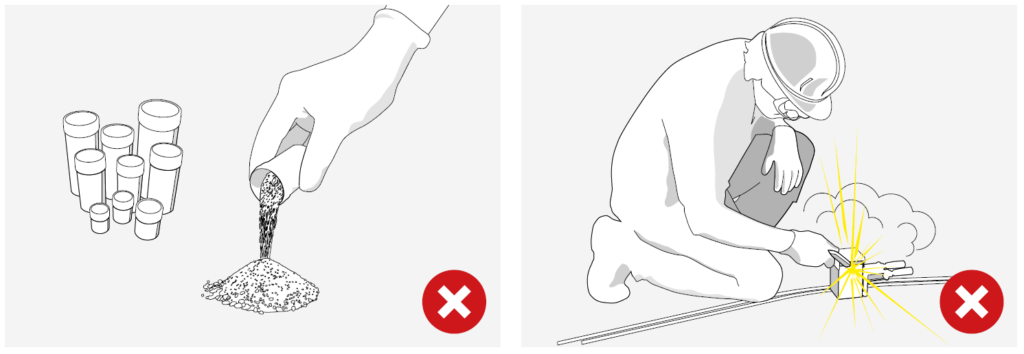
Traditionally, exothermic welding required the user to be provided with multiple cartridges with different welding powder weights for establishing various connections.
Once the conductors were inserted in the graphite mould the welding compound and the reactive powder (usually a flammable compound) were poured into the crucible. Then a flint gun applied manually to the starting powder at arm’s length produced a spark triggering the exothermic reaction.
Apliweld Secure+ utilises exothermic welding tablets NOT powders which are activated at safe working distance to suit all conductor combinations and configurations. The exothermically welded earthing connections are engineered to provide a permanent, molecular bond that will resist corrosion and loosening.
AT3W & Thorne & Derrick
Thorne & Derrick will be working with AT3W to introduce and develop specifications and business for the Apliweld Secure+ exothermic welding system.
Jason Leatherland comments, “having worked successfully together with Thorne & Derrick in the past, I was keen to demonstrate and discuss this product system with them as I knew they would be best suited to showcase the system, and in particular, its increased health and safety benefits, to the most relevant sectors in order to increase the users efficiency and reduce the potential of site accidents from exothermic welding.”
Jonny Hewitt (T&D UK Power Team) added, “working with the UK DNO’s and their preferred ICP’s we look forward to further developing relationships and presenting the exothermic welding system to existing and new clients. We will be working closely with AT3W to introduce the product to market and improve worker and site safety in the utility industry.”
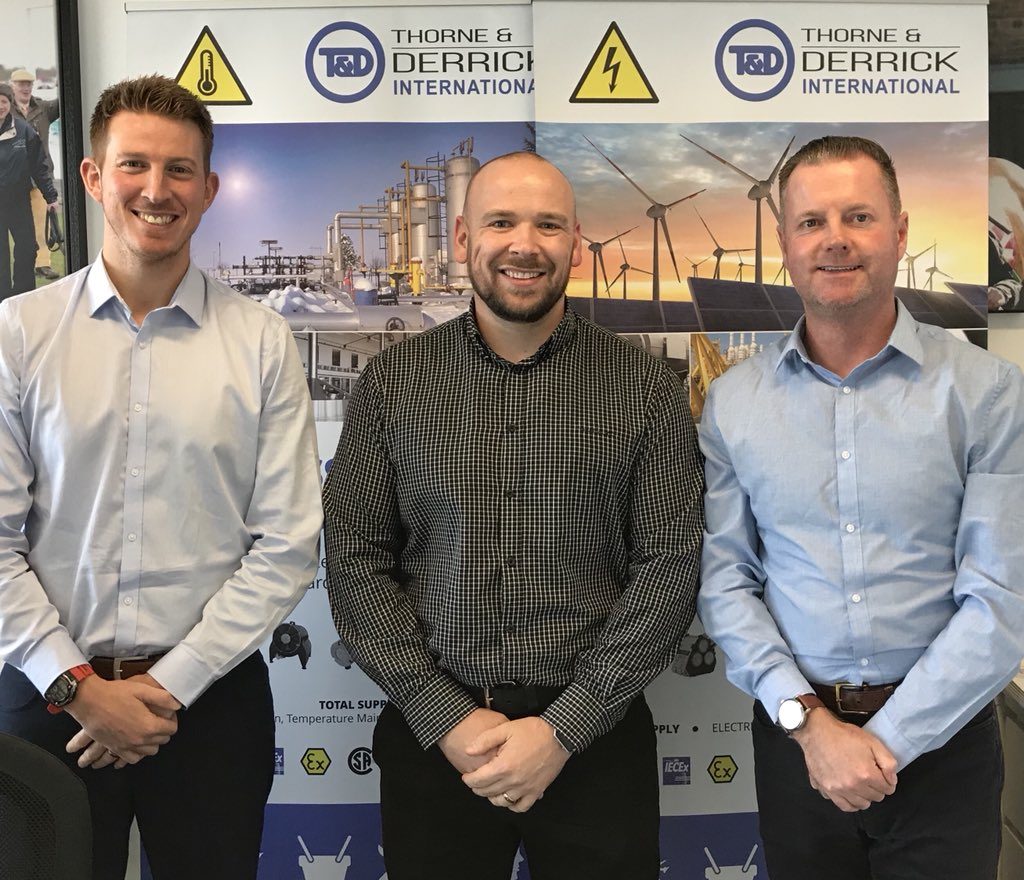
Pictured: Jonny Hewitt (T&D) with Jason Leatherland and Chris Dodds (T&D).
💡 HV Earthing & Lightning Protection Training Courses go to ➡ Online Training Resource provided by Ian Griffiths, Principal Engineer at GreyMatters. Ian is an Earthing & Lightning Consultant of 27 years, one of the top 1% UKAS accredited CDEGS consultants and professional advisor to international utility companies, data centre and infrastructure developers. See our Blog to learn more about GreyMatters and High Voltage Earthing.
Thorne & Derrick are Specialist Distributors of leading manufacturers of Cable Accessories, Substation Earthing, Jointing & Installation Equipment.
LV MV HV cable accessories from stock used to joint, terminate, connect, cleat and gland power cables to air and gas insulated substations, transformers, switchgear and overhead line networks.
Celebrating Charlie & Ella’s Level 4 Sales Executive Apprenticeships At Thorne & Derrick International, we are proud to champion talent development and recognise the dedication required to achieve professional growth. We are therefore delighted to congratulate Charlie Baines and...
Thorne & Derrick will be Exhibiting at Solar & Storage Live UK 2026 at the NEC Birmingham from 22nd–24th September, showcasing our support for HV Cable Accessories, Joints, Terminations, Separable Connectors, Cable Tooling and Grid Connection Products used across...