Arc Flash Protection
Arc Flash – The Definitive Guide to Protecting Lives
May 25th, 2021
Arc Flash Clothing
ProGARM are a market-leading Arc Flash Clothing, Garment & PPE manufacturer, delivering the ultimate in arc flash protective clothing and worker protection without compromising on wearer comfort.
Specialist Distributor & Customer Service
Thorne and Derrick are Approved Specialist Suppliers & Distributors of ProGARM Arc Flash Clothing & PPE providing competitive prices from extensive stocks with excellent customer service levels. We protect LV HV Cable Jointers, SAP’s, Overhead Linesmen, Substation & Electrical Engineers; whether racking and switching Medium Voltage switchgear or fusing Low Voltage feeder pillars – we have the correct clothing and workwear to provide safe protection against all calculated levels of arc flash hazards.
The dangers of Arc Flash incidents and protecting your workers with specialist Arc Flash & Flame Resistant Clothing has never been as front-of-mind as it is today and ProGARM supported by Thorne & Derrick have created the Ultimate Guide to Arc Flash which you can download your copy below.

Arc Flash Clothing | Polo Shirts | Coveralls | Helmets | Insulating Gloves
Contents of Arc Flash Guide
- What is Arc Flash
- Arc Flash Incident Reporting
- Risks & Consequences of Arc Flash
- Sectors Where Arc Flash is a Risk
- Arc Flash Test Methods
- Testing for Quality Assurance
- Testing for Quality Assurance
- Advising on Fabric
- Advising on Layers
- Questions to Ask your Customers
- Questions to Ask your Customers
- Glossary
- Resources
>> Download Your Guide To Here <<

💡 Did you know? – While high voltage equipment does increase the likelihood and intensity of arc flash explosions, they can occur in any live electrical environment – even low voltage.
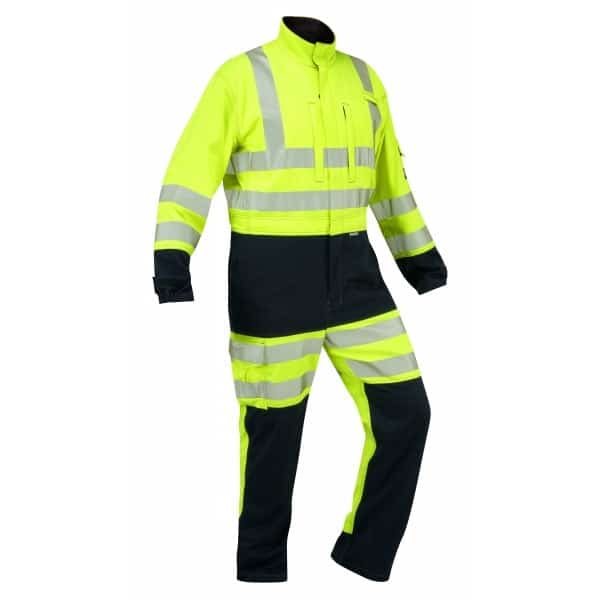
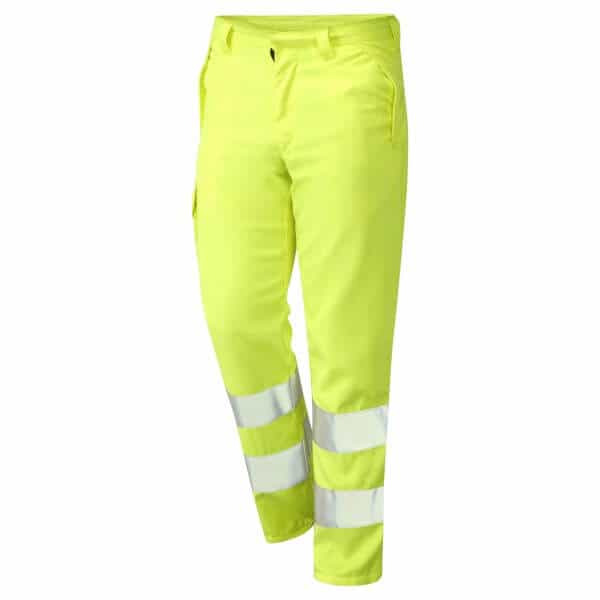
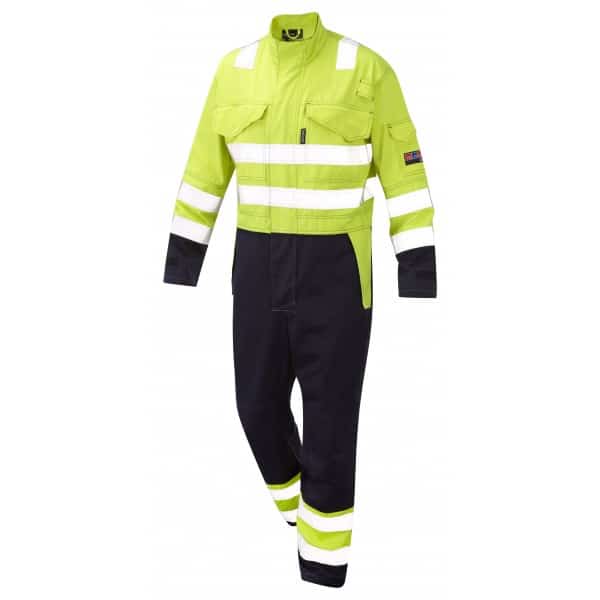
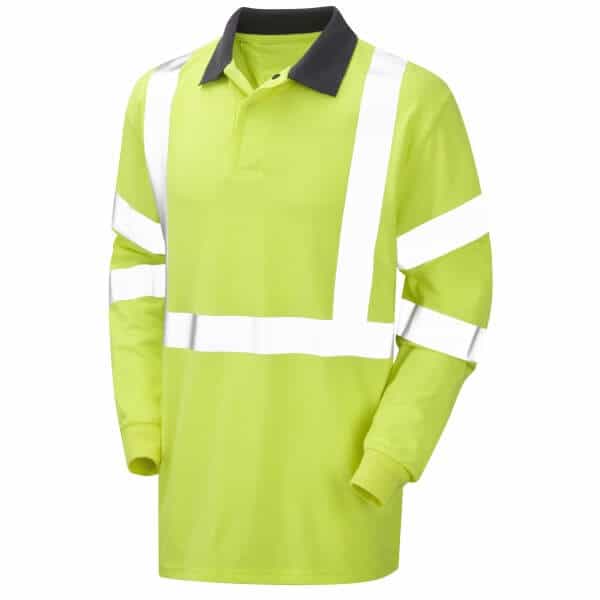
Overview of Arc Flash Clothing | Contact us to discuss your garment and PPE requirements, we can mitigate risk with guidance on safe working practices and by providing appropriate worker clothing that offers advanced Arc Flash Protection that saves lives every day. Whether working on underground cables or overhead lines, here is a selection of workwear clothing – contact us to discuss your requirements;

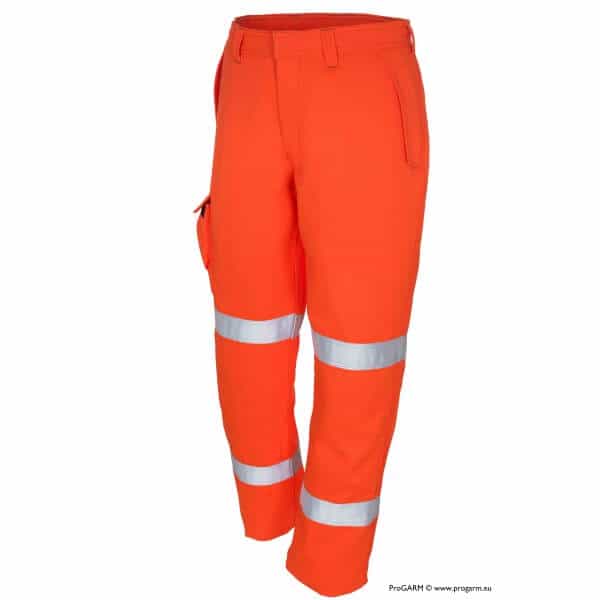
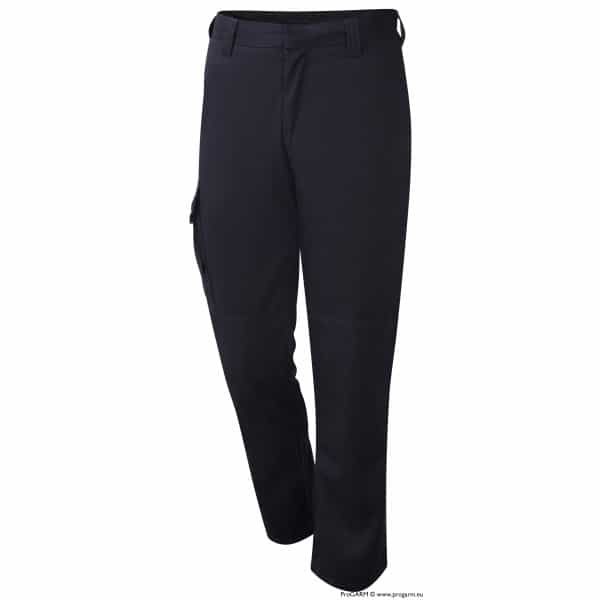




HV Cable Joints, Terminations & Connectors | Approved Stockists & Distributors | 3M Electrical (Cold Shrink) | Nexans (Euromold JTS MONO) | Pfisterer (CONNEX SEANEX) | 11kV 33kV 66kV Medium & High Voltage Cable Accessories
ProGARM Arc Flash Clothing & Accessories Resource Centre
May 12th, 2021Main UK Distributors
Resource Centre | Education & Learning with ProGarm
Thorne & Derrick provide competitive prices and fast delivery for the complete range of ProGarm arc flash clothing and accessories designed to protect people and save lives.
ProGarm offer a wide range of mens and womens arc flash garments providing comfortable protection to our clients in the LV HV Electrical Power & Substation sectors of the onshore and offshore renewable, rail, utility, data-centre and energy storage sectors.
Polo Shirts | | Coveralls | | Sweatshirts | Helmets | Insulating Gloves
A Selection of our Top Arc Flash Blogs
See our collection of the Top Arc Flash Blogs featuring the complete range of ProGARM clothing & workwear alongside best practices for protecting your workforce against arc flash and saving lives:
- Latest Arc Flash Legislation & Regulation Explained By ProGARM
- Arc Flash PPE Safety | Guidance On Protecting UK Rail Contractors
- Arc Flash | Customer Testimonial | Utility Cable Ploughing
- Arc Flash Clothing Saves Lives | Watch Eddies Story
- IEC 61482-2 | Arc Flash Standards For Protective Clothing
- Arc Flash Protection | A Whitepaper on Clothing & Garment Selection
- Arc Flash PPE | 7 Top Considerations
- Can Arc Clothing Save Utility Workers Lives?
- Arc Flash Protection Hoodie with FR Protection | ProGARM 5530
- New Arc Flash Coveralls from Protection Specialists ProGARM
- Arc Flash Garments & Protection For Safe Windfarm & Wind Turbine Working
- Arc Gloves | New Arc Flash Dexterity Gloves From Protection Specialists ProGARM
- The Definitive Guide To Arc Flash By ProGARM
- NEW | Arc Flash Hoods From Protection Specialists ProGARM
- Arc Clothing Ranges | New ProGARM Lightweight Arc Flash Protection Garments
- The Material Difference | Inherent v Treated Fabrics for Arc Flash Clothing & Protection
- Avoiding Danger From Underground Services | An HSE Document
- NEW PRODUCT LAUNCH | RIS-3279-TOM Tested Arc Flash Coveralls (Hi-Vis Orange) | ProGARM 4693
- The Arc Flash Risk in Electric Metering
- Arc Flash Garments & Clothing | The Top 10 Sellers
- Arc Flash Survivor Story – Jason Brozen
- Arc Flash Kit | Making Your Electrical PPE Work Even Harder
- Arc Clothing & Flame Resistant Clothing – What Is The Difference?
- Electrical PPE | When Will ProGARM’s Electrical PPE Gain UKCA & CE Certification?
- How Important Are Wearer Trials When Buying Arc Flash PPE?
- RIS-3279-TOM | The Orange Range of Arc Flash Clothing & Standard Overview
- Arc Flash | Don’t Let the Summer Sun Compromise Your Electrical PPE
- The Hidden Risks of Breaking Ground | Protecting Against Arc Flash
- Arc Flash Risks In The Rail Industry
- Arc Flash Safety Awareness Campaign | Service Cable Strikes – Internal Safety Training Video
- Arc Workwear Saves Lives | Watch Mitchell’s Story
- Arc Flash – The Definite Guide to Protecting Lives
- Arc Flash Clothing – PPE To Protect Highways, Street Lighting & Utility Contractors
- Arc Flash The Basics
- IEC 61482-2 2018 – Get Up To Speed With The New Arc Flash Standard
- Arc Flash Resistant Clothing Ranges | New ProGARM Lightweight Arc Flash Protection Garments
- Arc Flash | Risk Reduction by Using Arc Flash Gloves
- Arc Flash Study: Is It A Legal Requirement?
- Overhead Lines | Preventable & Fatal Risks of Electrocution & Arc Flash Incidents
- Arc Flash – The Electrician’s Insidious Companion
- Introduction To Arc Flash
- Overcoming Arc Flash Hazards
- Do Insulating Gloves Provide Arc Flash Protection?
- Arc Flash Calculation – Selecting Clothing & PPE To Protect Lives Against Arc Hazard
- 5 Arc Flash Risks for Solar Industry Personnel
Arc Flash Learning & Resources

Thorne and Derrick are proud to be distributors of ProGARM arc flash coveralls and protection.
We can help – should you require arc flash calculators or advice on the type of clothing and protection available please do not hesitate to contact us.
Arc Flash PPE Safety | Guidance On Protecting UK Rail Contractors
January 12th, 2021ARC FLASH PPE SAFETY
STEP UP FOR SAFETY – “Do we do enough to Protect Civil & Utility Contractors within the railway boundary?”
Guest Article | The following article has been republished with the kind permission of Integrum Power Engineering.
Integrum Power Engineering are committed to providing highest quality engineering services and solutions designed to add value to their clients’ businesses whilst maintaining a zero-harm approach to safety and the environment – operating in all sectors and industries where power distribution engineering services are required, including renewables, utilities, oil and gas, mass transit, private networks and independent connections.
LV HV Power Engineering Services
– Network modelling and fault analysis
– Power distribution network protection scheme design
– Protection relay settings and Programmeable Scheme Logic
– IEC 61850 substation automation design
– Protection transformer sizing and specification
– Protection & Control and SCADA interface design
– Substation earthing system analysis, modelling and detailed design
– Substation LV and domestic services design
– Substation protection & control panel secondary design
You can contact Integrum Power Engineering here.
Last year an article had been produced assessing the types of Arc Flash Risks and the prevention of those same risks through the implementation of effective Arc Flash Clothing & PPE for workers in the UK Highways & Street Lighting industry.
With the incident at Network Rail’s Godinton Substation in December 2018, still at the forefront of our minds at Integrum Power Engineering, the question that has been raised is: “Do we do enough to Protect Civil & Utility Contractors within the railway boundary?”
What is Arc Flash?
Electrical arcing (sometimes called a ‘flashover’ or ‘arc flash’) can generate intense heat leading to deep-seated and slow healing burns. The intense ultraviolet radiation from an electric arc can also cause damage to the eyes.

An arc fault is similar to the arc obtained during electric welding and the fault has to be manually started by something creating the path of conduction or a failure, such as a breakdown in insulation or contact with a conducting object.
When the air quality or insulation is degraded with moisture or other impurities, the possibility of an arc striking is increased. The arc column temperature can vary from 5,000ºC to 20,000ºC and the intense heat can vaporise the conductors and surrounding materials.
It can cause severe shock waves, splattering of molten debris, loud explosions due to the rapidly released vapour, as well as shrapnel and serious burn injury to anyone in the vicinity. The arc has a tendency to move away from its source.
What do the statistics tell us about Arc Flash incidents?

Cable strikes are one of the most common causes of an Arc Flash, with approximately 60,000 strikes taking place in the UK per year.
The HSE states that around 1,000 workplace electrical incidents are reported to them each year, with around 25 people a year dying from their injuries.
It can be assumed that the proportion of incidents which resulted in life changing injuries or death being caused by Arc Flash incidents are likely to be even higher.
Alarmingly, ProGARM’s recent research revealed that a staggering 57% of electrical workers had first-hand experience of an Arc Flash incident having experienced or seen someone else suffer a strike during their career. This supports that the frequency of Arc Flash incidents that occur are far higher than the officially reported electrical incident statistics to HSE.

LVac Arc Flash victim in USA
Despite being extremely dangerous – potentially fatal for those caught in one – the UK’s Health & Safety Executive (HSE) categorises such reportable incidents together with all other electrical work incidents.
Arc Flash UK Legislative
Regulation 4(1) of the Electricity at Work Regulations 1989 states
‘All systems shall at all times be of such construction as to prevent, so far as is reasonably practicable, danger’.
Regulation 2(1) of the same regulations defines danger as meaning the risk of injury and
‘injury means the death or personal injury from electric shock, electric burn, electrical explosion or arcing, or from fire or explosion initiated by electrical energy, where any such death or injury is associated with the generation, provision, transmission, transformation, rectification, conversion, conduction, distribution, control, storage, measurement or use of electrical energy’.
Electricity is a hazard, and the risks posed are electric shock, burns, fires, arcing and explosion. Regulation 3(1) of the Management of Health and Safety at Work Regulations 1999 states:
‘every employer shall make suitable and sufficient assessment of: (a) the risks to the health and safety of his employees to which they are exposed whilst they are at work; and (b) the risks to the health and safety of persons not in his employment arising out of or in connection with the conduct by him of his undertaking, for the purpose of identifying the measures he needs to take to comply with the requirements of and prohibitions imposed upon him by or under the relevant statutory provisions and by Part II of the Fire Precautions (Workplace) Regulations 1997’.
the HSE have concern about Arc Flash
There are two types of enforcement notices that have been issued by the HSE that refer to Arc Flash, Improvement Notices and Prohibition Notices. There have been 37 Enforcement Notices issued in the past few years by the HSE that concern Arc Flash. The Enforcement Notices cite the following Legislation and Regulations:
- Health And Safety At Work Act 1974 (HASAWA)
This is the “umbrella” legislation that defines how workplace health, safety and welfare is controlled. - Management of Health and Safety at Work Regulations 1999
A more detailed document that covers the principles needed to ensure workplace health and safety. This covers the need to carry out risk assessments. - Personal Protective Equipment at Work Regulations 2002
This implements the requirements of the European PPE directive. - Provision and Use of Work Equipment Regulations 1998 (PUWER)
Covering the provision of safe working equipment and the training in its operation. - Electricity at Work Regulations 1989
General electrical regulations that cover working on or around electrical equipment including live systems.
Network Rail’s response to Godinton Substation Incident
Following the Godinton incident, the minimum requirements for Arc Flash PPE have been enhanced.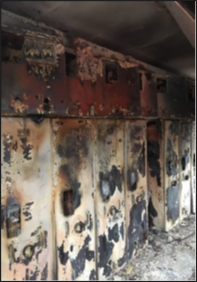
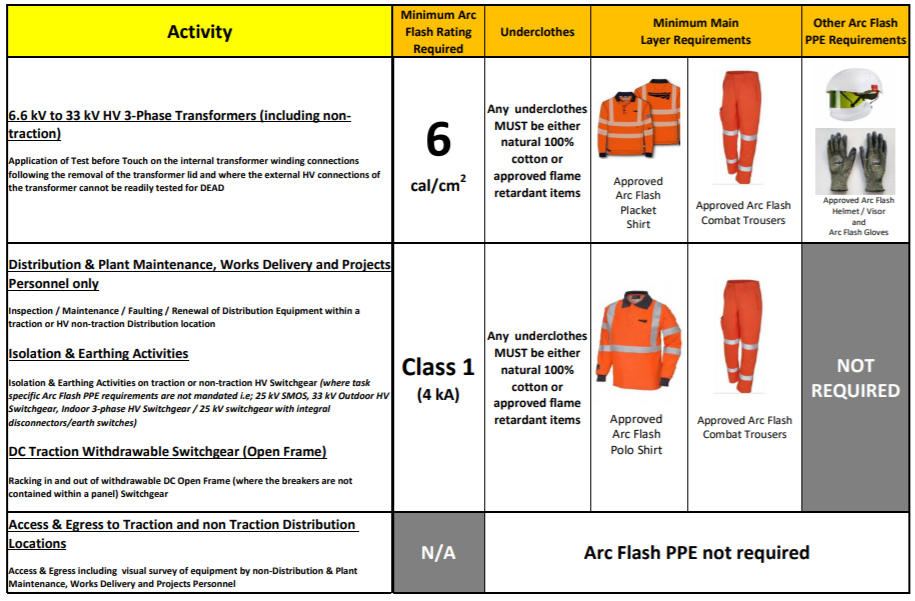
But the enhancements are only limited to Distribution & Plant maintenance and projects staff who undertake work inside traction / non traction distribution locations, which are required to wear the following at all times:
- Main layer – Arc Flash polo shirt and Arc flash cargo trousers
- Any Base layer underclothes MUST be either natural 100% cotton or approved flame retardant items

Does the Network Rail response go far enough?
In May 2015, an Injured Person (IP) undertaking work on behalf of Amey was removing the bottom of a concrete service box with a hand-held breaker machine to lay a cable duct in a non railway environment. The IP hit a live 11,000Vac cable that was under the box and received an electric shock. The IP’s clothing caught fire and sustained serious burns to their face, chest, arms, hands, legs and stomach.
The IP was put in a medically induced coma for two weeks and has undergone several skin grafts. The accident also affected their eyesight and heart rhythm, while nerve damage means they no longer have full use of their left hand. The IP still attends physiotherapy appointments and has been unable to return to work.
Amey stopped work immediately after the accident and has since reviewed its safety procedures and operating practices. Amey now mandate the requirement that all workers wear arc flash personal protective equipment. Amey has also appointed an Electrical Duty Holder and improved its risk assessment process and increased supervisor training.
Operatives are exposed to arc flash risks if correct digging procedures are not followed while excavating underground electricity cables – operatives have suffered arc flash burns when digging with a hammer drill directly above an identified live buried cable. Upon making contact with even a 415Vac street lighting cable, ‘arc flash’ would still occur resulting in burns to the wrist and elbow and a visit to the hospital A&E. Never dig directly over an identified live buried service. Powered hand tools used close to live cables are likely to represent the greatest risk of injury.
what does Arc Flash Risk Management Good Practice look like?
In brief, good practice can be achieved by implementing certain tasks:
1)Calculate the Arc Flash Incident Energy Levels and Arc Flash Boundary Distances on each piece of equipment that is connected to your Electrical Distribution Network.
2)Label the equipment with the calculated values and recommended Personal Protective Equipment (PPE) that could be used to mitigate the risk.
3)Reduce the arc flash incident energy levels. (where practicable)
4)Carry out task-based arc flash risk assessments on the equipment with the highest levels of incident energy.
5)Give your staff the competence to understand Arc Flash Risk and how they can mitigate it.
6)Ensure visitors and contractors on your site understand their responsibilities in ensuring that your arc flash risk is managed appropriately.
Is Carrying Out An Arc Flash Study
A Legal Requirement In The UK?
The simple answer is yes. By virtue of Regulation 4(1) of the Electricity at Work Regulations 1989 and Regulation 3(1) of the Management of Health and Safety at Work Regulations 1999, the need to carry out a suitable and sufficient risk assessment of risk and to put measures in place to protect those who could be put at risk is mandated.
Regulation 4(1) of the Electricity at Work Regulations 1989 states ‘All systems shall at all times be of such construction as to prevent, so far as is reasonably practicable, danger’. Regulation 2(1) of the same regulations defines danger as meaning the risk of injury and ‘injury means the death or personal injury from electric shock, electric burn, electrical explosion or arcing, or from fire or explosion initiated by electrical energy, where any such death or injury is associated with the generation, provision, transmission, transformation, rectification, conversion, conduction, distribution, control, storage, measurement or use of electrical energy’.
Electricity is a hazard, and the risks posed are electric shock, burns, fires, arcing and explosion. Regulation 3(1) of the Management of Health and Safety at Work Regulations 1999 states ‘every employer shall make suitable and sufficient assessment of: (a) the risks to the health and safety of his employees to which they are exposed whilst they are at work; and (b) the risks to the health and safety of persons not in his employment arising out of or in connection with the conduct by him of his undertaking, for the purpose of identifying the measures he needs to take to comply with the requirements of and prohibitions imposed upon him by or under the relevant statutory provisions and by Part II of the Fire Precautions (Workplace) Regulations 1997’.
Current Stance and Misconception
Despite all that has been recommended by HSE a recent study by ProGARM and the British Safety Industry Federation (BSIF) revealed a shocking level of widespread industry ignorance with 25% of employers attributing the sole responsibility to the employee, not the employer, to self-protect against arc flash.
This employer-employee confrontation across the knowledge gap is exacerbated by government passivity, resulting in an unresolved tension with workers endangered daily due to lack of understanding and ultimately absence of UK legislation – until more legal action is taken, as in the USA, the stand-off prevails and the risk pervades.
So as not to get caught up in this “Mexican Standoff” mentality on TRUW, should we not “Step Up for Safety” and consider mandating Arc Flash PPE in which to further protect Civil & Utility Contractors within the railway boundary?
More findings from the BSIF report:
- 84% Understood the risk of arc flash.
- 57% Were aware of someone who has suffered an arc flash injury.
- 90% Believe revised Government guidelines or enacted legislation is required to protect workers exposed to arc flash hazard.
We’re here to help you find the right solution for your operatives who are at risk of an electric arc to make sure they come home safely.
Polo Shirts | Jackets | Coveralls | Trousers | Gloves | Sweatshirts | Helmets
Arc Flash Learning & Resources
Thorne and Derrick are proud to be distributors of ProGARM arc flash coveralls and protection.
We can help – should you require arc flash calculators or advice on the type of clothing and protection available please do not hesitate to contact us.
FURTHER READING
- Arc Flash Clothing – PPE To Protect Highways, Street Lighting & Utility Contractors
- Arc Gloves | New Arc Flash Dexterity Gloves from Protection Specialists ProGARM
- New Arc Flash Coveralls from Protection Specialists ProGARM
- Latest Arc Flash Legislation & Regulation Explained By ProGarm
- Arc Flash PPE | 7 Top Considerations
THORNE & DERRICK
Thorne & Derrick are national distributors of LV, MV & HV Cable Installation, Jointing, Substation & Electrical Equipment – servicing businesses involved in cabling, jointing, substation, earthing, overhead line and electrical construction at LV, 11kV, 33kV, 66kV and EHV. Supplying a complete range of power cable accessories to support the installation and maintenance of low/medium and high voltage power systems:
- Slip-on Cable Terminations
- Cold-shrink Cable Terminations
- Heat-shrink Cable Terminations
- Cable Joints – Heat & Cold-shrink
- Separable Connectors (Euromold)
- Surge Arresters & Switchgear/Transformer Bushings
Key Product Categories: Duct Seals | Cable Cleats | Cable Glands | Electrical Safety | Arc Flash Protection | Cable Jointing Tools | Cable Pulling | Earthing | Feeder Pillars | Cable Joints LV | Joints & Terminations MV

Arc Flash Clothing | Customer Testimonial | Utility Cable Ploughing
December 1st, 2020
Arc Flash Clothing Protection PPE
“As our last line of defence ATP Cable Plough have selected ProGARM arc flash clothing distributed by Thorne & Derrick to protect our utility workers when cable ploughing, trenching and excavating in the vicinity of live electrical cables. With a lifetime seam guarantee their arc clothing is purpose built with superior quality and industry-leading innovations to meet safety standards whilst keeping our teams comfortable in challenging environments.” Ben James, Operations Manager at ATP Cable Plough.
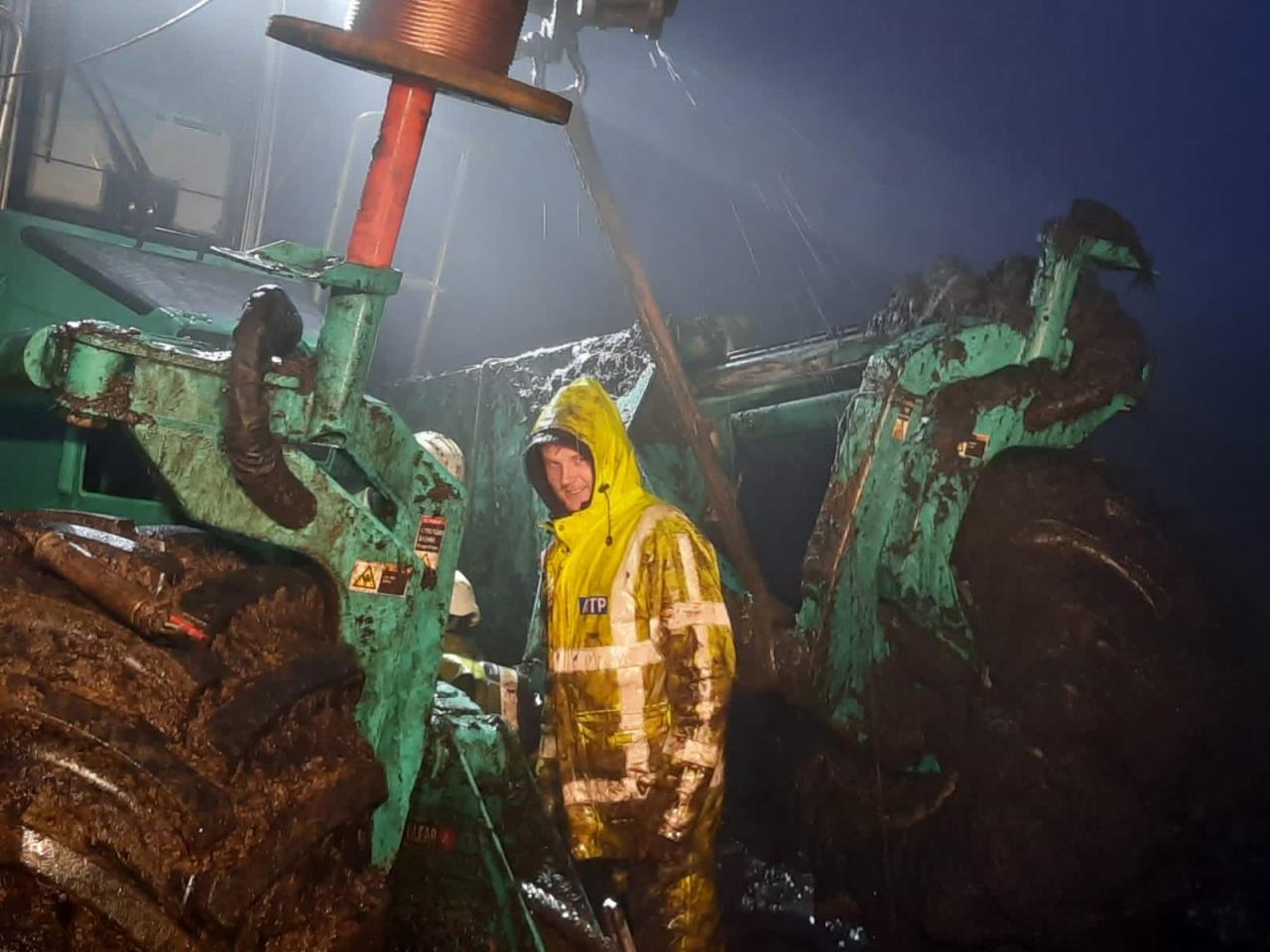
Utility Showcase: Cable Ploughing | Meet ATP The Utility Ploughing Specialists

Arc Flash Learning & Resources
Thorne and Derrick are proud to be distributors of ProGARM arc flash coveralls and protection.
We can help – should you require arc flash calculators or advice on the type of clothing and protection available please do not hesitate to contact us.
LV, MV & HV Jointing, Earthing, Substation & Electrical Eqpt
Thorne & Derrick International are specialist distributors of LV, MV & HV Cable Installation, Jointing, Duct Sealing, Substation & Electrical Equipment – servicing UK and global businesses involved in cable installations, cable jointing, substation, overhead line and electrical construction at LV, 11kV, 33kV and EHV.

THORNE & DERRICK Product Categories: Duct Seals | Cable Cleats | Cable Glands | Electrical Safety | Arc Flash Protection | Cable Jointing Tools | Cable Pulling | Earthing | Feeder Pillars | Cable Joints LV | Joints & Terminations MV HV
Arc Flash Clothing Saves Lives | Watch Eddies Story
November 23rd, 2020
Saving Lives | Arc Flash Clothing & Protection
Lifesaving Arc Flash Clothing
-
uploaded by Chris Dodds | Sales Marketing Manager at Thorne & Derrick
“If I wasn’t wearing my PPE, it probably would have been a different story.”
This Case Study focuses on the importance of wearing PPE clothing to protect against Arc Flash in the construction and utilities industries when working around buried services – it could save your life, like it did Eddie’s.
A few years ago, an operative was using a jackhammer when he struck a low voltage electrical cable, which led to an Arc Flash incident.
Fortunately, Eddie was wearing suitable arc flash clothing and PPE which ended up saving his life and protecting him from further and more significant injuries.
We were fortunate enough to meet with Eddie Smith, a Team Leader for construction firm, Clancy Docwra, and his colleagues to speak to them about the day, the incident itself and the importance of keeping people safe while at work.
Utilities | Avoiding Danger from Underground Services
Guidance is provided by the HSE HSG47 Document to utilities workers involved in commissioning, planning, managing and carrying out work on or near underground services – this includes all underground pipes, cables and equipment associated with electricity, gas, water (including piped sewage) and telecommunications.
How Arc Flash Clothing
Saves Lives
The video that ProGARM created in partnership with Clancy Docwra is to be used as part of internal training for their operatives and to better educate those working around live electricity, of the realities of the risks involved.
We thought it was too important not to show you, so please watch Eddie’s story below and feel free to share.
Jim Eldred – Operation Manager at Clancy Docwra “I received a phone call mid to late morning from Eddie’s teammate. He informed me that Eddie had had an accident and that he had suffered injuries. I was informed that it was electric and that an ambulance was on route.
For me I was scared, I was pretty worried.”
Eddie’s Jackhammer had hit a live electrical cable.
Stephen Bainbridge – Field Performance Manager at Clancy Docwra “The first thing that runs through your mind is, is Eddie okay? And then you start thinking about his children – because he had a young family and a wife. having children myself, that was my concern for Eddie, is he going to come back from this, is he going to work again? As a team we took it quite badly..”
Eddie Smith “When the Arc Flash hit me – it went so fast. And then everything that happened after seemed to go in slow motion. There were these thoughts running through my head; the first one being obviously my little boy, but also my family and my job, and worry about the physical injuries.
“I had burns all the way up my hands, down my neck, inside my nose, mouth and around my face. But because I wear this PPE it didn’t touch my chest, legs or arms.”
“It’s one of those things you think is never going to happen to me, I know what I’m doing I’ve been doing it years – when it does its a massive shock to you and your family.”
Stephen Bainbridge – Field Performance Manager at Clancy Docwra “We need to get across that it’s not about money, it’s not about how many jobs you get done in a day – it’s about doing that job safely. Mostly. You have to wear this PPE. If you don’t wear it you could be dead with just one cable strike.
Eddie Smith “If I wasn’t wearing my PPE, it probably would have been a different story.”
On seeing the photos, Mark Lant, a Technical Expert at ProGARM said: “Obviously, we’d prefer it if Arc Flash incidents never occurred. However, the fact is they do, and we’re pleased to see our polo shirt performing as effectively in the field as it did in the lab. We wish the operative a speedy recovery from his other injuries.”

The PPE that saved Eddie’s life.
“It’s only when you see ProGARM’s Arc Flash garments in action like this that you realise how vital they are to saving lives in the field. We can perform every test available on our range of protective clothing, but to see real garments in real situations saving real lives is the ultimate proof of our success. When an Arc Flash incident occurs, we know that our protective garments are up to the job.”
Thankfully, Eddie made a full recovery in the end and is now back at work. Make sure that your team can do the same.
Remember, PPE is the last line of defence. Make sure you have safe working procedures in place before undertaking any work near live electricity.
Stay safe and don’t compromise.
Further Arc Flash Reading
- Arc Flash PPE | 7 Top Considerations
- Arc Flash The Basics
- 5 Arc Flash Risks for Solar Industry Personnel
PROGARM | THE ARC FLASH SPECIALISTS

Specialist Distributor & Customer Service
Thorne and Derrick are Approved Specialist Suppliers & Distributors of ProGARM Arc Flash Clothing & PPE providing competitive prices from extensive stocks with excellent customer service levels. We protect LV HV Cable Jointers, SAP’s, Overhead Linesmen, Substation & Electrical Engineers; whether racking and switching Medium Voltage switchgear or fusing Low Voltage feeder pillars – we have the correct clothing and workwear to provide safe protection against all calculated levels of arc flash hazards.
Overview of Arc Flash Clothing | Contact us to discuss your garment and PPE requirements, we can mitigate risk with guidance on safe working practices and by providing appropriate worker clothing that offers advanced Arc Flash Protection that saves lives every day. Whether working on underground cables or overhead lines, here is a selection of workwear clothing – contact us to discuss your requirements;
>> Download Your Guide To Here <<
HV Cable Joints, Terminations & Connectors | Approved Stockists & Distributors | 3M Electrical (Cold Shrink) | Nexans (Euromold JTS MONO) | Pfisterer (CONNEX SEANEX) | 11kV 33kV 66kV Medium & High Voltage Cable Accessories