Blog
Why Is Electrical Safety Important?
April 19th, 2022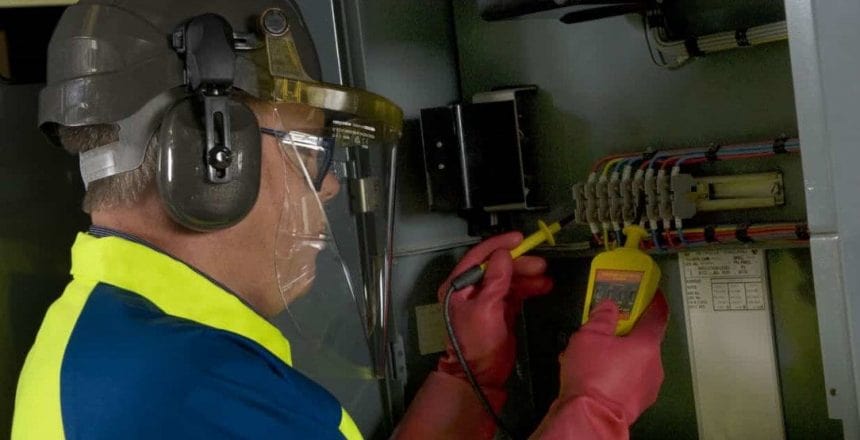
Electrical Safety In The Workplace
- Special thanks to MD at Electrical Safety UK for the kind permission to republish
Electrical safety
Identify Electrical Safety Hazards
You cannot smell, hear, or see electricity, so making sure you have the right systems in place to manage this hazardous energy is critical to the wellbeing of your employees and your Company.
There are two major hazards of electricity:
- Electric Shock
- Arc Flash
Electrical safety is important because hazards such as arc flash and shock can result in death if you are exposed to them. Fortunately, the likelihood of this occurring is relatively low. However, the control measures that prevent these hazards require careful management, attention to detail and technical competence.
Injuries that can result from electric shock are as follows:
- Cardiac arrest due to the electrical effect on the heart
- Muscle, nerve, and tissue destruction from a current passing through the body
- Thermal burns from contact with the electrical source
- Falling or injury after contact with electricity
Injuries that can result from arc flash are as follows:
- Burns from the high temperatures produced by the arc
- Blindness from the ultra-violet light produced by the arc
- Hearing loss caused by the pressure wave from the arc blast
Comply with Electrical Safety Legislation
Not surprisingly there is legislation in place that aims to regulate these electrical hazards. The three main ones are:
- Health and Safety at Work Act – Primary piece of legislation covering occupational health and safety in Great Britain. It sets out the general duties which:
- employers have towards employees and members of the public
- employees have to themselves and to each other
- certain self-employed have towards themselves and others
- The Electricity at Work Regulations – expand on the rules regarding electrical safety in the Health and Safety at Work Act 1974. Employers are given duties and responsibilities to make sure that all work activity that uses or may be affected by electricity is done safely, and that all foreseeable risks are assessed and minimised as much as possible.
- Management of Health & Safety at Work Regulations 1999 – Employers are required to undertake an assessment of the risks to the health and safety of their employees and other people who may be affected by their work activity.

More Electrical Safety Products for LV MV HV Cables, Conductors, Substations & Overhead Lines
Managing Electrical Risk is Important
We will now try to answer the question: What should you have in place to manage electrical risk?
In a nutshell, it is important have an Electrical Safety Management System in place. What does that consist of, you may ask? It depends upon the size of your organization, but let us assume you are a large company, you should have something like the following in place:
- Electrical Safety Rules – including training, compliance, and auditing.
- Electrical Safety Instructions typically these may cover subjects such as:
- Arc Flash
- Live Working
- Design Standards
- Earthing Systems
- Tools and Test Equipment
- Hazardous Areas
- Lightning Protection
- Electrical Maintenance
- Electrical Isolation and Immobilization
- Fault finding and phasing out
- Excavations and cartridge tools
- Ageing and obsolescence
- Fire Systems
- Electrical Permit System – typically:
- Low Voltage Permit to Work
- Limitation of Access
- High Voltage Permit to Work
- Isolation Certificate
- Sanction for Test
- Sanction for Live Work
- Electrical Authorisation System – You should have different levels of authorisation for electrical personnel that limits what work they can do. You may have several different levels of authorisation such as:
- Senior Authorised Person
- Authorised Person
- Competent Person
Take our free electrical safety self assessment for a formal report on your current situation.
Within each category there can also be different levels of authorisation dependent upon the competency required to undertake certain tasks.
1. Electrical Competency Management System:
This should describe how you manage electrical competence, from recruitment through to technical competence requirements for each electrical role within your organisation.
2. Organisational Arrangements:
This should describe who is responsible for electrical safety and how your organisation is set up to manage electrical safety, including individual roles and responsibilities.
Electrical Safety Management is our core business. We provide expert consultancy and advice services for blue chip organisations across Europe concerned with the safe management of risk associated with all electrical work activities.
Electrical Safety UK provide a multi-faceted holistic approach including a full electrical safety management programme, project management and policy documentation all bespoke to the client’s requirements including fully accredited and bespoke training courses and personnel assessment programmes.
2 Genesis Business Park
Sheffield Road
Rotherham
S60 1DX
Tel: 0800 652 1124
Tel: 01709 961 666
Email: [email protected]
To find out more information click here
Electrical Safety Providers
We protect substation engineers, asset managers, SAPS, cable jointers, overhead linesmen and utility workers with PPE and safety equipment: this includes insulating gloves, arc flash clothing, voltage detectors, insulating matting and portable earthing to ensure worker safety when carrying out repair and maintenance on LV-HV switchgear, transformers, substations and turbines.
All of our Cable Connection & Energisation Accessories including Medium & High Voltage joints, terminations, connectors and cleats are tested to the latest international standards and supporting ranges of professional installation tools are stocked to reduce incident, accident and downtime to plant and people.
Cable Socks – Proper Usage, Maintenance & Inspection for Pulling-in Cable
April 19th, 2022
Thorne & Derrick | Jointing, Termination & Pulling Equipment
Cable Socks
Have You Inspected Your Cable Socks?
Inspecting cable socks (also known as a cable grip and cable stocking) is not an exact science, but is crucially important to ensure safe cable pulling operations, maximum grip strength and grip longevity. There are a number of variables that can weaken cable socks that are not immediately obvious on visual inspection. However, there are some important and simple checks that you can do routinely to mitigate product wear, deterioration and potential accidents from happening.
When inspecting a cable grip, it is critical to know the potential damage and trouble spots. Below highlights the type of damage you need to be aware of prior to beginning any pulling project with your cable socks.
CABLE Sock INSPECTION
Safety is Slingco & Thorne & Derrick’s primary concern.
The products manufactured by Slingco are safety critical and must be used by competent trained personnel – it is essential to choose the right cable grip for the job. Inspecting a cable grip is not an exact science. There are a number of variables that can weaken a cable grip that are not immediately obvious on visual inspection.
This is why we work to Factors of Safety.
It is important to know the difference between Working Load and Approximate Break Load, and how to use the Factor of Safety to calculate the Working Load Limit for the cable grip that will be utilized. To maximize grip performance, we highly recommend utilizing banding on the ends of cable grips, as shown in the figure below.
WLL = ABL ÷ FoS
Cable Grip Factor of Safety (FoS) *
- Overhead Pulling – 5 : 1
- Underground Pulling – 3 : 1
- Cable Supporting – 10 : 1
WORKING LOAD LIMIT
The Working Load Limit (WLL), sometimes also known as the safety working load, is the mass that the equipment being used can safely hold, pull, or lower without breaking. In short, it’s the maximum load that can be applied to the product safely when in general service.
The Approximate Break Load (ABL) is the load at which a new grip can be reasonably expected to break. This is measured on a straight line pull only, as side pulling, or angular loads, will produce different results.
The Working Load is calculated by dividing the Approximate Break Load (ABL) by the Factor of Safety (FoS). No component in the system should exceed the working load for the cable grip.
The Factor of Safety (FoS) is the “extra” coverage of the breaking load over the over the working load expected. Factor of Safety is often noted as “X to 1” or “X:1”. The Factor of Safety accommodates normal spikes in load tension that may occur when under load.
Note: Slingco recommends double banding the ends of cable socks.
When you are inspecting a cable sock, it is critical to be able to identify damage or potential trouble spots. The following are some of the types of damage you should be aware of prior to beginning a pulling project with your cable grips. If these are observed, replacement of grip should be considered.

Pulling & Supporting Power & Subsea Cables in the Wind Sector | These cable socks manufactured from offshore/marine grade type 316 Stainless Steel are suitable for use in the renewable energy sector in applications such as cable installation (onshore and offshore), cable support inside wind turbines and cable management – used to pull, protect and support wind turbine cables. Pictured: June 2020 : the first of two export cables, each 37 kilometres in length, has been installed at the nearshore of Thorntonloch Beach as part of construction of the Neart na Gaoithe (NnG) Offshore Wind Farm.
CABLE SOCKS & PULLING PRODUCTS LV MV HV
Complete range of LV, MV and HV cable pulling products for installation and enabling cable jointing in trench or ducts including LV, 11kV/33kV medium voltage (MV), 66kV/132kV high voltage (HV) and EHV transmission and distribution cables up to 400kV.
Thorne & Derrick distribute the most extensive range of Cable Installation & Electrical Distribution Equipment to the Power Transmission & Distribution industry in the onshore and offshore wind, solar, rail, oil/gas, data centre, battery storage and utility sectors.
We service UK and international clients working on underground cables, overhead lines, substations and electrical construction at 11kV and up to and EHV transmission and distribution voltages.
➡ See Also Further Reading
- Cable Laying, Installation & Support Products | MV HV Windfarm
- Thorne & Derrick Appointed Approved Stockist for UK Leading Cable Pulling Equipment Manufacturer
- NOF Members Thorne & Derrick and Slingco Ltd Supporting Cables in the Offshore Wind Industry
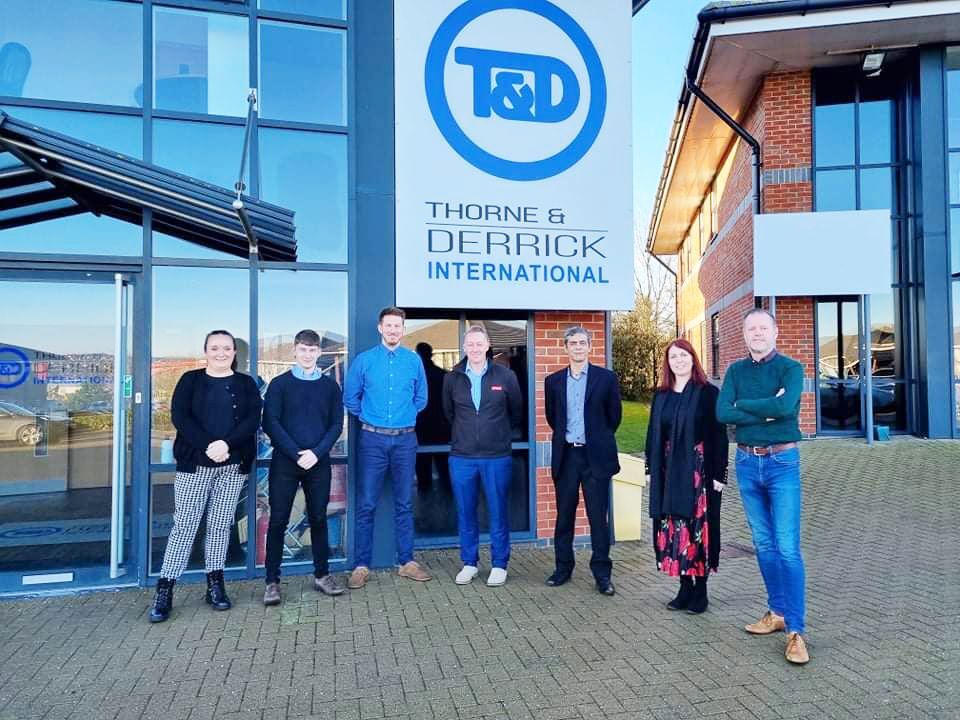
Earlier this year, Thorne & Derrick welcomed Phil Day from Slingco Limited, the world-leading manufacturer of cable pulling and support socks, swivels, cable protectors, wire rope assemblies and accessories. Phil provided an Offshore Wind focussed company presentation to our Sales Team (pictured left-to-right Sarah Henderson, Carl Cox, Jonathan Hewitt, Phil Day, Jeff Jhanke, Natalie Lundie and Chris Dodds.

Cable Rollers | Duct Rods | Cable Socks | Cable Lubricant | Duct Seals | Cable Duct
On-line Partial Discharge Monitoring & Location on a 33kV Offshore Wind Farm Export Cable
April 19th, 2022
-
Special thanks to Jordan Edmenson at HVPD for the kind permission to republish
Link to the original article can be found here
Partial Discharge
Monitoring & Location on a 33kV Offshore Wind Farm Export Cable
Project
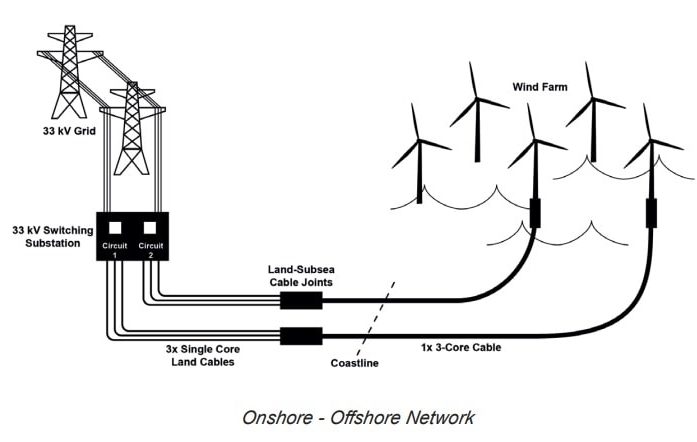
An offshore wind farm operator in the UK requested On-Line Partial Discharge monitoring and cable fault location on two 33kV XLPE land sea export cables to an offshore wind farm. The 33kV circuit began from a grid-connected onshore substation feeding a 2 km long land subsea transition joint, which in turn fed a 12 km 3-core cable directly to the offshore wind farm.
Solution
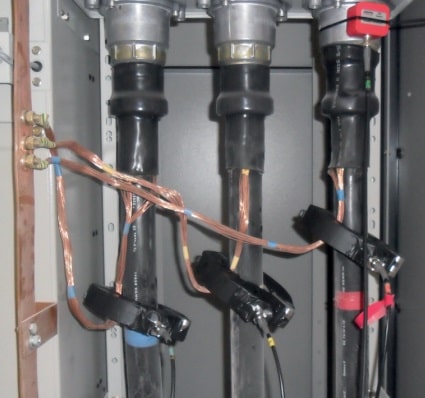
Short-term continuous monitoring was conducted using an HVPD diagnostic device connected to High Frequency Current Transformer (HFCT) and a Transient Earth Voltage (TEV) sensor.
- The HFCT and TEV sensors were installed at the cable terminations during a temporary outage
- The HFCT sensors are split core enabling them to be easily installed around the cable core and earth for detection of PD activity within the cable
- The TEV is a capacitive probe designed to detect local, high frequency PD pulses originating within the switchgear and terminations
Conducting short-term continuous monitoring over a number of days enables intermittent PD activity to be captured and correlated with other parameters such as load, temperature and humidity.
HFCT and TEV Sensors
Background Theory
If significant levels of PD activity were detected, fault location could be carried out using the cable mapping function of the HVPD diagnostic device. Cable mapping is conducted by detecting the an original PD pulse from the fault location as well as a reflected PD pulse (caused when the original PD pulse reaches the far end of the cable). Using the time delta between these pulses, and the signal propagation speed (which is provided in the cable data sheet) the approximate location of the PD source can be identified.
Results
During the short-term monitoring period, high levels of PD activity were detected with the HFCT on Phase L3 of Circuit 1. Cable mapping on this circuit was then carried out to confirm the location of the fault, with the results indicating that the source was located 800m from the onshore substation.
This result was then corroborated with the cable schedule which confirmed the presence of cable joint no.7 at this location. Based on these findings, it was recommended that the affected joint no.7 be replaced. Following this replacement a forensic analysis on the joints was conducted in which significant insulation damage and tracking within the inner insulation section was found.
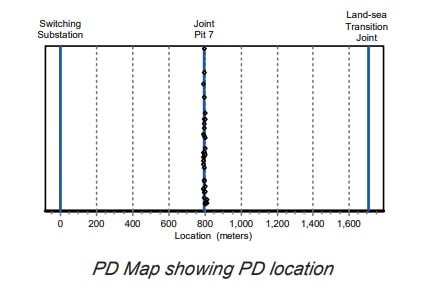
Partial Discharge Map Showing PD Location
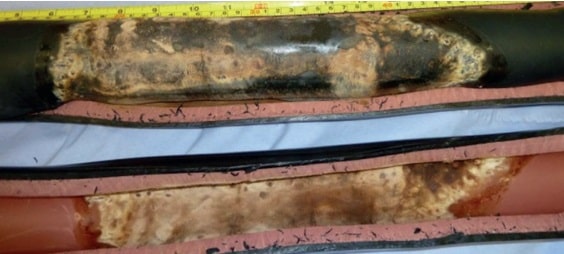
Forensic Examination of Cable Joint
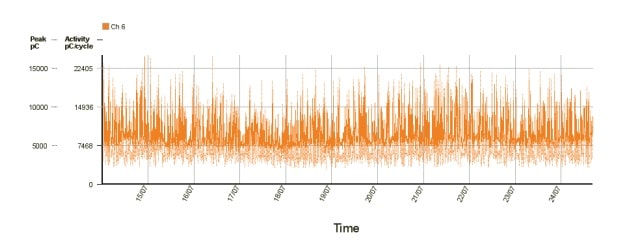
PD Trend Line Before Replacement
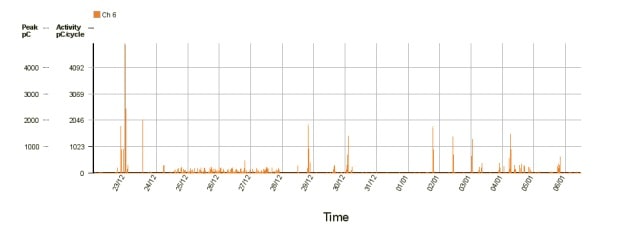
PD Trend Line After Replacement
Conclusions and Recommendations
During the short-term monitoring period, high levels of PD activity were detected and cable mapping on this circuit then confirmed the location of the fault. The affected joint was able to be taken out of service and replaced during a scheduled outage, avoiding the risk of an in-service cable failure.

About HVPD
HVPD supplies a comprehensive range of equipment to detect and monitor On-line PD for the condition assessment of in-service power cables, switchgear, motors and generators, and transformers rated at 3.3kV and above. Our PD testing and monitoring technology provide you with an early warning of developing insulation faults, helping you to avoid costly failures and resulting unplanned network outages.
To find out how we can test and monitor your cable network for PD and locate any faults, terminations or joints, get in touch today at [email protected] or call us on 0161 877 6142.
Thorne & Derrick
Specialist Electrical Distributor
Established since 1985, T&D International based in the UK distribute the most extensive range of LV, MV & HV Cable Jointing, Terminating, Pulling & Installation Equipment – contact us today for a competitive quotation.
Key Products : MV Joints & Terminations, Access Chambers, Cable Cleats, Duct Seals, Cable Transits, Jointing Tools, Feeder Pillars, Cable Duct, Earthing & Lightning Protection, Electrical Safety, Cable Glands, Arc Flash Clothing Protection & Fusegear.
Distributors for : 3M, Pfisterer CONNEX, Nexans Euromold, Elastimold, Catu, Roxtec, Emtelle, Centriforce, Lucy Zodion, Alroc, Cembre, Prysmian, Ellis Patents, ABB & Furse.

T&D Providers Of Jointer Training Courses By Pfisterer CONNEX & Nexans Euromold
Caring & Maintaining Arc Flash Clothing by CATU Electrical
April 14th, 2022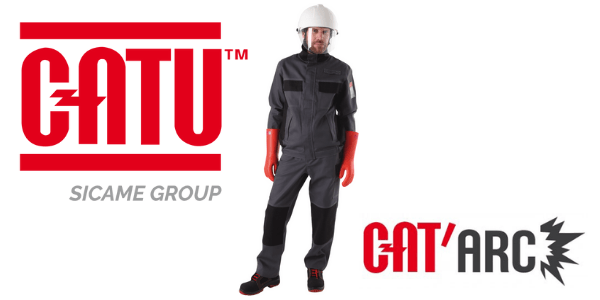
Heavy-Duty Arc Flash Clothing
Industrial Washing & Drying
Maintaining Arc Flash Clothing For Long Term Multi-Risk Protection
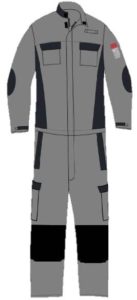
The CATU range of Arc Flash Clothing Kits are comfortable, lightweight and range from 12 cal/cm² – 40 cal/cm². The Pro Kit gathers a selection of essential garments to guarantee protection against electrical arc risks – should you require guidance on selection and use of an Arc Flash Calculator please call Thorne & Derrick.
Thorne & Derrick stock and distribute an extensive range of arc flash clothing and protection available in a range of sizes and cal ratings to ensure protection against the dangers and risks of arc flash hazards manufactured by market-leading specialists CATU.
The CAT’ARC range now offers multi-risk and Arc-Flash protection from 12 to 40 cal/cm². These comfortable garments are worn on a daily basis and therefore need to be cleaned regularly. CATU helps you to maintain their protection levels, even after many washes.

Technical and innovative, the 12 cal/cm² CAT’ARC garments have been tested according to the ISO 15 797 standard, which certifies that they retain their properties throughout their period of use. This standard verifies that our garments support global industrial maintenance solutions offered by service providers, such as professional laundries.
The arc flash protective garments were subjected to 50 wash cycles at 75 ° C and drum drying at 70 ° C – this makes it possible to check the maintenance of the different protections, the dimensional stability, the behaviour of the colours, the wrinkling, the formation of creases, the pilling and the visual.
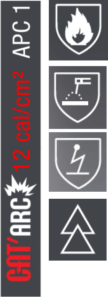
12 Cal Arc Flash Protection Kit
-
-
-
- Flame spread (ISO 11612 – A1 A2)
- Source of heat emmited by convection, radiation, or contact
- (ISO 11612 B1, C1, F1)
- Molten metal spatter (ISO 11612 E2)
- Protection against welding hazards (ISO 11611 class 2)
- Electrostatic dissipation (EN 1149-5)
- Arc-Flash resistance
- box test (IEC61482-1-2 / Box Test APC 1)
- Mechanical strength (tensile, tear)
-
-

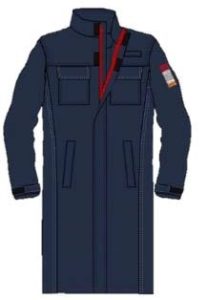
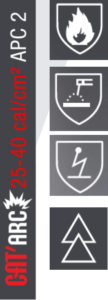
The innovative CAT’ARC 25-40 cal/cm² fabric has been subjected to 50 complete wash cycles at 40°C and tumble drying at 60°C, in accordance with ISO 6330, Household Washing and Drying Methods for Textile Testing. This standard verifies that our garments can withstand the care solutions. Thus, the fabric has been tested and validated after 50 industrial wash-dry cycles for the following performances:
25-40 Cal Arc Flash Protection Kit
-
-
-
- Flame spread (ISO 11612 – A1 A2)
Source of heat emmited by convection, radiation, or contact - (cf ISO 11612 B1, C2, F2)
- Protection against welding hazards (cf ISO 11611 class 2)
- Electrostatic dissipation (EN 1149-5)
- Arc-Flash resistance
box test (IEC61482-1-2 / Box Test APC 2) - Mechanical strength (tensile, tear)
- Flame spread (ISO 11612 – A1 A2)
-
-
Caring & Maintaining Arc Flash Clothing
Some Tips On How To Care For Your Garment
As a reminder, the useful life of clothing depends on the use of the PPE, maintenance, storage, etc. it is therefore important to take good care of your clothing and adapt the frequency of washing to the working conditions and the degree of soiling. To wash your garment properly, there are a few simple tips to follow:
- Close all hook and loop fasteners and zips. Empty all pockets.
- Turn the arc flash garment inside out to avoid damage from rubbing against the machine drum.
- Wash separately the arc flash clothing. Do not mix with ordinary garments without similar protective properties.
- Recommended washing temperature: 40°C (104ºF).
- Do not bleach the clothing.
- Tumble dry possible at 60ºC (140ºF)
Arc Flash PPE & Electrical Safety
Main UK Stockists & Distributors of Electrical Safety Products
Thorne & Derrick provide Electrical Safety Equipment to substation engineers, cable jointers, overhead linesmen and utility workers with PPE and electrical safety equipment including insulating gloves, voltage detectors, insulating matting and portable earthing to ensure worker safety when carrying out maintenance on LV-HV switchgear, substations, cables and electrical equipment.
We protect substation engineers, asset managers, SAPS, cable jointers, overhead linesmen and utility workers with PPE and safety equipment: this includes insulating gloves, voltage detectors, insulating matting and portable earthing to ensure worker safety when carrying out repair and maintenance on LV-HV switchgear, transformers, substations and turbines.
All our Cable Connection & Energisation Accessories including Medium & High Voltage joints, terminations, connectors and cleats are tested to the latest international standards and supporting ranges of professional cabling tools are stocked to reduce incident, accident and downtime to plant and people.
Thorne & Derrick Secure New Renewable MV Cable Accessory Package Contract Order
April 13th, 2022Press Release 13.4.22 by Chris Dodds | Sales & Marketing Manager at Thorne & Derrick
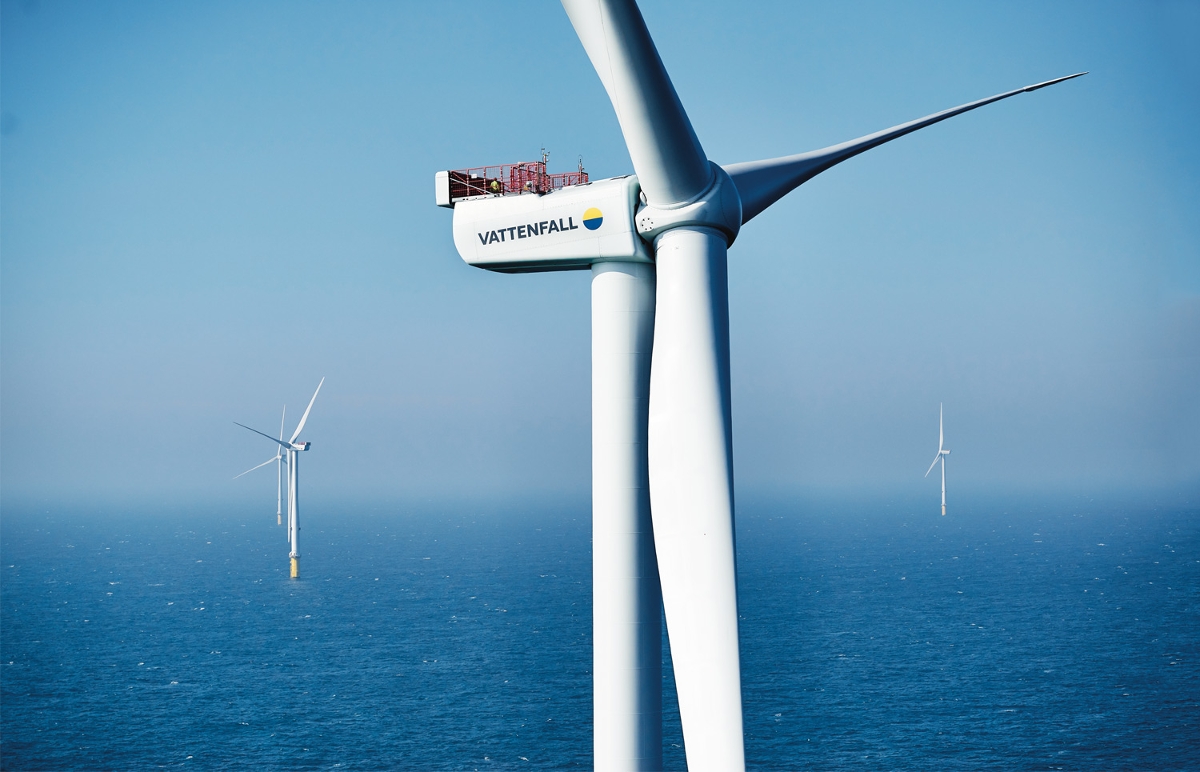
Image Credit: Vattenfall
Thorne & Derrick International, a leading UK based Specialist Distributor of LV HV Jointing, Earthing, Substation & Electrical Eqpt are delighted to confirm receipt today of a new purchase contract order for an offshore wind farm project – this is to supply 33kV Tee Connectors (NEXANS EUROMOLD) and Inline Cable Joints (3M COLDSHRINK) following several rounds of technical qualification, specification and commercial submissions.
Thorne & Derrick’s technical submission for the jointing of the 33kV cables was accepted by the Senior Lead Cable Specialist based upon their 3M QS2000 range – the cable joint designed utilises a unique Cold Shrink delivery system. The 3M Cold Shrink products are supplied pre-stretched on a removable core for efficiency and ease of installation by the jointer with an integral electrical field control device and faraday cage pre-installed in the insulation body to reduce complexity during the installation.
As Approved Vendors to Vattenfall, the Swedish multinational power company, Thorne & Derrick will be supplying a 33kV Inter-Array Cable Accessory Package including medium voltage joints, connectors and cable cleats to support the installation of 19/33 (36)kV Single Core Submarine Cable with 24 Fibers (IEC 60502-2).
The cable insulation system features water tree retardant (WTR) XLPE material, consisting of an inner semi-conductive screen, insulation and outer semi-conductive screen extruded in same operation (triplex extruded) – 3M Cold Shrink provides secure sealing and insulating of medium voltage cable termination and connections up to 36kV.
The MV cable originally manufactured by Prysmian Draka was installed by VMBMS under contract to Vattenfall Vindkraft A/S at the Horns Rev 3 project in Denmark.
Thorne & Derrick can support the specification and supply of standard and customised Cable Termination & Jointing Systems up to 66kV including separable connectors for Interface C-F Outer Cone and Size 3 Inner Cone gas insulated switchgear – extensive ranges of Cold Shrink and heat shrink jointing technologies are available from stock for immediate delivery to reduce downtime periods on unplanned cable outages.
➡ See more about Thorne & Derrick and our Renewable Energy projects.
Horns Rev 3
- Vattenfall Vindkraft’s agreement with the Danish State will make the production from Horns Rev 3 one of the cheapest in Europe, with a price for electricity of DKK 0.77 per kilowatt hour.
- With the construction of Horns Rev 3 with a capacity of 406.7 MW, Vattenfall is on its way to becoming one of Europe’s largest producers of wind power.
- For Horns Rev 3, Vattenfall has opted for the world’s most powerful wind turbine – MHI Vestas V164 of 8.3 MW.
Horns Rev 3 covers the annual electricity consumption of approximately 425,000 Danish households.

Fossil-free Living Within One Generation
Vattenfall are one of Europe’s largest producers and retailers of electricity and heat – a European energy company with approximately 19,000 employees. For more than 100 years, they have electrified industries, supplying energy to people’s homes and modernised our way of living through innovation and cooperation. We are determined to enable fossil-free living within one generation. To succeed we must become fossil free ourselves. But that’s not enough. Vattenfall are looking beyond their own industry to see how they can really make a difference. Together with their partners, they are taking on the responsibility to find new and sustainable ways to electrify transportation, industries and heating.

Supplying Cable Termination, Jointing, Pull-in & Electrical Equipment up to 66kV
Key Product Categories: Connectors, Joints & Terminations MV HV | Cable Preparation & Jointing Tools | Duct Seals | Cable Transits | Cable Cleats | Cable Glands | Electrical Safety | Arc Flash Clothing & Protection | Cable Pulling | Earthing & Lightning Protection | Feeder Pillars
Main UK Stockists for: 3M Electrical, PFISTERER Connex, Nexans Power Cable Accessories (Euromold), Alroc, Ellis Patents, ABB, Roxtec, Cembre & CATU Electrical.