uploaded by Chris Dodds - Thorne & Derrick Sales & Marketing Manager
Cable Terminations
The following information is uploaded to assist in the selection and specification of the correct Triplex terminations to suit 11kV XLPE insulated cables with copper wire screen typically in accordance with BS7870 – the cable terminations manufactured by 3M Electrical are Cold Shrink type from the QTIII range of indoor cable termination kits.
These MV HV Cable Terminations are approved for use by Northern Powergrid (NPG) jointers and their framework contractors for the termination of 11kV Triplex cables – a complete range of Cold Shrink Terminations are available for 11kV, 33kV and 66kV single and 3-core cables with XLPE or EPR type insulation.
Cold Shrink Termination
92-EP621-1-NY43
92-EP631-1-NY44
92-EP641-1-NY45
92-EP641-1-NY52
NPG Catalogue Number
163660
163661
163662
163663
Cable Termination (CSA)
95sqmm
185-300sqmm
400sqmm
630sqmm
Suits XLPE Insulation Diameter
16.3-27.4mm
21.1-38.9mm
26.7-45.7mm
26.7-45.7mm
For Example:
Northern Powergrid NPG – Bill Of Materials For 11kV Triplex Termination Kit NPG163662
Cable Termination Kit List – Triplex Terminations
SED T110-T 3M Cold Shrink Cable Termination Body x 3
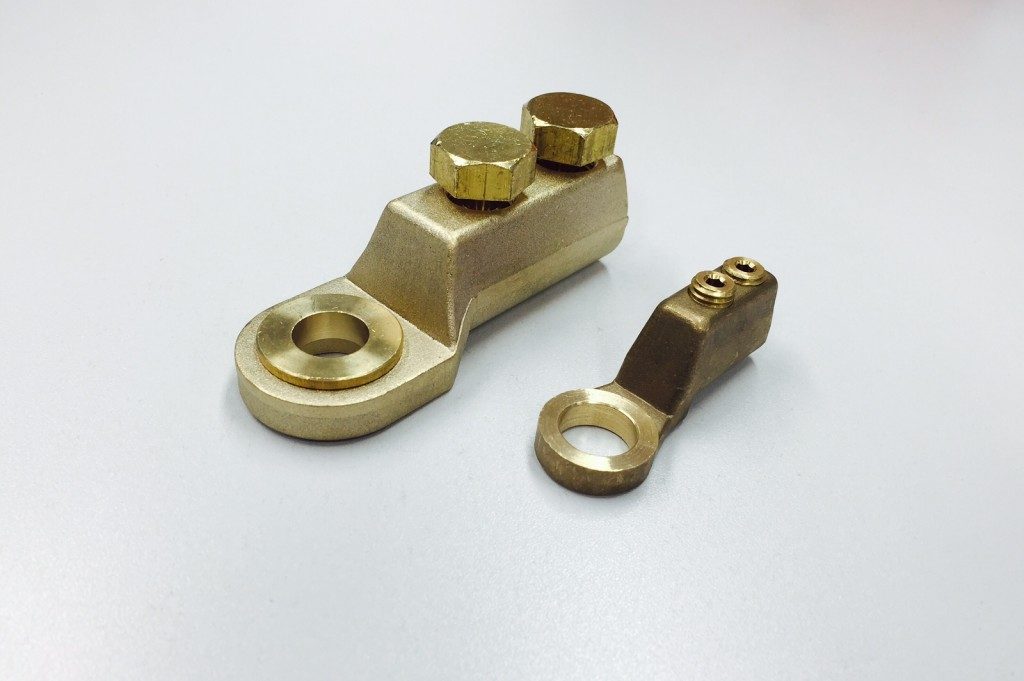
Sicame ML4 range of mechanical cable lugs are designed for the termination of stranded/solid/circular conductor cores – also used for the termination of earth screen wires of MV-HV polymeric cables as a component of Triplex terminations kits.
The mechanical lugs are manufactured in copper alloy and suitable for jointing either copper or aluminium cored conductor – see complete range of Sicame cable lugs.
NOTE: Triplex cable terminations are supplied as sets of 3 – to terminate 11kV cables onto private networks using heat shrink cable terminations please go to Triplex terminations.
T&D distribute the most extensive range of LV, MV & HV Cable Jointing, Terminating, Cable Pulling & Installation Equipment – we service UK and international clients working on underground cables, overhead lines, substations and electrical construction at LV, 11kV, 33kV and EHV transmission and distribution voltages.
uploaded by Chris Dodds - Thorne & Derrick Sales & Marketing Manager
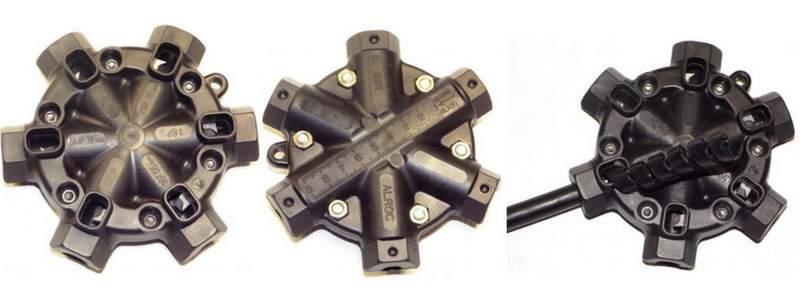
Thorne & Derrick, Specialist Distributor of LV HV Jointing & Cable Installation Equipmentare working with Alroc to improve the efficiency of cable preparation for Jointers working on LV MV HV electrical distribution systems.
The innovative Alroc DBT compact cable stripping tool is used by LV Jointers employed by NERS Accredited Independent Connection Providers (ICP’s) for the removal of the PVC outer cable sheath and primary insulation over the stranded copper or solid aluminium conductor on BS7870 Concentric & Split Concentric cables.
These LV aluminium and copper cables are approved by UK Distribution Network Operators (DNOs) including Scottish Power Energy Networks (SPEN), Scottish & Southern Energy (SSE) and UK Power Network (UKPN).
Concentric and split concentric cables have been adopted as standard for use by DNOs to provide the final connection to residential properties. Additional cable functionality includes use for LV sub-main distribution and installation within high-rise buildings (LSZH Low Smoke Zero Halogen type) and street lighting systems.
The choice between Concentric and Split Concentric cable is determined by the supply type: TN-C-S supply for Concentric and TN-S supply for Split Concentric.
Concentric Cables
Concentric cables are used for power supplies with Protective Multiple Earthing (PME) systems, where a combined Protective Earth (PE) and Neutral (N) – together known as the PEN – connects the combined neutral-and-earth to real earth at multiple locations to reduce the risk of electric shock in the event of a broken PEN.
Split Concentric Cables
Split Concentric Cables are used when the power supply has separate PE & N conductors and are only combined as PEN near the power source. The Protective Earth and Neutral are not connected after the building entry point.
Jointers Tools
Alroc DTB cable end strippers enable the user to remove the outer sheath insulation of LV cable ranging from 16sqmm up to 150sqmm. The ruler engraved in the cable jointing tool sets the length of the XLPE insulation to be removed. The DTB cable end strippers are compact, light and heavy duty and are available for different cable sections – 16-25sqmm, 35-54.6sqmm and 70-150sqmm.
Alroc offer a range of low voltage cable preparation splicing and stripping tools suitable for use prior to cable joint and termination installation.
➡ Watch the following Video which demonstrates the ease and simplicity the Jointer can remove the cable sheath and insulation from the Concentric cables prior to installing the cable joints onto the distribution network.
Alroc Tools are used and recommended by PFISTERER for MV HV cable preparation of cables prior to installation of their market-leading CONNEX plug terminations for connection to gas insulated switchgear and substations.
Thorne & Derrick
T&D are Specialist Distributors to UK Distribution Network Operators (DNO’s), NERS Registered Service Providers, ICP’s and HV Jointing Contractors of an extensive range of LV, MV & HV Jointing, Earthing, Substation & Electrical Eqpt– this includes 11kV/33kV/66kV cable joints, terminations and connectors for both DNO and private network applications.
Contact our UK Power Team for competitive quotations, fast delivery from stock and technical support or training on all LV-HV products.
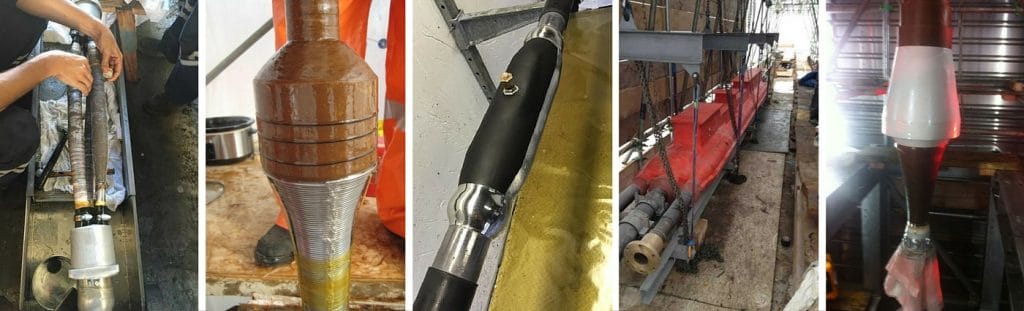
These type of cable joints must only be installed by Trained & Competent Jointers using the approved and correct Consac cable jointing tools.
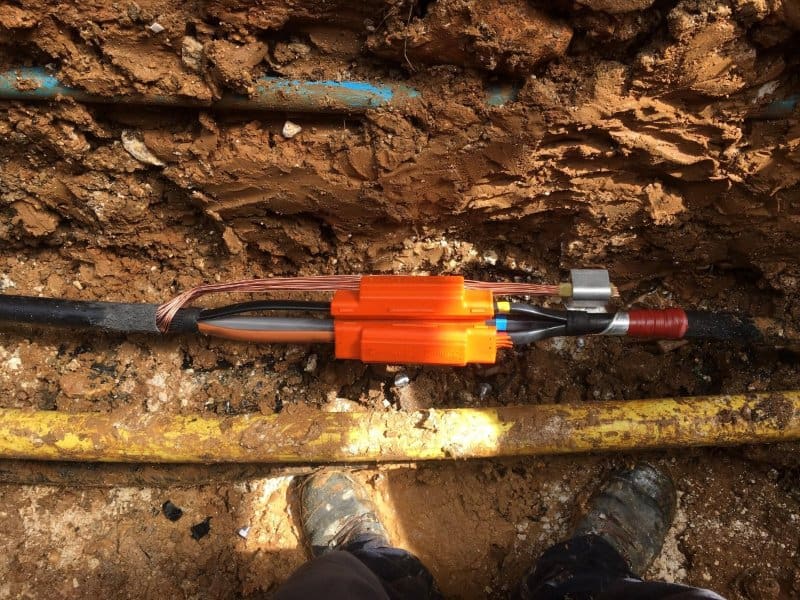
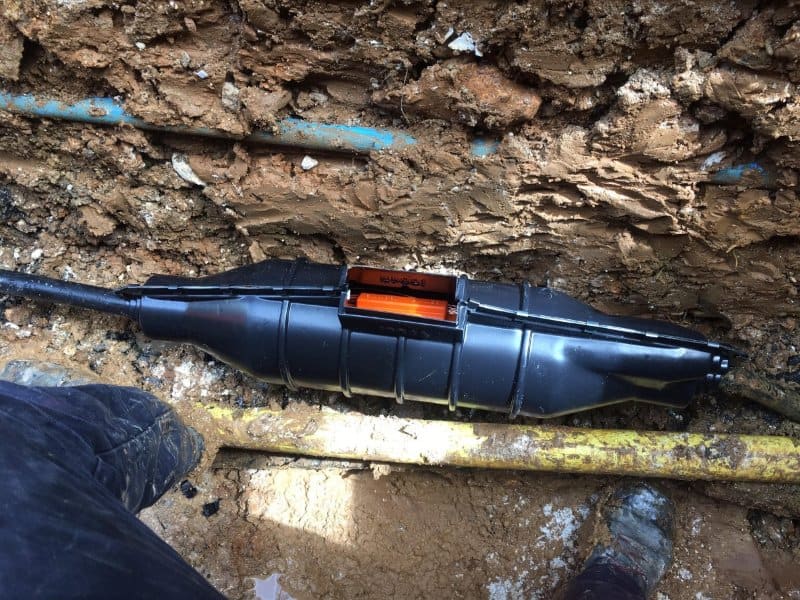
.1 x 5 Core Cu PILC STA Mains Cable to 3 Core 95sqmm Wavecon Transitional Straight Joints
Consac Live Cut & Test Whilst Fault Finding To Locate Underground Fault
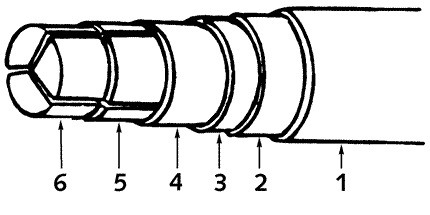
Consac Cable Construction
Extruded PVC or polythene oversheath cable jacket
Layer of bitumen containing corrosion inhibitor
Extruded smooth aluminium sheath
Paper belt insulation
Paper core insulation
Solid aluminium conductors —-
How To Remove The Aluminium Sheath From Consac Cable
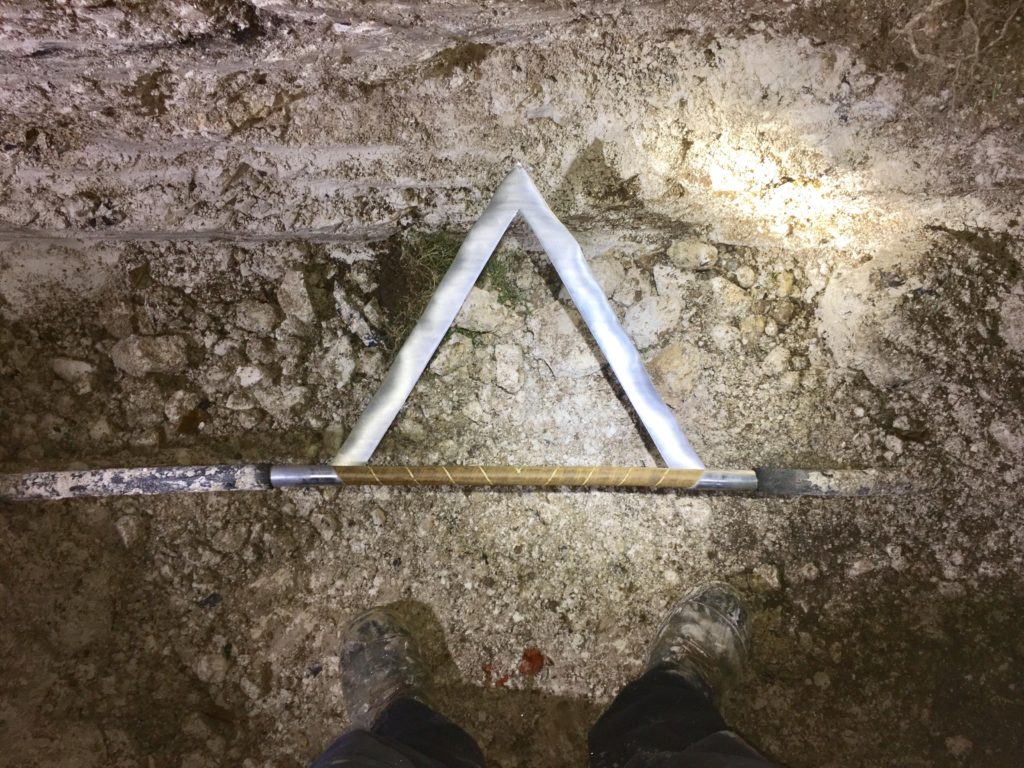
Mark the aluminium sheath at the cable joint centre and make an additional two extra marks at 60 degrees to form an arrow – this arrow MUST point to the cable jointer
Select the correct cutting wheel for the Consac sheath stripping tool according to the cable cross sectional area. The 45 thousands of an inch cutter is used for 70mm to 120mm cable, the 70 thousands of an inch cutter is used for 150 to 240mm cable
Set the angle of the Consac sheath cutting tool to 60 degrees, using the front control wheel and scale
Using the rear pressure control wheel, open then close the tool onto the first of the 60 degrees marks. Apply the light pressure then rotate the tool outward along the cable until it butts up to the PVC sheath edge, this should occur at tool bottom dead centre
Repeat this operation, moving the cable jointing tool forward and backward along the cable, gradually increasing the pressure using the rear wheel. Continue this process until scuff marks from the shoulders of the cutting wheel appear along the edges of the cut, then stop
Remove the cable cutting tool and re-set the cutter angle to 60 degrees on the opposite hand. Re-fit the tool and repeat operations 4 & 5. Remove the tool on completion
At the point where the two tool cuts join, use the edge of a six inch half round file to deepen the cut until the underlying papers begin to appear. The flat side of the file must point towards the inside of the arrow
Using a hammer and pliers lift the point of the arrow – wearing insulating gloves unpeel the aluminium sheath from the cable until the ends of the cut are reached. The sheath should now appear as shown in the illustration pointing away from the cable jointer
Fit PVC binders at the points where the underlying papers are to be terminated
Bear the cut part of the sheath flat with a pair of wooden beaters
Holes can be punched in the aluminium sheath where required using a special purpose hole punching tool
Note: Using approved cable cleaning wipes ensure that the prepared Consac cables are cleaned thoroughly and all dirt, debris or contaminants are removed.
Should you require any assistance with the selection or specification of LV cable joints, connectors or terminations please do not hesitate to contact us.
T&D distribute the most extensive range of LV, MV & HV Cable Jointing, Terminating, Pulling & Installation Equipment – we service UK and international clients working on underground cables, overhead lines, substation earthing and electrical construction at LV, 11kV, 33kV and EHV transmission and distribution voltages.
Thorne & Derrick invite you to join LinkedIn’s largest LV-HV Electrical Discussion Group : Low & High Voltage Power, Cabling, Jointing & Electricals. Discussion subjects include cable installations, cable jointing, substation, overhead line and electrical construction at LV, 11kV, 33kV and EHV. Network, engage and promote your profile, company or products with over 10,000 influencers.
The following post is provided to enable the selection of cable cleats to suit a standard UK DNO utility cable for medium/high voltage power systems – this type of MV HV cable commonly referred to as “Triplex” cable has increasingly replaced conventional BS6622 11kV 3 core XLPE insulated cable.
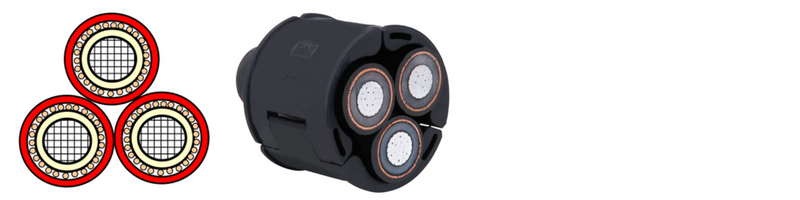
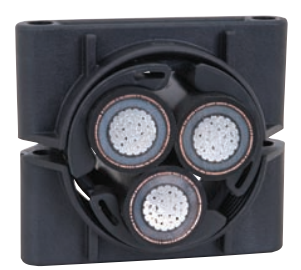
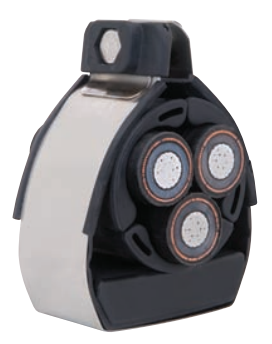
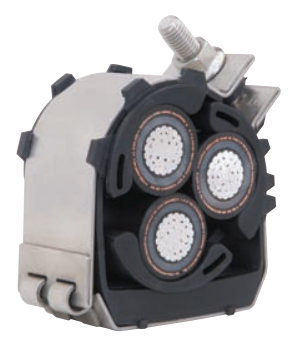
Triplex cable consists of 3 x single cores in a “twisted” spiral formation – this non linear cable orientation must be recreated into a circular formation using Triplex cable surrounds.
It is essential to effectively cable cleat Triplex cables to containment to ensure safe and reliable cable restraint in the event of a short-circuit situation – to simplify the cable cleat selection process it is a basic requirement to consider the calculated short-circuit fault current rating, installation environment and overall outside diameter of the 3 x single core cables when combined in Triplex formation.
The short circuit calculation would normally be the responsibility of the Electrical Design Engineer and can be calculated using a formula as recommended by IEC61914 the international standard which specifies requirements and tests for cable cleats and intermediate restraints used for securing cable in electrical installations.
♦ Important: Manufacturers cable dimensional data and tolerances can vary by significant % factors hence critical measurements can be inconsistent – always provide manufacturers cable specification complete with construction information to ensure supply of correct cable cleats. Above is provided for guideline purposes only – check with Thorne & Derrick.
Based on the above cable dimensions we can supply the range of cable cleats listed below.
Triplex Liner & Cable Surrounds
Ellis Patents Triplex cable surrounds are manufactured from LSF Zero Halogen Polymeric material and used within single cable cleats to secure triplex cables – the cable liner surrounds have a maximum short circuit test level of 76kA when used with Ellis Patents 2F cable clamps and 600mm cleat spacings.
Triplex Cleats
The following table provides an overview of the Ellis Patents range of Triplex cable cleats depending on levels of short circuit fault protection required by the clamps.
uploaded by Chris Dodds - Thorne & Derrick Sales & Marketing Manager
The following information is provided courtesy of Severn Trent Water as part of their series of Lessons Learn Bulletins which highlight the potential use or adoption of products to ensure cleaner, safer and more reliable distribution of water supply – specifically this short update is focussed on duct sealing to prevent pollution of potable drinking water.
Brief Description
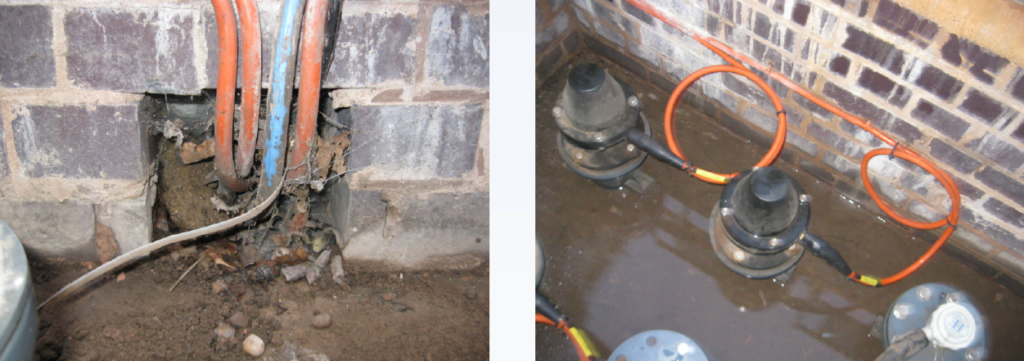
The Whitacre / Warwickshire team identified a shortfall in the way cable ducts are sealed following installation of new and the maintenance of existing assets.
This was identified as part of coliform investigations where there is a potential for water ingress into injection chambers, reservoirs and back wash tanks. Lack of correct duct sealing in this instance resulted in water entering a level probe chamber with the potential to pollute potable drinking water.
Sealing Cable Ducts
Several options to securely seal cable ducts have been investigated with support from Water R&D. As a result of findings Asset Creation updated the STW design manual for E&M Plant Electrical Design (DM0106-03) and issued a technical bulletin informing key departments, ensuring that the new minimum standard is adhered to.
Two duct sealing kits were used and approved by PH&S, both provided similar results.
PLEASE NOTE:These kits are not DWI Reg 31 approved and must not be used where direct contact with potable water occurs. Any proprietary seal kit used must be of the type listed in the Water Industry Mechanical & Electrical Specification 3.02 (SPC 0302-W302).
Lessons Learnt
Share at your Comm Cells with your operational and maintenance teams.
• During routine inspections check for any cable ducts which could possibly allow ingress into reservoirs or injection chambers which could lead to a water quality failure?
• Contact either of the above for any assistance for procuring and advice on installing the sealing kits.
• Track any next steps via your Comm Cell, raise WQ U/C and sign off when complete.
Thorne & Derrick supply an extensive range of underground cable duct and protection covers suitable for LV MV HV cable installations – this includes Tape Tile 11kV and Stokbord Covers 33kV used to protect underground power cables pulled and laid into trenches.
To promote the installation of cable into duct a labour-saving range of cable lubricants is available to facilitate friction-free cable pulling and reduce damage to cables. See our range of cable ducts suitable for low, medium and high voltage power and utility cables.
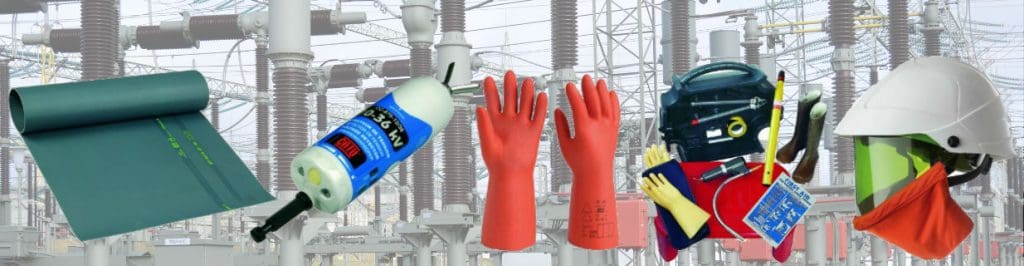
What Is Arc Flash PPE and Why Is It Important? Arc flash PPE is specialist personal protective equipment designed to help protect electrical workers against the thermal hazards of an electric arc. It includes arc-rated clothing, protective helmets, face...
Voltage detectors are electrical safety instruments used to identify the presence or absence of voltage on electrical equipment and conductors. They are used by electricians, electrical engineers, utilities and maintenance teams working on low voltage (LV), medium voltage (MV)...







 conductor on BS7870 Concentric & Split Concentric cables.