Work Type: Installing Service Termination Heads (Cut-outs ) 80- 100A
Posted By
Jordan Hamer (Recruitment Consultant at Cordant Group PLC / Utilities G.W.E.T)
My client is a successful infrastructure business offering services to the power, water, gas, rail, telecommunications and infrastructure sectors.
They have depots in Leicestershire, North London, Kent and Magherafelt.
Due to the acquisition of large contracts with DNO’s they have a large recruitment drive in progressand are recruiting teams of cable jointers for the duration of the UKPN project.
Role Outline
The Cable Jointers will be required to work in teams of 2 (Cable Jointer + Jointers Mate).
They will perform cut-outs across the M25 corridor and will be targeted to do 25 per week.
Any cut-outs completed after the 25, will be paid at £65 per cut off per jointing team.
Applicant Requirements
Jointers must have UKPN Authorisation (any area) – the successful applicants will be prepared to travel, hold EUSR Card and carry own tools.
Benefits
£500 per day per Jointing team
£65 bonus per Jointing team per cut off
Ongoing long term work up to 4 years
Immediate starts
What Next?
To apply for this role or if you would like to discuss in more detail please contact me directly or apply with an up to date CV:
At Cordant Engineering we research all aspects of low, medium and high voltage power generation, transmission and distribution, as the demands of power networks continue to grow across the UK.
A wide variety of problems can affect power anywhere and at anytime but it is by providing specialist engineering skills that consequently minimise problems encountered.
Therefore, we aim to support our clients to guarantee safe and reliable operation of LV MV HV electrical power systems today and in the future.
We have the expertise and capability to work with a range of businesses concerned with T&D, power generation, substation service and maintenance.
Staff and contractors are provided for everything from 11kV-33kV private network services to 132kV-400kV turnkey projects for all medium/high voltage cabling projects.
Our expertise covers a range of specialised sub-sectors including:
Electricity history courtesy of the Western Power Electricity Historical Society UK – photographs of pulling, laying and jointing LV up to 33kV cables from yesteryear.
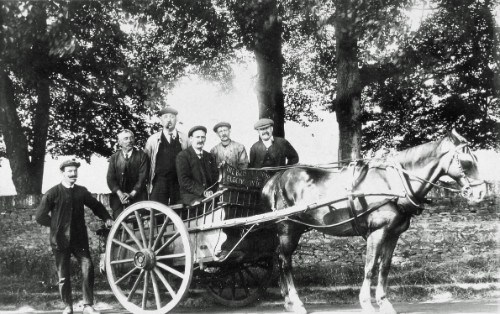
Peer into the past to a time when dapper, bowler-hatted and waistcoated Cable Gang Managers attired in three piece suits oversaw the hand pulling of cables into trenches worked by Jointers in cloth caps, trouser braces and brogues.
The first picture is poignant, The Cable Gang.
Workmates Tom, Arthur and Albert carted up and ready for a day in the cable trench.
It’s 1915 and the First World War is raging across Europe. No doubt the Gang would have friends and family in an altogether different type of trench somewhere along the muddy and bloody Western Front.
The Cable Gang – a cable jointing gang in Shirehampton Road. Bristol. Tom Webb was in charge of driving cart, tall man is Arthur Attwood and on the extreme right is cable jointer Albert Keepin (1915).
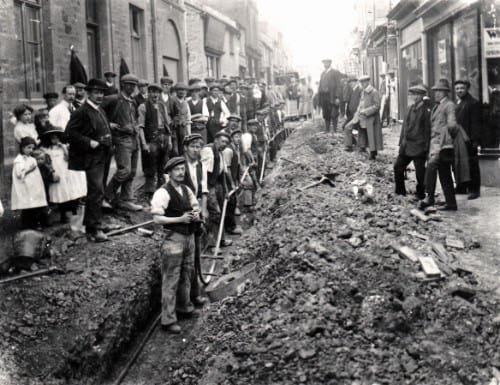
Cable Laying – power cables being manually pulled from cable drums and laid underground at High Street/Back of Bridge Street, Bristol (1898).
Cable Protection – Baldwin Street cable works with cable protection covers and markers made from brick, Bristol (1893).
Cable Pulling – electric power cables being laid into cable trench from The Strand to Beacon Quay electricity works Devon, Torquay (1897).
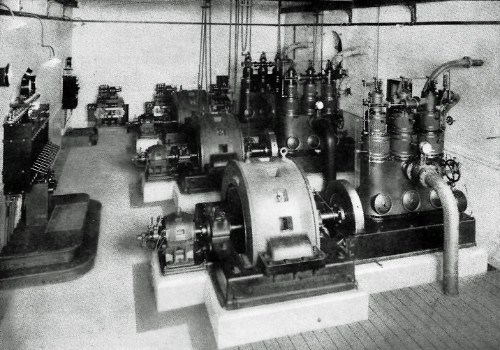
Power Rectifiers – three Willans steam engine/Easton Anderson alternators with three Ferranti rectifiers in background. Devon, Torquay (1898).
Cable Jointing – Baldwin Street, near Bristol Bridge. Mr J Duggan behind cloth capped gentleman on left. Note bricks with circuit description (1900).
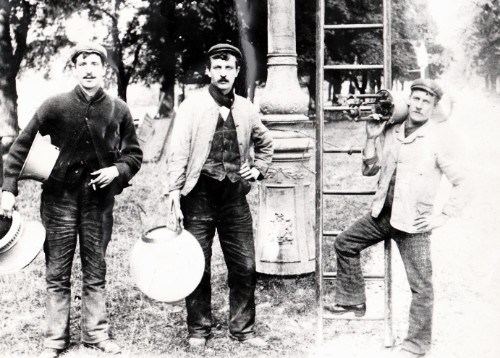
Trimming Team – arc lamp maintenance and trimmer team. Bristol (1904).
High Voltage Jointing – 10kV 0.4 PILC high voltage cable in Mannesman tubes and low voltage cables in a bunch. Cornwall, Causewayhead, Penzance (1912).
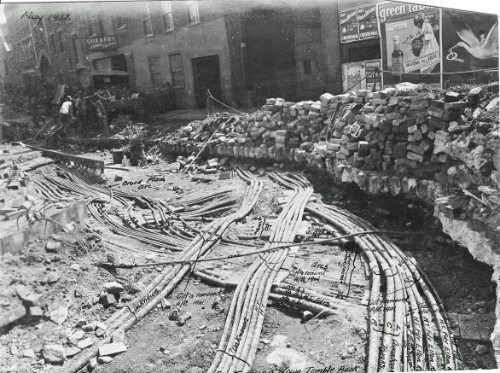
Cable Diversions – Temple Back from Half Penny Bridge direction. On the photograph, the cables have been identified in ink. Bristol, Temple Back (1914).
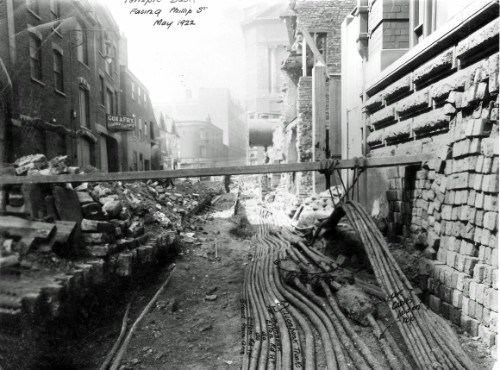
Cable Works – extensive cable works in Temple Back facing Phillip Street. On the photograph, the cables have been identified in ink. Bristol, Temple Back (1914).
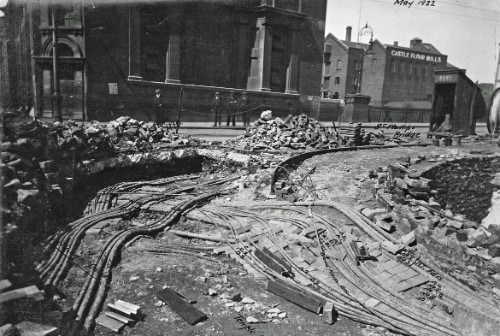
Cable Diversion– cable diversions from Temple Back adjacent to Half Penny Bridge. On the photograph, the cables have been identified in ink. Bristol Tramways and Carriage Power Station opposite and Castle Flour Mills across bridge in background (1914).
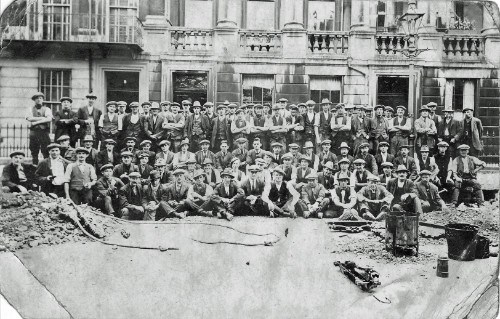
Cable Jointers – some cable jointers and workmen involved in the single to 3 phase changeover photographed in Vyvian Terrace. Bristol, Clifton (1921).
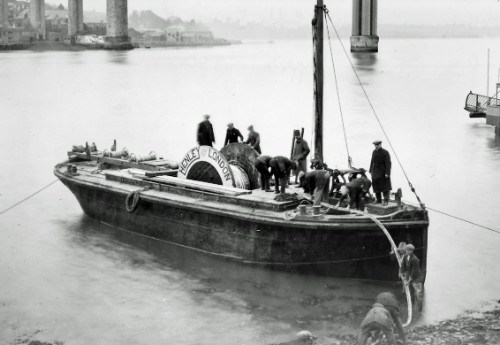
Power Cables – delivery of Henley cables. Small van of Cornwall Electric Power Company (1927).
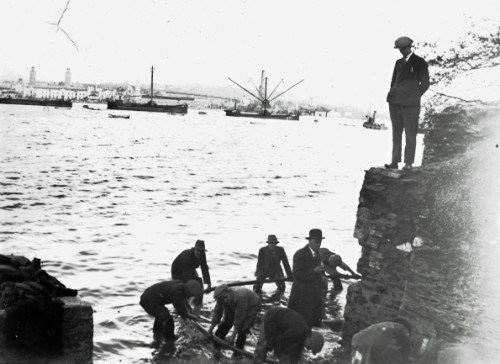
33kV Cables – submarine cable from Saltash to Devonport being installed. Devon, Torpoint (1931).
33kV Cables – Devonport to Saltash 33kV power cable crossing. Barge with high voltage cable on Devonport shore (1931).
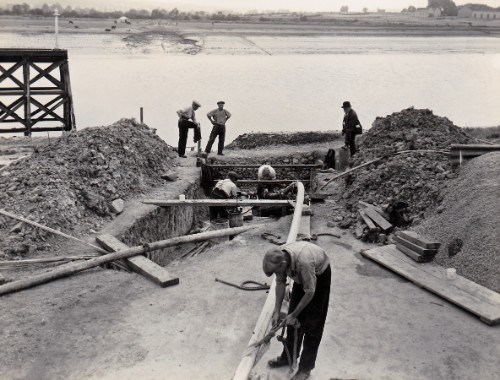
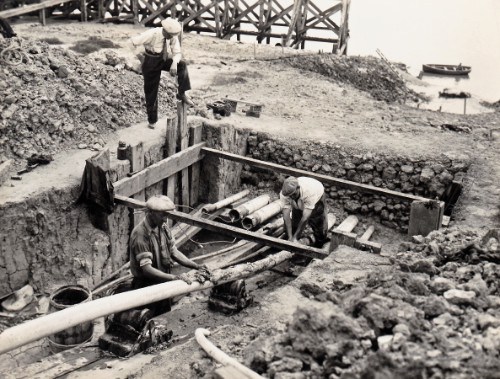
33kV Cables – cable laying and jointing 33kV cables from Portishead Generating Station across River Avon (to Avonmouth). North Somerset, Portbury (1934).
33kV Cables – laying 33kV cables from Portishead Generating Station between Avonmouth Dock and Avonmouth. Bristol, Avonmouth Dock (1934).
Laying 33kV Cables – from Portishead Generating Station between Avonmouth Dock and Avonmouth at River Avon crossing. Avonmouth Dock high voltage cables being greased before being pulled through pipes across River Avon (1934).
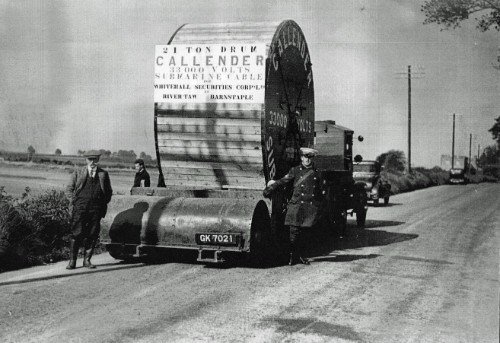
33kV Cables – River Taw crossing. 21 ton drum of Callender 33,000kV submarine cable for Whitehall Securities Corp. Ltd. View of cable drum on special low loading wagon. Devon, Barnstaple (1935).
Thorne & Derrick Working With Western Power Distribution
Today Western Power Distribution (WPD), is the electricity distribution network operator for the Midlands, South Wales and the South West.
Electricity is conveyed countrywide via the National Grid at 275kV or 400kV – the EHV (Extra High Voltage) power is reduced to 132kV for regional distribution at high voltage substations known as Grid Supply Points. From there the power is distributed to further electricity substations via overhead lines or underground cables at 132kV. The voltage is reduced again to 33kV and then to 11kV by medium voltage transformers.
This power distribution network then carries electricity to individual towns and villages throughout the Midlands, South West and Wales where distribution substations transform the voltage to low voltages (230 volts).
WPD network is comprised of over 220,000 kilometres of overhead lines and power cables and 185,000 transformers which are used to step down voltages. These medium/high voltage transformers vary in size from large units capable of supplying an entire town, to tiny ones serving isolated remote cottages.
Since 1985, Thorne & Derrick have been proud to supply and support WPD with an extensive range of LV, MV & HV Jointing, Earthing, Substation & Electrical Eqpt.
Headquartered in Bristol, Thorne & Derrick’s home DNO is WPD.
THORNE & DERRICK are national distributors of LV, MV & HV Cable Installation, Jointing, Duct Sealing, Earthing & Electrical Equipment – we service UK and global businesses involved in cable installations, cable jointing, substation, overhead line and electrical construction at LV, 11kV, 33kV and EHV.
Contact us for 3M Electrical, ABB, Alroc, AN Wallis, CATU Electrical, Cembre, Centriforce, CMP, CSD, Elastimold, Ellis Patents, Emtelle, Euromold, Filoform , Furse, Lucy Electric & Zodion, Nexans, Pfisterer, Polypipe, Prysmian, Roxtec, Sicame, WT Henley.
uploaded by Chris Dodds - Thorne & Derrick, Sales & Marketing Manager
Cable Jointing Tools For LV MV HV Cables
Thorne & Derrick are Specialist Distributors of LV, MV & HV Jointing, Earthing, Substation & Electrical Eqptapproved for use by UKPN on their medium/high voltage underground cables and overhead lines network – including complete range of cable jointing tools approved by UKPN available from stock for the removal of sheath, screen and insulation from UKPN Polylam specification cables.
Customised for UKPN the jointers tool sets are used to prepare Polylam medium/high voltage cables prior to the installation of heat shrink joints, terminations or connectors.
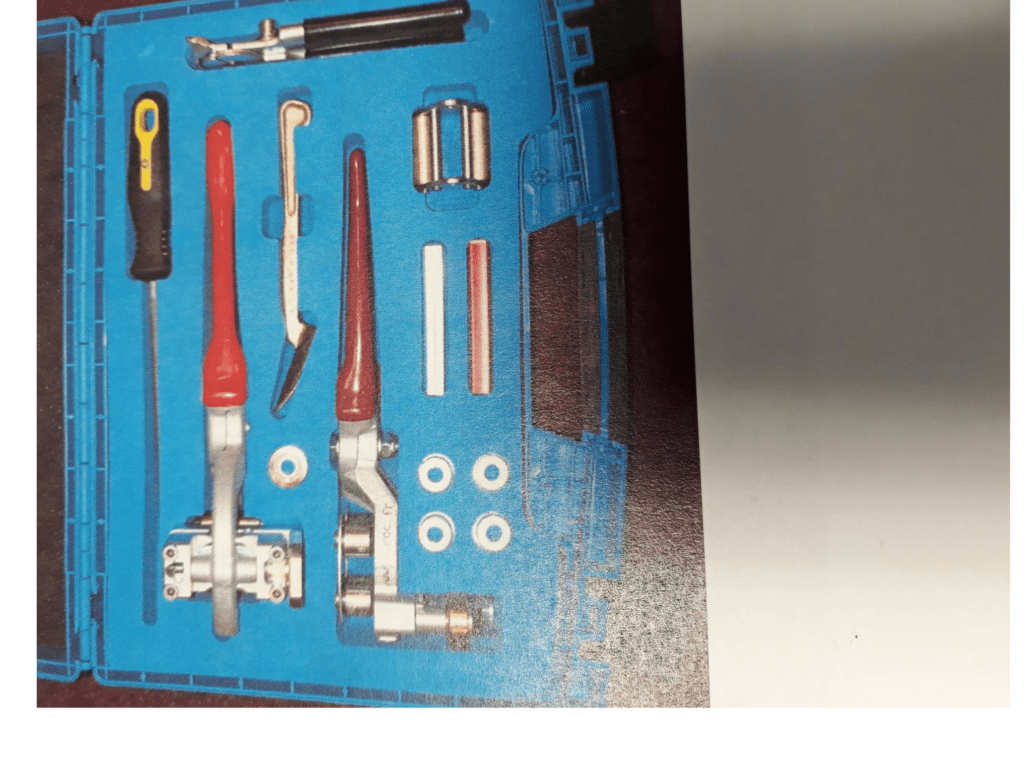
Order Code From Thorne & Derrick: ALROC CPM-GB1
The jointers tool set includes:
1 X Alroc CPM-1GB Empty Plastic Tool Case
1 X Alroc Cable Sheath Pliers PG3HTA/2833
4 X Circular Cable Cutting Blade For PG3
1 X Longitudinal Cable Cutting Spare Blade PG3
1 X Spreader For Sheath Aluminium Screen 150sqmmm | 240sqmm
1 X Ligarex Pliers
1 X Alrocan Tightening Pliers For Cables 50sqmm 50-240sqmm 12kV 20kV
Jointing tools are also available to strip and prepare waveform cables prior to termination or jointing.
NOTE– The header image also shows depth cutters and a jointers rasp file – these are supplied as additional items and prices are available from Thorne & Derrick on request.
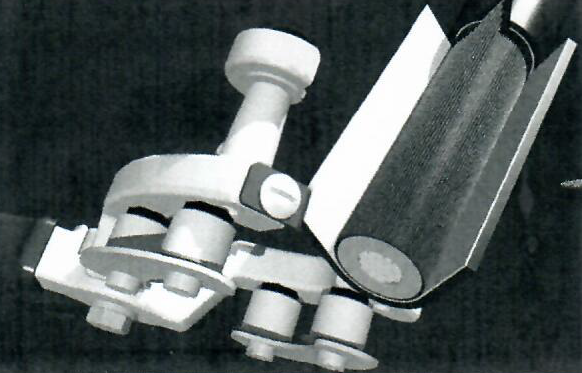
Using Alroc PG HTA Cable Sheath Pliers
Longitudinal Cut. Position the Alroc PG HTA cable cutting pliers to remove the cable sheath to the desired length – tighten the stripping pliers until the cable cutting wheel penetrates onto the stop rollers. Pull the stripping pliers along the length to be stripped.
Circular Cut. Position the Alroc PG HTA cable cutting pliers at the end of the longitudinal cut. Close the pliers onto the cables pressing slightly to ensure penetration of the cutting wheels – rotate the pliers back and forth by a third of revolution.
Sheath Removal. Use the two end blades to separate the cable sheath as show opposite.
As Specialist Distributors of MV HV Cable Joints & Terminations using heat shrink and cold shrink type technologies, Thorne & Derrick have a commitment to clients to ensure cable accessories are installed safely, correctly and in accordance with the manufacturers instructions to provide reliability of medium / high voltage electrical power supply.
The Training Video is uploaded to provide general oversight and demonstrate the working procedure to terminate 33kV cables with single core XLPE insulation into medium voltage / high voltage indoor electrical equipment such as switchgear, transformer, RMU, motor or electrical enclosure.
Please note this Video is not intended to qualify electricians to install MV HV cable accessories – 33kV cable joints and terminations should only ever be installed by Competent Jointers and online familiarisation videos are not intended as a substitute for industry regulated and recognised Cable Jointer Training Courses.
In the following Video you will see the cable jointer install a 33kV indoor heat shrinkable cable termination onto XLPE insulated cables, a type of polymeric cable – the cable is unarmoured type with copper wire screens in accordance with BS7870.
If the cable is armoured, the single core cable would be aluminium wire armoured (AWA) not steel (SWA) – armoured 33kV cable construction would include a copper tape screen and require additional screen earth kits.
Installation process for 33kV terminations is similar to 11kV and 17.5kV, however different kit selection is required and we recommend you contact us to discuss your application.
Watching the video you will understand the importance of using correct cable jointing tools and observing the exact cable stripping measurements – the following stages of the cable termination procedure are also covered:
Wire Screen Treatment – learn how to earth, bond or ground 33kV power cables with copper wire screens
Semicon Screen Cut– importance of correct measurement, marking out and preparation of the bonded screen cables
Cable Shaving – stripping the semiconductive screen from the 33kV cable using jointing tools to achieve a reliable screen-end
Rain Sheds – installing the heat shrink sheds and heating the collars depending on whether cable termination is indoor or outdoor located
Cleaning Cables – clean all carbon deposits from MV-HV primary cable insulation (XLPE) to prevent potential tracking by using suitable solvent or cable cleaning wipes.
➡ See the complete range of Heat Shrink Cable Terminations for high voltage cable installations – this includes both 11kV/33kV terminations for single and 3 core polymeric insulated cables, located indoors our outdoors.
by Chris Dodds T&D - estimated reading time 5 minutes
11kV Cable Terminations
The following 11kV Terminations are currently approved by ENWL for use on their medium/high voltage cable network when jointing, connecting and terminating 11kV polymeric cables to indoor electrical equipment in substations or buildings and pole-mounted overhead line applications. All cables and conductors should be thoroughly prepared and cleaned using approved cable cleaning wipes prior to the installation of terminations, joints or connectors.
For private network installations the Nexans FB1 bushing boots are suitable for either straight or angled connections to switchgear or transformers without need for heat-shrinking. The boots are cold applied and type tested to 15kV for use with Cold shrink or heat shrink cable terminations. Also, the bushing boot can be peeled back for routine medium/high voltage equipment maintenance and testing by voltage detectors without need to be cut-off and re-terminated as with heat shrink types.
Read Our Blog: The Next Generation Of 11kV Transformers For MV HV Networks
Termination Of Cable Conductors
Cable jointer preferences and installation conditions of cable joints and terminations determine whether compression or shearbolt technology is used to terminate cable conductors. For instance, 11kV and 33kV single and multi-core medium/high voltage power cables with stranded copper conductors (Class 1) according to BS6622 are commonly crimped or terminated using hydraulic crimping tools (Cembre HT131-C) or battery operated crimping tools (Cembre B1350-CE) – these Cembre tools accommodate cable lugs up to 400sqmm. To install MV HV cable lugs with cross sectional areas 500sqmm and up to 630sqmm we can recommend the Cembre ECW-H3D crimphead coupled with the hydraulic PO7000 foot pumpor B70M-P24 portable 24v electro-hydraulic pump.
The Pfisterer Sicon range of mechanical shearbolt cable lugs, terminals and connectors are suitable for the connection and termination of MV HV cables up to 66kV with copper or aluminium conductors (stranded circular, solid, sectoral shaped) without requirement for crimping tools – installed using no specialist jointing tools. The stepless shearbolt cable lugs have no predetermined breaking points in the thread ensuring the optimum thread load is achieved without protusions or need for conductor filing by the MV HV jointer.
T&D are Approved Vendors of Electricity North West Approved Materials List & Assessed Products to enable the cable jointing, termination, distribution and installation of LV, MV (11kV-33kV) & HV cables onto ENW cable network from manufacturers including:
What Is Arc Flash PPE and Why Is It Important? Arc flash PPE is specialist personal protective equipment designed to help protect electrical workers against the thermal hazards of an electric arc. It includes arc-rated clothing, protective helmets, face...
Voltage detectors are electrical safety instruments used to identify the presence or absence of voltage on electrical equipment and conductors. They are used by electricians, electrical engineers, utilities and maintenance teams working on low voltage (LV), medium voltage (MV)...