Cable Joints & Terminations HV
A Guide To HV Efficiency: Distribution Transformers & Voltage Management (Part 2 of 3)
September 12th, 2019
A Guide To HV Efficiency Distribution Transformers & Voltage Management
HV Efficiency
Distribution Transformers & Voltage Management (Part 2 of 3)
-
uploaded by Chris Dodds - Thorne & Derrick Sales and Marketing Manager
The second installment of the HV efficiency blog series intends to define the difference between tapping down HV transformers, and voltage management technologies such as voltage optimisation, with the end goal of decreasing a site’s voltage.
There’s a clear difference between HV distribution transformers and the Powerstar range of voltage optimisation products namely that HV distribution transformers decrease the high voltage (HV) electricity from the grid, typically 11000V or 6600V, to low voltage (LV) electricity, typically 400V-433V, so that it can be used safely.
This technique alters all the power to a site from HV to LV.
In comparison, voltage optimisation technology reduces the LV voltage, when greater than required, to the optimal voltage for the specifications of the electrical equipment on-site; this is done by subtraction, rather than by transformation.
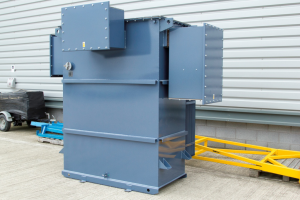
Distribution Transformers & Voltage Management
Can tapping my transformer achieve greater efficiencies?
A voltage reduction using distribution transformers can occur through changing the tapping of the transformer although this is not advised. Voltage management can be achieved by tapping as you can get different turns ratio and the ability to control output.
Care should be taken as changing the tapping has a knock on effect on the number of coils leading to the impedance of the transformer. This leads to an increase in the transformer current if the voltage is reduced, or a deduction in the transformer current in the event of an increase in voltage.
When altering the tapping it should not be tapped beyond the settings that they were built for to ensure they still function at their optimal efficiency. Using this technique to decrease the voltage is ineffective due to the relationship between voltage and current.
The current will be raised by 5% when the voltage in the transformer is lowered by the same percentage. Using this example, the losses in the transformer would increase by 25%. In the case of a typical 1000kVA transformer with a load loss of 8kW, based on a 75% load, reducing the voltage by 5% will increase these losses to 10kW, which will increase the site consumption by 17,520kWh a year, therefore inflating the site’s energy bill.
Tapping of HV transformers should be inline with site requirements e.g site capacity in order for them to function at full efficiency.

Optimal efficiency through voltage management
Purpose-built voltage management technology together with an an amorphous core distribution transformer integrated with electronic-dynamic voltage management is the best approach to reducing voltage with the ultimately saving money. The Powerstar HV MAX is the perfect transformer.
The HV MAX incorporates features of a super low loss amorphous core transformer, which decreased the load losses by up to 75% in comparison with a CRGO distribution transformer, with the benefits of LV electronic-dynamic voltage management, which reduces and stabilises the on-site voltage providing energy consumption and cost savings.
Combining the technology means the Powerstar HV MAX is appropriate for sites performing their own HV/LV supply alongside sites with a high incoming voltage profile and an inefficient HV/LV distribution transformer.

LV MV HV Transformers

Further Reading
A Guide To HV Efficiency: The Core Of The Problem (1 of 3)
A Guide To HV Efficiency: Optimising Efficiency With Remote Monitoring (3 of 3)
THORNE & DERRICK SPECIALIST ELECTRICAL DISTRIBUTOR
The 11kV Specialists
Thorne & Derrick distribute the most extensive range of 11kV Cable Jointing, Terminating, Pulling & Installation Equipment – we service UK and international clients working on underground cables, overhead lines, substations and electrical construction at 11kV and up to EHV transmission and distribution voltages.
THORNE & DERRICK today welcomed Lindsay Brownless from @PowerstarVO today – look out for a series of online articles from us about their UK manufactured, online, smart #Transformers with amorphous core and remote monitoring capabilities, 415/11kV.#POWER pic.twitter.com/KfmIZoBuPJ
— Thorne & Derrick (@ThorneanDerrick) January 16, 2019
- Key 11kV Products: MV-HV Cable Joints & Terminations, Cable Cleats, Duct Seals, Cable Transits, Underground Cable Protection, Copper Earth Tapes, Cable Jointing Tools, Feeder Pillars, Cable Ducting, Earthing & Lightning Protection, Electrical Safety, Cable Glands, Arc Flash Protection & Fusegear.
- Distributors for: 3M Cold Shrink, ABB, Alroc, Band-It, Catu, Cembre, Centriforce, CMP, Elastimold, Ellis Patents, Emtelle, Furse, Lucy Zodion, Nexans Euromold, Pfisterer, Polypipe, Prysmian, Roxtec.

LV – Low Voltage Cable Joints, Glands, Cleats, Lugs & Accessories (1000 Volts)

MV HV – Medium & High Voltage Cable Joints, Terminations & Connectors (11kV 33kV EHV)

Cable Laying – Underground Cable Covers, Ducting, Seals & Cable Pulling Equipment
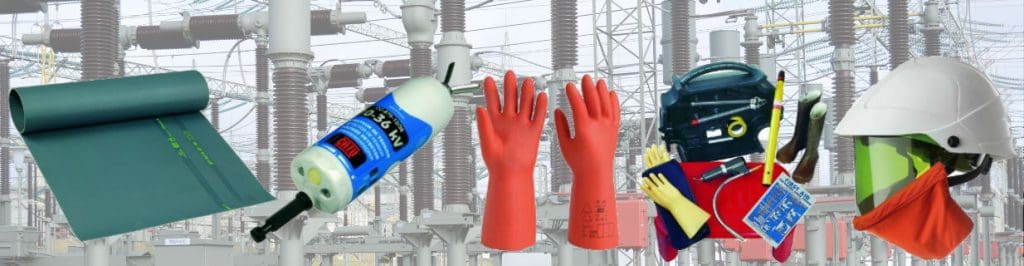
T&D, CATU Electrical Safety & Arc Flash Protection Specialists for SAP’s, Linesmen, Jointers & Electrical Engineers – Largest UK Stockist
A Guide To HV Efficiency: The Core Of The Problem (Part 1 of 3)
September 12th, 2019
A Guide To HV Efficiency The Core Of The Problem
HV Efficiency In The Energy Industry
The Core Of The Problem (Part 1 of 3)
-
uploaded by Chris Dodds - Thorne & Derrick Sales and Marketing Manager
Changes in the energy industry happen frequently and can often be complicated to understand. Powerstar simplifies any developments and ensures their clients are kept in the loop with regards to changing technologies. This ensures they have the insight to make knowledgeable decisions about their energy infrastructure including 11kV transformers.
In this 3 part Blog series we will discuss a step by step guide on how your HV infrastructure can by more efficient by discussing the following:
- Benefits of installing a super low loss amorphous core transformer over a traditional CRGO transformer
- Difference between stepping down your transformers voltage and purpose-built voltage management technologies, such as voltage optimisation
- Advantages of installing a smart distribution transformer integrated with remote monitoring capabilities
Since the taking over Bromsgrove Winding Services (BWS) Ltd, Powerstar have been able to extend theiFhatr smart energy solution capabilities which now include distribution transformers.
Now Powerstar are able to offer advice to their clients around the efficiencies of HV infrastructures and how companies can enhance them.
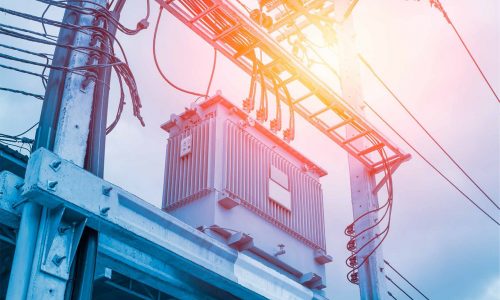
Greater efficiencies at the core
Many businesses look into upgrading their HV infrastructure to increase efficiencies and decrease electricity consumption, and this has aided advancement of core materials which experience lower losses and are more efficient than the materials traditionally used to manufacture HV transformers.
Amorphous alloy core technology has established a name for itself as providing positive results when studied and tested across numerous applications.
In comparison to CRGO’s the amorphous alloy has a flexible atom structure that allows for easy magnetisation and demagnetisation to occur. In turn this offers enhanced efficiencies and limits the volume of wasted energy.
Another advantage is the distribution transformer can be manufactured to meet the precise needs of the site. When provided, distribution transformers designed and delivered from concept to completion can provide enhanced site resilience and increased HV efficiencies.
The importance of upgrading
your HV transformer
Transformers have a life expectancy of up to 40 years and those currently installed were made from various materials that no longer of high priority.
There has been a significant shift towards using more eco-friendly equipment as the issue of climate change has become more prevalent. Nowadays when upgrading your transformer you need to consider being more environmentally friendly and decreasing its carbon emissions.
Older transformers are often extremely less efficient than newer transformers for example new amorphous core transformers are able to obtain up to 75% lower core losses in comparison to traditional CRGO transformers.

Super Low Loss Transformers Up To 11kV By Powerstar SO-LO
Furthermore new bespoke transformers such as the Powerstar SO-LO amorphous core transformer meets and surpasses 2021 EU Ecodesign Directive standards set by the European Commission.
Older transformers are not likely to adhere to these standards and therefore in spite of their long life expectancy are out of date when measured against contemporary standards.
Changing a traditional transformer with a more efficient amorphous core transformer will reduce energy consumption and costs for businesses who manage their own HV infrastructure.
LV MV HV Transformers
Further Reading
A Guide To HV Efficiency: Distribution Transformers & Voltage Management (2 of 3)
A Guide To HV Efficiency: Optimising Efficiency With Remote Monitoring (3 of 3)
THORNE & DERRICK SPECIALIST ELECTRICAL DISTRIBUTOR
The 11kV Specialists
Thorne & Derrick distribute the most extensive range of 11kV Cable Jointing, Terminating, Pulling & Installation Equipment – we service UK and international clients working on underground cables, overhead lines, substations and electrical construction at 11kV and up to EHV transmission and distribution voltages.
THORNE & DERRICK today welcomed Lindsay Brownless from @PowerstarVO today – look out for a series of online articles from us about their UK manufactured, online, smart #Transformers with amorphous core and remote monitoring capabilities, 415/11kV.#POWER pic.twitter.com/KfmIZoBuPJ
— Thorne & Derrick (@ThorneanDerrick) January 16, 2019
- Key 11kV Products: MV-HV Cable Joints & Terminations, Cable Cleats, Duct Seals, Cable Transits, Underground Cable Protection, Copper Earth Tapes, Cable Jointing Tools, Feeder Pillars, Cable Ducting, Earthing & Lightning Protection, Electrical Safety, Cable Glands, Arc Flash Protection & Fusegear.
- Distributors for: 3M Cold Shrink, ABB, Alroc, Band-It, Catu, Cembre, Centriforce, CMP, Elastimold, Ellis Patents, Emtelle, Furse, Lucy Zodion, Nexans Euromold, Pfisterer, Polypipe, Prysmian, Roxtec.
LV – Low Voltage Cable Joints, Glands, Cleats, Lugs & Accessories (1000 Volts)
MV HV – Medium & High Voltage Cable Joints, Terminations & Connectors (11kV 33kV EHV)
Cable Laying – Underground Cable Covers, Ducting, Seals & Cable Pulling Equipment
T&D, CATU Electrical Safety & Arc Flash Protection Specialists for SAP’s, Linesmen, Jointers & Electrical Engineers – Largest UK Stockist
Thorne & Derrick Partner With Powerstar | Smart Transformers & Energy Solutions
August 23rd, 2019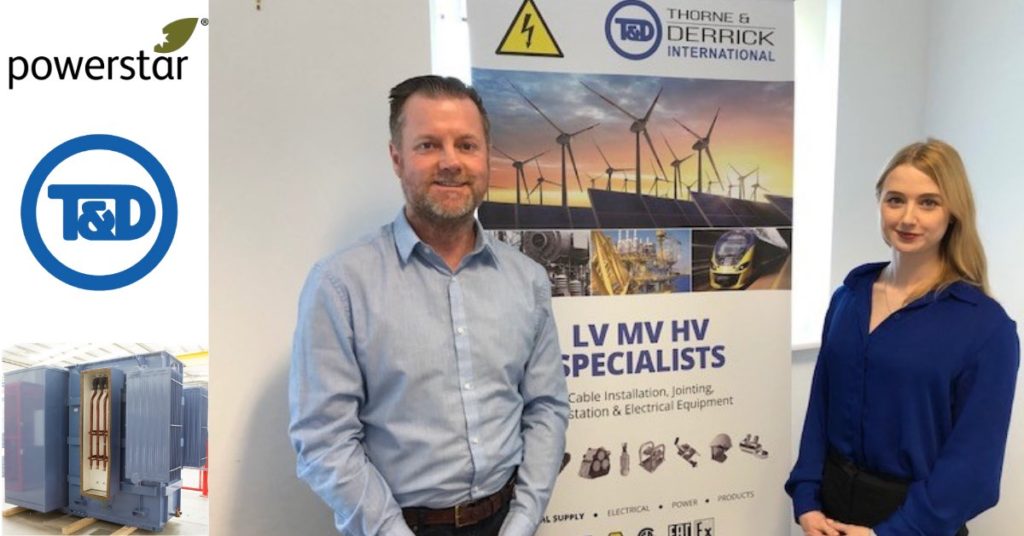
-
uploaded by Chris Dodds - Thorne & Derrick Sales and Marketing Manager
Press Release
UK, County Durham – Thorne & Derrick International
Thorne & Derrick have partnered with Powerstar.
Powerstar are leading manufacturers of LV HV Transformers to enable safe and reliable distribution of Smart Power with online remote monitoring functionality, 600v to 11kV .
The Powerstar SO-LO® range of super low loss Smart Transformers are the only amorphous core transformers designed and manufactured in the UK.
SO-LO® transformers deliver higher energy efficiency, improved distribution reliability and lower power consumption than conventional transformers.
Going Smart
Chris Dodds, Sales and Marketing Manager at Thorne & Derrick, says: “We look forward to developing existing relationships with customers while also presenting the full portfolio of Powerstar transformers up to 11kV to new clients. The ability to provide bespoke smart energy solutions from concept to completion that efficiently manage energy use while lowering electricity consumption and costs is highly attractive. Replacing your site transformer with a low loss amorphous core could reduce core losses by up to 75% when compared to traditional CRGO transformers. Smart Grid is the future.”
The partnership will facilitate knowledge sharing between our two companies and enable us to collaboratively promote the range of fit-for-purpose energy solutions and services available to clients in the utility, renewable and power generation industries.
Dr. Alex Mardapittas, CEO at Powerstar, commented: “We are proud to partner with the renowned and reputable LV HV Electrical Equipment Distributor Thorne & Derrick. The partnership will heighten the visibility of smart transformers and enable a wide variety of organisations to learn how they can modernise their high voltage electrical power infrastructure.”
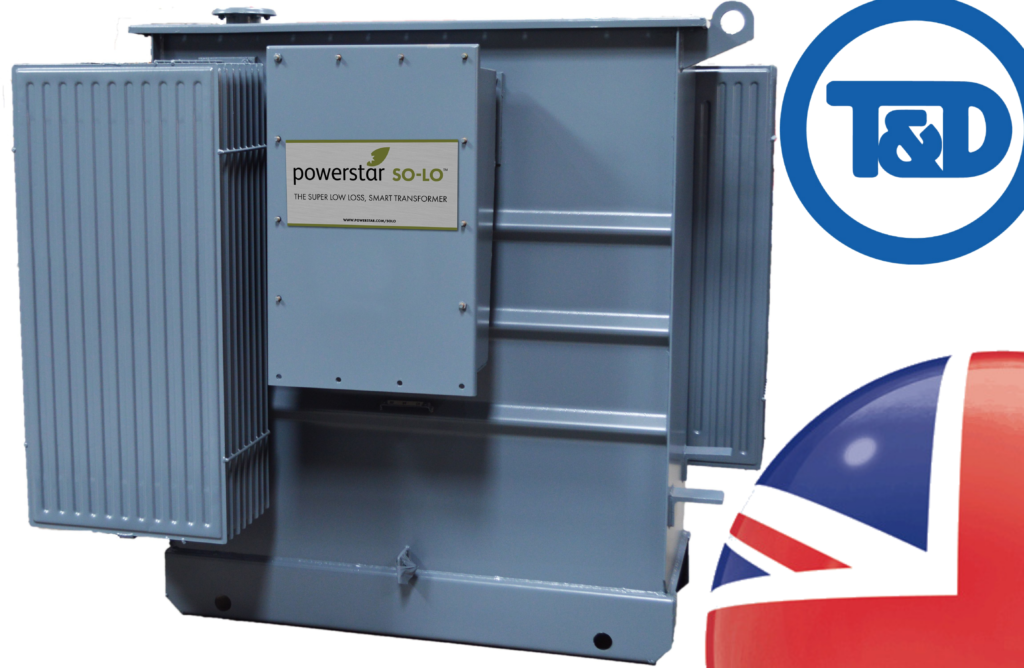
Smart Power, Smart Transformers – SO-LO transformers ensure real-time and remote asset monitoring to assess performance and operation.
The collaboration will be underpinned by the customer service offered by Thorne & Derrick and Powerstar to support and inform organisations on how they can further improve their LV MV HV infrastructure through customised recommendations such as the implementation of smart transformers that are Industry 4.0 ready.
Video: Powerstar HV MAX is a super low-loss amorphous core HV transformer combined with the award winning Powerstar technology. The product allows companies to save on electricity costs and reduce carbon emissions. Watch the video to see the Powerstar HV MAX installation:
Thorne & Derrick
Since 1985, Thorne & Derrick International, based in the UK, have been synonymous with the supply and distribution of tested, certified and accredited Electrical Equipment & Cable Accessories by leading manufacturers including ABB, 3M Electrical, Nexans Euromold, Pfisterer and Prysmian to guarantee the highest levels of reliability for LV MV HV Power Systems.

MV Terminations | Incompetency & Substandard Jointing Plumbs Another New Depth
July 11th, 2019
Contributed By: Watkins and Jacomb Construction Power & Consultancy
Uploaded By: Chris Dodds – Thorne & Derrick: Distributors of LV, MV & HV Cable Jointing, Cable Terminations, Substation & Electrical Eqpt
WJCPC are specialist LV HV Cable Termination & Jointing contractors with over 20 years experience in the High Voltage Electrical Industry covering the utilities, renewable energy, rail, data centre and general industry sectors – UKPN competent for LV & HV Termination and Jointing Of Cables, Confined Spaces, Substation Entry and Cable Fault Finding.
In the following post Ben Jacomb, Director of WJCPC, highlights several shortcomings and the dangerous consequences of clients failing to carefully vet and selectively employ Competent Cable Jointers.
WJCPC were asked to attend site to remove a total of 16 incorrectly specified and installed cable glands and install correct type brass glands. Due to the cable termination being a larger diameter to permit the existing and replacement cable glands to be changed WJCPC had to carefully remove the anti-track heat shrink (red insulation) from the heat shrink terminations.
After first inspection WJCPC were unsatisfied with the cable jointing technique undertaken to remove the semi conductive layer from the MV cable: this was done by using a semi-con stripping tool, the semi conductive layer is semi bonded so the stripping of the layer should be stripped by using a depth knife and the ringing of the stress control point by a soft file.
Any marks left in the XLPE insulation by the Jointer will influence the magnetic fields inside the MV cable and should be removed by emery cloth to leave a smooth finish eliminating any voids. If the heat shrink tube is shrunk on top of a void there will be moisture and where there is moisture there will be arcing, burning and then failure.
If the semi conductive layer is not removed correctly at the crucial point discharges occur and can damage the medium voltage cable and safe operation of the power network.
Below are WJCPC’s site observations.
Incorrect cable gland installed
The cable installed is a 11kV single core power cable with XLPE insulation and 120sqmm stranded copper conductors (16sqmm earth wires) – the original cable glands installed were 50mm plastic glands which are over-sized and incorrect for the cable diameter consequently failing to provide adequate mechanical retention.
Also, due to the cable being a backup supply from generators the vibrations will evidently loosen the cable gland until it is effectively and dangerously removed from the gland plate of the cable box which will then allow the cable to move around within the termination box – this could potentially loosen the cable termination connection.
This could do serious damage within the generator.
New 40mm brass cable glands were installed to the correct specification and that corrective action by WJCPC now has eliminated any vibration and loosening of the connection issues.
Observations
Ensure that when ordering jointing materials that manufacturers recommendations and specifications are met to eliminate incorrect installations.

Incorrect Cable Gland Installed
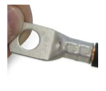
Over-Crimped Cable Lugs
All 16 of the site 11kV cable terminations had been over compressed or “crimped” due to the Jointer using an incorrect crimping die set.
Over compression of the cable lugs caused a distinct gap between the cable lugs and the cable insulation.
| Incorrect Cable Lug Compression | Correct Cable Lug Compression |
 |
 |
- Choose a manufacturer providing crimp tooling die set and lugs matched to work together to give assured crimping performance.
- Each lug should be clearly marked with a reference on the barrel or palm which enables the user to verify that the lug selected is the correct size and type for the conductor. The manufacturer’s name or logo also allows the correct die set and crimp tool to be selected from their recommended list.
- Prepare the conductor by stripping the insulation back so that, when assembled, it cannot be trapped in the barrel of the lug. The strip length should be equal to that of the barrel. Take care to avoid damage to the conductor strands during the stripping operation. Exposed conductor strands should be cleaned to remove any particles of insulation.
- Fully insert the conductor into the barrel. If an inspection hole is provided, check the conductor is fully inserted.
- Crimp the lug in accordance with the manufacturer’s instructions. Pay careful attention to the positioning of the die on the barrel and, if multiple compressions are required, the sequence in which they are made.
- For further information visit Cembre | Cable Lugs & Crimping Tools.
Examine The Completed Cable Crimp Lug To Check
- Marking on cable lug shows it is correct for the conductor type and size.
- The marking on the cable lugs show the correct die set was used.
- No insulation is trapped in the cable lug barrel.
- Excess grease is removed from insulation and lug.
- If an inspection hole is provided, the conductor has been fully inserted
- It is NOT to be over-compressed causing excessive flash or burrs, which are detrimental to the performance of the joint.
It is NOT under-compressed, as this is detrimental to the performance of the joint.
If any doubt exists, samples should be produced for test purposes.
Poor Cable stripping
of semi conductive layer
The semi conductive layer of the MV cable has been stripped by a stripping tool and on one occasion the stripping tool has impeded past the manufacturer’s requirements for their insulation diameter which will cause a void within the cable termination – the void could cause a hotspot and potential flash over which will render the connection irreparable.
The semi conductive layer is semi bonded (easy peel) so the semi conductive layer should be removed using a specialist Jointers tool or depth knife – here the semi con layer has been removed from the cable using a bonded semi-con layer stripping tool and it has left a poor finish to the XLPE insulation.
Even if the semi con layer is bonded type then the cable jointer should use 3 stage emery cloth ( 80, 120, 240 grit) to sand out any ridges and voids and then clean down the cable with a non- conductive cleaning cable wipe.

Poor Stripping By The Jointer Of The Semicon Layer Of The MV Cables
The XLPE insulation finish on easy peel type cables should be a nice smooth finish without ridges, undulations or jagged surfaces.
The semi con round off point should be a perfect finish as this is the most crucial point of the cable termination – if this is not perfectly smooth and the void filler mastic is not installed properly this can affect the stress relief from electrical fields.
It is essential this is undertaken by the Jointer with due care and attention.
Below is a photo of potential damaged caused by above non-conformances.
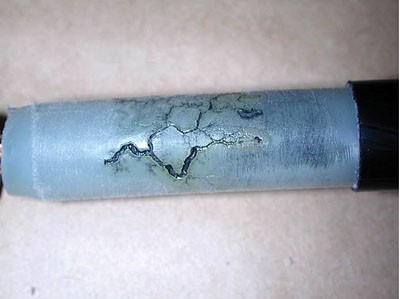
Missing earth strands from cable
On 50% of the cables WJCPC found missing earth strands. This will degrade the earthing protection for that cable.

Missing Earth Strands From Cable
Poor outer sheath strip
The outer sheath on occasions was poorly removed and not stripped according to the manufacturers jointing instruction – this may affect the damp seal which is installed on the outer sheath and the cable terminations measurements may come out of sync and affect the electrical connections durability.

Poor outer sheath strip
Conclusion
After full inspection WJCPC found that poor Jointing and sub-standard workmanship without quality control had introduced serious and potentially catastrophic operational issues into the medium voltage cable and power system network.
WJCPC recommend that a survey onsite is conducted to check more cable terminations as they suspect this will be a continuous issue onsite – using a thermal camera and partial discharge tester can help determine any cable terminations that need to be looked at and maybe pick some at random to strip down and visually inspect.
Due widespread concerns about industry workmanship, lack of Jointer training and declining standards, WJCPC can provide an audit service to visually audit jointers and ensure they are completing their termination to the manufacturers jointing instruction – this may not eradicate Jointer incompetency but it will contribute to a reduction in the volume of poorly installed cable joints.
There is also another process you can introduce and this is a step-by-step photo sequence of the termination installation at its crucial stages – this does not take long and captures the poorly installed cable joints or terminations before they are energised.
➡ Please Note: The cable glands WJCPC have changed and the re-termination of the cables will not be guaranteed by WJCPC due to the terminations not being installed to the manufacturers instructions. WJCPC have terminated them to their best ability but only as a temporary measure to allow the generators to be commissioned.
WJCPC strongly advise these cables are removed and new cable and new terminations installed immediately.
HV Cable Terminations
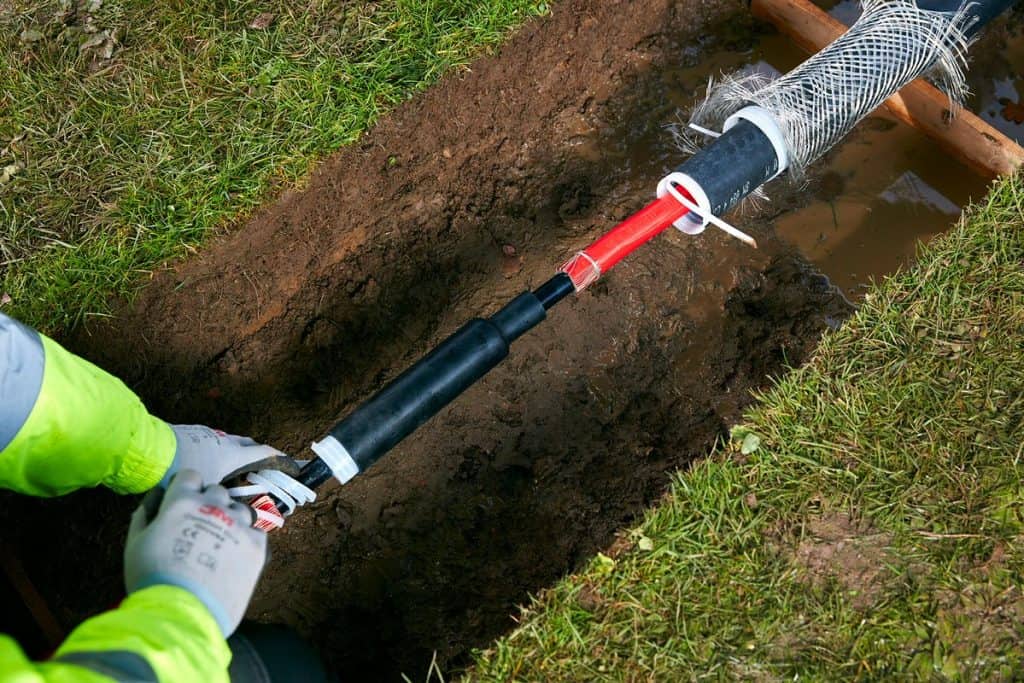
Thorne & Derrick distribute the most extensive range of HV Cable Terminations & Joints to suit 11kV/33kV medium and high voltage power cables, including indoor cold shrink and heat shrink terminations, outdoor pole-mounted terminations or separable connectors for gas insulated equipment applications.
HV High Voltage Cable Joints | Cable Terminations | Cable Connectors | MV HV 11kV 33kV

Joint | Terminate | Connect Medium & High Voltage Cables MV HV
THORNE & DERRICK are national distributors of Cable Installation, Jointing, Substation & Electrical Safety Equipment MV HV – we service UK and global businesses involved in cable installations, cable jointing, substation, overhead line and electrical construction at LV, 11kV, 33kV and EHV.
Contact us for 3M Electrical, ABB, Alroc, AN Wallis, CATU Electrical, Cembre, Centriforce, CMP, CSD, Elastimold, Ellis Patents, Emtelle, Euromold, Filoform , Furse, Lucy Electric & Zodion, Nexans, Pfisterer, Polypipe, Prysmian, Roxtec, Sicame, WT Henley.

Invitation
Thorne & Derrick invite you to join LinkedIn’s largest LV-HV Electrical Discussion Group : Low & High Voltage Power, Cabling, Jointing & Electricals.
Discussion subjects include cable installations, cable jointing, substation, overhead line and electrical construction at LV, 11kV, 33kV and EHV. Network, engage and promote your profile, company or products with over 10,000 influencers.


15kV/17.5kV Type Test Reports | 3M Cold Shrink QS1000 Cable Joints & Splices
July 8th, 2019➡ QS1000 are Cold Shrink Joints/Splices manufactured by 3M Electrical – the 3M QS1000 cable joints for single and 3 core cables are tested and rated to 15kV/17.5kV.
3M Electrical have a full type test report to 11kV for the cable joints – also 3M Electrical have type tests to show that the QS1000 splice bodies are tested to 15kV. The QS1000 splice is used in both the single, and 3 core joints, and the impulse level tests are relevant to show that all joints using the QS1000 are rated to 15/17.5kV.
Test Report | Cold Shrink | Single Core Cables MV HV Joints up to 15kV/17.5kV
Test Report | Cold Shrink | 3 Core Cables MV HV Joints up to 15kV/17.5kV
Information confirmed by 3M Electrical.
Should you require any assistance with the selection or specification of Joints & Terminations for use with MV HV cables please contact us.