uploaded by - Chris Dodds Thorne & Derrick Sales & Marketing Manager
Heat shrink cable joints for jointing paper or polymeric insulated cables (PILC or XLPE) with lead sheaths are specified for Low Voltagepower distribution systems in the oil, gas and petrochemical industries where underground cables are exposed to waterlogging and corrosive liquids and vapours – cable construction including the lead sheath cover or jacket protects against penetration and degradation of electric cable insulation by hydrocarbon contaminants (whether underground or airborne).
Today, lead wiping has virtually disappeared from the cable jointers skill-set as more modern techniques, such as constant force spring armour and lead earthing continuity kits, which are integral to 3M hydrocarbon resistant cable joint kits have become commonplace. The modern day trend towards the manufacture and adoption of Polymeric (XLPE EPR insulated) cables has further reduced the demand for jointers with competency to work, maintain and splice using PILC type cables.
Lead Sheath Cutting & Removal From Paper Insulated Cables
Due to Occupational Health & Safety problems with handling lead and associated fumes, lead wiping has been replaced by jointing the cable sheaths using copper earth braid and constant force springs.
Lead Sheath Wiping
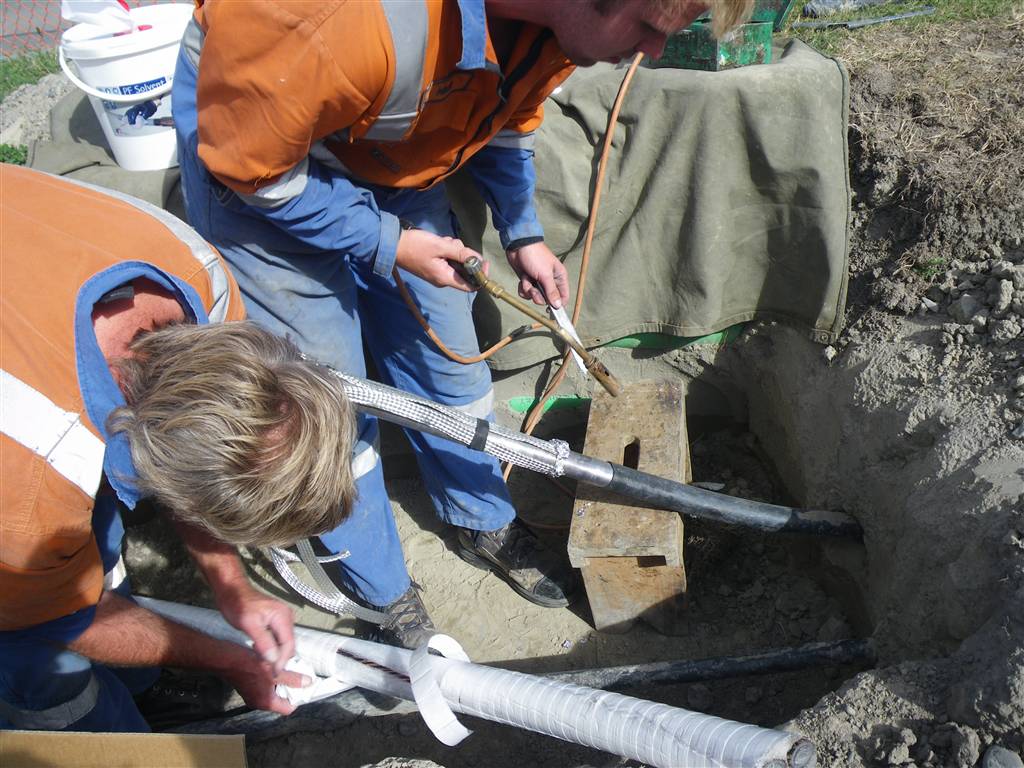
Pictured : A cable repair being conducted on a 200 pair (400 wire) lead-sheathed, paper-insulated cable (PILC). The photo illustrates the difficult conditions under which cable jointers often have to work. The gas lantern is required for both lighting and heating as it is important that the paper insulation of the individual wires do not become damp.
The joining of paper-insulated, lead-sheathed cables is not an easy task. Each 200 pair joint can take over two days to complete. The wires are identified by a colour code and are layered in a particular way: a common mistake when repairing these cables is to join pair number 1 to pair number 200 (i.e. 180 degrees out of phase). Each wire is individually joined together and covered by a paper sleeve. The photo below shows a close-up of the cable being spliced with some pairs having been joined and the remainder temporarily folded back out of the way.
Cable Splicing
LV Cable Joints (Low Voltage Cables)
Thorne & Derrick stock and distribute LV Joints in Cold Shrink, Heat Shrink or Resin Cast technologies – multicore and multi-pair cable joints are available for immediate backfill and energisation of Low Voltage power, control and instrumentation cables 600V/1000V 3.3kV.
The following information and clauses concerning fire walls is extracted from BS EN 61936-1:2010.
Power Installations Exceeding 1kV a.c. Common Rules
8.7 Protection Against Fire 8.7.1 General
Relevant national, provincial and local fire protection regulations shall be taken into account in the design of the installation.
NOTE: Fire hazard and fire risk of electrical equipment is separated into two categories: fire victim and fire origin.
Precautions for each category should be taken into account in the installation requirements.
precautions to fire victim:
space separation from origin of fire;
flame propagation prevention:
physical layout of the substation,
liquid containment,
fire barriers (e.g. REI fire-resistant materials 60/90),
extinguishing system;
precautions to fire origin:
electrical protection;
thermal protection;
pressure protection;
fire resistant materials.
Care shall be taken that, in the event of fire, the escape and rescue paths and the emergency exits can be used (see 7.1.6).
The user or owner of the installation shall specify any requirement for fire extinguishing equipment. Automatic devices to protect against equipment burning due to severe overheating, overloading and faults (internal/external) shall be provided, depending on the size and significance of the installation.
Equipment in which there is a potential for sparks, arcing, explosion or high temperature, for example electrical machines, transformers, resistors, switches and fuses, shall not be used in operating areas subject to fire hazard unless the construction of this equipment is such that flammable materials cannot be ignited by them.
If this cannot be ensured, special precautions, for example fire walls, fire-resistant separations, vaults, enclosures and containment, are necessary.
Consideration should be given to separating different sections of switchgear by fire walls. This can be achieved by means of bus ducts which penetrate the fire wall and which connect the sections of the switchgear together.
8.7.2 Transformers, Reactors
In the following sub-clauses, the word ‘transformer’ represents ‘transformers and reactors’.
For the identification of coolant types, see 6.2.2.IEC 61100 classifies insulating liquids and transformer oils according to:fire point and net caloric value (heat of combustion).
Three classes have been defined:
Class O, if the fire-point is less than or equal to 300 °C. (e.g Mineral Oil).
Class K, if the fire-point is above 300 °C. (e.g MIDEL 7131 and MIDEL eN 1024).
Class L, if the insulating liquid has no measurable fire-point.(e.g. Xiameter PMX-561).
IEC 60076-11 classifies dry-type transformers in terms of their behaviour when exposed to fire. The fire hazard associated with transformers of outdoor and indoor installations is dependent on the rating of the equipment, the volume and type of insulating mediums, the type and proximity and exposure of nearby equipment and structures.
The use of one or more recognized safeguard measures shall be used in accordance with the evaluation of the risk.
♦ IEC 60076-11:2018 Power Transformers– Part 11: Dry-type Transformers
NOTE:For definition of risk, see ISO/IEC Guide 51.
Common sumps or catchment tanks, if required, for several transformers shall be arranged so that a fire in one transformer cannot spread to another. The same applies to individual sumps which are connected to the catchment tanks of other transformers; gravel layers or pipes filled with fluid can, for example, be used for this purpose.
Arrangements which tend to minimize the fire hazard of the escaped fluid are preferred.
8.7.2.1 Outdoor Transformer Installations
The layout of an outdoor installation shall be such that burning of a transformer with a liquid volume of more than 1,000 litres will not cause a fire hazard to other transformers or objects, with the exception of those directly associated with the transformer. For this purpose, adequate clearances, G, shall be necessary.
Guide values are given in Table 3. Where transformers with a liquid volume below 1,000 litres are installed near combustible walls, special fire precautions may be necessary, depending on the nature and the use of the building.
If automatically activated fire extinguishing equipment is installed, the clearance G can be reduced.
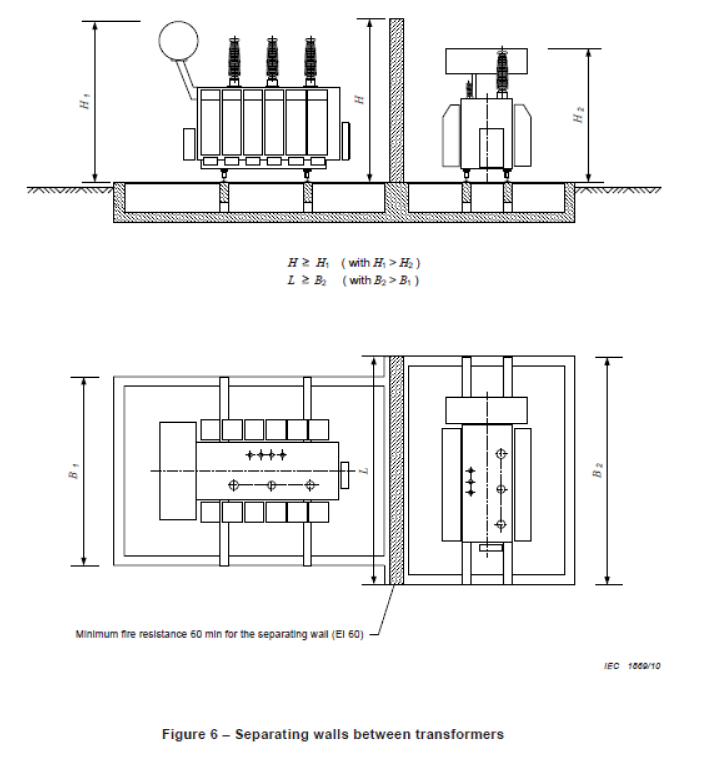
If it is not possible to allow for adequate clearance as indicated in Table 3, fire-resistant separating walls with the following dimensions shall be provided:-
a) between transformers (see Figure 6) separating walls. For example EI 60 in accordance with the Official Journal of the European Community, No. C 62/23:
height: top of the expansion chamber (if any), otherwise the top of the transformer tank;
length: width or length of the sump (in the case of a dry-type transformer, the width or length of the transformer, depending upon the direction of the transformer);
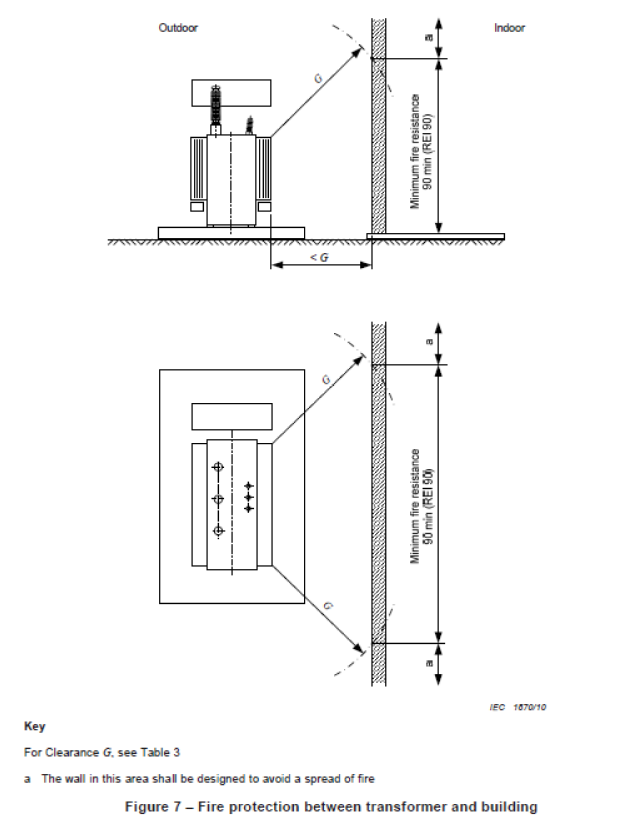
b) between transformers and buildings separating walls. For example EI 60; if additional fire separating wall is not provided, fire rating of the building wall should be increased, for example REI 90 (see Figure 7) in accordance with the Official Journal of the European Community C 62/23.
Table 3 – Guide Values For Outdoor Transformer Clearances
Transformer Type
Liquid Volume
Clearance G to
Other transformers or non-combustible building surface (m)
Combustible building surface (m)
Oil insulated transformers (O)
1000 <…..< 2000
3
7.5
2000 <…..< 20000
5
10
20000 <…..< 45000
10
20
< 45000
15
30
Less flammable liquid insulated transformers (K) without enhanced protection
1000 <…..< 2000
1.5
7.5
≥3800
4.5
15
Clearance G to building surface or adjacent transformers
Less flammable liquid insulated transformers (K) without enhanced protection
Horizontal (m)
Vertical (m)
0.9
1.5
Dry-type transformers (A)
Fire behaviour class
Clearance G to building surface or adjacent transformers
Horizontal (m)
Vertical (m)
F0
1.5
3.0
F1
None
None
NOTE 1:Enhanced protection means:
tank rupture strength
tank pressure relief
low-current fault protection
high-current fault protection
For an example of enhanced protection, see Factory Global standard 3990 (33) or equivalent.
NOTE 2: Sufficient space should be allowed for periodic cleaning of resin-encapsulated transformer windings, in order to prevent possible electrical faults and fire hazard caused by deposited atmospheric pollution.
Three classes have been defined:
Class O, if the fire-point is less than or equal to 300 °C. (e.g Mineral Oil)
Class K, if the fire-point is above 300 °C. (e.g MIDEL 7131 and MIDEL eN 1024)
Class L, if the insulating liquid has no measurable fire-point.(e.g. Xiameter PMX-561)
8.7.2.2 Indoor Transformer Installation In Closed Electrical Operating Areas
Minimum requirements for the installation of indoor transformers are given in Table 4.
Table 4 – Minimum Requirements For The Installation Of Indoor Transformers
Transformer Type
Class
Safeguards
Liquid Volume
≤ 1000 I
El 60 respectively REI 60
≤ 1000 I
El 90 respectively REI 90 or El 60 respectively REI 60 and automatic sprinkler protection
Less flammable liquid insulted transformers (K)
Nominal power/max
Without enhanced protection
(no restriction)
El 60 respectively REI 60 or automatic sprinkler protection
With enhanced protection
≤ 10 MVA and UM ≤ 38 kV
El 60 respectively REI 60 or separation distances 1.5m horizontally and 1.5m vertically
Dry-type transformer (A)
Fire behaviour
F0
El 60 respectively REI 60 or separation distances 0.9m horizontally and 1.5m vertically
F1
Non combustible walls
NOTE 1: REI represents the bearing system (wall) whereas El represents the non-load bearing system (wall) where R is the load bearing capacity, E is the fire integrity, I is the thermal insulation and 60/90 refers to time in minutes.
NOTE 2:Enhanced protection means:
tank rupture strength
tank pressure relief
low-current fault protection
high-current fault protection
For an example of enhanced protection, see Factory Global standard 3990 (33) or equivalent.
NOTE 3: Sufficient space should be allowed for periodic cleaning of resin-encapsulated transformer windings, in order to prevent possible electrical faults and fire hazards caused by deposited atmospheric pollution.
Doors shall have a fire resistance of at least 60 min. Doors which open to the outside are adequate if they are of low flammability material. Ventilation openings necessary for the operation of the transformers are permitted in the doors or in adjacent walls. When designing the openings, the possible escape of hot gases shall be considered.
8.7.2.3 Indoor Transformer Installations In Industrial Buildings
For all transformers in industrial buildings, fast-acting protective devices which provide immediate automatic interruption in the event of failure are necessary.
Transformers with coolant type O require the same provisions as in 8.7.2.2.
For all other liquid-immersed transformers, no special arrangements in respect of fire.
protection are required, except for the provisions for liquid retention in case of leakage and the provision of portable fire extinguishing apparatus suitable for electrical equipment.
Dry-type transformers (A) require the selection of the correct fire behaviour class depending on the activity of the industry and on the material present in the surroundings. Fire extinguishing provisions are advisable, particularly for class F0.
NOTE: For all transformers in industrial buildings, additional fire precautions may be necessary, depending on the nature and use of the building.
8.7.2.4 Indoor Installations In Buildings Which Are Permanently Occupied By Persons
In high-voltage installations, located in public or residential buildings, special conditions shall be observed in accordance with existing standards or national regulations.
8.7.2.5 Fire in the vicinity of transformers
If there is an exceptional risk of the transformer being exposed to external fire, consideration shall be given to
fire-resistant separating walls;
gas-tight vessels capable of withstanding the internal pressure generated;
controlled release of the hot liquid; fire extinguishing systems.
8.7.3 Cables
The danger of the spread of fire and its consequences shall be reduced, as far as possible, by selecting suitable cables and by the method of installation.
The cables may be assessed by reference to the following categories:
cables without particular fire performance characteristics;
cables (single) with resistance to flame propagation (IEC 60332 series);
cables (bunched) with resistance to flame propagation (IEC 60332 series);
cables with low emission of smoke (IEC 61034-1);
cables with low emission of acidic and corrosive gases (IEC 60754-1 and IEC 60754-2);
cables with fire-resisting characteristics (IEC 60331-21 or IEC 60331-1).
Cables in trenches and buildings shall be laid in such a way that the regulations regarding fire safety of the building are not adversely affected. For example, to avoid fire propagation, holes or cable ducts through which the cables go from one room to another shall be sealed with suitable fire proof and resistant material.
A physical separation or different routing of power circuits from the control circuits for high voltage equipment is recommended if it is necessary to preserve the integrity of the latter as long as possible following damage to the power circuits.
Where necessary, a fire alarm and fire extinguishing systems shall be installed in cable tunnels and in cable racks in the basement of control buildings.
8.7.4 Other Equipment With Flammable Liquid
For all equipment, such as switchgear which contains more than 100 l of flammable liquid in each separate compartment, special fire precautions as specified for transformers may be necessary, depending on the nature and use of the installation and its location.
Figure 6 – Separating Walls Between Transformers
Figure 7 – Fire Protection Between Transformer & Building
Key
For Clearance G. see Table 3
a) The wall in this area shall be designed to avoid a spread of fire
Thorne & Derrick distribute the most extensive range of 11kV Cable Jointing, Terminating, Pulling & Installation Equipment – we service UK and international clients working on underground cables, overhead lines, substations and electrical construction at 11kV and up to and EHV transmission and distribution voltages.
ALVIN by EA Technology Identify LV Electrical Equipment Faults
uploaded by - Chris Dodds Thorne & Derrick Sales & Marketing Manager
ALVIN by EA Technology
The ALVIN (Automatic Low Voltage Intelligent Network) has been developed by EA Technology (EATL) and is supporting customers and saving time and money through speedy fault and location detection.
ALVIN Reclose is the next generation of supply-restoration reclose equipment, providing Network Operators with invaluable support in reducing costs and delivering better customer service.
ALVIN Reclose meets the immediate needs of Network Operators to improve customer service on ageing, low voltage networks, while providing the foundation for future automation and communication schemes.
EA Technology’s ALVIN Reclose is the most advanced, compact, cost-effective solution available on the market enabling intelligent automation and fault restoration on low voltage electrical and cable networks.
ALVIN Reclose
ALVIN & Western Power Distribution
Stoke Plant Team Manager at Western Power Distribution Steve Weddell said: “We use the ALVINs on intermittent faults where existing electrical equipment has failed to locate the issue or where visibility of the underlying problem is required. It provides visibility to power quality information which helps to locate the fault or power quality issue.”
Steve and his team worked closely with EA Technology for 12 months and the team has since achieved 100% success rate in detecting issues where we have deployed the ALVIN on known faults and problem circuits.
Western Power Distribution Using ALVINs On Intermittent Faults
Stoke Engineering Specialist David Phillips gave a real case example of where the ALVIN has helped customers. “In early 2018 we received reports of flickering lights in Alrewas in the Stoke distribution patch. Power quality devices were fitted but no meaningful cause for the disturbance was found.
The issue continued for several months.
During a visit to EA Technology my colleague and I discussed the matter and we decided to use the ALVIN as an experiment to investigate the cause. On installation, the problem was immediately found and the electrical power fault rectified within two days.”
The device records the voltage and current waveforms associated with a collection of brief faults, which disappear (self-heal) before a fuse operates. The ALVIN fits in a standard low voltage holder and which, on detection of a fault, will break the circuit and disconnect supplies, wait for approximately thirty seconds, then reclose and reconnect the circuit.
The ALVIN fits in a standard low voltage holder and which, on detection of a fault, will break the circuit and disconnect supplies, wait for approximately thirty seconds, then reclose and reconnect the circuit.
In 2017 EA Technology launched a new LV (Low Voltage) Cloud data service which enabled the voltage and current waveform visualisation and fault location service to be provided.
Identify LV Electrical Equipment Faults With ALVIN By EA Technology
We have had several sets of ALVINs since 2016. Approximately 12 months ago, we bought the communication equipment which enabled it to communicate to the LV Cloud. These sets have been distributed between Nottingham and Stoke depots where the ALVIN systems have been deployed to manage and locate problematic LV faults.
David explained: “The waveform data is captured by the device and the status of customer supplies is confirmed by text or email. The severity and frequency of pre-fault activity can be used to indicate supply interference as well as implying the likelihood of an impending fault or probability of getting a good thermal reading or ‘sniff’ of fault gases to confirm the suspected location fault.
David concluded: “We have found the units to be extremely versatile and currently work in close partnership with EA technology in exploring the possibilities of these devices and future development.”
ALVIN Reclose
ALVIN
Business Benefits
Ability to identify and ‘self-clear’ multiple transients and overload faults so reducing engineering costs and delivering improved customer service
Simple, retrofit installation with no hidden ‘start up’ costs means the low-cost ALVIN Reclose offers excellent cost/benefits justification.
flexible features give businesses exactly what they need now. The device is the foundation building block of a range of low-cost add-on devices and services, making it ‘future-adaptable’
ALVIN Reclose uses the latest technologies, ensuring the safety of employees and customers
The ALVIN Reclose device allows for more effective asset management, increasing reliability, efficiency and safety at lower costs
Automatic Low Voltage Intelligent Network
Features
Automatic ‘self-clearing ‘of transient and overload faults,
Supply restoration with no need for manual intervention
High quality specification, functionality and reliability
‘All-in-one’ mechanism tests and restores power automatically
Unique SafeON™ technology ensures power can be restored safely
Fully self-contained, it does not require any auxiliary components
Full load, network analysis and diagnostics are available through the external data port
Ready for future use: it is the foundation for a range of low-cost, add-on products and services
The only retrofit product with arc-less switching for improved network protection.
Fitting is simple, fast, safe and compatible with existing 92mm fuse holders
factory programmed to suit different customer requirements
Comprehensive training, together with on-call service support
ALVIN Technical Specification
ITEM
RATING
Rated Operating Voltage
275V phase to neutral on either pole
440V across poles
Rated Insulation Voltage
690V
Rated Operating Current
400A or 500A as thump option for ALVIN RecloseITTM version
Operating frequency
50Hz
Rated making capacity
80kA
Rated breaking capacity
80kA
Overcurrent trip characteristic
Inverse time-based on 315A & 400A BS88-2 It zones
Ambient air temperature
-25°C to +45°C
Operating cycles
1000
Voltage measurement
±1.5% 50V to 253V AC RMS
Current measurement
±1% >200A, ±2A ≤200A
Harmonic monitoring
Yes
Directional Fault Indicators
Yes
Fault location ready
Yes
Making on faulty cable
SafeONTM with current limiting to 2.4kA
Standards applied
IEC 60947-2, IEC 61000, IEC60255
EA Technology
EA Technology are a global provider of end to end power engineering solutions and provide expert consultancy, innovative instruments, skills training, technical services and more.
Established since 1985, T&D distribute the most extensive range of LV, MV & HV Cable Jointing, Terminating, Pulling & Installation Equipment – contact us today for a competitive quotation.
A multi-award winning second generation family owned business, Rock Fall has positioned itself at the forefront of the electrical safety footwear industry as a leading manufacturer of linesmans boots and dielectric insulating boots to meet the ever-changing demands of the power transmission and distribution industry.
Recognising the strong growth and focus on clean energy and sustainability around the world Rock Fall have developed the first Electrical Safety Trainers available in Europe.
Certified against European and International Electrical Hazard standards the safety trainers are designed to protect wearers against electrical risks up to 18kV in accordance with the ASTM F2412-11 test method.
The range is in stock in the UK and available exclusively from the largest PPE resellers in the UK, including Thorne & Derrick.
The range, which has already been recognised by the industry for Innovation at the recent Professional Clothing Awards is driving quick and significant growth in Australia and New Zealand, with major electrical contractors specifying the products for their electrical operations.
The electrical hazard trainers comply with European and American Standards:
EN ISO 20345:2011 SB P E FO WRU SRC
ASTM F 2413-11 1/75 C/75 EH PR
Electrical Hazard Trainer
Speaking about the development, Richard Noon said:
“Electrical risks are increasing as the prominence of hybrid and fully electric vehicles continues to grow. In manufacture, service and at the end of life these vehicles must be handled safely using correctly specified electrical safety equipment.
Electric Vehicles aren’t the only driver for this, as we increase the pressure on our electricity networks, there will be even greater demand for preventative maintenance and work on live lines.
Increased pressure can cause accidents and to have an additional item of PPE to be the last line of defence, in our opinion is critical.
We have seen from the great improvements in Safety Management during the Crossrail project.
With HS2 electrification high on the agenda, from the view of a Electrical Safety Equipment manufacturer it’s important that our industry makes the most of these major infrastructure projects.”
ARC FLASH PROTECTION, CLOTHING & PPE FOR LINESMEN, JOINTERS & UTILITY WORKERS
Thorne & Derrick International are specialist distributors of LV, MV & HV Cable Installation, Jointing, Duct Sealing, Substation & Electrical Equipment – servicing UK and global businesses involved in cable installations, cable jointing, substation, overhead line and electrical construction at LV, 11kV, 33kV and EHV.
uploaded by - Chris Dodds Thorne & Derrick Sales & Marketing Manager
WPD’s Safety Footwear Solution
Electrical Safety Equipment LV MV HV
Western Power Distribution are the electricity distribution network operator for the Midlands, South West and Wales. They deliver electricity to over 7.8 million customers over a 55,500 square kilometres service area. A network which consists of 220,000 km of overhead lines and underground cables, and 185,000 substations resulting in the employment of over 6,500 staff.
Rock Fall design and develop electrical hazard linesmens boots and shoes to impede the flow of LV MV HVelectricity through the shoe and to the ground reducing the likelihood of electrocution, in accordance with ASTM F2413-11.
Below is a case study of how Rock Fall and Western Power Distribution have achieved an electrical safety footwear solution meeting all the necessary standards.
The problem
WPD felt they had a few problems with their electrical safety footwear solution. These included:
Missing specification
High costs
Requirement for bespoke design choices
The story
Western Power Distribution approached Rock Fall to develop a range of styles to protect them from the electrical risks that they face. WPD were fully aware that these styles are designed as secondary protective equipment for use in addition to other electrical hazard protection equipment i.e. insulating gloves. Key features of these electrical safety products are:
Certified to 18kV protection in accordance with ASTM F2413-11
Waterproof tested for 100 hours
New design features including yellow collar and lacing and new outsole mould compatible with climbing irons
Rock Fall supplied wearer trials to several operatives across a variety of business units.
The trialled products were:
Rock Fall RF800 & RF900 certified to ASTM F2413-11 as well as EN ISO 20345:2011
Ortholite® Climate breathable footbed – reduces foot swelling and provides anti-fatigue and moisture wicking properties
IMPACT SHIELD™ Internal Digging Plate – reduces impact into the under-foot and increases stability
Finally, Rock Fall have added a yellow collar, meaning that wearers can be identified to be wearing the correct EH Footwear from a distance by Health and Safety and Site Managers.
Linesmens Boots
solution
Following a diligent trial and development process the RF800 PowerMax and RF900 Power were specified on the Western Power Distribution safety footwear tender that took place during Q4 of 2017.
The linesmen boots are on the ground and wearer feedback is continually being monitored.
Matthew Noon, Director at Rock Fall and Lucine Evans, Safety Advisor at Western Power Distribution worked together on the project.
Matthew said “We are thrilled to have had the opportunity to work with Western Power Distribution on such an important project for both them, and the industry. Rock Fall has positioned itself as the go to manufacturer for end-users when they need something brand new. Working with WPD has been a pleasure from start to finish and we are proud of the results.”
Lucine said “As a business we had been waiting for an electrical hazard boot which was CE marked to come on to the market, so we were more than happy to work with Rock Fall on the development of these work boots. Throughout the process Rock Fall have listened to our feedback and the result is two styles of work boot that are fit for purpose, comfortable, robust and meet WPD’s minimum standards for footwear.”
Rock Fall are eager for ongoing user feedback so their electrical hazard footwear and dielectric boots can be reviewed to ensure the continual performance and value for money is achieved.
ARC FLASH PROTECTION, CLOTHING & PPE FOR LINESMEN, JOINTERS & UTILITY WORKERS
Thorne & Derrick International are specialist distributors of LV, MV & HV Cable Installation, Jointing, Duct Sealing, Substation & Electrical Equipment – servicing UK and global businesses involved in cable installations, cable jointing, substation, overhead line and electrical construction at LV, 11kV, 33kV and EHV.
klauke ekm60unv – universal cutting, crimping & punching tool The Klauke EKM 60 UNV is a versatile battery powered hydraulic universal tool engineered that can be used as a battery powered cable crimping tool and battery operated cable cutting tools that comes...
INDUSTRIAL LABEL PRINTING SOLUTIONS When clear, durable and professional identification is required across control panels, cable systems, production facilities and industrial installations, print quality, reliability and ease of use are critical. Cembre industrial label printers are designed to support...