Blog
Ten Most Common Errors in Arc Flash Studies | Guest Article By Power EasyPower LLC
June 20th, 2022
Ten Most Common Errors in Arc Flash Studies
- Special thanks to Emily Sotupo Marketing Co-ordinator from EasyPower LLC for the kind permission to republish – view the original article click here
Arc Flash Studies
Each year we see dozens of arc flash studies ranging from first attempts to submittals from seasoned veterans in the industry. With an eye towards improving the overall results in the field, we offer this list of “Ten Most Common Errors.” This is not a criticism of anyone or any group; it is more of an effort to bring some insight to areas that may not be that well understood, including changes in the standards, the phenomenon of arc flash, and the application of analytical tools toward that end.
#1 – The Lack of Understanding the “Arc Flash Paradox.”
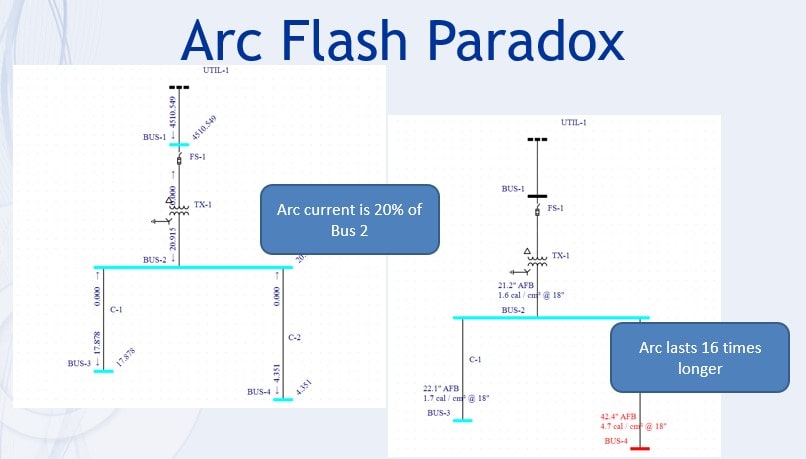
The counter-intuitive nature of the arc flash hazard tends to impede the acceptance of arc flash as a hazard by some of us with a long history in the industry. Put simply, within the same system you can have buses that have high current and high arc incident energy AND other buses that have lower current but that calculate a higher arc incident energy. Incident energy has a significant relationship to the time required to clear the arc.
Comparing Bus-4 to Bus-2 in the example below, Bus-4 has a higher incident energy in spite of having available fault current at Bus-4 that is only 20% of the fault current available at Bus-2. The length of time to clear the arc in this case has a significant bearing on the arc flash calculation.
#2 – “Infinite source” is Not the Worst Case
Nor should it be used in place of actual utility data when calculating arc flash results. Often times, the local utility company cannot or does not respond to a request for short circuit data as required for an arc flash hazard assessment. From the early days of power system design, the engineer responsible for the electrical system was tasked with the requirement to have the system be able to safely protect itself against the worst-case short circuit current that it could possibly see from the utility source. The concern was due to the short circuit rating for each piece of equipment in the system.
Each piece of equipment needed to be able to survive in the case of a short circuit fault. The results of an equipment duty analysis will determine if any system element has the potential for being over-stressed in the case of a worst-case fault at that location.
In that case, using an infinite source would be valid to determine system integrity. In the case of arc flash analysis, however, the use of a higher short circuit current value than is really expected could potentially yield a lower result for arcing incident energy since the higher current value of the infinite source would cause the protective devices to trip quicker than the same circuit exposed to actual or estimated fault current at the utility connection. This can be shown in the framework of an EasyPower study by using the Scenario Manager to compare results.
#3 – Not all buses are created equal!
The long-awaited release of IEEE 1584-2018 promised improved alignment between model results and the test data upon which the model is built. Part of this improvement is the inclusion of a number of parameters that were not included in the original arc flash calculation method. Included in the updated standard is a table of typical values for each of these parameters along with equipment type and different voltage levels.
It is therefore a good practice to ensure that the data collection team can identify the type of switchgear or panelboard and at the same time recognize if there is a significant difference between the typical values listed in the standard and record the actual values for:
- Working distance
- Electrode gap
- Enclosure size
- Electrode configuration
In EasyPower, the default values for each of these parameters are included in the Arc Flash Hazard Default table in the Device Library. If the actual system diverges from the default values significantly, it is incumbent on the person creating the digital model of the system to update the recorded values during model creation.
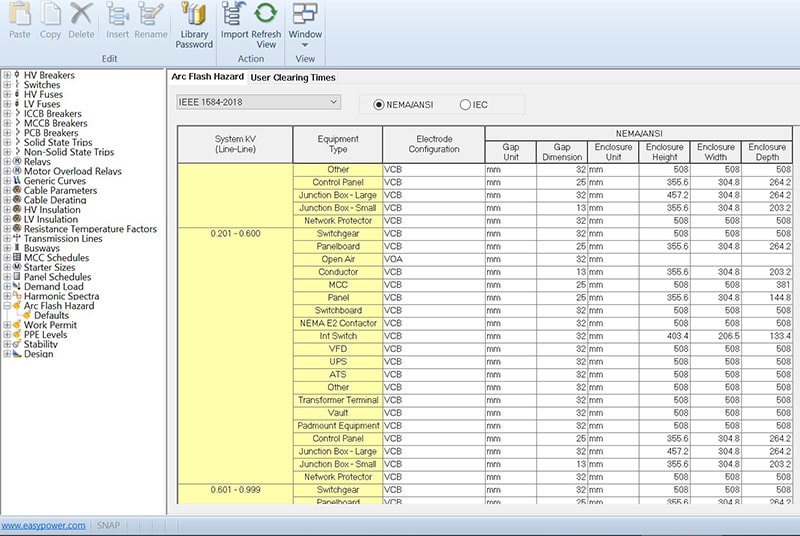
Arc Flash Hazard Default Values
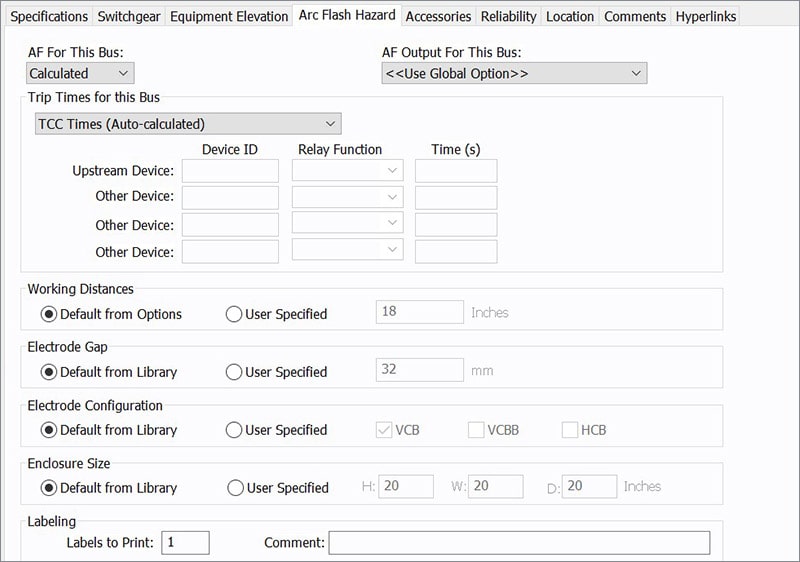
Typical Parameters in the Arc Flash Hazard Tab
#4 – Why Not Put 6 Inches Working Distance on the Label, Since That is What My Hand Will See?
It is expected that the results of the arc flash study will be reviewed by management with an eye towards verifying that all hot work required in the plant will be necessary and conducted with the utmost focus on employee safety.
As such, all hot work should be conducted under the auspices of properly completed Hot Work Permit. Labels do not authorize hot work. The working distance on the label is generally based upon the distance from the bus to the head or thorax of a worker while the panel cover is being removed. It is really a convenient number to permit the qualified worker to understand the relative magnitude of the hazard when the cover is removed. Additional information on the label is discouraged to prevent any misunderstanding of this restriction.
#5 – Why Calculate Equipment Duty on Plant Equipment That Has Already Been in Operation For 25 Years?
If it has been working for that long without an issue, why bother? Right? SCCR (short circuit current rating) is the maximum short-circuit current an electrical component can safely withstand without causing shock or fire hazard. In general, the SCCR for electrical switchgear or panels is based on the lowest component’s SCCR in that panel. Protective devices included in the one-line diagram must be linked to the datasheet for that element located in the Device Library.
As long as the one-line element is linked to the Device Library (meaning it is verified using the Calculate button on the Short Circuit tab of the Data dialog box), EasyPower calculates the equipment duty during a short circuit analysis.
The withstand rating of switchboards, panels, and MCC enclosures is usually listed on the nameplate of the installed element. In EasyPower, this rating should be entered in the dialog box for the element to be included in the equipment duty calculation.
Consideration should be given to system changes over the life of the installation. Changes in load size and location, increases in fuse sizes, breaker trip settings, as well as unannounced changes in utility short circuit values could render the original system design guard bands inadequate. Even if the SCCR for some elements may not have been entered during the original arc flash study, it seems prudent to include the data during study updates.
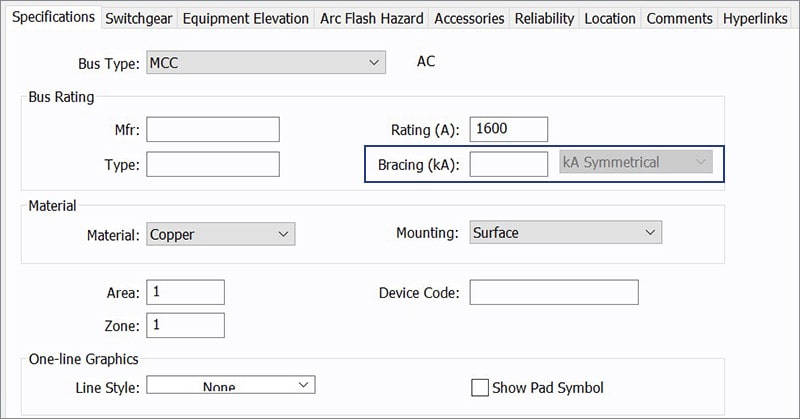
Bus Bracing Missing in the Data Dialog Box for an MCC
#6 – We Do Not Need a Coordination Study on Protective Devices During This Update. We Did It Five Years Ago
You may be correct unless:
- Some blown fuses were swapped out with a different manufacturer’s product or values because they were available during urgent times.
- Relay or LVPCB trip settings were tweaked to eliminate nuisance tripping.
- Large system loads have been added, moved, or deleted.
At a minimum, you should check the Sequence of Events. PowerProtector™ is the name of the EasyPower module used for plotting TCC curves and verifying coordination. When system fault current is displayed during a single bus fault, EasyPower illuminates an icon labeled Sequence of Events.
A simple click on that icon displays the chronological trip order of all device between the faulted single bus and the energy sources affected, providing a quick and efficient way to verify device coordination.

Arc Flash Protection & Electrical Safety Products | Distributed By Thorne & Derrick
#7 – I Always Calculate Arc Incident Energy Including the Main Breaker Because I Don’t Think It Will Fail
The IEEE 1584 standards (both 2002 and 2018) recommend excluding the main breaker of a panel or switchgear when there is not an arc barrier between the incoming conductors to the main breaker and anyone working downstream on the main bus. The reason has less to do with the reliability of the breaker itself and is more based on the fact that once established, an arcing fault will produce a plasma ball, often several millimeters in diameter.
If that plasma ball contacts any electrified bus work, the arc can propagate and potentially render the protective device useless. Verifying the existence of an arc barrier between the incoming conductors and the downstream bus is the only way to recommend including the main breaker.
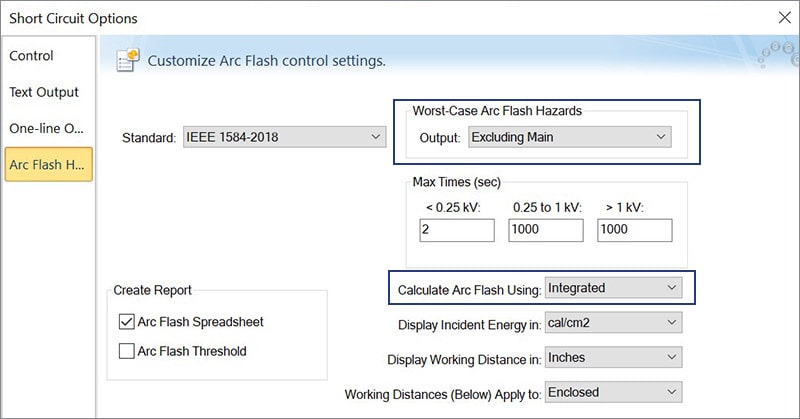
Worst-Case Arc Flash Hazards Indicating the Option to Exclude Main Breaker and Use the Integrated Method to Calculate Arc Flash
#8 – Half-cycle (Momentary) Current is the Worst-case Fault Current, so I Use It to Calculate Arc Incident Energy
Recognizing that the available fault current may change over time, IEEE 1584-2018 recommends that a dynamic assessment of fault current be used to accommodate changes that may be the result of reducing motor contribution, load drops, or other changes in fault current. In EasyPower, the recommendation is to use the Integrated Method.
In the EasyPower Integrated Method, during:
- The first cycle of the fault, momentary current is used for energy integration.
- The next 8 cycles, interrupting (5-cycle) current is used to calculate energy.
- For any additional time to clear the protective device, 30-cycle current is used.
9 & 10 Deal with labels, which are the source of a large number of frequent errors. These are two of the most frequent:
#9 – I Want My Labels to Show the HRC #, in Spite of the NFPA 70E Changes
NFPA 70E revision history includes the following changes:
- The 2012 version had Hazard Risk Category (HRC) tables.
- The intent was to calculate incident energy and then use the table to determine the PPE needed.
- The 2015 version changed HRC to PPE category.
- The label may have calculated Incident Energy OR PPE category, but NOT BOTH.
- Allows for a “Site Specific” option for companies to define their own categories.
- The 2018 version repeats label restrictions.
- The industry is migrating to align training for labels and PPE rating to reflect the incident energy.
While the standard is voluntary, the industry is moving to align with the NFPA 70E recommendations to label PPE with incident energy. So, the reasons (if any) to stay with using the HRC # on labels should be reconsidered. We recommend:
- Set a timetable to achieve NFPA 70E alignment.
- Decide between Site Specific or Incident Energy to determine PPE.
- Update the safety manual and training to follow NFPA 70E.
#10 – I Want to Put Maintenance Mode incident Energy on the Label
For at least the last 10 years, hardware companies have made available a feature that enables the user to temporarily set the trip time of a relay or LVPCB unit to be much quicker and provide a safer, lower arc hazard on the protected bus. This feature can be enabled by a switch on the front panel or an electric control signal routed to the back of the panel and is called Maintenance Mode.
This is a method of hazard reduction preferred over just adding more PPE for the worker at the higher energy level. It also falls into the category of hot work. Therefore, the information should not be on a label. Instead, the maintenance procedure, correct PPE, and instructions to use the Maintenance Mode feature should be approved and listed on the Hot Work Permit.
EasyPower LLC – Bio

Since our inception in 1984, we’ve been redefining how companies manage, design, and analyze their electrical power distribution. We continue to develop unprecedented technologies to make it simpler, smarter, and safer— driven by an unyielding commitment to deliver cutting-edge power system software that’s inherently easy to use.
Organizations throughout the world use our advanced— yet simple— software tools to safeguard their valuable resources of time, money, and personnel. Oil refineries, power utilities, paper and pulp manufacturers, military installations, data centers, and a host of others rely on EasyPower to keep their power systems running safely and smoothly.
From plant personnel to the most experienced electrical engineers, EasyPower users continually rave about its simplicity and power.
Our family of products includes the EasyPower® suite, ArcFlash Essentials™, and OnSite™, as well as our grounding calculation solution, XGSLab, for which we are the exclusive reseller in the United States and Canada. We also provide training for EasyPower and electrical safety in general, in addition to offering a full range of engineering services.
EasyPower Customer Service
EasyPower’s Sales Team is available to meet all of your customer service needs:
- Provide free demos
- Provide pricing information
- Customize a software package to meet your specific engineering needs
- Provide answers regarding upgrades, maintenance contracts, and key replacements
If you need Engineering Services, we are happy to process your Request for Proposal from our Consulting Team. Or, if you have Training Questions, we’ll gladly answer those as well.
Contact us by email at [email protected]
Contact us electronically by using our Contact Form, or reach us with our address or phone number here:
EasyPower LLC
15862 SW 72nd Ave, Suite 100
Portland, OR 97224
+1 (503) 655-5059
Arc Flash PPE & Electrical Safety
Main UK Stockists & Distributors of Electrical Safety Products
Thorne & Derrick provide Electrical Safety Equipment to substation engineers, cable jointers, overhead linesmen and utility workers with PPE and electrical safety equipment including insulating gloves, voltage detectors, insulating matting and portable earthing to ensure worker safety when carrying out maintenance on LV-HV switchgear, substations, cables and electrical equipment.

We protect substation engineers, asset managers, SAPS, cable jointers, overhead linesmen and utility workers with PPE and safety equipment: this includes insulating gloves, voltage detectors, insulating matting and portable earthing to ensure worker safety when carrying out repair and maintenance on LV-HV switchgear, transformers, substations and turbines.
All our Cable Connection & Energisation Accessories including Medium & High Voltage joints, terminations, connectors and cleats are tested to the latest international standards and supporting ranges of professional cabling tools are stocked to reduce incident, accident and downtime to plant and people.
Lucy Zodion Awarded Tender by Scottish Power Energy Networks
June 15th, 2022
-
Uploaded By - Chris Dodds (Thorne & Derrick Sales & Marketing Manager)
Press Release: Thorne & Derrick and Lucy Zodion | 17.6.22
STREET LIGHTING CUT OUTS
Thorne & Derrick, a Specialist Distributor for Lucy Zodion the market-leading manufacturer of Street Lighting & ICP Connection Solutions, are delighted to announce that Scottish Power Energy Networks (SPEN) have awarded a 2-year tender to Lucy Zodion to supply the following G81 approved products:
- Lucy 0260009009 SLF 25A Street Lighting Cut Out TYPE 1 SNE Boxed
- Lucy 0350012009 5 Way Connector Box
The Lucy Zodion range of street lighting cut-outs, controls, feeder pillars and isolators are specified and installed by ICP’s throughout the UK providing reliable and effective street lighting and electrical connections to our utility network.
Thorne & Derrick are Approved Vendors to SPEN and their Lloyds NERS accredited ICP’s, you can contact us for competitive prices and stock availability for the complete range of Lucy Zodion Street Lighting Equipment.
➡ For further information about how Lucy Zodion provide control and power distribution products for street lighting applications, please review the Lucy Titan (Cut-outs) and Lucy Trojan (Isolators) ranges of products.
Should you require any technical support or have any commercial requirements about G81 Approved 11kV/33kV Cables & Accessories please do not hesitate to contact Thorne & Derrick Sales Team.
Lucy Zodion SLF fused cut out
- Separate neutral and earth (SNE) cut out
- Maximum continuous load 25A
- Simple cam lever fuse carrier removal
- Single fuse
- Double pole
- Cut-out full conformity to BS7654
- Terminals accept cables up to 25sqmm
- IP22
- 2 x 20mmØ cable entry- grommets
Lucy Zodion Cut Outs | The SLF cut out range is approved by all Distribution Network Operators (DNO’s) throughout England, Scotland and Wales – G81 approved versions are available for ICP/IDNO connections.
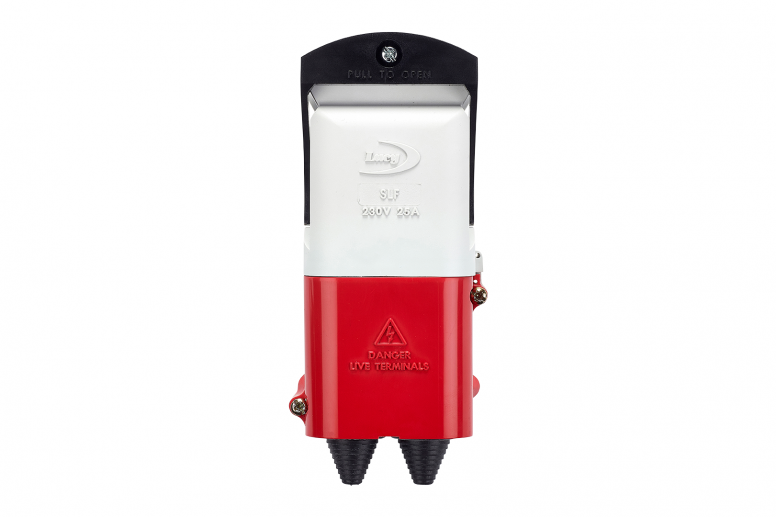
Lucy Zodion Cut Outs
| SPEN SAP Code* | Lucy Zodion Part Code | Description* |
| 30980590 | 0260009009 | CUT OUT 25A STREET LIGHTING TYPE 1 SNE: 25 AMP STREET LIGHTING CUT OUT, SNE CONSTRUCTION |
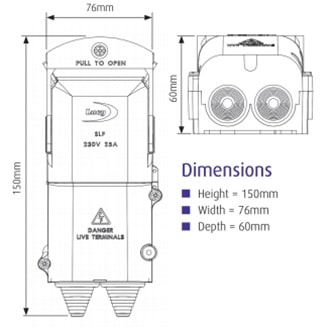
SLF
Lucy Zodion MLNS – 5 Way connector block

MLNS
- Maximum continuous load 100A
- Suitable for phase, neutral or earth conductors
- Serrated cable bores accept conductors up to 35mm² section
- Two M8 slotted head cable pinching screws per conductor
- Sealing wire facility
- IP22
- Removable shields for unused cable entries
- Robust thermoplastic housing
| SPEN SAP Code* | Lucy Zodion Part Code | Description* |
| 30980639 | 0350012009 | 100 A, 5 WAY SINGLE POLE CONNECTOR BLOCK. SUITABLE FOR TERMINATING PHASE, NEUTRAL OR EARTH CONDUCTORS |

*The SPEN part codes and descriptions in the tables are taken directly from the tender document.
Lucy Zodion’s SLCOs are compliant with BS7654, which covers all aspects of the cut out from the materials in which it is manufactured, to a series of tests relating to temperature, ingress protection, current and mechanical strength.
BS 7654 | 10th Edition, May 15, 2020 | Specification for single‑phase street lighting cut-out assemblies for low-voltage public electricity distribution systems – 25 A rating for highway power supplies and street furniture | purchase copy.

About SPEN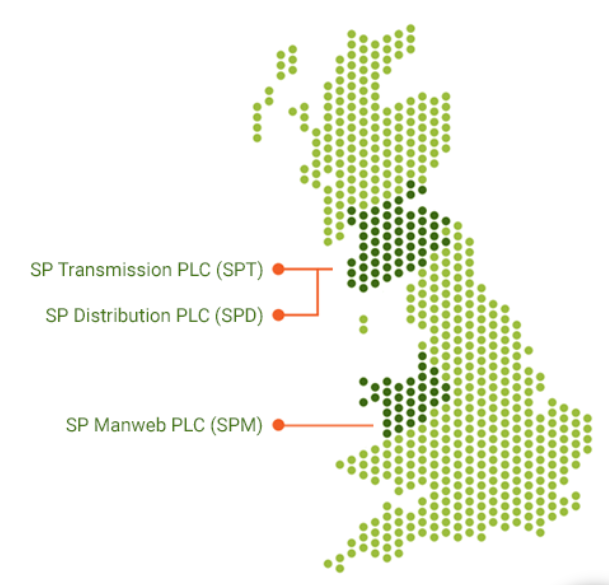
SP Energy Networks are a Distribution & Transmission Network Operator keeping electricity flowing to homes and businesses throughout Central and Southern Scotland, North Wales, Merseyside, Cheshire and North Shropshire – this is achieved via a network of Overhead Lines & Underground Cables which they own and maintain.
This includes over 30,000 substations, 40,000km overhead lines and 65,000km underground cables.
3 SPEN Regulated Electricity Businesses
- SP Transmission PLC (SPT)
- SP Distribution PLC (SPD)
- SP Manweb PLC (SPM)
THORNE & DERRICK
T&D are Specialist Distributors to UK Distribution Network Operators (DNO’s), NERS Registered Service Providers, ICP’s and HV Jointing Contractors of an extensive range of LV, MV & HV Jointing, Earthing, Substation & Electrical Eqpt – this includes 11kV/33kV/66kV cable joints, terminations and connectors for both DNO and private network applications.
Contact our UK Power Team for competitive quotations, fast delivery from stock and technical support or training on all LV-HV products.
Key Product Categories: Duct Seals | Cable Cleats | Cable Glands | Electrical Safety | Arc Flash Protection | Cable Jointing Tools | Cable Pulling | Earthing | Feeder Pillars | Cable Joints LV | Joints & Terminations MV HV

Wind Farm Maintenance | SWALEK for High Voltage Cable Jointing
June 13th, 2022
Solar & Wind Farm Maintenance
-
Special thanks to Tristan Jones Business Development Manager at Swalek High Voltage Servicesfor kind permission to share
Wind Farm Fault Emergency Call-Out
11kV | 33kV | 132kV
Swalek provide a comprehensive range of Solar & Wind Farm Maintenance Services including high voltage power cable installation, jointing, termination and testing.
Swalek cover design, consultancy, installation, testing and commissioning, energisation, operation and maintenance for electrical networks and cables up to 132kV.
Having built over 30 wind farms and operating and maintaining renewable energy assets across the UK, Swalek is well placed to provide high voltage electric power consultancy, operation and maintenance services including:
- Wind Farm Maintenance Services
- GWO Certified
- High Voltage Turnkey Solutions
- Installation
- SAP Service
- Fault Analysis & Management
- Consultancy & HV Safety
- Operation & Maintenance
- Commissioning
A Recent Wind Farm Maintenance Project Application
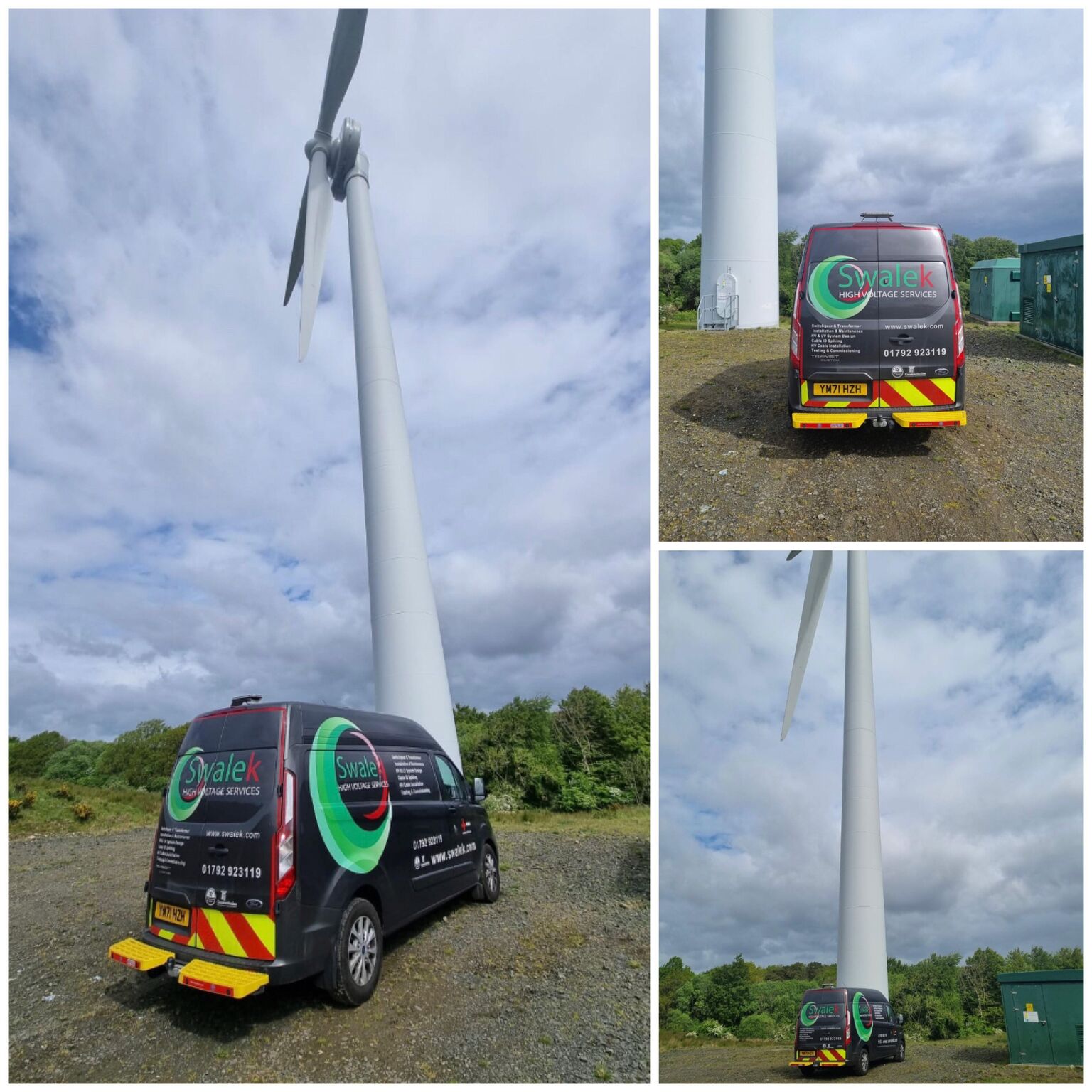
Swalek’s wind farm maintenance division supported a customer yesterday with their off-supply issue at a wind farm in Scotland, near Falkirk. An engineer attended site to assess the problem and found that the site had lost communications. The engineer checked the Scottish Power Network and didn’t find any problems. It was assumed that there was a loss of supply.
An investigation was then carried out and it was found that there was no supply to site or to the transformer to Scottish Power. The engineer contacted Scottish Power Energy Networks and discovered their switch had tripped on fault which was feeding the wind farm transformer.
A visual inspection was carried out on the transformer which didn’t indicate any stress or irregularities. The decision was made by Scottish Power to attempt a re-energization. The network tripped again immediately on fault and the decision was made to carry out an intrusive investigation.
The engineer then carried out a detailed investigation and it was discovered that Transformer 1 had a failure. An 11kV insulation resistance test was carried out which proved a fault on the HV winding. Swalek High Voltage Services are now in the process of sourcing and installing a new 800kVA transformer to replace the faulty transformer and ensure the wind farm continues to generate.
Swalek carry out wind farm high voltage design, build, operation & maintenance services throughout the UK and across Europe. Swalek deliver operation, maintenance and turnkey HV Design & Build (Civil & Electrical) balance of plant solutions for wind farm projects.
Wind Farm High Voltage Services
- Site Management / SAP Duties up to 132kV
- Control & Operation /HV Safety HV Consultancy
- Switchgear & Transformer Installation & Testing
- Design and Network Analysis, Discrimination Studies
- Earthing Design
- HV Electrical System Design
- HV Electrical Installation Primary Substation: Construction & Commissioning
- Switchgear, Transformers, Plant & Apparatus: Installation & Refurbishment
- Cable Containment: HV/LV, Cable Ladders Trays & Trunking Earthing Systems
- Panel Wiring: Relay Panels, Remote Terminal Unit (RTUs) and LVAC boards
- Lighting, Heating, Power & Security Systems: Substations & Control Rooms Retrofit
- Upgrade & Decommissioning: Equipment Protection, Design, Testing & Commissioning
- VLF & Partial Discharge Testing
- Cable Connections: HV/LV, Multi-Core & Power, Cable Laying, Pulling, Jointing
- Maintenance of HV & LV Switchgear
- HV Inspection & Testing Services up to 68kV (Peak)
- HV Switching
- Fault Finding Analysis & Management
- Transformer Repairs Oil Sampling – Laboratory Analysis Dissolved Gas Analysis
- Cable Installation & Jointing Services – 11kV, 33kV & 66kV
- Contestable Grid Connections
- Operation & Maintenance
- Asset Management, Condition Inspection & Monitoring

Wind Farm Maintenance – Swalek Project Photos

Swalek High Voltage Services design, installation, construction, commissioning, energising, maintaining and operating high voltage electrical infrastructures on 11kV, 33kV and 132kV private networks.
- High Voltage Cable Spiking – provide specialist engineering teams to carry out cable spiking on underground cables
- Switchgear & Transformer Maintenance – support you with Switchgear and transformer maintenance throughout your network
- Design & Earthing Studies – professional and competent specialists ensure your earthing system is appropriate for the installation
- Transformer & Switchgear Installation – installations are carried out to the highest safety standards and by fully trained engineers
Find out more about the operation & maintenance options Swalek High Voltage Services can provide to support you with maintaining the security of your electricity supply to your wind farm’s high voltage private network.
Alternatively call +44(0)1792 923199, or email: [email protected]
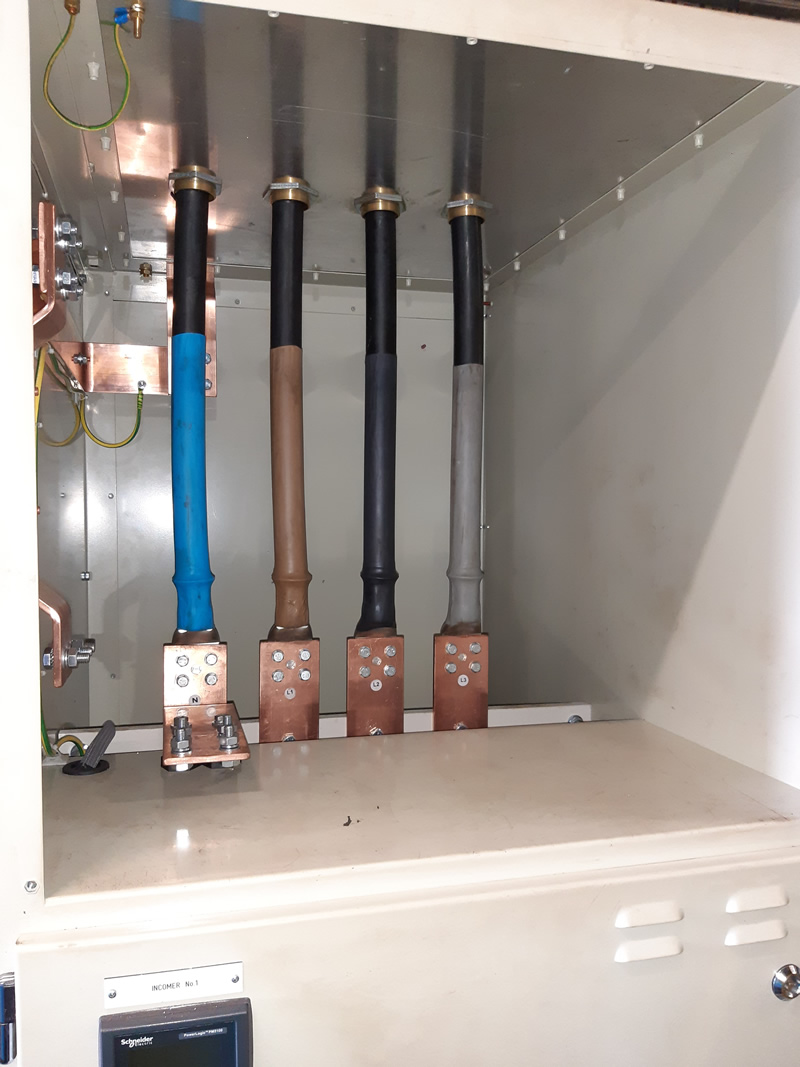
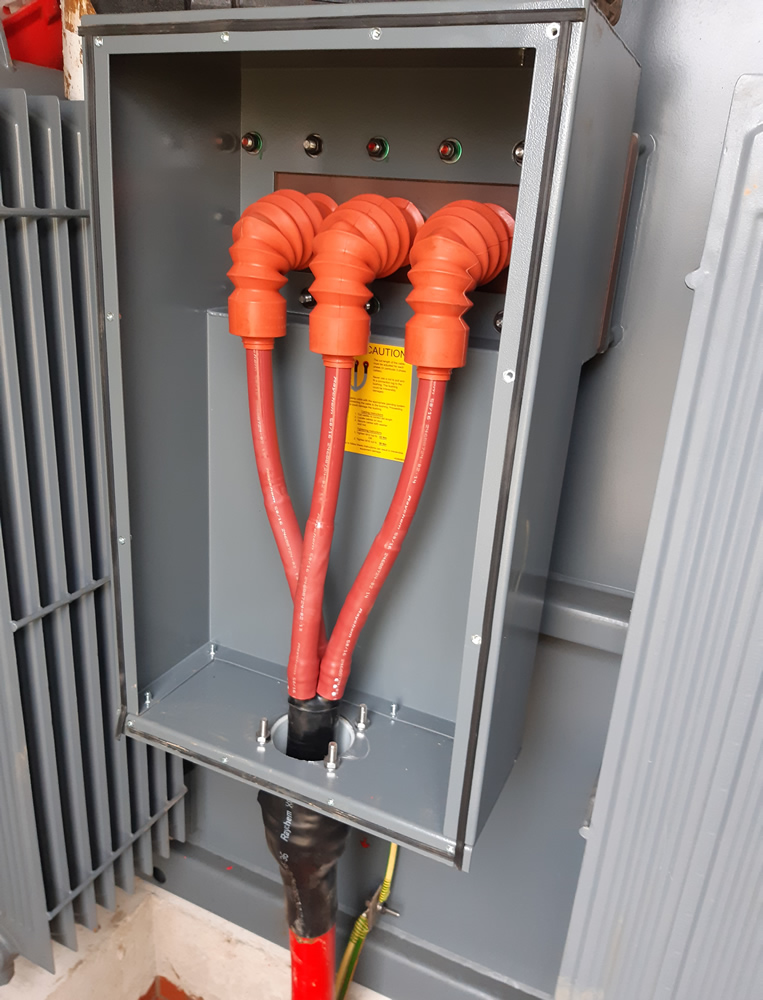
Jointing Gallery
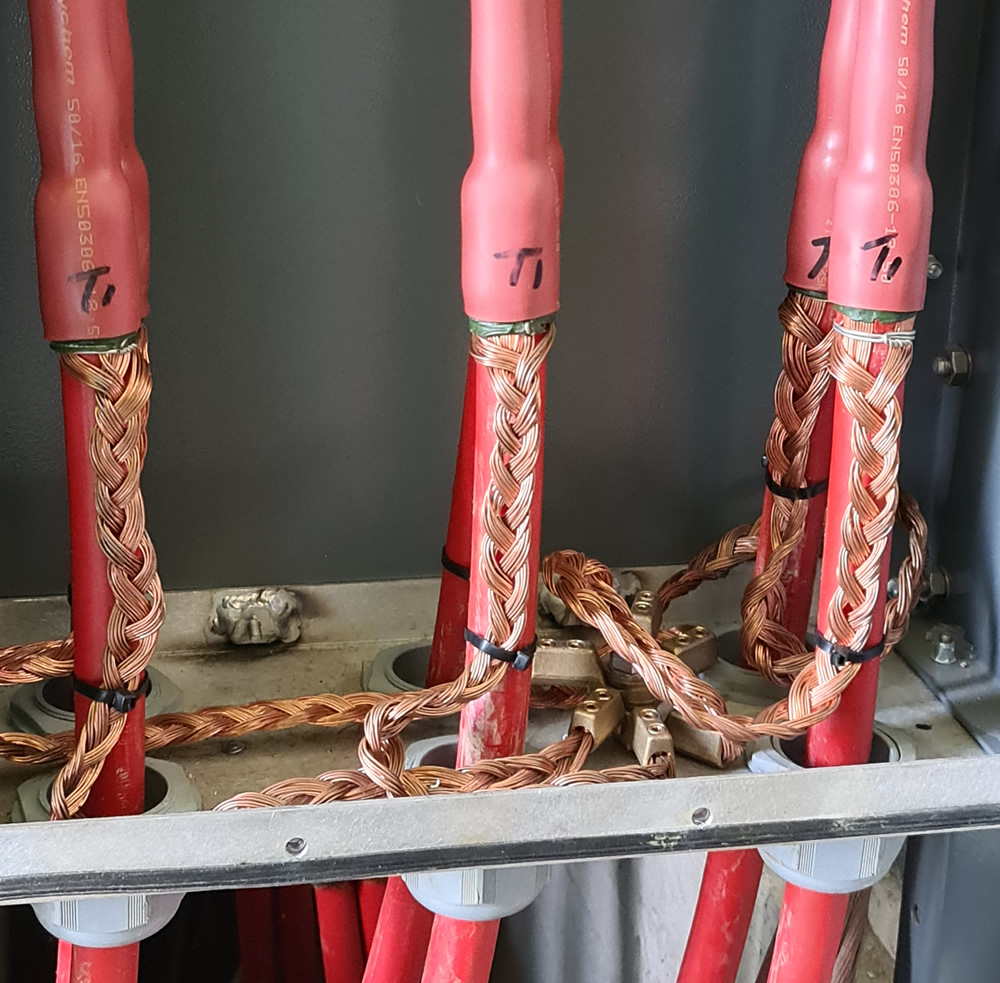
Specialist Distributors of High Voltage Jointing & Electrical Safety Equipment
Thorne & Derrick International are Specialist Suppliers to the UK and international Wind Industry of products to provide safe and reliable LV HV Electrical Cable Termination, Jointing, Installation & Power Systems up to 66kV.
We are based in North-East England, recognised as a key strategic location to service the offshore renewables energy market in the UK, from the North Sea to the Nordics – our Exports Division support international offshore wind power projects from USA to China.
Key Product Categories: Connectors, Joints & Terminations MV HV | Cable Preparation & Jointing Tools | Duct Seals | Cable Transits | Cable Cleats | Cable Glands | Electrical Safety | Arc Flash Clothing & Protection | Cable Pulling | Earthing & Lightning Protection | Feeder Pillars
Thorne & Derrick distribute the most extensive range of MV HV Medium & High Voltage Cable Joints, Terminations & Connectors from manufacturers including 3M, Prysmian, Nexans Euromold, Elastimold, Pfisterer CONNEX & SEANEX.

NEW | Cable Semi-Con Scoring Tools for SCS Series | Ripley Tools
June 13th, 2022
Semi-con Scoring Tools
SCS Series By Ripley Tools
Ripley Tools has launched three new tools for safe and efficient cable semi-con scoring, part of its SCS Series. Ripley SCS is a general purpose semi-con scoring tool for most medium voltage cable constructions and is equipped with a standard cable guide. The adjustable semi-con scoring tool removes easy strip type semi-con screens from HV power cables, this includes 11kV and 33kV power cables.
Between them, the new cable jointing tools are capable of precisely scoring medium-voltage cables from 0.31′′ to 2.96′′ (8 to 75mm), eliminating the need for traditional, higher-risk blades making them perfect for high voltage power cable preparation prior to jointing and terminating and easily mounts on the cable.
 See the full range of Cable Jointing Tools distributed by T&D, including Cable Tools For Underground Primary Distribution Cables and High Voltage Cable Jointing Tools
The first Jointing Tool in the series is the compact and adjustable SCS semi-con scoring tool, which precisely scores the semi-con to ease its removal while protecting the underlying insulation. The SCS works on medium voltage 5kV to 35kV cables with semi-con diameters of 0.31′′ – 2.00′′ (8 to 51mm) and is able to perform longitudinal, spiral and calibrated square cuts.
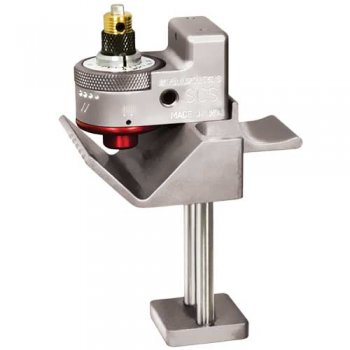
Ripley SCS Adjustable Cable Semi-Con Scoring Tool (Compact & User Friendly)
It’s the SCS tool’s micro-adjustable blade depth that ensures accuracy so cable insulation is not damaged and the innovative slide tray keeps the cable square to the cutting head for precision.
The UtilityTool SCS’s design eases operation for cable engineers. It opens and snaps on the cable quickly and simply. Plus, it can work in a small envelope of space, especially on large cable sizes and covers the range of both the BP1A and BP2A.
For highly bowed or curved cables, the SCS V2 has been created to give engineers enhanced control. Its narrow cable guide is suitable for sheathed and jacketed 3 phase assemblies.
Completing the trio is the SCS Max, an extended version of the SCS to make precision cuts on large diameter power cables with strippable semi-con. The tool is designed for cables with a diameter of 1.77′′ to 2.96′′ (45 to 75mm) and it can operate within a 4′′ (101.6 mm) envelope on larger cables.
“All three tools in the SCS Series overcome the mechanical limitations of their counterparts in the market and replace the need for the use of basic, high-risk knives, thanks to the design and engineering capabilities of the Ripley team,” said Brian Bourgoin, Director of Engineering at Ripley Tools.
RIPLEY SCS CABLE INSULATION END STRIPPER
Specifications
| Scoring Tool Model | Order Code | Scale Units | Scale Increments | Cable Size Ø | Adjustable Blade Depth | Replacement Blade |
| SCS | 43630 | Customary | 0.002″ | 0.31″ to 2.0″ (8 to 51 mm) | Up to 0.16″ (Up to 4 mm) |
43645 |
| 43625 | Metric | 0.05 mm | ||||
| SCS V2 | 43651 | Customary | 0.002″ | |||
| 43650 | Metric | 0.05 mm |

Ripley SCS Operation Instructions

Ripley Cable Tools | Jointing, Splicing & Cable Preparation Tools for Underground Cables & Overhead Line Conductors | LV MV HV
LV, MV & HV JOINTING, EARTHING, SUBSTATION & ELECTRICAL EQPT
Thorne & Derrick International are specialist distributors of LV, MV & HV Cable Installation, Jointing, Duct Sealing, Substation & Electrical Equipment – servicing UK and global businesses involved in cable installations, cable jointing, substation, overhead line and electrical construction at LV, 11kV, 33kV and EHV.
THORNE & DERRICK Product Categories: Duct Seals | Cable Cleats | Cable Glands | Electrical Safety | Arc Flash Protection | Cable Jointing Tools | Cable Pulling | Earthing | Feeder Pillars | Cable Joints LV | Joints & Terminations MV HV
Work Smarter, Not Harder | Using The Most Efficient Ridgid Tools
June 8th, 2022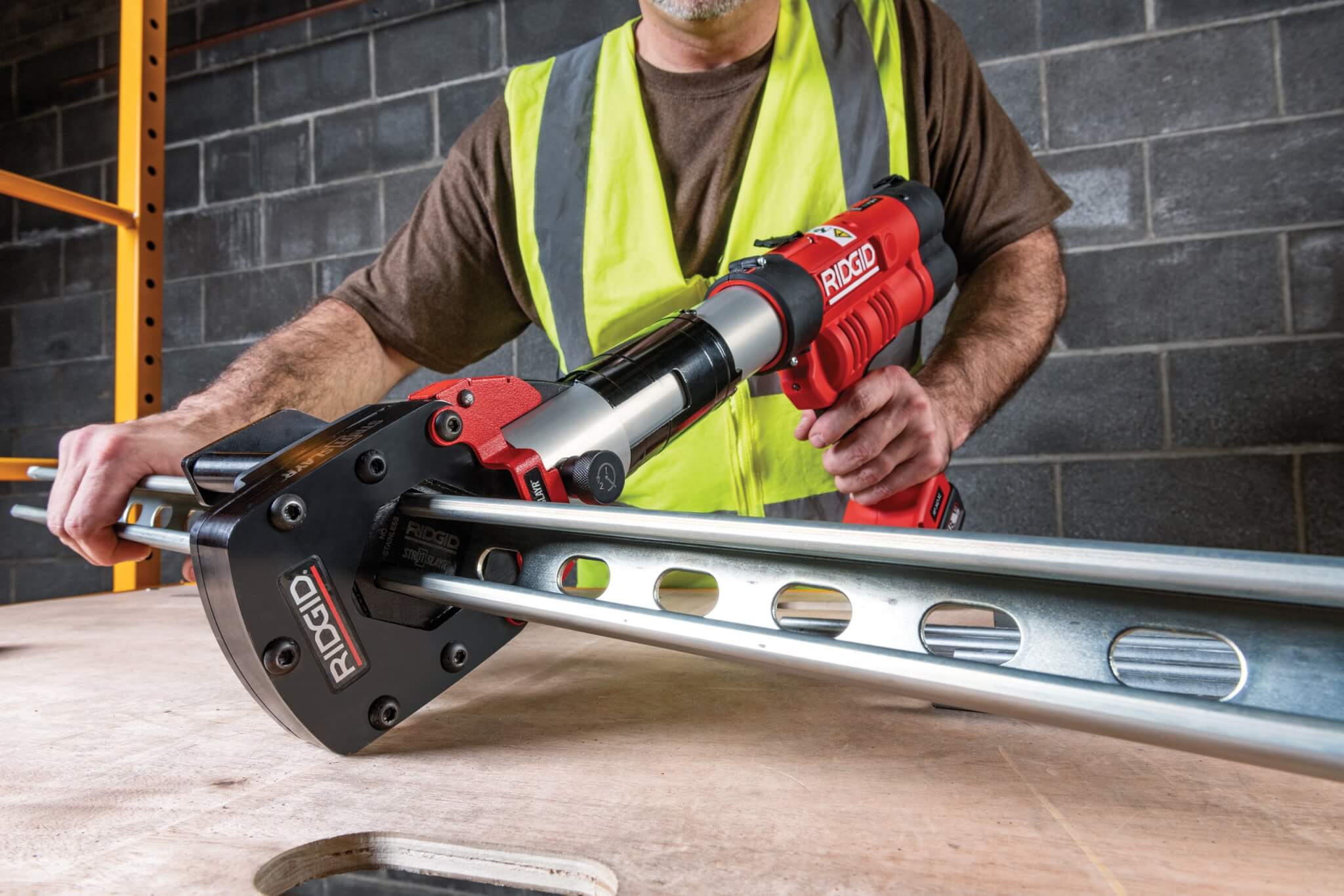
Versatile tools save you time and money on the job. For example, RP 342-XL press tool, shown here with the StrutSlayr Strut Shear Head, works with all of the RIDGID press tool accessories.
Cut Down Time On Your Jobsite
In today’s high-tech world, when people talk about tool timesavers they tend to focus on the latest Bluetooth technology or the newest gadget. Yet, technology is not the only way to cut down time on a jobsite: tools that allow you to work smarter, not harder, can help any professional get to the next jobsite more effectively and efficiently.
Here are a few questions to consider when evaluating the timesaving merits of a tool.
Can the tool do more than one job?
Anytime you can rely on a tool to perform more than one task, that is a win – you will reach in your toolbox less and have less to haul onto a jobsite. The best tools seem to help you do more with less: less gear, less time, less looking around. For example, some wrenches provide multiple surface wrench sizes on one side and have an open box-end for line nuts. This type of wrench has you covered for straight stops, appliance legs, shower heads, faucet nuts, stool bolts, and more.
Are you maximizing the tool’s versatility?
A key factor when saving time and limiting redundancy in your toolbox is to have knowledge of a tool’s full ability. Pressing tools are a good example: Plumbers appreciate press tools because they save time on connections and eliminate the need for soldering. Some press tools can do more than just press pipe connections. For example, RIDGID tools have designed their press tools to be multipurpose. Understanding that no two jobs are created equal, RIDGID tools built the RP 342-XL for them all: its versatile design packs major power and boasts the widest range of applications of any press tool. It can press 1/2” to 4” copper, stainless steel, and carbon steel pipe and 1/2” to 2” PEX—in less than 10 seconds. It is also compatible with the full line of RIDGID Standard 32kN press tool accessories, including the StrutSlayr™ Strut Shear Head, Press Snap™ Soil Pipe Cutter, and all MegaPress jaws.
➡ STRUTSLAYR tool is designed to mechanically shear steel strut channels up to a maximum size of 41 x 41mm, thickness 2.5mm. Compatible with RIDGID 32kN press tools*, the STRUTSLAYR strut cutter offers reduced risk sparking when compared to grinders and chop saws and still manages to produce a clean, consistent cut just by pulling the trigger – a cutting-edge innovation. 
STRUTSLAYR™ Strut Shear Head
How reliable are the tools you buy?
Any tool is a timesaver if it is reliable. Think about the tools you have owned the longest. Which tools push through a hard job without breaking? What brand is a one- or two-year tool versus a lifetime of performance? When you are constantly having tools break down and you are investing time and money to replace or repair them, that is a waste.
Buying reliable, proven tools is the best timesaver (and moneymaker). A strong warranty program is nice, but if the tool is always breaking—even if the repairs are free—that downtime will cost you money every time.
Are you buying tools for today or tomorrow?
This question builds on the issue of reliability. Sometimes cost is a hard line that you cannot cross; but when you can, always consider your long-term plans. You might buy a smaller drain cleaner because it costs less. Yet, you know that the larger commercial drain cleaner will allow you to do 10 times as many jobs and build your business in the future.
Which is a better investment? Tool redundancy has its place, but for higher-cost items, it can be a drain on expenses and a sore spot if your small drain cleaner is collecting dust in a warehouse a year from now.
Will I have to start from scratch when I need to upgrade?
When you buy equipment to meet your immediate needs, consider whether there are products designed to complement the equipment as you upgrade. For example, RIDGID reels, imaging cameras, monitors, locators, recorders, and drain cleaning equipment are designed to work together, so setup time is fast and compatibility is a given. Along with faster setup time, purchasing tools that integrate with each other can save you money and minimise downtime for training.
Saving time equals more jobs, and that means more income. There are many ways to adjust your tool inventory so you can work smarter, not harder.
CABLE TOOLS
Should you require technical assistance to select the correct cable crimping or cable cutting tools please contact us.
Thorne & Derrick are Specialist Distributors of cable tools to enable the preparation of all LV MV HV cables prior to the installation of Joints, Terminations & Connectors – this includes Klauke, Cembre, Alroc and Boddingtons cable jointing tools for removal of cable sheath, screen and insulation on 11/33kV (MV) and 66kV/132kV (HV) power cables.

View the complete range of Cable Crimping & Cable Cutting Tools