uploaded by Chris Dodds - Sales & Marketing Manager at Thorne & Derrick
MV Cable Joints
A/ All 3M Electrical Cable Accessories which utilise 3M Cold Shrink technology are inherently safe to install in potentially explosive atmospheres as they do not pose a risk of ignition to flammable gases in hazardous area workplace locations as designated Zone 1 or Zone 2 according to the ATEX Directive.
For clarification on the relationship and application of ATEX with respect to Cold Shrink cable accessories for LV MV applications refer to our Blog ➡
Thorne & Derrick stock and supply 3M Electrical cable joints for MV cables with 3 core cable construction for both XLPE/EPR type cables – these are polymeric insulated cables.
For single core cables where the cables to be jointed are located in hazardous areas with hydrocarbons present the cable joints can be encapsulated using a joint mould/shell and Scotchcast 1402FR resin – the joint would be installed according to the Jointing Instruction as usual apart from the final cold shrink outer tube which would be substituted with the cable joint mould/resin.
Typically, installers have used the 92-NA-6U cable joint kit, manufactured by 3M Electrical, which is designed for LV unarmoured cables – the mould shell fits over the cable stripping dimensions of the 3M 92-AG Cold Shrink range of MV joints for single core polymeric cables (XLPE EPR). The larger 1451-PET mould can also be used in conjunction with appropriate volume of 3M resin using the Mix Pack 7 litre packs. This solution would provide excellent protection of the cable joint against the deteriorative effects of prolonged exposure to hydrocarbons in either air installations on cable containment or direct burial where the joint is to be buried in underground contaminated ground or cable trench.
For Use In Hazardous Areas & Explosive Atmospheres
Thorne & Derrick International are specialist distributors of LV, MV & HV Cable Installation, Jointing, Duct Sealing, Substation & Electrical Equipment – servicing UK and global businesses involved in cable installations, cable jointing, substation, overhead line and electrical construction at LV, 11kV, 33kV and EHV.
uploaded by Chris Dodds Sales & Marketing Manager | Thorne & Derrick
Cable Joints
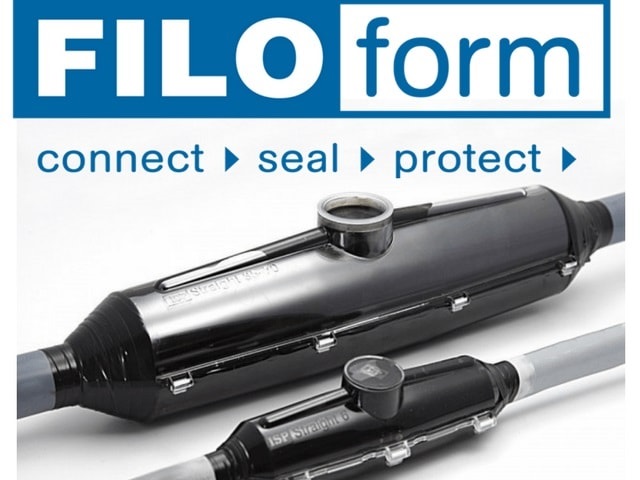
Thorne & Derrick International are the UK distributors for Filoform, a leading manufacturer of cable joints, duct seals and special resins for installation in the utilities, telecom, traffic, rail, fibre optic, street lighting and construction industries.
In the following overview we explain what makes a good cable joint and via video demonstrate how to install Filoform resin cable joints.
Firstly, lets examine the kit contents of Filoform resin cable joints.
Joints Tested & Certified
Cable Joints
To European Standard
Filoform cable joints are approved in accordance with the standard DIN EN 50393 VDE 0278-393:2015-10 – test methods and requirements for accessories for use on distribution cables of rated voltage 0,6/1,0 (1,2) kV. This European Standard details the performance requirements and the test methods for type testing of cable joints for use with power distribution cables of rated voltage 0,6/1,0 (1,2) kV as defined in HD 603 or other relevant cable standards.
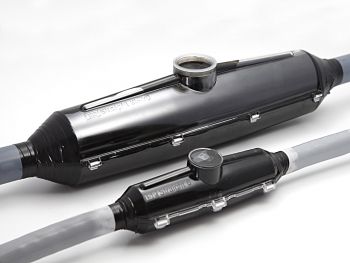
Injection Moulded Cable Joint Shells
Rigid and very strong snap-lock design forms an excellent seal and prevents resin leakage from the cable joint. Filform cable joints are designed and sized around UK manufactured steel wire armour cables (SWA) to BS5467 ensuring ample working-space for the jointer within the cable joint shell.
Transitions from PILC to XLPE, cross-core jointing and jointing of 3.3kV power cables can also be achieved with minor kit modifications.
Mechanical Connectors
Brass Tunnel Connectors
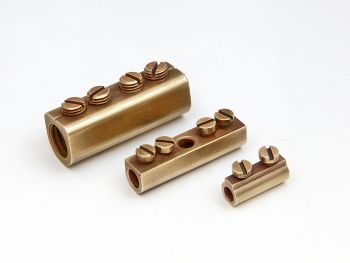
Brass tunnel connectors provide straight connections on stranded or solid circular conductors (both copper and aluminium). The range-taking tunnel connectors permit the jointing imperial to metric and step-down transitions where dissimilar size conductors preclude the use of conventional crimp connectors.
No specialist jointing tools – fast and simplified jointing of cable conductors without resort to crimping tools and associated die sets is achieved by Filoform brass tunnel connectors.
Two Allen screws for each core ensure a sound electrical performance and an Allen key is also provided with each resin joint kit to ensure that everything needed to joint a cable is included in the one box.
Earth Braid Armour Continuity
Armour Continuity Earth Braids
Wire Armour & Braided Cables
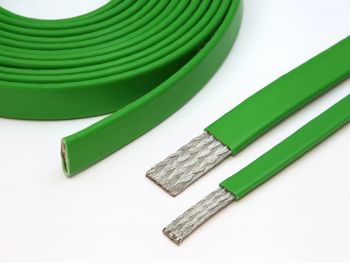
Tinned copper earth braid offers significant advantages over “single wire type” earth continuity systems in resin cable joint kits, which can fail if poorly positioned within wire armour cores that have “spread”. The flat, soft braid ensures good electrical contact and is insulated for extra protection – suitable for both wire braided and wire armoured cables.
Constant Force Springs
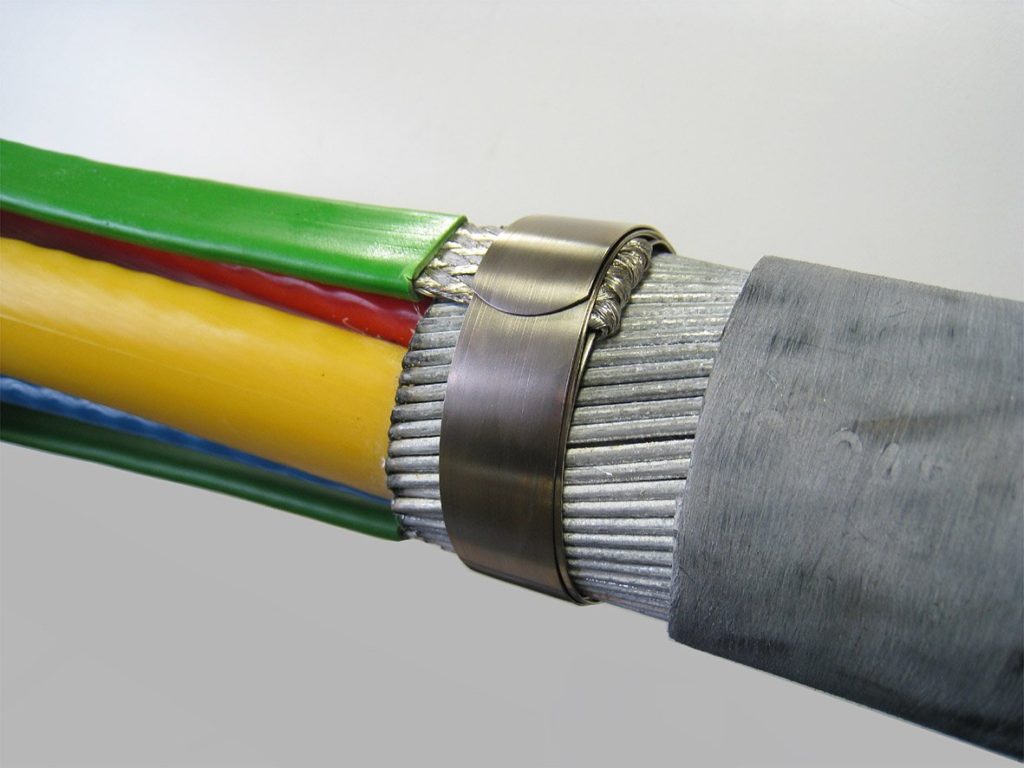
Cable joints move and expand due to earth shift and heat from electrical current. Constant force springs react to this movement and maintain a sound electrical connection between the steel wire armouring and the earth continuity braid.
Constant Force Springs
Core Separators
Provide safe separation of cores and connectors within the resin joint.
Two-Part Cable Jointing Resin
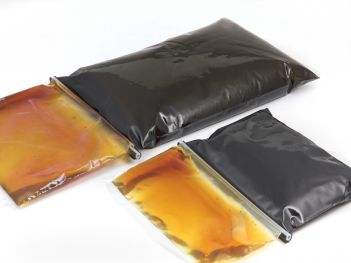
Filoform cable joint resin formula is equally suitable for both LV and HV jointing applications and provides excellent adhesion to PVC, XLPE, polythene and paper cables. Supplied in “easy-mix” transparent 2 component bag.
Cable Joint Resins
Cable Jointers Instructions
Detailed, clear and concise cable jointing instruction sheets ensure there is no ambiguity about safe jointing procedures – less cable jointer error.
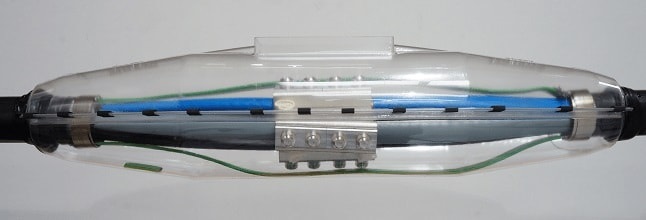
Cable Joints – prior to resin pour with steel wire armour continuity across the cable by flexible copper earth braid, conductors jointed with mechanical range-take connectors
Thorne & Derrick International distribute the complete range of Filoform Resin Cable Joints for low voltage power, control, pilot and telecoms cable jointing.
LV Cable Joints (Low Voltage Cables)
Thorne & Derrick stock and distribute LV Joints in Cold Shrink, Heat Shrink or Resin Cast technologies – multicore and multi-pair cable joints are available for immediate backfill and energisation of Low Voltage power, control and instrumentation cables 600V/1000V 3.3kV.
Why Gamble With Your Power Supply By Installing Underspecified Cable Joints?
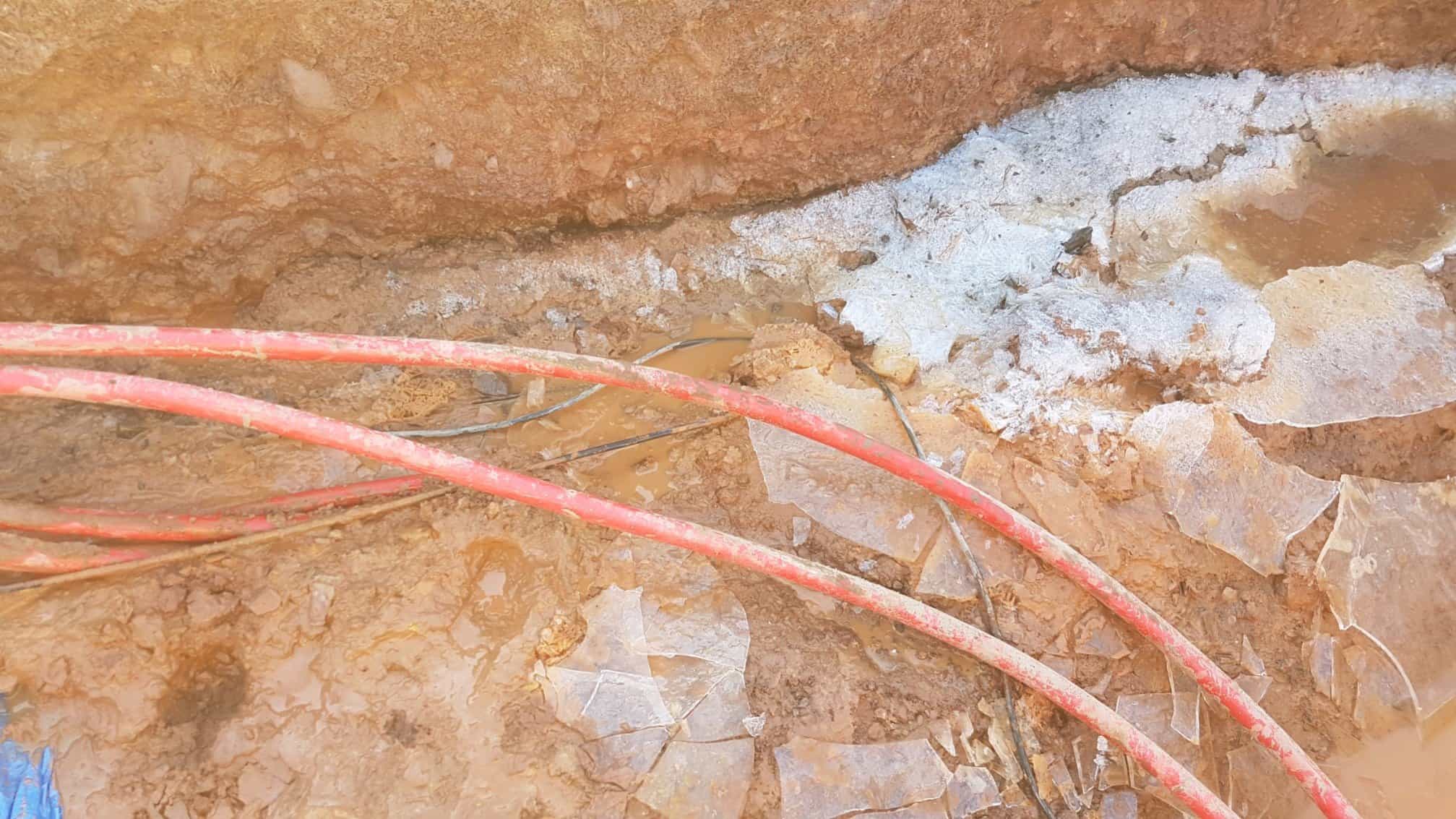
A Failed Cable Joint
Since 1985, Thorne & Derrick International, have stocked and distributed 3M Scotchcast cable joints renowned for their field service record and dependability for the connection and repair of existing damaged cables or the extension or diversion of new cable installations.
Whether XLPE, EPR, PILC or other cable type, Scotchcast joints are the preferred option for LV power, instrumentation or control cables.
The primary purpose of any LV cable joint is to remove a damaged or faulted section of cable and re-instate the electrical performance of the jointed cable as closely as possible to the original manufactured condition.
The specification, selection and installation of Low Voltage Resin Cable Joints varies according to industry. So, without a universal methodology the selection factors are usually specific to the cable and industry. Several key factors include : cable function, cable reliability, installation application and consequential loss due to outage or downtime.
Standard resin cable joints are often inadvertently installed forming weak links in many industrial cable networks.
Scotchcast Joints
Whether by Land, Air or Sea
3M Scotchcast resin cable joints provide reliable and safe performance in the construction, rail, renewable, airfield lighting, port authority, offshore, marine, mining, utilities and hazardous area (oil, gas and petrochem) industries.
“Scotchcast” has now become a byword for cable joints.
Scotchcast resins are synonymous with reliability, qualityand dependability when jointing cables, whether above or below ground – a comprehensive range of jointing resins have been developed by 3M with fire resistance, flame retardant, low smoke zero halogen and hydrocarbon resistant performance.
Deep Underground
3M Scotchcast 82-F cable joints are specified for the straight and branch jointing of flexible mining and trailing cables. Utilising flame retardant and flexible 3M Scotchcast 2131 resin with Mine Safety and Health Administration (MSHA) Acceptance 07-KA060002-MSHA.
3M 82-F flexible cable joints do not impair the bend radius of frequently coiled cables – the submersible cable joints are also seawater resistant for connecting cables by divers to ROV (Remotely Operated Underwater Vehicles).
Seeing Beyond The Surface – Worker & Site Safety With 3M Cable Joints
The World’s Biggest Coalmine : Peabody Energy’s operations in the Powder River Basin of Wyoming USA. 40% of America’s coal comes out of the North Antelope Rochelle Mine. Photograph: Mae Ryan for the Guardian
Offshore Cable Joints
3M Scotchcast resin cable joints are specified by the global oil and gas exploration companies for the low voltage jointing of power, instrumentation and control cables.
3M LVI3 resin cable joints suit offshore and marine power, instrumentation and control cable (BS6883, IEEE, UL, UK00A, NEK606 BFOU RFOU types) and instrumentation cable (pair, triple, quad types) – typically used to joint and connect cables in Zone 1 and Zone 2 hazardous areas to provide low voltage electricity distribution to power and lighting in potentially explosive atmospheres.
3M LVI3 joints are hydro-carbon resistant based on the specification performance of 3M Scotchcast 1402FR and resist degradation by drilling fluids (mud) – the ability of offshore topside and shipboard cable joints to withstand degradation by hydro-carbons and drilling MUD is vital avoid potential cable faults.
3M : Specified By Global Oil & Gas Industry
Repairing Damaged Cables
Cable damage is common offshore due to the extreme mechanical conditions caused by vibration, shock and movement on oil and gas platforms.
Overtime, EPR type rubber cable sheaths are degraded and complete cable change-out can be cost prohibitive or actually impossible.
3M LVI cable joints provide an excellent cable repair or full cable joint to damaged offshore cables preventing possible downtime caused by cable failure due to salt sea atmospheres reacting with cable braiding and conductors and causing a short circuit.
The wrap-around or snap-on 2 part type cable joint moulds permit mid-span cable repairing or jointing without requiring cable disconnection from the remote end – refer to our recent post about repairing damaged cables for further information and solutions including use of cold shrink tubes.
3M Cable Joints are installed on offshore oil and gas platforms, FPSO’s, FPS’s, oil tankers and carriers
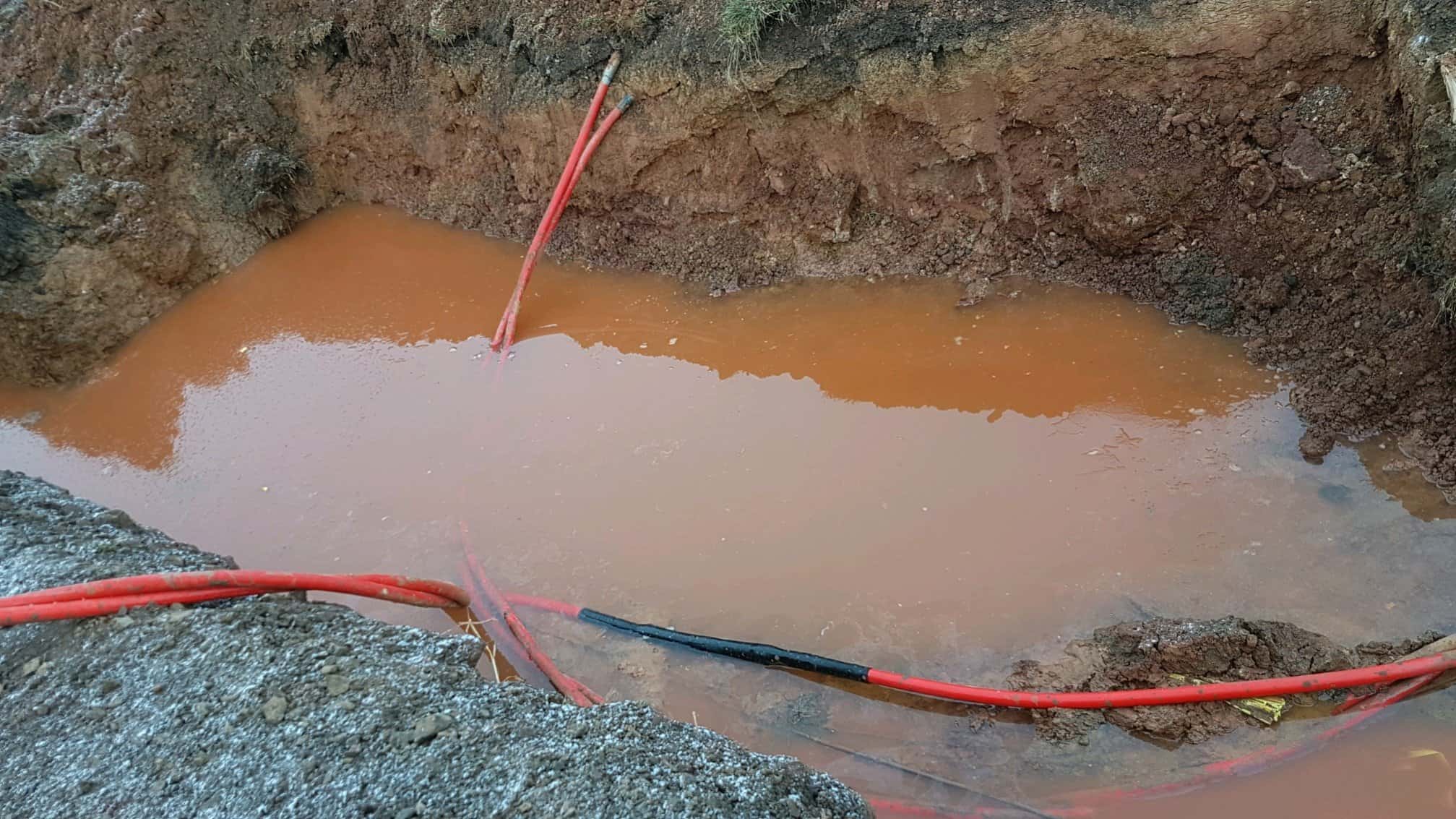
With You In The Cable Trenches
Image : Lovink.
Bent double in a muddy hole in the ground wrestling with a post-war imperial PILC cable.
And if you’re cable jointing in the UK then it’s probably raining.
We know the score. Hence, 3M cable joints are designed by jointers for jointers.
Large shell 3M cable joints enable crimping tool access or mechanical shearbolt connector compatibility for simplified cable jointing in tight access cable trenches and cable containment.
Cross core and transition cable jointing of multi-core XLPE to PILC is enabled.
Strong impact resistant cable joints shells withstand trench backfill. Often sand backfill can be mixed with sharp stones, clay and organic detritus.
3M can cope.
Size Matters
The internal working space permitted by the cable joint shell design impacts upon the ability of the LV cable jointer to work comfortably and safely often in tough site conditions.
Ample work-room enables efficient and reliable armour bonding, cross-core jointing, transition jointing and conductor connecting.
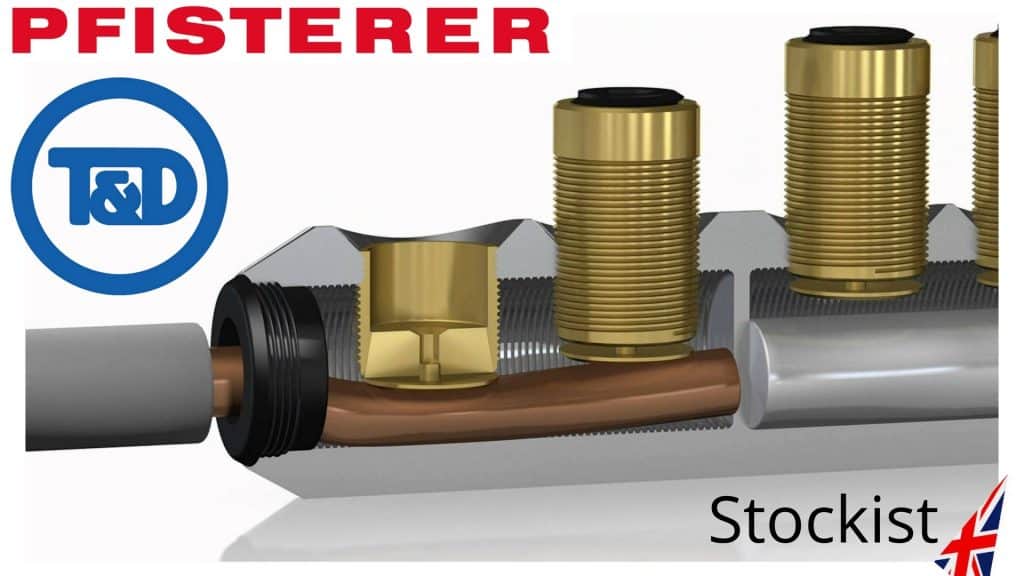
Large cable jointing shells enable the use of mechanical shearbolt connectors, such as Pfisterer Sicon, ideal for imperial-metric-AWG connections and hydraulic crimp tool heads where close quarter working is needed.
Is The Cable Joint Shell Large Enough For The Crossing Of Phased Cores?
Whatever the Weather
Cable damage is common offshore due to the extreme mechanical conditions caused by vibration, shock and movement on oil and gas platforms. Challenging offshore weather conditions vary from brutal hurricanes in the Gulf of Mexico to violent Atlantic nor’easters.
Closer to home, the North Sea UK continental shelf regularly experiences violent Force 10 storms inflicting extreme wind and wave effects on offshore assets.
3M Scotchcast Standing Out From The Crowd
3M Scotchcast low voltage cable joints are designed to ensure the installation process is simpler, quicker and safer.
Some selection and specification considerations :
Safety – 3M’s unique Advanced Delivery system provides integrated resin pour for the cable jointer eliminating vapour inhalation or direct skin contact
Simplicity – one part, wraparound cable joint shell enables rapid installation. Reduced man-hours cuts installed cost and drives labour productivity gains often during tight time schedule shutdowns
Reliability – eliminate or minimise cable faults
Specify and buy 3M Scotchcast cable joints for first class safety and service record without any hidden dangers.
3M Scotchcast Resin Advanced Delivery
Just How Do 3M Do It?
Single Piece Cable Joint Mould Shell – simpler installation process for the cable jointer. No cutting or sawing cable mould to size. Range taking foam seals at the ends of the cable joint shells provide an excellent tight and reliable seal – this adaptable 3M cable sealing system eliminates the need for the cable jointer to cut and tape the joint shell to size. Folding cable mould meets at the top of cable joint, not along both sides reducing potential resin leakage paths. 3M cable joint moulds resist cracks or breaks even at low temperatures. Suitable for direct burial.
Why Don’t I Need To Cut 3M Cable Joint Shell To Fit The Cable?
Earthing – 3M’s robust armour continuity earthing system suits both wire armoured (AWA single core and SWA multi-core), wire braided (copper and phosphur bronze) and lead sheathed cables. To avoid awkward manipulation of armour wires while trying to fit worm drive clips over the cable support rings, 3M have chosen to use constant force springs for earthing. Constant force springs offer significant advantages over “single wire type” earth continuity systems, which can fail if poorly positioned within wire armour cores that have “spread”. The flat soft copper earth braid ensures good electrical contact.
Safe & Sound With Constant Force Springs : Cable joints move and expand due to earth shift and heat from electrical current. Constant force springs react to this movement and maintain a sound electrical connection between the steel wire armouring and the earth continuity braid
Mechanical Connectors – fast, simple and range-taking conductor jointing of copper and aluminium conductors, whether stranded, sectoral or solid. Suits jointing of metric, imperial and AWG conductors.
Resins – high quality cable jointing resin with good moisture resistance and always enough in the joint kit for the application. No need for “topping-up”.
T&D distribute the most extensive range of LV, MV & HV Cable Jointing, Terminating, Pulling & Installation Equipment – we service UK and international clients working on underground cables, overhead lines, substations, switchgear and electrical construction at LV, 11kV, 33kV and EHV transmission and distribution voltages.
Thorne & Derrick invite you to join LinkedIn’s largest LV-HV Electrical Discussion Group : Low & High Voltage Power, Cabling, Jointing & Electricals. Discussion subjects include cable installations, cable jointing, substation, overhead line and electrical construction at LV, 11kV, 33kV and EHV. Network, engage and promote your profile, company or products with over 10,000 influencers.
This video by 3M Electrical shows how to apply3M Cold Shrink Cable Joints safely to splice, repair and connect low voltage power cables, 600V/1000V.
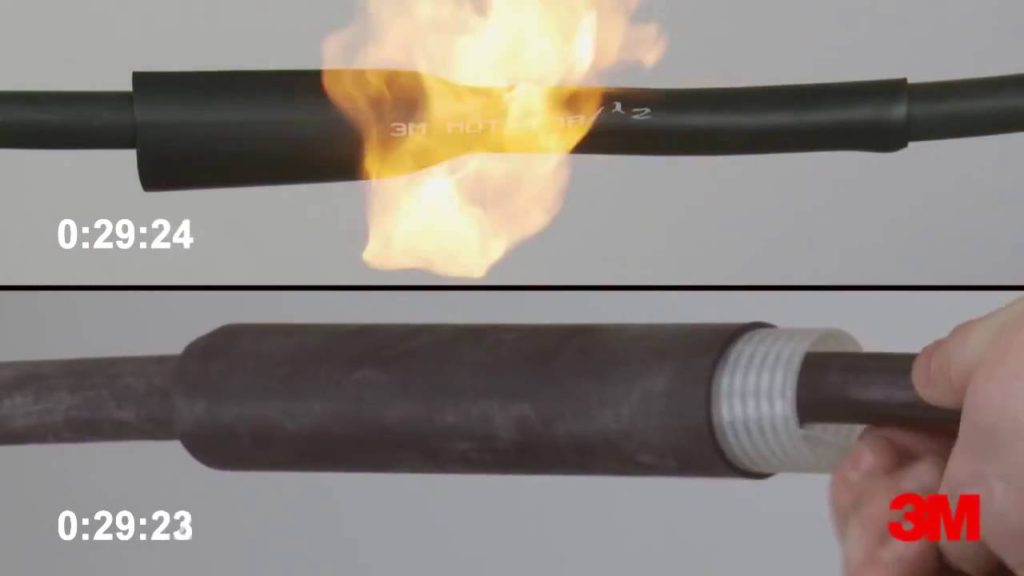
3M Cold Shrink cable joints utilise tool free cold shrink technology where no heat or gas torch is required for jointing cable in onshore and offshore locations with polymeric type cable insulation construction including both XLPE and EPR.
Cold shrink is an effective alternative to resin cable joints and can be used indoors, outdoors, overhead or used in cable trays.
Jointing Cables
Ensure all cables and conductors are free from dirt, residue and contaminants using cable cleaning wipes prior to preparing the cable to install the joint.
Cold shrink tubes and copper wire sleeves are first positioned over the cable.
The cable cores are then cut in such a way to stagger the position of the connectors – either mechanical shearbolt or crimp splice connectors are compatible. Check the proposed conductor connector is of suitable physical dimensions to be used with the cold shrink joint – on larger conductors due to volume displacement of multiple mechanical type connectors it maybe preferable for the jointer to use crimp/compression splices due to smooth profile design overcoming any potential bulging or distortion of the cold shrink tubes.
Accepted brands include Cembre, Arcus and Pfisterer Sicon type connectors.
The cable insulation is then removed and connectors are installed.
Most connector technology can be used providing they suit the requirements of the cable voltage, conductor construction and fit dimensionally within the 3M cable joint.
Scotch Electrical Tapes
Scotch 23 self-amalgamating tape is used to over tape the connectors. Layers of Scotch 23 are applied tightly around each connector overlapping into the primary insulation on each side of the connector position.
A piece of cable jacketing that has been saved from the cable preparation is then wrapped around the connectors for added mechanical protection.
Scotch 33+ premium insulation tape is applied across the lengths of the cold shrink joint to improve electrical insulation and water sealing protection.
The copper wire sleeve is then repositioned over the joint and secured onto the cable armours (either wire or braid armour) with constant force springs providing a 360º earth screen around the cold shrink cable joint for added protection.
Scotch 23 self-amalgamating tape is used to tape over the constant force springs ensuring the application is in the same direction as the constant force springs.
Scotch 2228 mastic tape is wrapped over the constant force springs to ensure a smooth profile and to achieve the required cable seal.
The 3M cold shrink protection tube is then positioned over the cable joint. The coil is then removed by hand to install. The live memory action of the specially formulated material shrinks the cold tube into position and ensures a constant radial pressure and seal.
Cold Shrink Joints Selection Table For Power Cables
Selecting the correct 3M LC type cable joint for use with single and multi-core type power cables, typically BS5467 (SWA) or BS6883 (GSWB).
Standard 3M Cold Shrink cable joints in the LC range can be over-protected by using cable joint moulds and then filled by pouring resin into the mould to encapsulate the joint – for example the cold shrink joint can be modified to provide resistance to hydrocarbon damage in hazardous area locations by using 3M Scotchcast 1402FR resin.
Can 3M Cold Shrink Joints Be Used To Joint Halogen Free & Flame Retardant Cables?
3M cold shrink joints can be used in conjunction with 3M STFF outer-protection sleeve – the joint sleeve is designed to protect the joint from fire. STFF sleeve is halogen free/zero halogen, flame retardant and does not emit toxic fumes in fire situations. Specified for onshore, offshore and rail tunnel applications where fire resistant protection of the cable joint is critical to overall performance, safety integrity and operational fire performance of the electrical cable and power system.
Can 3M Cold Shrink Be Used For Cable Repair?
Where cables have been subject to sheath degradation overtime due to electrical and mechanical stresses whilst in service a cold shrink tube can be used to re-instate the levels of cable insulation – note this requires access to an open-end of the cable or disconnection of the cable due to the tubular design of the cold shrink. If disconnection or isolation of the power cable system is not possible a heat shrink wrap-around type cable repair can be carried out. Read more about this subject in our detailed Blog covering solutions for repairing damaged cables.
Cold Shrink – invented by 3M over 40 years ago and now the preferred technology for heat-free jointing, terminating, sealing and abandonment of LV HV cables
We hope you find this video informative and educational, contact T&D for technical support, quotations and stock availability for 3M Low Voltage Cold Shrink Cable Joints.
➡ Visit 3M Electrical for further information about joints, terminations, tapes and insulation to seal, repair, splice and connect LV MV HV cables.
Learn more about the benefits and applications of Cold Shrink:
Polymeric insulated cables distributing high voltage electricity at 33kV can be used to joint cables with XLPE or EPR type insulation, armoured/unarmoured and with copper wire screen (BS7870) or copper tape screened cables (BS6622).
Heat shrink cable joints feature integrated stress control sleeves and torque controlled mechanical shearbolt connectors can be used to connect conductors (copper or aluminium) without resort to use of crimping tools or associated die sets.
Mechanical cable connectors are ideal for confined space cable jointing where there is restricted working space in manholes, cable vaults and underground trenches, especially on large cross sectional area conductors where hydraulic crimping heads coupled with foot pumps are required for conductor jointing. Bolted cable connections, such as Pfisterer SICON connectors, are installed directly onto the 33kV conductor using standard Allen keys. The bolt shears off smoothly and cleanly when tightened by the cable jointer.
Pfisterer Sicon – cable lugs and connectors with stepless shearbolts for use with cable joints and terminations on high voltage power cable systems
Heat Shrink
Primarily, a heat shrink cable joint provides electrical insulation, mechanical protection and stress control for high voltage power cables – integral also to the cable joint design is the requirement to prevent water ingress into the cables. Although initial risk assessments would include consideration of electrical water damage, such as cable flood damage, the requirement to deliver medium/high voltage power can necessitate cable exposure to potential flooding, condensation and water immersion. A robust cable joint is designed to withstand the deteriorative effects of water in both indoor or outdoor environments.
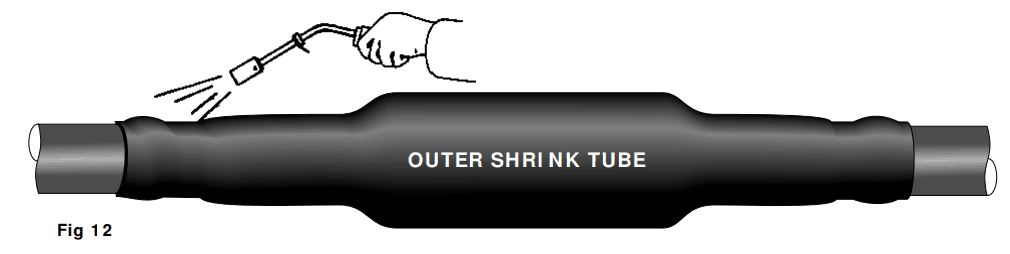
The cable joint kits include thick-wall heat shrink adhesive lined tubes to provide high performance water sealing, protection and corrosion resistance in above ground exposed or direct buried underground cable trenches – the outer protection heat shrink tubing (colour black) provides a moisture barrier to water ingress through the activation of an inner lining of adhesive which melts and flows upon the application of a heat source provided by the cable jointers gas torch.
Prior to installing the outer shrink tube the jointer should clean, de-grease and abrade the outer cable sheath of the 33kV cable – to achieve an even wall thickness the cable jointer should keep the flame moving and avoid scorch or burn damage to the heat shrink or cable.
The jointer will apply heat evenly to the centre of the cable joint – once the heat shrink tube is fully recovered (“shrunk”) the joint should be smooth, wrinkle-free and the heat activated sealant should be visible at the tube ends in contact with the cable sheath.
The tough and durable heat shrink provides reinstatement of cable sheath or jacket insulation and withstands trench backfill prior to energisation of the HV joint.
The 33kV joints are installed using normal procedures for heat shrink cable joints with clear installation instructions confirming precise cable stripping dimensions and marking measurements for sheath, semicon and insulation removal – joints are installed using the standard cable jointing tools depending upon cable construction.
Although not designed to be permanently submerged in water, 33kV cable joints use heat shrink tubes to prevent water ingress into high voltage cables whether buried underground or located onto cable containment in MV-HV substations.
Should you require any assistance with the selection or specification of MV-HV joints or terminations please do not hesitate to contact us.
The following Training Video shows the installation process for installing heat shrink joints to single core 33kV cable – this Video is for familiarisation purposes and not intended as a substitute for attending recognised industry training courses and achieving manufacturers competency. The Video produced by SPS with narration provides comprehensive guidance from the initial stripping and removal of the 33kV cable sheath to the final completion of the heat shrink joint.
T&D distribute the most extensive range of LV, MV & HV Cable Jointing, Terminating, Installation & Cable Pulling Equipment – we service UK and international clients working on underground cables, overhead lines, substation earthing and electrical construction at LV, 11kV, 33kV and EHV transmission and distribution voltages.
The Complete Guide to Stokbord Sheets & Cable Covers For utility contractors and civil engineers, the risk of “striking” buried infrastructure is a daily operational hazard. Whether it’s an 11kV distribution line or a 132kV transmission cable, the consequences...
The Klauke EK30IDML and EKM60ID Revolution In the demanding world of industrial electrical installation, the goal is always a perfect balance between speed and precision. Traditional crimping methods, while reliable, often introduce an issue: the management of crimping dies....


 explosive atmospheres as they