Blog
HV Cable Terminations – A Report Into 11kV Heat Shrink Termination Failure
January 2nd, 2018
Contributed By: Watkins and Jacomb Construction Power & Consultancy
Uploaded By: Chris Dodds – Thorne & Derrick: Distributors of LV, MV & HV Cable Jointing, Cable Terminations, Substation & Electrical Eqpt
Cable Terminations
WJCPC are specialist LV HV Cable Termination & Jointing contractors with over 20 years experience in the High Voltage Electrical Industry covering the utilities, renewable energy, rail, data centre and general industry sectors – UKPN competent for LV & HV Termination and Jointing Of Cables, Confined Spaces, Substation Entry and Cable Fault Finding.
In the following post Ben Jacomb highlights 5 serious shortcomings across cable terminations installations on the same site – this installation investigation underlines the scope for jointer error at various key stages including critical cable preparation mistakes prior to installing the HV cable terminations.
Clearly under-trained, unskilled labour has been used to perform work normally carried out by highly-skilled, experienced and certified cable jointers.
This article covers the termination of BS6622 11kV 3 Core XLPE high voltage power cables – in a previous contribution WJCPC discussed and displayed the process of terminating 11kV Triplex cables.
- Steel Wire Armour – poor termination of the 11kV wire amours (SWA)
- Semicon Screen – failure to observe correct measurement and use correct jointing tools
- XLPE Insulation – undue care and attention by jointer when working on 11kV insulation
- Disregard Of Cable Termination Instruction – failed to apply the void filler correctly
- Cable Stripping – insufficient cable insulation on 11kV cable due to overstripping
“On behalf of one of our clients we were asked to complete several heat shrink terminations onto high voltage 11kV 3 core XLPE SWA power cables. After the first inspection of the HV cable terminations I was not satisfied with the cable jointers technique undertaken to remove the semi conductive layer, which had been done by using a semicon cable stripping tool. The high voltage semi conductive layer is semi bonded type so the stripping of the layer should be stripped by using a depth knife and the ringing of the stress control point on the 11kV cable by a soft file.

Thorne & Derrick are the UK’s largest stockist of cable jointing tools manufactured by Alroc.
Any marks left in the XLPE insulation of the 11kV cable will influence the magnetic fields inside the power cable and should be removed by emery cloth to leave a smooth finish eliminating any voids. If the heat shrink tube is shrunk on top of a void there will be moisture and where there is moisture there will be arcing, burning and then potential failure of the 11kV cable. If the semi conductive layer is not removed correctly at the crucial point then discharges arise causing damage to the cable.
♦ Further Reading: The Semicon Screen – A Most Critical Point In Any MV Cable Joint, Termination Or Connector.

Perfect Semicon Screen Cutback
Below are pictures and comments on several findings from recent 11kV cable termination inspections.
Steel Wire Armour
When terminating 11kV cables with heat shrink cable terminations there is a requirement to ensure safe earthing and termination of the armour wires (SWA steel wire armour) using cable glands, commonly referred to as “top-hat” cable glands.
In most 11kV cable installations the cable gland body can be installed after completion of the 11kV terminations. Completion of the final 11kV connections should be done before bolting the cable gland into place on the 11kV cable box.
Note, the correct jointing procedure for termination of the wire armour is to open-up or splay the SWA armours and bend back over onto the cable gland body and using worm drive clamps to connect the armour and screen earth braids to the gland body.
Before applying heat with a gas torch to the heat shrink tube, which is used to shroud and provide environmental and corrosion protection to HV cable terminations, the jointer can abrade the cable sheath and then using cable cleaning tissues thoroughly degrease the 11kV cable.
Insulated 11kV cable glands are also available for industrial medium/high voltage power systems with steel wire (SWA) or aluminium wire (AWA) cables.
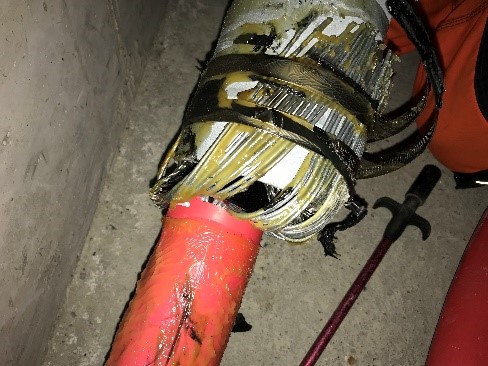
Incorrect Installation Of HV 11kV Cable Glands

Correct Installation Of HV 11kV Cable Glands
Semicon Screen
The semi conductive layer cut back should be 20mm and not over according to the HV cable terminations instruction – on this cable installation the dimensional error was consistent on all 5 cable termination breakdowns with semicon screen layers averaging between 25mm – 40mm.
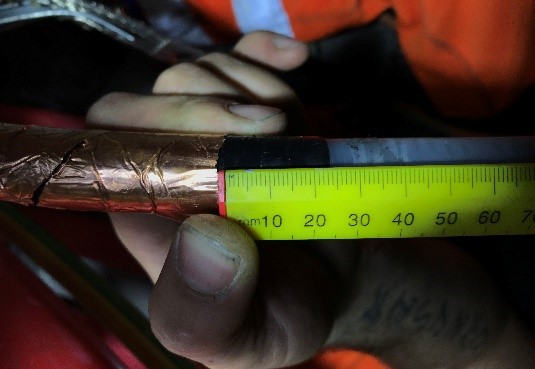
Semi Conductive Layer Length
Here, the semi conductive layer has been left on the 11kV XLPE insulation which can cause surface tracking and eventual flash over. This occurred on 2 out 5 cable termination breakdowns.

Semi Conductive Layer Left On The Cable Insulation
XLPE Insulation

Damage To 11kV Cable Insulation
Disregard Of Cable Termination Instruction
Here, the yellow mastic void filler has not been applied correctly by the cable jointer. It clearly states in the heat shrink termination kit instructions that 5mm of yellow mastic is to be installed on the copper tape screen and to continue over the semicon layer and then finish 10mm onto the cable installation. The yellow mastic is used to fill voids – the mastic provides stress relief from electrical fields so it is essential this is installed correctly.

Yellow Mastic Void Filler Not Applied Correctly On The Cable Terminations
Score marks on insulation – this will more then certainly cause flash overs as previously mentioned in this report.

Score Marks On 11kV Cable Insulation
Cable Stripping

The image above shows the XLPE cable insulation cut for a cable lug on one cable termination – the required insulation measurement is 5mm.
On all the cables that have been stripped using a stripping tool the cable jointer has left less then the minimum requirement of insulation needed around the conductor of the 11kV cable. The cable manufacturer has confirmed that the finished XLPE insulation around a conductor should be 3.4mm and any part of the insulation under the minimum of 2.95mm is a failure.
After breaking down 5 cable terminations to find 5 different failures on each one this is very concerning. I would not energise any of the 11kV cable terminations until further investigation.”
HV Cable Terminations
Thorne & Derrick distribute the most extensive range of HV Cable Terminations & Joints to suit 11kV/33kV medium and high voltage power cables, including indoor cold shrink and heat shrink terminations, outdoor pole-mounted terminations or separable connectors for gas insulated equipment applications.
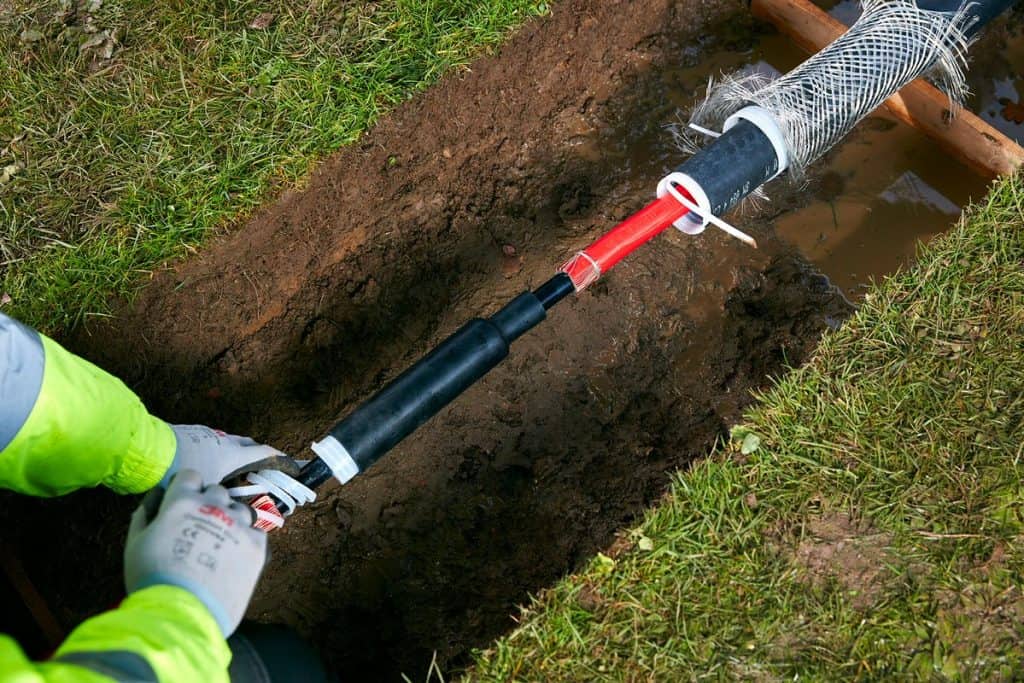
HV High Voltage Cable Joints | Cable Terminations | Cable Connectors | MV HV 11kV 33kV

Joint | Terminate | Connect Medium & High Voltage Cables MV HV
THORNE & DERRICK are national distributors of Cable Installation, Jointing, Substation & Electrical Safety Equipment MV HV – we service UK and global businesses involved in cable installations, cable jointing, substation, overhead line and electrical construction at LV, 11kV, 33kV and EHV.
Contact us for 3M Electrical, ABB, Alroc, AN Wallis, CATU Electrical, Cembre, Centriforce, CMP, CSD, Elastimold, Ellis Patents, Emtelle, Euromold, Filoform , Furse, Lucy Electric & Zodion, Nexans, Pfisterer, Polypipe, Prysmian, Roxtec, Sicame, WT Henley.

Invitation
Thorne & Derrick invite you to join LinkedIn’s largest LV-HV Electrical Discussion Group : Low & High Voltage Power, Cabling, Jointing & Electricals.
Discussion subjects include cable installations, cable jointing, substation, overhead line and electrical construction at LV, 11kV, 33kV and EHV. Network, engage and promote your profile, company or products with over 10,000 influencers.


Insulated Tools & Live Cable Jointing
December 19th, 2017
Ad: Insulated Tools (Live Line & Cable Jointing Tool Sets) – T&D supply a full range of insulated tools kits for electrical engineers, cable jointers and overhead linesmen

Electrical Safety & Live Working Equipment
-
uploaded by Chris Dodds - Thorne & Derrick
In the UK the Distribution Network Operators permit appropriately accredited ICP’s to carry out live cable jointing onto service and mains connections on their low voltage electrical distribution systems – those cable jointers must be trained, assessed and authorised as competent to work on live cables with a professional working knowledge (practical and theoretical) of the electrical safety considerations when jointing energised cables.
Furthermore, contractors must use approved and tested insulated tools, jointing tools and electrical safety equipment to prevent workplace risk becoming workplace accident.
Insulated tools will protect workers against contact with live circuits and cables. Without them you could be risking serious injury, liability or even death.
Typical 400v low voltage cables jointed under live conditions are waveform, wavecon, PILC STA and Consac – live working is essential but not encouraged and suitable arc flash clothing should be worn when carrying out maintenance on energised substations, cables and electrical equipment. See the UK HSE HSG85 document for further information about safe working near dead or live electrical equipment.
The following series of site photographs kindly contributed by Billy Ayling, an authorised Live Cable Jointer, shows the stages of cable stripping, preparation, shrouding and branch jointing of wavecon cables. The photo’s were taken by the Jointers mate.
- Application: Live Cable Jointing
- Cable Joint Type: Breech/Branch Joint
- Cable Type: Wavecon Cables – 95sqmm 3 Core Wavecon Breeched
- Cable Jointer: Billy Ayling (Self Employed – DNO (SSE) Trained Live LV / 11kV Jointer
About Billy,
Billy has worked in the utility industry since leaving school in 2001 and has been a cable jointer since 2010. Professionally trained at SSE Thatcham Jointing School and authorised to fault find, repair and cable joint wavecon, consac, PILC SWA and associated services with additional skills including operating and linking on the low voltage electricity network.
Cable Jointing In The Danger Zone
With nerves of steel and the concentration powers of a chess Grandmaster a live cable jointer must maintain a steady hand and focussed mind when working on live cables.
Billy comments, “the main risk during live cable jointing is losing concentration – generally I would not speak to my Jointers mate whilst live working on cables unless something critical to the cable joint installation is required. All adjacent conductive metal work must be shrouded using rubber insulating shrouds UV stabilised suitable for outdoor and underground use in cable trenches. Only one phase should be worked on at a time.”
Typically, when working on Live LV Conductors insulating gloves should be used when working on, or in close proximity to cables – UK DNO’s such as Scottish Power Energy Networks (SPEN) according to their policy guideline Rubber Gloves For Electrical Purposes recommend jointers wear Class 1 insulated gloves (7.5kV) to the British Standard BS EN 60903 (2003).
Hand protection is vital as is the use of dielectric boots where there is a real risk to the cable jointer of electrical shock from either low voltage or high voltages – see insulating boots for further information on suitable PPE for jointers.
An 11kV Jointer
Billy has ascended the voltages and is currently a high voltage cable jointer authorised to work on 11kV polymeric (XLPE) and 11kV paper (PILC PICAS) insulated cables.

1 View From The Trenches – working conditions complicate but do not prevent skilled cable jointers from live working in cramped and confined underground cable trenches. Here, the cable fault has been located and the damaged cable excavated prior to jointing. In the field, jointer training centre conditions are never replicated with an onus on the jointer to maintain high skill levels, concentration and dexterity in the face of bad weather and under pressure to restore power to our homes or businesses with minimum disruption.

2 – Mud, Mud, Glorious Mud – plodging in muddy holes with conditions favoured by hippo’s the cable jointer must maintain complete awareness of the electrical safety precautions and considerations required for safe live working on LV cables. The centre of the wave is accurately located on the cable – this must be done to ensure correct cable stripping and separation of the copper neutral earth wires. Also, the waveform cable is marked up for where to strip the cable prior to jointing.

3 Get Stripped! – the cables are carefully prepared using jointers tools to remove the cable sheath and expose the cable and conductors to allow the cable joint to be installed. Here, the jointer has relied on insulated cable knives to safely remove the waveform cable sheath. Correct cable preparation is essential to avoid malfunction of the cable joint post-energisation.

4 Shocking Risks – the cable jointer uses insulated tools to work on the live cables to avoid potential electrocution when live working. The jointer uses insulated cable wedges to space cores for testing (hence the lamps) and provide space for the ‘w’ breech connectors. Insulated tool kits would usually include insulated pliers, cable cutters, sockets, spanners, wrenches and screwdrivers – contact us for further information.

5 Shrouded For Safety – the jointer uses Boddingtons rubber insulating shrouding to protect against live voltages up to 1000V when underground cable jointing. Insulated clamps hold the protective shrouding in position covering the live cables so the LV cable joint can be positioned and installed.

6 Insulated Tools – the jointer has used an insulated ratchet tool to tighten the shear off bolts on the mechanical shearbolt connectors. Insulated wedges to were used to separate the cable cores and an insulated knife used to strip insulation from the cores. Cable joint is manufactured by TE Connectivity and approved by SSE – this is a completed wavecon to wavecon 95sqmm 3 core mains breech joint.

7 Hometime – the branch joint is completed with the shell encapsulating the jointing resin and ready for trench backfilling. Live cable jointing should only ever be carried out by competent and certified Jointers using the correct jointing, insulated tools and electrical safety equipment.

SSE Scottish & Southern Energy – a live low voltage 185sqmm wavecon straight joint prior to filling the joint shell with cable joint resin.

Cable Joints – The Birdcage. Here, the cable jointer ensures the binders are cut off before cable joint is ‘complete’ making a cage around the crutch rather than just split apart as per the previous photo. Although forming part of the SSE jointers trade test at the Jointing School this is rarely used in the field. The neutral earths are formed as a “bird-cage” type arrangement at the cable crotch using wire binders. Image: Lee Richards (LV 33kV Competent Cable Jointer).
Insulated Tools & IEC 60900

IEC 60900 Symbol
Quality insulated tools should be tested to IEC 60900 – this standard controls hand tools for live working up to 1000 V a.c. and 1500 V d.c.
Look for the official 1000V symbol, this will ensure the tools protect workers against accidental or incidental contact with electricity voltages up to 1000V. Purchase a copy of IEC 60900 from the IEC webstore here.
T&D also distribute the complete range of Class 0, 1, 2, 3 and 4 ranges of insulating matting to provide protection to utility workers, substation workers and cable jointers working on low, medium and high voltage cables and power systems.
Thorne & Derrick
Specialist Electrical Distributor
LV ♦ MV ♦ HV
T&D distribute the most extensive range of LV, MV & HV Cable Joints & Terminations for repairing, jointing and connecting 11kV/33kV cables in underground cable trenches or substations, switchgear and transformers – the extensive range of cold shrink and heat shrink joints and terminations are supported by a complete range of cable jointing tools to enable the removal of sheath, insulation and screen from LV, MV & HV cables.
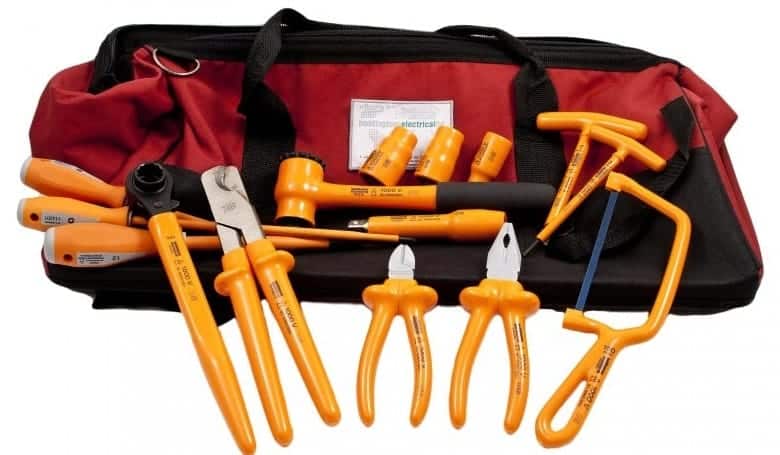
Customised & Standard Insulated Tool Sets – Tested To IEC 60900: 2012.
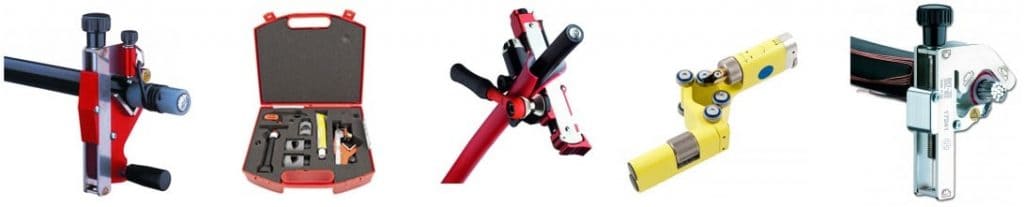
Cable Jointing Tools for Low, Medium & High Voltage Jointers – Boddingtons Electrical
How To Use 3M Cold Shrink Tubes – Silicone & Rubber Cold Shrink Tubings
December 11th, 2017
A series of How-To videos for repairing, jointing and terminating cables using 3M Cold Shrink & Scotchcast products.
-
uploaded by Chris Dodds - Thorne & Derrick Sales & Marketing Manager
Cold Shrink Tubes
Thorne & Derrick International, based in the UK, are the largest stockist and supplier of Cold Shrink Tubes manufactured by 3M Electrical – contact us for competitive prices, stock availability and delivery to UK and overseas destinations.
This video by 3M Electrical shows how to apply Cold Shrink Tubes safely and correctly.
3M Cold Shrink Tubes are a series of open-ended, tubular rubber sleeves, which are factory expanded and assembled onto a removable core. They are supplied for field installation in a pre-stretched condition and used by electrical engineers, installers and cable jointers to carry out electrical cable insulation, cable sheath repair and splice joints on cable containment or cable trench applications.
The 3M video shows how to install the cold shrink tubes by unwinding the removable core allowing the tube to shrink and form a tight waterproof seal to prevent water or humidity ingress into the cable. Quicker, easier and with enhanced installer safety benefits compared to heat shrink tube alternatives without a requirement for a heat source or tooling.
Cold Shrinking – the installer should use a gentle unwinding motion to release the expanded Cold Shrink tube from the core maintaining a consistent and even technique resisting temptation to snatch and pull as this will snag the plastic tail within the cold shrink tube. The outer core should remain relatively stationary while unwinding the inner core – the live memory action of the specially formulated 3M Cold Shrink material ensures a permanent, durable environmental seal and insulation. The tough, durable, EPDM rubber construction ensures 3M Cold Shrink tubes withstand operating temperatures of -40 to 194 degrees F (-40 to 90 degrees C).
- Black EPDM Cold Shrink Tubing Manufactured by 3M Electrical
Hazardous Areas
Consequently, cold shrink tubes have been adopted by the hazardous area industries (oil, gas and petrochem) for safe cable sealing and environmental protection in potentially explosive atmospheres and confined spaces where flammable gases or combustible vapours combined with “hot-working” could ignite the “Fire Triangle”.
Suitable for hazardous area cable repair, however where installation location is exposed hydro carbons a complete range of ATEX cable joints are available for jointing cables in hazardous areas, Zone 1 and Zone 2.

Safe Cable Protection & Jointing In Hazardous Areas & Potentially Explosive Atmospheres – cold shrink is safe to use where “hot-working” is precluded
The absence of a naked flame requirement eliminates fire risk and removes the danger of incurring heat, burn or scorch damage to cable sheath by over-heating with gas torches.
The core is removed manually by a simple clockwise unwinding of a tail piece of the inner former – after the cold applied tube has been positioned for installation over an inline connection, cable terminal lug or other similar application the cold shrink is collapsed to form an effective cable seal.
Faster to install for use on LV, MV or HV cables where working access is possible to an open cable end either by cable cutting or disconnecting from supply point.
Other possible applications include electrical installation, cable repair, mechanical protection and moisture sealing barrier – providing a constant radial seal and pressure even under thermal cyclical load.

No playing with fire when installing Cold Shrink by 3M
Selecting Cold Shrink Tubes
Cold shrink tubes are supplied in a range of sizes with specified minimum/maximum tolerances per tube – the selection of the correct 3M tube requires the outside diameter of the cable to ideally be midway between the recommended min/max range of the shrink tube. Once installed the tubes are immediately energisable and suitable for direct burial, overhead or submersed applications on 1000 volt cables located in indoor/outdoor locations in both safe (non-hazardous) and hazardous area cable locations.
Cold shrink tubes are available in EPDM and Silicone.

Cold Shrink – invented by 3M over 40 years ago and now the preferred technology for heat-free jointing, terminating, sealing and abandonment of LV HV cables
We hope you find this video informative and educational, contact T&D for technical support, quotations and stock availability for 3M Cold Shrink Tubes.
♦ More Cold Shrink | Cable Caps | Cable Abandonment | Cable Joints LV | Cable Joints Terminations HV 11kV 33kV
Silicone Cold Shrink – Fire resistant & Low Smoke Zero Halogen
Silicone cold shrink tubes are open ended, silicone rubber, tubular sleeves installed onto cables, pipes and umbilicals to provide a watertight seal with additional resistance for fire, acids, ultra violet light, moisture and flame – the cold shrink tube is inherently low smoke zero halogen (LSOH).
No heat source or naked flames are required to install cold shrink – specified for cable joint, repair or cable splice work in hazardous area locations or potentially explosive atmospheres.
The 3M 8440 series of silicone tubes are outlined in the below table to enable correct selection – call should you require any assistance.
The silicone cold shrink tubes manufactured by 3M Electrical provide primary electrical insulation on solid dielectric (rubber EPR and plastic XLPE) insulated low voltage LV cables up to 1000 volts.
| 3M Silicone Cold Shrink Tube | OD Min mm | OD Max mm | Length mm | Type |
| 3M 8443-2 | 6.86 | 14.0 | 44.0 | Silicone |
| 3M 8443-6.5 | 6.86 | 14.0 | 159.0 | Silicone |
| 3M 8445-2.5 | 8.89 | 18.0 | 57.0 | Silicone |
| 3M 8445-7.5 | 8.89 | 18.0 | 179.0 | Silicone |
| 3M 8447-3.2 | 12.19 | 24.0 | 76.0 | Silicone |
| 3M 8447-8 | 12.19 | 24.0 | 184.0 | Silicone |

Silicone Cold Shrink Manufactured By 3M
➡ Visit 3M Electrical for further information about 3M cable joints, terminations, tapes and insulation to seal, repair, splice and connect LV MV HV cables.

Cold Shrink | Joint | Terminate | Seal | Repair | Splice | LV MV HV Cables | 3M
- 3M Electrical Products Stocked By Thorne & Derrick International
132kV Cable Joint By Energi Cable Engineering Limited
December 11th, 2017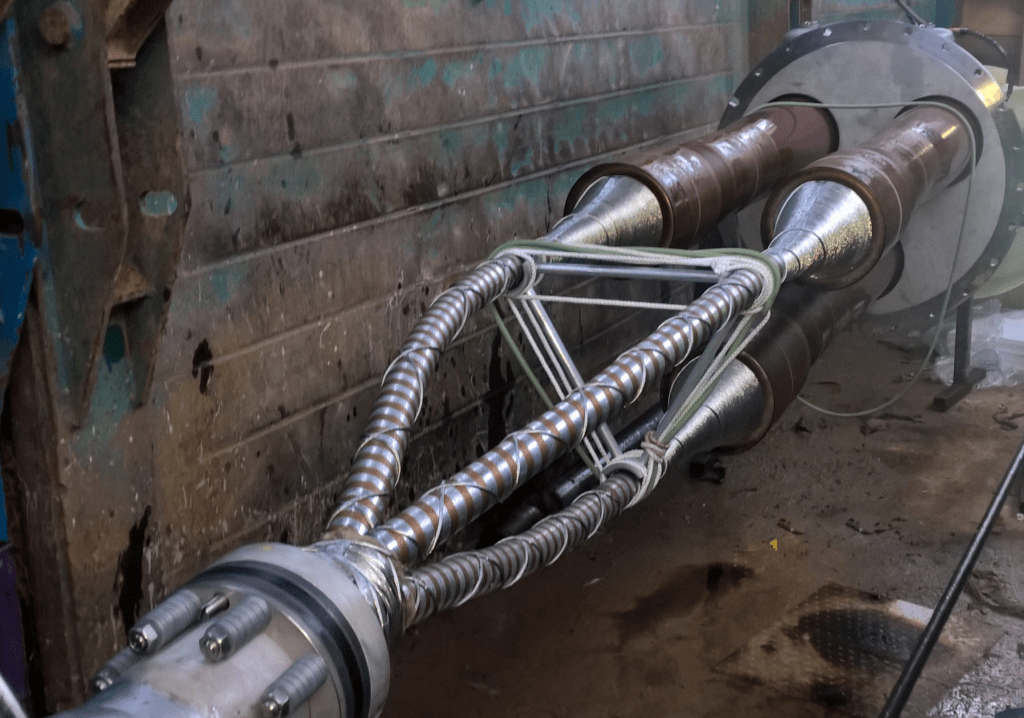
132kV Ericsson Transition Joint – 3 Core Cable Joint XLPE To Oil Filled Cable
Uploaded by Chris Dodds T&D
- Contractor: Energi Cable Services
- Contributed By: Dan Chessher
Energi Cable Engineering
Energi Cable Engineering have developed a strong and close relationship with two of the leading manufacturers of high voltage cable systems: NKT of Denmark and LS Cable & Systems of South Korea. Through these partnerships Energi Cable Engineering can design, specify, procure and deliver high voltage cable systems up to 500kV to provide solutions for XLPE, Oil Filled and Gas filled cable systems.
Energi Cable Engineering provides a complete range of cable accessories for XLPE, oil filled and gas filled cable systems. The highly experienced team of cable design engineers ensures that a fully engineered solution is provided to meet customer requirements, including all the ancillary equipment.
More from ECS
- 132kV Cable Sheath Testing With Pfisterer GIS Terminations
- 132kV HV Cable Testing Using Amprobe ISO 5000 Test Equipment
- Oil Cabinet Monitoring Oil Pressure On 132kV Circuit
- 132kV Outdoor Sealing Ends (ODSE) Manufactured By nkt Cables Installed By Energi Cable
- Degasifier Trailer – Oil Preparation For Extra High Voltage Cable Circuits
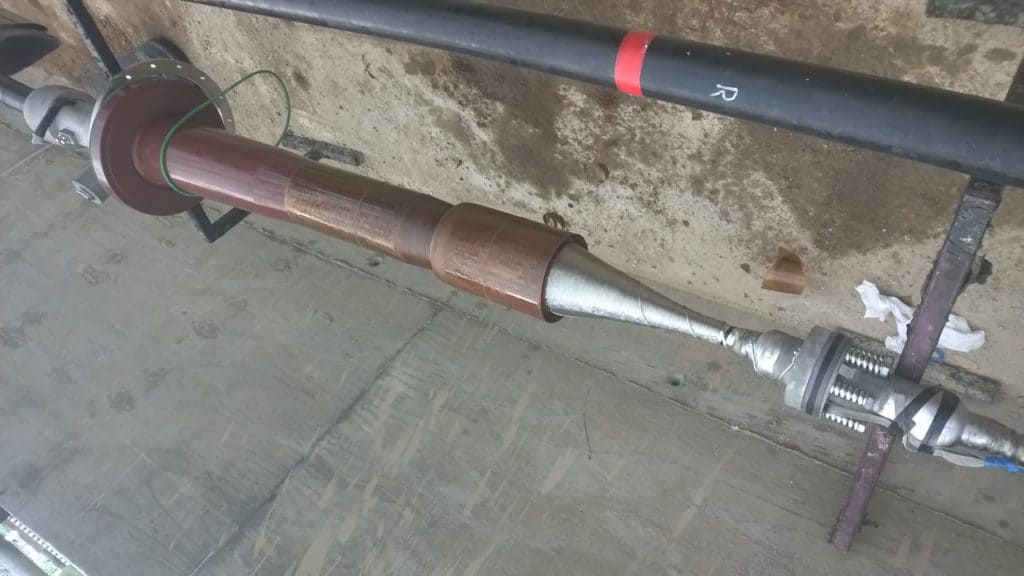
66kV Ericsson Transition Joint
See more: MV HV EHV Cable Jointing & Installation Photo Blogs.


Thorne & Derrick | Stockists & Distributors for 3M Electrical | Nexans Euromold | Pfisterer Connex | Joints Terminations Connectors up to 66kV from Stock
11kV Triplex Cables Terminated Onto Switchgear Bushings Using Heat Shrink Cable Terminations
December 8th, 2017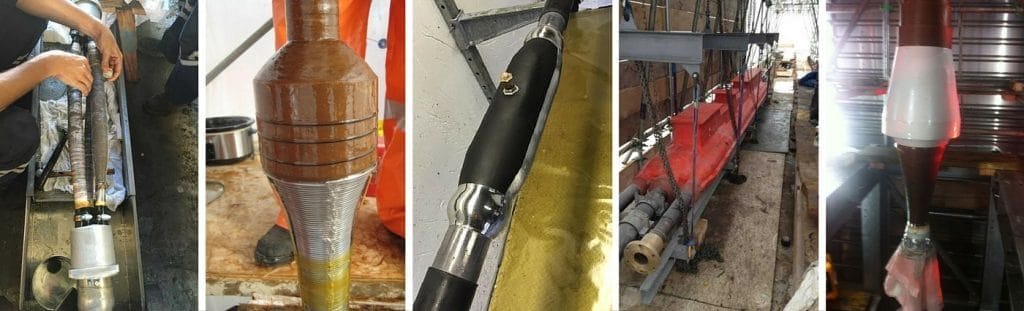
- Application: 11kV Triplex Cables Terminated Onto Switchgear Bushings
- Cable Type: 11kV Triplex Cables BS7870-4.10 – 3 Core Cable High Voltage (HV) Power
- Cable Jointer: Watkins and Jacomb Construction Power & Consultancy
- Featured Product: Heat Shrink Cable Terminations 11kV
Heat Shrink Terminations

In order to safely and professionally prepare medium/high voltage cables a complete set of cable jointing tools are required to enable the stripping and removal of the 11kV triplex cable sheath, insulation and screen – this includes Alroc tools used by jointers for MV/HV cable preparation and Cembre tools to cleanly cut and crimp cables.

The jointers have used cable cleaning wipes to carefully remove debris, dust or contaminants from the Triplex cables to ensure the overall reliability of the 11kV heat shrink cable terminations.

Lucy Switchgear
11kV cables are shown terminated using heat shrink terminations into Lucy VRN2a SF6 Ring Main Unit with a 200A Circuit Breaker to UKPN specification – the Sabre range of RMU’s manufactured by Lucy Switchgear are non extensible ring main units for outdoor high voltage substations. Along with low voltage distribution cabinets, these RMU’s can be easily coupled to the distribution transformer forming a compact outdoor package substation.
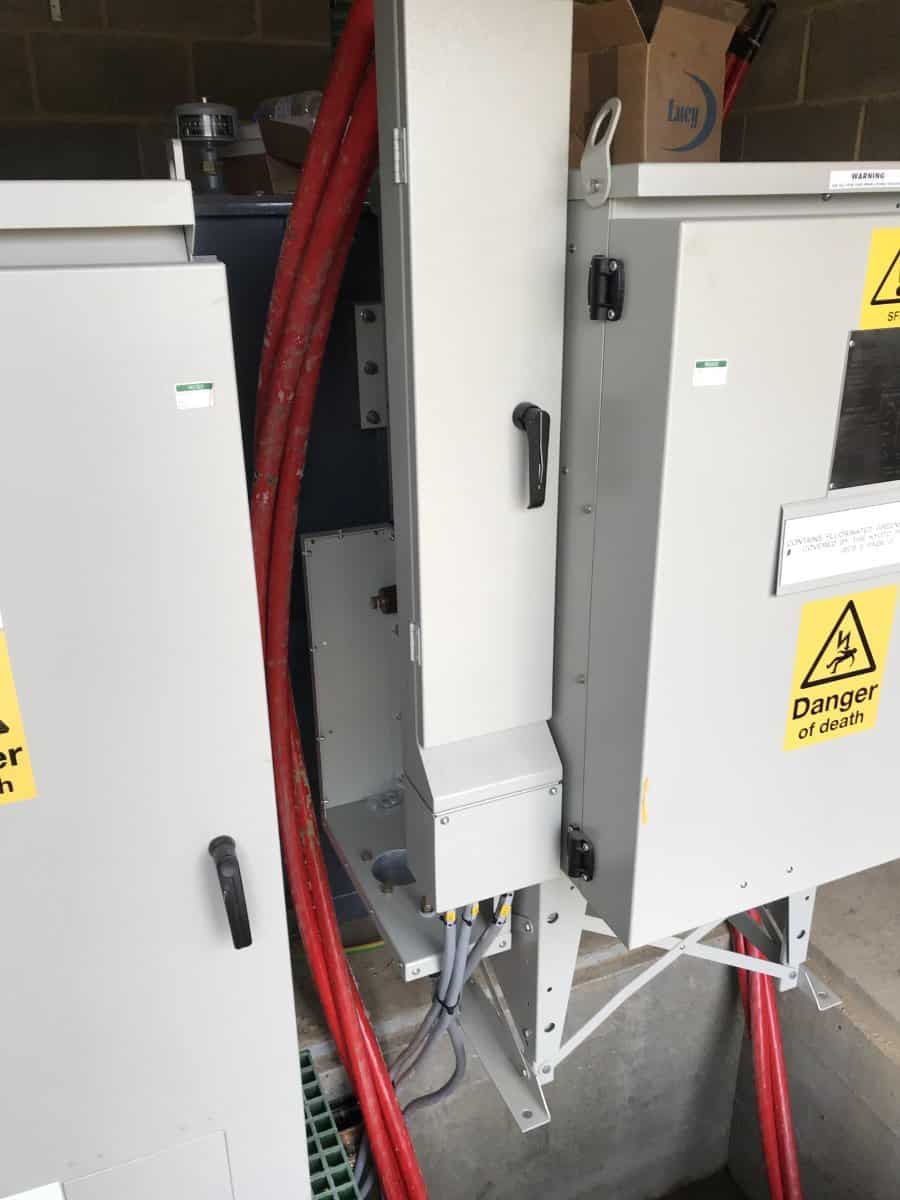
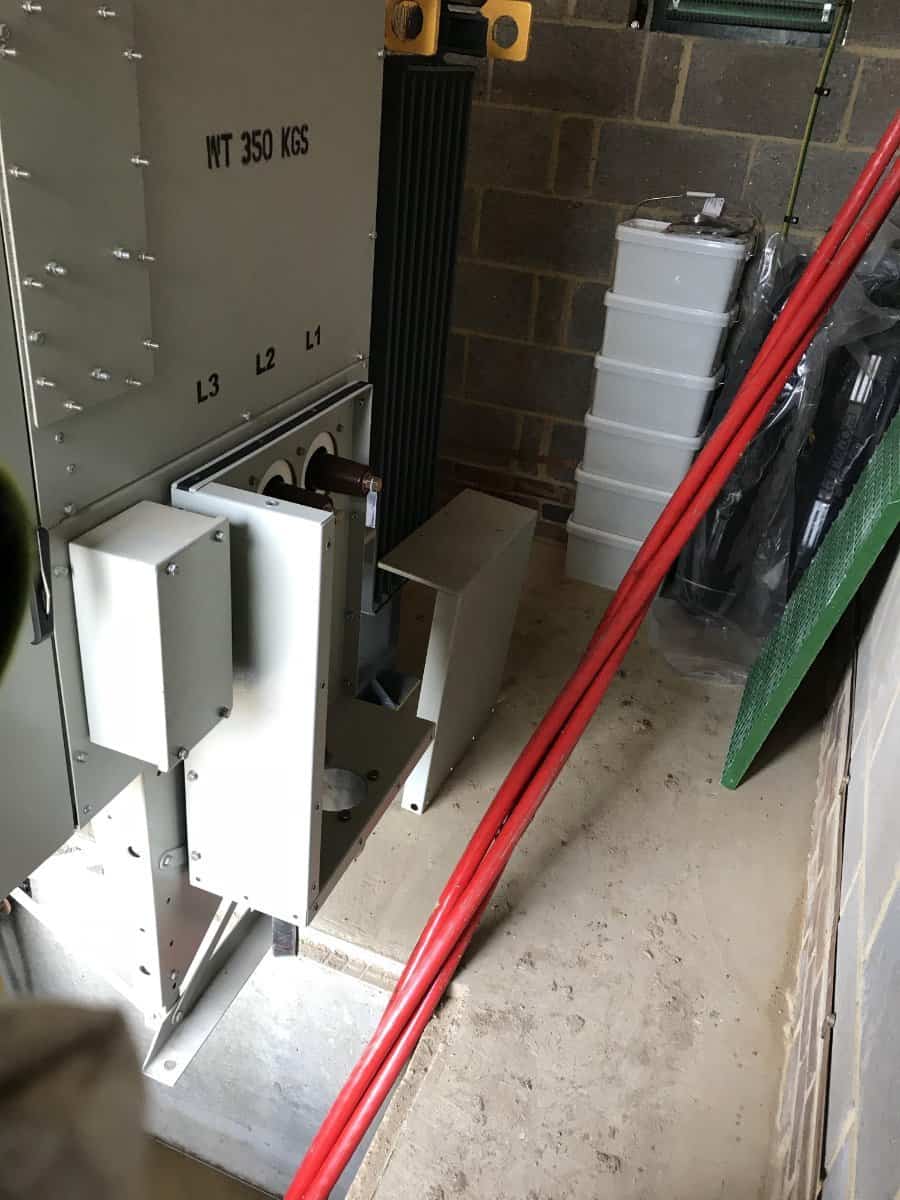
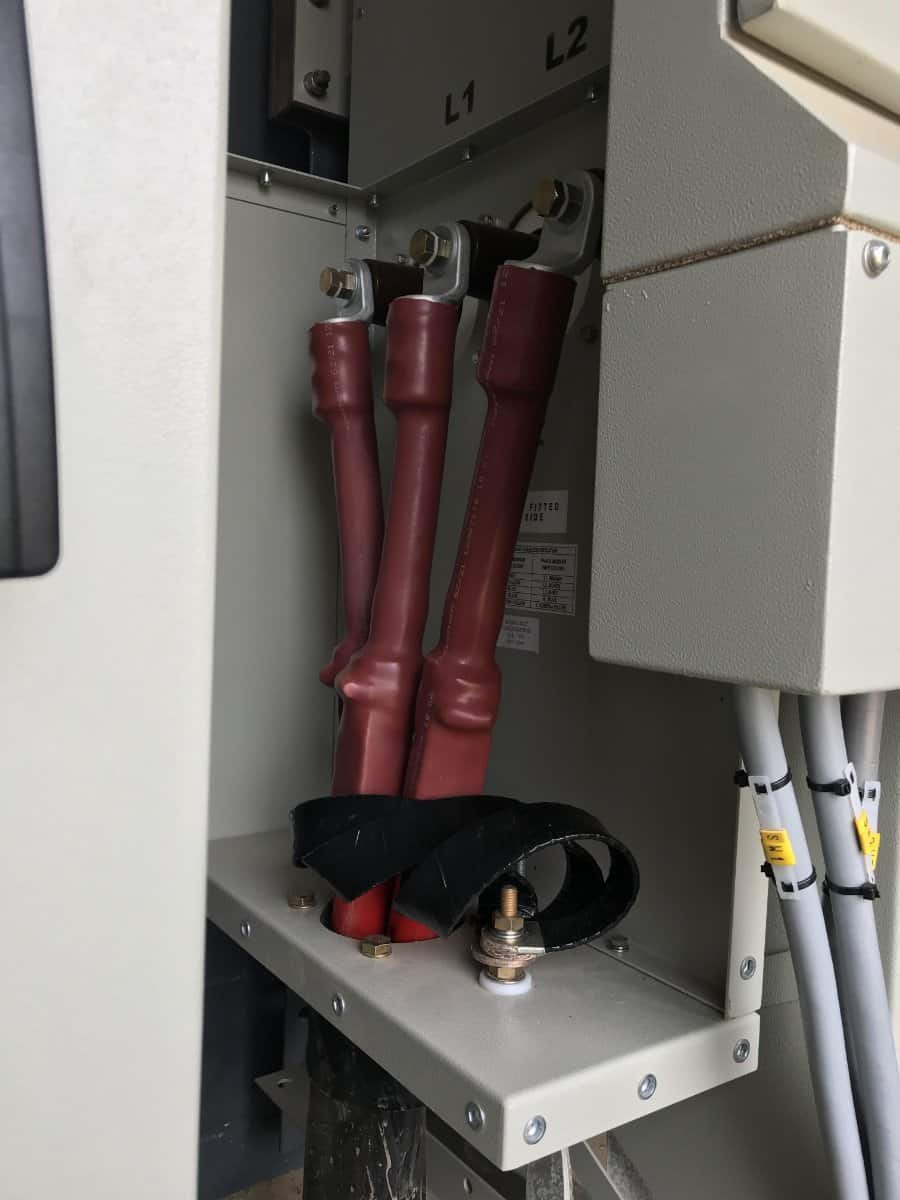

The 11kV heat shrink terminations are crimped using mechanical shearbolt cable lugs and bolted to the interface bushings of the air insulated cable box.
Terminating Triplex Using Cold Shrink
Here, the 11kV Triplex cables are shown terminated into a high voltage cable termination box using 3M Cold Shrink terminations – the concertina style bushing boot is cold-applied and suitable for both straight or right-angled 11kV switchgear connections, part code 3M 92EE717-1.
The bushing boots insulate the cable lug connection onto the bushing interface located on the electrical equipment. The Triplex copper wire screens are shown bonded to earth using brass mechanical shearbolt cable lugs.
The unarmoured Triplex cables are provided with mechanical cable retention and moisture ingress protection using heat shrink cable glands – the glands provide a watertight and fume-tight cable seal where the Triplex cables enter high voltage connection boxes, switchgear, bulkheads, or other enclosures.
The HV cables are cable ducted within the hot zone and a stand-off insulator is mounted in each HV cable box. The cable sheath is shown terminated to an earth bar mounted onto the stand-off insulator.
Image: NPG Northern Powergrid

Triplex Cable Sheath Earthing Arrangement 11kV
Should you require any assistance with the selection or specification of 11kV triplex cables or 11kV cable lugs please do not hesitate to contact us.
♦ Also 11kV : Nexans Connectors | Pfisterer Plugs | 3M Joints & Terminations | Ellis Cable Cleats | Duct Seals
Thorne & Derrick Specialist Electrical Distributor
LV ♦ MV ♦ HV
T&D distribute the most extensive range of LV, MV & HV Cable Jointing, Terminating, Installation & Cable Pulling Equipment – we service UK and international clients working on underground cables, overhead lines, substations and electrical construction at LV, 11kV, 33kV and EHV transmission and distribution voltages.
- Key Products: MV-HV Cable Joints & Terminations, Cable Cleats, Sealing Cable Ducts, Cable Transits, Underground Cable Protection, Cable Jointing Tools, Feeder Pillars, Cable Ducting, Earthing & Lightning Protection, Electrical Safety, Cable Glands, Arc Flash Protection & Fusegear.
- Distributors for: 3M, ABB, Alroc, Band-It, Catu, Cembre, Centriforce, CMP, Elastimold, Ellis Patents, Emtelle, Furse, Lucy Zodion, Nexans Euromold, Pfisterer, Polypipe, Prysmian, Roxtec.

LV – Low Voltage Cable Joints, Glands, Cleats, Lugs & Accessories (1000 Volts)

MV HV – Medium & High Voltage Cable Joints, Terminations & Connectors (11kV 33kV EHV)

Cable Laying – Underground Cable Covers, Ducting, Seals & Cable Pulling Equipment
More…
T&D’s Power Blog covers: LV MV HV & EHV Transmission & Distribution, Substations, Switchgear, Cable Jointing & Termination, Cable Fault & Repair, Underground Cables.
➡ Visit Power Blog.